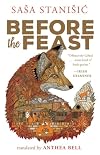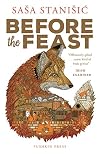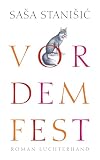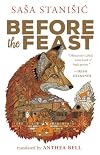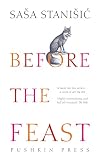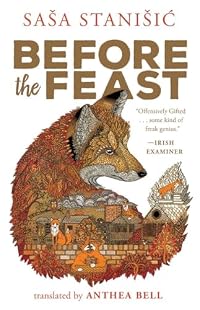
Before the Feast
by Saša Stanišić
On This Page
Description
It's the night before the feast in the village of Furstenfelde (population: an odd number). The village is asleep. Except for the ferryman--he's dead. And Mrs. Kranz, the night-blind painter, who wants to depict her village for the first time at night. A bell-ringer and his apprentice want to ring the bells--the only problem is that the bells have gone. A vixen is looking for eggs for her young, and Mr. Schramm is discovering more reasons to quit life than smoking. Someone has opened the show more doors to the Village Archive, but what drives the sleepless out of their houses is not that which was stolen, but that which has escaped. Old stories, myths and fairy tales are wandering about the streets with the people. They come together in a novel about a long night, a mosaic of village life, in which the long-established and newcomers, the dead and the living, craftsmen, pensioners and noble robbers in football shirts bump into each other. They all want to bring something to a close, on this night before the feast. show lessTags
Recommendations













Member Recommendations
Member Reviews
Fürstenfelde, between two lakes in the Uckermark north of Berlin, has all the typical problems of rural life in the New Bundesländer — an ageing and shrinking population, unemployment, neo-nazis, declining services, Wessies turning the few desirable properties into craft centres and potteries, Dutch farmers buying up the arable land, and so on. And of course it has seen more than its fair share of horrors over the past four or five centuries of border wars and political turmoil. Plenty of scope for a panoramic realistic novel like Juli Zeh's Unterleuten, which came out two years later.
But Saša Stanišić doesn't quite do that: he is writing a multiple-PoV community novel celebrating the oddities of the villagers, and he touches on show more all the obvious problems of 21st century life in small communities in the Uckermark, but he compresses it all into an unusually tight timeframe, in the night before the annual village festival, when all kinds of crazy things happen to people in the village as tragedies and folktales from centuries ago start to get mixed up with their present-day lives.
It's partly a charmingly comic view of the oddity that can flourish in small communities, partly a hard look at how big events trample on people, but mostly a celebration of the way history is defined both by the endlessly diverse individuals whose acts it summarises and by the endlessly diverse ways we read it and react to its stories. Very interesting. show less
But Saša Stanišić doesn't quite do that: he is writing a multiple-PoV community novel celebrating the oddities of the villagers, and he touches on show more all the obvious problems of 21st century life in small communities in the Uckermark, but he compresses it all into an unusually tight timeframe, in the night before the annual village festival, when all kinds of crazy things happen to people in the village as tragedies and folktales from centuries ago start to get mixed up with their present-day lives.
It's partly a charmingly comic view of the oddity that can flourish in small communities, partly a hard look at how big events trample on people, but mostly a celebration of the way history is defined both by the endlessly diverse individuals whose acts it summarises and by the endlessly diverse ways we read it and react to its stories. Very interesting. show less
I ultimately went from liking Before the Feast in an agreeable way to falling in love with it. It was just the oddest, loveliest book. I took a while to get into its rhythm and figure out what was going on, but it grew on me with every page until I was really sorry to finish it. Let's see... kind of like Grimms Fairy Tales meets Wisconsin Death Trip meets Samuel Beckett meets a DDR Spoon River Anthology... oh, I don't even have enough references to triangulate with.
The book takes place over the course of one night in a little East German village, and there's no plot to speak of. The subject is basically how all of history is made of people, places, and stories, using the hyper-local to comment on the bigger picture. But where a more show more sprawling novel with that kind of focus would be called a tapestry, the scale of this one makes me think of a hand-drawn map, with all its oddities and beauty. It's contemporary and at the same time mythical—both within the modern narrative and the interwoven centuries-old legends—full of wonderfully black political humor, quirky without being cute, dreamlike and mundane. Definitely one to reread, and I don't reread often—I really wanted to start over right away, but I'll let it sit and percolate a bit (plus I want to suggest it for a books-in-translation book group I might join and if so, I'll reread it then).
The lack of plot means this isn't for everyone, but if it sounds like your kind of thing it probably is. show less
The book takes place over the course of one night in a little East German village, and there's no plot to speak of. The subject is basically how all of history is made of people, places, and stories, using the hyper-local to comment on the bigger picture. But where a more show more sprawling novel with that kind of focus would be called a tapestry, the scale of this one makes me think of a hand-drawn map, with all its oddities and beauty. It's contemporary and at the same time mythical—both within the modern narrative and the interwoven centuries-old legends—full of wonderfully black political humor, quirky without being cute, dreamlike and mundane. Definitely one to reread, and I don't reread often—I really wanted to start over right away, but I'll let it sit and percolate a bit (plus I want to suggest it for a books-in-translation book group I might join and if so, I'll reread it then).
The lack of plot means this isn't for everyone, but if it sounds like your kind of thing it probably is. show less
This book sort of reminds me of a more folkish, chaotic cousin of Milan Kundera's "Unbearable Lightness of Being", I think because both books are made up of small vignettes of various characters in the past and present to form a larger story, with plenty of social and political commentary. It's written very lyrically and put together in a whimsical, disjointed fashion. There's an atmospheric weariness to the story, a dryness that translates into abrupt humor.
I wouldn't consider this book plot-driven; it's not really about the death of the ferryman. It's about these village people who, through several generations, have been through World Wars, multiple political systems, been citizens of a wealthy country, and yet again, citizens of an show more ideologically split, war-ravaged, penniless Germany; people who've had the unfortunate experience of witnessing the collective worst of humanity in their own countrymen, and the consequences of their choices. show less
I wouldn't consider this book plot-driven; it's not really about the death of the ferryman. It's about these village people who, through several generations, have been through World Wars, multiple political systems, been citizens of a wealthy country, and yet again, citizens of an show more ideologically split, war-ravaged, penniless Germany; people who've had the unfortunate experience of witnessing the collective worst of humanity in their own countrymen, and the consequences of their choices. show less
Saša Stanišić's Before the Feast is a phantasmagoric journey through the history of Fürstenfelde, an East German town which has had a surprisingly large number of residents named Anna. We learn about the town, its residents, and its ghosts over the course of a single night, the eve of the titular Feast, and our introduction to the current Anna is disconcerting:
"We are glad. Anna is going to be burnt. The sentence will be carried out at the Feast tomorrow evening."
Shades of "The Wicker Man" or Shirley Jackson's "The Lottery," right? Fear not; Before the Feast is a lot of things - a dizzying swirl of fact and myth, at times playful, at others sly - but one thing it is not is a horror story. Rather, it is a delightful celebration of show more the ways in which the occupants of a small town come together to form a community, full of eccentric artists, mutant pigs, reclusive chicken owners, members of the aristocratic Poppo von Blankenburg family, wild animals, and yes, even the occasional neo-Nazi.
Those looking for a linear plot should go elsewhere; we travel through Fürstenfelde, in both time and place, via a series of vignettes, the connections among which are not always readily apparent. But Stanišić told us what to expect early on:
"Our Anna Feast. No one really knows what we're celebrating. It's not the anniversary of anything, nothing ends or began on exactly that day. St Anne has her own saint's day sometime in the summer, and the saints aren't saintly to us any more. Perhaps we're simply celebrating the existence of the village. Fürstenfelde. And the stories that we tell about it.
. . .
On this day the night wears three liveries: What Was, What Is, What Is Yet To Be."
Regardless of which uniform it wears, Fürstenfelde is a remarkable destination. Come, but bring your own cigarettes; Herr Schramm just shot our cigarette machine (and then rammed it with a Mammoth 6800 silage chopper with a Kemper chopper head and 350 horsepower for good measure).
I received a free copy of Before the Feast from the publisher in exchange for an honest review. show less
"We are glad. Anna is going to be burnt. The sentence will be carried out at the Feast tomorrow evening."
Shades of "The Wicker Man" or Shirley Jackson's "The Lottery," right? Fear not; Before the Feast is a lot of things - a dizzying swirl of fact and myth, at times playful, at others sly - but one thing it is not is a horror story. Rather, it is a delightful celebration of show more the ways in which the occupants of a small town come together to form a community, full of eccentric artists, mutant pigs, reclusive chicken owners, members of the aristocratic Poppo von Blankenburg family, wild animals, and yes, even the occasional neo-Nazi.
Those looking for a linear plot should go elsewhere; we travel through Fürstenfelde, in both time and place, via a series of vignettes, the connections among which are not always readily apparent. But Stanišić told us what to expect early on:
"Our Anna Feast. No one really knows what we're celebrating. It's not the anniversary of anything, nothing ends or began on exactly that day. St Anne has her own saint's day sometime in the summer, and the saints aren't saintly to us any more. Perhaps we're simply celebrating the existence of the village. Fürstenfelde. And the stories that we tell about it.
. . .
On this day the night wears three liveries: What Was, What Is, What Is Yet To Be."
Regardless of which uniform it wears, Fürstenfelde is a remarkable destination. Come, but bring your own cigarettes; Herr Schramm just shot our cigarette machine (and then rammed it with a Mammoth 6800 silage chopper with a Kemper chopper head and 350 horsepower for good measure).
I received a free copy of Before the Feast from the publisher in exchange for an honest review. show less
Stanišić has either strongly supported or revitalized the patchwork village portrait novel. The first striking technique is a first person plural narration, a more precise identity for which is hinted at but never revealed. As he drips from one place to another, he gives his non-human characters no less respect than the human ones, and provides an immense and honest grace for them all. Execution of the characters' interaction, building tension despite skipping from one thread to another, and characters in the background never fully revealed suggest that Stanišić is well-acquainted with small town novels or small towns, but most likely both. The prose is unexpected of itself, and the first plural provides authority that is consistent show more with the historical flashes that dot the narration. No continuity is lacking, though the length of the sections give a concise staccato air. show less
This is not only a good story, it is a very pleasant reminder that there is really no difference between the largest city and the smallest hamlet: both are populated by people, with all of their strengths and weaknesses.
Ich erwarte von Stanisic immer mehr, weil - er kann ja viel mehr, und so ist das Schicksal der begabten. Das Wollen ist ihm auch nicht abhanden gekommen, aber ich habe das Gefühl, dass es ihm doch ein wenig zu lange dauert, so ein Schreibprozess, und dass es ihm ein wenig langweilig wird dabei. Das Aufräumen lästig, und die Enden sollten schon ein wenig sauber umgeschlagen werden. Folgendes sehe ich: er schreibt sehr gerne los, ungebändigt, vor Ideen sprühend, beeilt sich, und irgendwann... findet sich prustend im einem Meer seiner Ideen die alle doch ein wenig sortiert werden wollen, bevor man sie an den Leser loslässt. Für mich kann er sein Können noch nicht so richtig zu seinem Vorteil nutzen, und dich hoffe, dass er das show more schafft. Die Zeichen sind gut. show less
Members
- Recently Added By
Lists

German Literature
514 works; 51 members

Top Five Books of 2016
795 works; 229 members

Fêtes worse than death? — Village festivals in fiction
37 works; 7 members

Novels set over the course of a single day (or less)
72 works; 8 members

Books Read in 2016
4,666 works; 197 members

Speculative Fiction from around the World
610 works; 17 members
International Dublin Literary Award Longlist 2017
147 works; 3 members

Dublin Literary Award Longlist 2017
147 works; 2 members

"We" narration
49 works; 2 members

Books Read in 2024
4,623 works; 126 members
Author Information

15+ Works 1,435 Members
Some Editions
Awards and Honors
Awards
Distinctions
Common Knowledge
- Canonical title
- Before the Feast
- Original title
- Vor dem Fest
- Original publication date
- 2014-03-10
- Important places
- Uckermark, Brandenburg, Germany; Fürstenfelde, Uckermark, Brandenburg, Germany
- Epigraph*
- For billions of years since the outset of time
Every single one of your ancestors has survived
Every single person on your mum and dad's side
Successfully looked after and passed on to you life.
What are the chanc... (show all)es of that like? - Dedication*
- Für Katja.
- First words
- We are sad.
- Last words
- (Click to show. Warning: May contain spoilers.)We are glad Anna probably won't be burnt. Standing by the bonfire, she raises a burning brand in the air and bids ten euros, but we outbid her, we bid twelve.
- Original language*
- Deutsch
*Some information comes from Common Knowledge in other languages. Click "Edit" for more information.
Classifications
Statistics
- Members
- 332
- Popularity
- 95,106
- Reviews
- 11
- Rating
- (3.75)
- Languages
- 7 — Dutch, English, Finnish, French, German, Portuguese, Swedish
- Media
- Paper, Audiobook, Ebook
- ISBNs
- 22
- ASINs
- 6