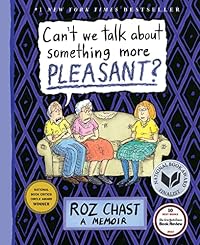
Can't We Talk About Something More Pleasant? A Memoir
by Roz Chast
On This Page
Description
In her first memoir, Roz Chast brings her signature wit to the topic of aging parents. Spanning the last several years of their lives and told through a mixture of cartoons, family photos, documents, and a narrative as rife with laughs as it is with tears, Chast's memoir is both comfort and comic relief for anyone experiencing the life-altering loss of elderly parents. When it came to her elderly mother and father, Roz held to the practices of denial, avoidance, and distraction. But when show more Elizabeth Chast climbed a ladder to locate an old souvenir from the "crazy closet"--with predictable results--the tools that had served Roz well through her parents' seventies, eighties, and into their early nineties could no longer be deployed. While the particulars are Chast-ian in their idiosyncrasies--an anxious father who had relied heavily on his wife for stability as he slipped into dementia and a former assistant principal mother whose overbearing personality had sidelined Roz for decades--the themes are universal: adult children accepting a parental role; aging and unstable parents leaving a family home for an institution; dealing with uncomfortable physical intimacies; managing logistics; and hiring strangers to provide the most personal care. show lessTags
Recommendations
Member Recommendations
Member Reviews
It turns out cartoon illustration is a surprisingly powerful way to describe end-of-life decisions. But still sobering content to wade through.
Using her own very creative cartoons and straightforward first-person account, author and illustrator Roz Chast (staff cartoonist at The New Yorker Magazine) recounts the story of her parents’ slow decline and the growing role of caretaker she is forced to assume as their only child. Though sprinkled with lots of humor, for me, this was nevertheless a sad read.
At the beginning, her parents are self-sufficient and highly functioning (if a tad co-dependent), living independently in the same apartment in Brooklyn they have occupied for decades. The book then walks us through the end-of-life show more decisions so many of us will face. Not just with our parents but eventually for ourselves. How do you convince loved ones to face what’s ahead? When is it the right time to leave one’s own home? What happens to all years of accumulated stuff? How does one find a reasonable place where more assistance is available. And then what happens when EVEN MORE assistance becomes necessary? Then, when health begins to decline or dementia sets in, how much treatment is reasonable? And what kinds of medical risks should you expose someone in their 90s to? And Chast must face each question, while living several hours away from her parents and having her own career and family to juggle.
Chast did not have close relationships with either parent and a particularly contentious one with her mother. Yet another layer. She honestly shares the psychological baggage that comes with her role as parental caretaker. It's a mix of feelings -- understandable concern, perpetual annoyance, and deep resentment.
End-of-life care in the United States can be an expensive proposition and Chast is clear about her mounting financial concerns as her parents linger over years. It’s probably clear by now why I found so many aspects of the book chilling. A big part of me, like Chast’s parents, kept thinking “Can’t we talk about something more pleasant?”
It's is a quick read, only 230-ish pages, and filled with illustrations. So just a couple of hours. And a good introduction to begin understanding the complexities of aging.
See more of my reviews at www.tobyasmith.com show less
Using her own very creative cartoons and straightforward first-person account, author and illustrator Roz Chast (staff cartoonist at The New Yorker Magazine) recounts the story of her parents’ slow decline and the growing role of caretaker she is forced to assume as their only child. Though sprinkled with lots of humor, for me, this was nevertheless a sad read.
At the beginning, her parents are self-sufficient and highly functioning (if a tad co-dependent), living independently in the same apartment in Brooklyn they have occupied for decades. The book then walks us through the end-of-life show more decisions so many of us will face. Not just with our parents but eventually for ourselves. How do you convince loved ones to face what’s ahead? When is it the right time to leave one’s own home? What happens to all years of accumulated stuff? How does one find a reasonable place where more assistance is available. And then what happens when EVEN MORE assistance becomes necessary? Then, when health begins to decline or dementia sets in, how much treatment is reasonable? And what kinds of medical risks should you expose someone in their 90s to? And Chast must face each question, while living several hours away from her parents and having her own career and family to juggle.
Chast did not have close relationships with either parent and a particularly contentious one with her mother. Yet another layer. She honestly shares the psychological baggage that comes with her role as parental caretaker. It's a mix of feelings -- understandable concern, perpetual annoyance, and deep resentment.
End-of-life care in the United States can be an expensive proposition and Chast is clear about her mounting financial concerns as her parents linger over years. It’s probably clear by now why I found so many aspects of the book chilling. A big part of me, like Chast’s parents, kept thinking “Can’t we talk about something more pleasant?”
It's is a quick read, only 230-ish pages, and filled with illustrations. So just a couple of hours. And a good introduction to begin understanding the complexities of aging.
See more of my reviews at www.tobyasmith.com show less
Certain topics are perennial material for the writer. Death, for one, never goes out of style. Aging, too, has become more popular, perhaps as life spans have risen for recent generations. There is no shortage of books about how to thrive in later years, how to age gracefully, how to remain healthy longer. And indeed aging, as the old dictum has it, is a privilege denied to many.
But of course nothing lasts forever. Which brings us to Roz Chast’s graphic memoir. This gifted cartoonist illustrates her family history and the disturbing, touching final years of her parents. I’m not sure anyone has brought the combination of humor, candor, horror and celebration to caring for parents in decline. No one of a certain age can look show more away.
Can’t We Talk About Something More Pleasant? Perhaps, but the conversation is worth having. show less
But of course nothing lasts forever. Which brings us to Roz Chast’s graphic memoir. This gifted cartoonist illustrates her family history and the disturbing, touching final years of her parents. I’m not sure anyone has brought the combination of humor, candor, horror and celebration to caring for parents in decline. No one of a certain age can look show more away.
Can’t We Talk About Something More Pleasant? Perhaps, but the conversation is worth having. show less
I absolutely adore this book and its author Roz Chast.The last comic book that I have read was a Mickey Mouse comic book when I was a child. And normally comics aren't really my thing. But "Can't we talk about something more pleasant?" had me hooked from page one. I couldn't turn the pages fast enough. Probably because it deals with the important issue of death and dying. Chast manages to discuss a topic that many people find hard to address in a real and thought-provoking manner while still being incredibly funny. This book will make you think and it will make you laugh out loud. What more could you want?
See full review @ The Indigo Quill
Can’t We Talk About Something More Pleasant? : A Memoir, Is a graphic novel by Roz Chast that tells the story of her experiences caring for her elderly parents as they make their way through the least popular stage of life; the last one. Chast uses her unique and candid voice and eccentric drawing style to illuminate a very dark topic in society. What she creates is a story that is equal parts hilarious, heartwarming and downright depressing.
Can’t We Talk About Something More Pleasant gives a brutally honest account of the author’s life and the lives of her parents from childhood to the inevitable conclusion. Chast pulls no punches when describing the challenges of caring for an aging parent. She show more manages to distill every moment of heartache and comedy out of everything from senility to generational differences to just plain stubbornness. Can’t We Talk About Something More Pleasant is part biography, part memoir, part new Yorker comic, except it’s actually funny. The comedic portions are extremely funny but the dark aspect to the humor had me wondering if I should be laughing at times. The idiosyncrasies of Chast and her family make for some truly funny moments until they are put against the backdrop of the hurt that bore them. In that sense, Can’t We Talk About Something More Pleasant is a perfect slice of the human experience; funny on the surface, dig a bit deeper and it is morbidly depressing, see the big picture and everything kind of turns out all right.
The entire book feels like a therapeutic exercise on the part of the author. She really delves into the problems she had with her parents, especially her mother and how those problems affected their dynamic later in life. Extremely complex feelings are unearthed and captured in comic form. The medium of the comic lends a lighthearted air to what is a very uncomfortable subject, but Chast also uses it to profound effect to plumb the depths of familial relations. Her brutal honesty for her portrayal of events is only matched by her brutal honesty about herself. For every strip about an annoying quirk of her father or the brash overbearing nature of her mother, there is one about her own guilt over her impatience with her parents or selfish thoughts. It all goes a long way toward chronicling the unceasingly arduous, mercilessly expensive, insanity inducing and at times extremely funny experience of taking care of the people who once took care of you.
Calvin and Hobbes holds the same kind of importance for young, only children as Can’t We Talk About Something More Pleasant will hold for those in the sandwich generation. It is the quintessential dark comedy for anyone with aging parents but should by no means be limited to that. Within hours of reading it, I had already recommended it to everyone close to me. I would recommend it to anyone who is in need of a laugh, a cry, or both at the same time. Can’t We Talk About Something More Pleasant is incredibly evocative and charming and is well worth a read. show less
Can’t We Talk About Something More Pleasant? : A Memoir, Is a graphic novel by Roz Chast that tells the story of her experiences caring for her elderly parents as they make their way through the least popular stage of life; the last one. Chast uses her unique and candid voice and eccentric drawing style to illuminate a very dark topic in society. What she creates is a story that is equal parts hilarious, heartwarming and downright depressing.
Can’t We Talk About Something More Pleasant gives a brutally honest account of the author’s life and the lives of her parents from childhood to the inevitable conclusion. Chast pulls no punches when describing the challenges of caring for an aging parent. She show more manages to distill every moment of heartache and comedy out of everything from senility to generational differences to just plain stubbornness. Can’t We Talk About Something More Pleasant is part biography, part memoir, part new Yorker comic, except it’s actually funny. The comedic portions are extremely funny but the dark aspect to the humor had me wondering if I should be laughing at times. The idiosyncrasies of Chast and her family make for some truly funny moments until they are put against the backdrop of the hurt that bore them. In that sense, Can’t We Talk About Something More Pleasant is a perfect slice of the human experience; funny on the surface, dig a bit deeper and it is morbidly depressing, see the big picture and everything kind of turns out all right.
The entire book feels like a therapeutic exercise on the part of the author. She really delves into the problems she had with her parents, especially her mother and how those problems affected their dynamic later in life. Extremely complex feelings are unearthed and captured in comic form. The medium of the comic lends a lighthearted air to what is a very uncomfortable subject, but Chast also uses it to profound effect to plumb the depths of familial relations. Her brutal honesty for her portrayal of events is only matched by her brutal honesty about herself. For every strip about an annoying quirk of her father or the brash overbearing nature of her mother, there is one about her own guilt over her impatience with her parents or selfish thoughts. It all goes a long way toward chronicling the unceasingly arduous, mercilessly expensive, insanity inducing and at times extremely funny experience of taking care of the people who once took care of you.
Calvin and Hobbes holds the same kind of importance for young, only children as Can’t We Talk About Something More Pleasant will hold for those in the sandwich generation. It is the quintessential dark comedy for anyone with aging parents but should by no means be limited to that. Within hours of reading it, I had already recommended it to everyone close to me. I would recommend it to anyone who is in need of a laugh, a cry, or both at the same time. Can’t We Talk About Something More Pleasant is incredibly evocative and charming and is well worth a read. show less
It was probably inevitable that I would love this, even though it's in some ways a painful read: I've always loved Roz Chast's quietly absurd cartoons (they're one of the only reasons I would ever look at a copy of the New Yorker). This extended work, of course treads much darker territory than "Death -- Taxes -- Bobo."
And take it from someone who lived there for years: that part of Brooklyn REALLY DOES seem to be made up of "Bruised Fruit" stores.
And take it from someone who lived there for years: that part of Brooklyn REALLY DOES seem to be made up of "Bruised Fruit" stores.
A graphic memoir by New Yorker cartoonist Roz Chast chronicling her relationship with her parents, their relationship with each other, their declining final years, and their eventual deaths in their 90s. It's poignant, sad, and depressing, but also oddly charming and sometimes funny, and it captures the reality of aging, and of caring for aging parents profoundly and uncomfortably well. (It's also reminded me of the fact that I will never be able to afford to age and die with any dignity or humanity, since a half-decent "assisted living facility" costs more that I will ever, ever be able to afford, so, hey, that's a fun thing to think about!)
Roz Chast is an only child who had a rather unhappy childhood, moved from Brooklyn to Connecticut to have her own family, and never looked back. But now her parents are reaching 90 and are physically (her mother) and mentally (her father) declining. She now has to deal with their end-of-life care and all the drama that comes with it. In this memoir, by turns heartbreaking and hilarious, she chronicles that experience.
I really enjoyed this graphic novel memoir. Roz is no perfect daughter, and she's brutally honest about her mixed feelings, her rough relationship with her mother, and the challenges that she faces with her parents. Even though I'm the oldest of five and my parents have not yet had to deal with my parents' aging to the show more extent she does, I could relate to her ambivalence and the way families seem to refuse to communicate about important but daunting subjects such as aging. Who wants to talk about such things, after all? But it is an important topic, and her memoir is a sort of wake up call to that effect. show less
I really enjoyed this graphic novel memoir. Roz is no perfect daughter, and she's brutally honest about her mixed feelings, her rough relationship with her mother, and the challenges that she faces with her parents. Even though I'm the oldest of five and my parents have not yet had to deal with my parents' aging to the show more extent she does, I could relate to her ambivalence and the way families seem to refuse to communicate about important but daunting subjects such as aging. Who wants to talk about such things, after all? But it is an important topic, and her memoir is a sort of wake up call to that effect. show less
Members
- Recently Added By
Lists

National Book Award Finalists 2014
20 works; 16 members

Club Read's Graphic Stories Recommendations
127 works; 2 members

Graphic Memoirs by Women
175 works; 6 members

Most Frequently Tagged "Read in 2015"
70 works; 1 member

Top Five Books of 2015
811 works; 240 members

Books Read in 2016
4,666 works; 199 members

Bloomsbury Publishing
37 works; 2 members

Best 21st Century Books (So Far)
670 works; 85 members
NYTimes 10 Best of 2014
10 works; 3 members

Deathreads
78 works; 2 members

One Book, Many Authors
441 works; 40 members

Five star books
1,755 works; 108 members
Top Five Books of 2014
1,064 works; 398 members

NPR Readers Poll: 100 Favorite Funny Books
100 works; 5 members

Best Biographies, Autobiographies and Memoirs
464 works; 156 members

Mustich's 1000 Books to Read Before You Die: A Life Changing List
1,001 works; 18 members
Best Graphic Novel Nonfiction
199 works; 101 members
Author Information

32+ Works 4,391 Members
Roz Chast was born in Brooklyn, New York on November 26, 1954. She received a BFA in painting from Rhode Island School of Design in 1977. Her cartoons have appeared in The New Yorker, Scientific American, the Harvard Business Review, Redbook, and Mother Jones. She is the author of several books including The Party, After You Left: Collected show more Cartoons 1995-2003, What I Hate: From A to Z, Theories of Everything: Selected, Collected, and Health-Inspected Cartoons, 1978-2006, and Can't We Talk about Something More Pleasant?: A Memoir. She has also illustrated several books including The Alphabet from A to Y, with Bonus Letter, Z by Steve Martin. (Bowker Author Biography) show less
Awards and Honors
Awards
Distinctions
Common Knowledge
- Canonical title
- Can't We Talk About Something More Pleasant? A Memoir
- Original publication date
- 2014-05-06
- People/Characters
- Roz Chast; George Chast; Elizabeth Chast
- Important places
- Brooklyn, New York, New York, USA
- Dedication
- To my parents, George and Elizabeth
- First words
- So...do you guys ever think about...things?
- Last words
- (Click to show. Warning: May contain spoilers.)My father usually appears sitting at our kitchen counter, drinking tea, and reading the newspaper, and he is not worried.
- Blurbers
- Small, David; McCall, Bruce; Marx, Patricia; Bechdel, Alison
- Original language
- English
Classifications
- Genre
- Graphic Novels & Comics
- DDC/MDS
- 741.5 — Arts & recreation Drawing & decorative arts Drawing and drawings Comic books, graphic novels, fotonovelas, cartoons, caricatures, comic strips
- LCC
- NC1429 .C525 .A2 — Fine Arts Drawing. Design. Illustration Drawing. Design. Illustration Pictorial humor, caricature, etc.
- BISAC
Statistics
- Members
- 1,863
- Popularity
- 11,475
- Reviews
- 130
- Rating
- (4.30)
- Languages
- 8 — Chinese, Dutch, English, French, German, Italian, Polish, Spanish
- Media
- Paper, Ebook
- ISBNs
- 12
- UPCs
- 2
- ASINs
- 8