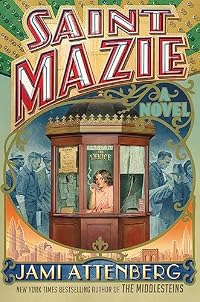
Saint Mazie
by Jami Attenberg
On This Page
Description
"Meet Mazie Phillips: big-hearted and bawdy, she's the truth-telling proprietress of The Venice, the famed New York City movie theater. It's the Jazz Age, with romance and booze aplenty--even when Prohibition kicks in--and Mazie never turns down a night on the town. But her high spirits mask a childhood rooted in poverty, and her diary, always close at hand, holds her dearest secrets. When the Great Depression hits, Mazie's life is on the brink of transformation. Addicts and bums roam the show more Bowery; homelessness is rampant. If Mazie won't help them, then who? When she opens the doors of The Venice to those in need, this ticket-taking, fun-time girl becomes the beating heart of the Lower East Side, and in defining one neighborhood helps define the city. Then, more than ninety years after Mazie began her diary, it's discovered by a documentarian in search of a good story. Who was Mazie Phillips, really? A chorus of voices from the past and present fill in some of the mysterious blanks of her adventurous life. Inspired by the life of a woman who was profiled in Joseph Mitchell's classic Up in the Old Hotel, SAINT MAZIE is infused with Jami Attenberg's signature wit, bravery, and heart. Mazie's rise to "sainthood"--and her irrepressible spirit--is unforgettable"-- "From the New York Times bestselling author of The Middlesteins comes a stunning novel about a Prohibition-era bad girl turned good: Saint Mazie, Queen of the Bowery"-- show lessTags
Recommendations












































Member Recommendations


Member Reviews
I am not going to try to describe much about this novel, except to say that it was a big-hearted, fun, vivid read with a central character wonderfully rendered as larger than life but still believable. I love novels about loneliness and connection, family both real and constructed, and alienation. Saint Mazie has all this but it's not sad or bleak. It's about trying to make one's corner of the world a little better and understanding that sometimes that's enough, that it is okay to be fully present in what *is*, rather than always chasing more.
Attenberg's novel is inspired by the story of a real Mazie, working on the Lower East Side of New York City in the 1920s and 1930s who became a saint for the bums and the homeless, a population that increased greatly after the Stock Market Crash, and for which there was very little help. But, in other ways, Mazie is no saint! She's a drinker and smoker and likes to party. She likes plenty of men but traditional love and marriage elude her. She loses patience with Rosie, the older sister who saved her from their abusive father, but who would prefer to keep Mazie locked safely in a cage. Told mostly through Mazie's diary entries and interviews with people who knew her or knew of her, Mazie's story absolutely shines. A true broad with a show more great figure and a soft heart of gold who gave whatever she could to the men who had nothing, living in the streets of the city because "somebody loved them once, and that's all you need to know." Mazie's story is captivating with ups and downs, joys and sorrows, and Mazie's unique voice. show less
Pleasantly surprising with some depth and plot twists that were not expected. Mazie Phillips is the quintessential good-time girl in NYC in the 19-teens and twenties. The story is told through her diary and excerpts of her unpublished autobiography and interviews with a few key people with ties to her. She works for her brother-in-law, Louis, selling tickets at his movie theater, back when the ticket booth was literally a small booth ("cage" Mazie calls it)outside on the sidewalk. She sees a lot of humanity that way, along with her visits to speak-easies and love of the streets. The appeal here is her love of life -- all of it, the good and the bad. She isn't necessarily immoral, she just wants to live deeply and her whole heart is in show more it. Once the depression hits, her true colors shine and she begins looking out for the riff-raff she is so comfortable among. Louis has some shady businesses, but a heart of gold, so with his money, Mazie is able to make a difference in her small corner of the world, with the bums in the Bowery. Sister Tee, a Catholic nun is her inspiration and dear friend, but Mazie does her service more out of love and understanding than a religious motivation. Mazie's sisters Rosie and Jeannie also figure prominently in the novel -- they are ties she will never break, much like the "cage" she will never break out of. show less
Unusual concept - taking a real character from another writer's story and creating a fictional character from the original. But anyone with the monicker "Queen of the Bowery" would be an interesting study in any context. Mazie's sisters, lover, and Sister Tee, her best friend who's a nun, are almost as compelling as Mazie herself. She spends her days, during the Depression and WW II, as the cashier at the Venice Movie Theatre and her nights aiding the indigent men of the streets. As Mazie and her family move through the city, each neighborhood is described in depth through Mazie's cynical yet empathetic eyes. Especially stimulating is her blissful solo commute (not approved of for women on the time) on the opening of the subway line show more from Coney Island to Manhattan.
As personal and historical tales of the eras and the locales go, this would be one of the best. show less
As personal and historical tales of the eras and the locales go, this would be one of the best. show less
Absolutely wonderful, though when I first started I wasn't sure if I was going to like this book. By the time I finished I felt as if I personally knew Maize, so much so, that if I met her on the street I would give her a big hug. The author did such a great job with this book and the characters within.
The story is told in journal entries by Maize, interviews by the writer of the book in the novel in the present day, interviewing those ancestors of the people who knew Maize and a few narrative entries.
Maize was quite the character, loved to drink and loved the streets of New York in the beginning of the 1900's. The depression in particular was amazingly described, the changes in New York, the east end and the bowery. All the bums Maize show more tried to help, families she provided for and her friendship with a sister of the Catholic faith, a faith Maize didn't believe in.
This story is based on a real person, Maize Gordon who did indeed do the things in this novel, but since very little information was available the author took what she could and wrote, this amazing story.
The real Maize was written up by Joseph Mitchell in a short story form the New Yorker, and is contained in his book of short stories.
Loved Maize's feistiness and her complicated personality. She truly was an angel of mercy for many.
ARC by publisher. show less
The story is told in journal entries by Maize, interviews by the writer of the book in the novel in the present day, interviewing those ancestors of the people who knew Maize and a few narrative entries.
Maize was quite the character, loved to drink and loved the streets of New York in the beginning of the 1900's. The depression in particular was amazingly described, the changes in New York, the east end and the bowery. All the bums Maize show more tried to help, families she provided for and her friendship with a sister of the Catholic faith, a faith Maize didn't believe in.
This story is based on a real person, Maize Gordon who did indeed do the things in this novel, but since very little information was available the author took what she could and wrote, this amazing story.
The real Maize was written up by Joseph Mitchell in a short story form the New Yorker, and is contained in his book of short stories.
Loved Maize's feistiness and her complicated personality. She truly was an angel of mercy for many.
ARC by publisher. show less
It’s the Jazz Age, but for every person who spends the night reveling at a speakeasy, many more spend their waking hours working but barely surviving. Prohibition and the Great Depression bring additional problems and heartache. Through it all, the brave and hardy struggle on, but in New York, in the Bowery, one woman will eventually emerge as the soul of city. Mazie Phillips, rescued by her older sister from a weary and brow-beaten mother and a cruel and despicable father, will herself become a rescuer for the homeless men who roam the streets. In this work of historical fiction, Mazie seems like an unlikely savior. She loves to party, drinks to excess, looks for love in all the wrong places, and has no qualms about speaking her show more mind. But she is generous to a fault, looks after her own, and, and in time, comes to realize that all humanity is her own. A fascinating read about a remarkable woman. show less
Mazie Philips-Gordon is the ticket taker/owner of The Venice, a movie theater in Depression-era NYC. She was a real person, well known by the people who frequented her theater and by those who received her trademark generosity to those who had lost almost everything. There isn't much information out there on her life, so Attenberg fleshed out a story worthy of its subject. Her story is told through Mazie's own voice, via journal entries, and through interviews with people close to her history. Thoroughly enjoyed the read.
Things I liked:
Mazie is a super interesting character. She's strong-willed, independent, kind, generous, sexually liberated, and devoted to her crazy ass family.
I don't read much historical/period fiction, but this was show more a great journey through the Depression. There was no heavy handed OMG EVERYTHING WAS SO BAD - instead, there were quiet details and instances where you could feel the weight of the loss and hardships.
Mazie's sisters Rosie and Jeanie were colorful and fun to read, even while they were making me crazy with sisterly rage.
Things I didn't like:
I'm having a hard time coming up with dislikes.
Definitely recommended. show less
Things I liked:
Mazie is a super interesting character. She's strong-willed, independent, kind, generous, sexually liberated, and devoted to her crazy ass family.
I don't read much historical/period fiction, but this was show more a great journey through the Depression. There was no heavy handed OMG EVERYTHING WAS SO BAD - instead, there were quiet details and instances where you could feel the weight of the loss and hardships.
Mazie's sisters Rosie and Jeanie were colorful and fun to read, even while they were making me crazy with sisterly rage.
Things I didn't like:
I'm having a hard time coming up with dislikes.
Definitely recommended. show less
Members
- Recently Added By
Lists

Best Historical Fiction
620 works; 258 members
Author Information

11+ Works 3,246 Members
Awards and Honors
Common Knowledge
- Canonical title
- Saint Mazie
- Original publication date
- 2015
- Important places
- New York, New York, USA
- Important events
- Great Depression
- First words
- Fannie brought one of her fancy friends down to the theater last night.
- Blurbers
- Shipstead, Maggie; Fowler, Therese; Shapiro, B.A.; Zevin, Gabrielle; Rogan, Charlotte
Classifications
Statistics
- Members
- 578
- Popularity
- 50,651
- Reviews
- 39
- Rating
- (3.67)
- Languages
- English, French, German, Italian
- Media
- Paper, Audiobook, Ebook
- ISBNs
- 26
- ASINs
- 8