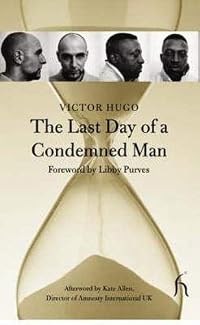
The Last Day of a Condemned Man
by Victor Hugo
On This Page
Description
A first-person diary of a prisoner's final day before being executed for an unspecified crime, Victor Hugo's poignant tale vividly conveys the mental anguish of a man confronted with the intransigent mechanism of justice, as his mind seeks refuge in recollections from his past and philosophical musings on his inevitable fate. As relevant today as when it was first published in 1829, The Last Day of a Condemned Man is an eloquent plea for compassion and a masterpiece of realist fiction.Tags
Recommendations




















Member Recommendations
Member Reviews
Oh this is very excellent!
I can only translate the blurb on the back of this book because it's perfect.
"Victor Hugo was 26 years old when he wrote, in two and a half months, The Last Day of a Condemned Man.
We willl not know who the condemned man is, nor will we know what crime he committed. Because the purpose of the author is not to enter a debate but to exhibit the horror and the absurdity of the situation in which any man finds himself whose neck we are about to slice in a few hours.
This book - with strangely modern accents - has a great power of suggestion that the reader ends by identifying with the narrator with whom he shares anxiety and vain hopes. Till the last lines of the book, Victor Hugo's genius has us participating in a show more grueiling wait: that of the screeching noise that the blade will make following the rails of the guillotine."
Part of the genius of the book is how the book begins: two explications. The first, that this book was discovered as a pile of crumpled yellow sheets of paper. The second, that a philospher imagined it all. Victor Hugo lets the reader decide for himself.
We are then presented with "A comedy about a tragedy", a short one act play with characters discussing this new book about a condemned man that has just come out. The characters reactions?
"It's a terrible book."
"At each chapter there is an ogre that eats a child."
"It takes place in Iceland."
"They have no right to make a reader suffer physically."
"It is certain that books are often a subversive poison to social order."
Then comes the actual narrative of the condemned man. Oh how he makes us feel pity and emotionally involved with his situation. We seek his innocence! (Never mind the fact that he briefly states that he has spilled blood.) When he cleverly gets a guard to almost switch clothes with him how we want to laugh in the guard's face.
And then, while the crowd parades around the guillotine waiting for the final chop, a man cries "who needs a spot?" to which our condemned man reflects "who wants mine?".
We ride with the condemned man to the guillotine, we have our hands tied behind our back, our hair chopped, our collar removed and then, reprising our role as the reader we stop to think: if the condemned man is the narrator how can he be relating this to us all? And that is Victor Hugo's final genius.
FOUR O'CLOCK. show less
I can only translate the blurb on the back of this book because it's perfect.
"Victor Hugo was 26 years old when he wrote, in two and a half months, The Last Day of a Condemned Man.
We willl not know who the condemned man is, nor will we know what crime he committed. Because the purpose of the author is not to enter a debate but to exhibit the horror and the absurdity of the situation in which any man finds himself whose neck we are about to slice in a few hours.
This book - with strangely modern accents - has a great power of suggestion that the reader ends by identifying with the narrator with whom he shares anxiety and vain hopes. Till the last lines of the book, Victor Hugo's genius has us participating in a show more grueiling wait: that of the screeching noise that the blade will make following the rails of the guillotine."
Part of the genius of the book is how the book begins: two explications. The first, that this book was discovered as a pile of crumpled yellow sheets of paper. The second, that a philospher imagined it all. Victor Hugo lets the reader decide for himself.
We are then presented with "A comedy about a tragedy", a short one act play with characters discussing this new book about a condemned man that has just come out. The characters reactions?
"It's a terrible book."
"At each chapter there is an ogre that eats a child."
"It takes place in Iceland."
"They have no right to make a reader suffer physically."
"It is certain that books are often a subversive poison to social order."
Then comes the actual narrative of the condemned man. Oh how he makes us feel pity and emotionally involved with his situation. We seek his innocence! (Never mind the fact that he briefly states that he has spilled blood.) When he cleverly gets a guard to almost switch clothes with him how we want to laugh in the guard's face.
And then, while the crowd parades around the guillotine waiting for the final chop, a man cries "who needs a spot?" to which our condemned man reflects "who wants mine?".
We ride with the condemned man to the guillotine, we have our hands tied behind our back, our hair chopped, our collar removed and then, reprising our role as the reader we stop to think: if the condemned man is the narrator how can he be relating this to us all? And that is Victor Hugo's final genius.
FOUR O'CLOCK. show less
Written as a critique of capital punishment, Hugo's Last Day of a Condemned Man highlights the inhuman, inherent suffering and fear experienced by prisoners awaiting their death. He briefly touches on the comparison between the prisoner's suffering and that of their victims, but, if anything, the victims of the prisoner on death row are always a distant concern. Even for those who are firm advocates of capital punishment will find, in this short book, a reason to approach a “just death” with humility. It gives the reader the opportunity to pause, to hesitate and breathe, in order to consider the choice they might support to take that same breath from another.
No-one rails against society’s injustices quite like Victor Hugo. This collection includes four pieces that fall somewhere along the continuum between fiction and reportage. Each is based to a greater or lesser extent on real events, but in each case Hugo has embroidered and excluded for effect, as is only reasonable. The first and most powerful piece is the most heavily fictionalised: ‘The Last Day of a Condemned Man’. This man isn’t a specific case, rather a synthesis or symbol of the kind Hugo is so adept at. The reader spends his final day with the condemned man and thus experiences the horror and inhumanity of the death penalty. Hugo was a staunch critic of it, and the cruelty of the criminal justice system in general. This show more runs through all the pieces in the book. I found every one thoughtful and well-expressed, although ‘The Last Day of a Condemned Man’ stood out as a devastating polemic. I actually put it aside part way through and took up [b:The Novel of the Century: The Extraordinary Adventure of Les Misérables|31244256|The Novel of the Century The Extraordinary Adventure of Les Misérables|David Bellos|https://images.gr-assets.com/books/1471287881s/31244256.jpg|51897497] for some light relief.
The latter pieces may not have the same level of emotional impact, but they remain powerful and, in the case of Hugo’s prison tours, distinctly eerie. Hugo displays his characteristic perceptiveness and eye for detail. This aside from ‘Claude Gueux’ seems singularly apropos for 2017:
The explanatory notes are extensive and informative, providing valuable contextual details of mid-19th century French politics. A rare point of continuity through the turbulent 18th and 19th centuries was the Sanson family, executioners who indiscriminately killed kings, revolutionaries, and regicides. Hugo manages to treat such macabre details of the penal system with thoughtful sympathy rather than salaciousness. There is even the odd darkly humorous moment in the prison visit pieces, notably this remark about English tourists:
Reading Hugo’s prison writings is both interesting from a historical perspective and thought-provoking as a reflection on the continued injustices and brutalities of penal systems. They still disproportionately punish the poor and reinforce inequality. At least the death penalty was abolished in both the UK and France in the second half of the twentieth century. ‘The Last Day of a Condemned Man’ is a particularly effective reminder of its horrors. show less
The latter pieces may not have the same level of emotional impact, but they remain powerful and, in the case of Hugo’s prison tours, distinctly eerie. Hugo displays his characteristic perceptiveness and eye for detail. This aside from ‘Claude Gueux’ seems singularly apropos for 2017:
Obstinacy unredeemed by intelligence is like stupidity crudely tacked on to and extending the scope of foolishness. It can have far-reaching consequences. As a rule, when either a public or private catastrophe befalls us, if from the wreckage lying on the ground we assess the defects that led to its collapse, we almost always find that the incompetent architect was a mediocre, obstinate man full of admiring faith in himself. The world is full of these pig-headed agents of destruction who claim to represent providence.
The explanatory notes are extensive and informative, providing valuable contextual details of mid-19th century French politics. A rare point of continuity through the turbulent 18th and 19th centuries was the Sanson family, executioners who indiscriminately killed kings, revolutionaries, and regicides. Hugo manages to treat such macabre details of the penal system with thoughtful sympathy rather than salaciousness. There is even the odd darkly humorous moment in the prison visit pieces, notably this remark about English tourists:
Almost all the English visitors ask to see the blade which cut off Louis XVI’s head. This was sold for scrap, as are all worn-out guillotine blades. The English refuse to believe this, and offer to purchase it from Sanson. If he had been tempted to trade in them, as many Louis XVI blades as Voltaire walking sticks might have been sold.
Reading Hugo’s prison writings is both interesting from a historical perspective and thought-provoking as a reflection on the continued injustices and brutalities of penal systems. They still disproportionately punish the poor and reinforce inequality. At least the death penalty was abolished in both the UK and France in the second half of the twentieth century. ‘The Last Day of a Condemned Man’ is a particularly effective reminder of its horrors. show less
Capital punishment has always been a difficult issue for me, and reading Hugo’s slim book from 1829 was timely given a measure to repeal it in California will be voted on this November.
The question that those against capital punishment must answer, I think, is why an incorrigible mass-murderer should be allowed to go on living, even if locked up in prison. Hugo’s answer to this is that we should not commit a murder in response to murder, and we should leave punishment to God. Atheists may have a problem with that last part, but the first part seems to be at the heart of the matter.
The question that those for the death penalty must answer is why do it, particularly when studies have shown it’s actually more expensive, does not show more serve as a deterrent to crime, and enforcement is not only racially biased, but sometimes wrong, As David Dow says in the forward to this book, it seems to come down to a need for retribution, and aside from the slippery slope that represents, vengeance is one of the more base parts of human nature.
Hugo doesn’t try to touch on those things or present a balanced argument; he makes it clear he is against capital punishment, and his approach is to make the case for all, instead of picking a single case of injustice (though they exist), or to focus on instances where the method of execution fails, resulting in cruel, lingering, agony (though he does mention a few). He alludes to the condemned man in the novel having killed, and mentions the hideous crimes of past occupants of the prison cell he’s in, but he doesn’t go into specific details for why this particular man should be spared – presumably because there will always be another person who’s committed worse crimes, and is “more deserving” of death.
Hugo’s approach is simple – to show the humanity of the killer. He does this by writing in first person, from the condemned man’s perspective, showing his experiences in prison leading all the way up to his actual execution in the Place de Grève. Behold this thinking, feeling fellow creature, he says. Remember he is a father, husband, and son. Forget for a moment what he has done – what are you about to do?
In the form of another convict he meets, Hugo shows how a man may have come to be a killer – orphaned, with a rough childhood, and once out of prison for theft and honestly trying to turn over a new leaf, shunned and denied work. Doesn’t this touch your heart of hearts, he seems to say, and shouldn’t we follow our most enlightened spiritual leaders in exercising clemency, and not become killers ourseves? You can hear those for the death penalty howl – remember the victims, *their* humanity, how they suffered! – and just where is “The Last Day of the Murdered Man” anyway?
And so it goes. This book is pretty simple, and I doubt it will change minds that are entrenched. It does reveal Hugo’s noble nature, which I admire, and it did make me think, and for that it was worth reading. Interestingly enough, after having used the guillotine for the last time in 1977(!), France ultimately did abolish the death penalty in 1981, nearly a century after Hugo’s death in 1885. show less
The question that those against capital punishment must answer, I think, is why an incorrigible mass-murderer should be allowed to go on living, even if locked up in prison. Hugo’s answer to this is that we should not commit a murder in response to murder, and we should leave punishment to God. Atheists may have a problem with that last part, but the first part seems to be at the heart of the matter.
The question that those for the death penalty must answer is why do it, particularly when studies have shown it’s actually more expensive, does not show more serve as a deterrent to crime, and enforcement is not only racially biased, but sometimes wrong, As David Dow says in the forward to this book, it seems to come down to a need for retribution, and aside from the slippery slope that represents, vengeance is one of the more base parts of human nature.
Hugo doesn’t try to touch on those things or present a balanced argument; he makes it clear he is against capital punishment, and his approach is to make the case for all, instead of picking a single case of injustice (though they exist), or to focus on instances where the method of execution fails, resulting in cruel, lingering, agony (though he does mention a few). He alludes to the condemned man in the novel having killed, and mentions the hideous crimes of past occupants of the prison cell he’s in, but he doesn’t go into specific details for why this particular man should be spared – presumably because there will always be another person who’s committed worse crimes, and is “more deserving” of death.
Hugo’s approach is simple – to show the humanity of the killer. He does this by writing in first person, from the condemned man’s perspective, showing his experiences in prison leading all the way up to his actual execution in the Place de Grève. Behold this thinking, feeling fellow creature, he says. Remember he is a father, husband, and son. Forget for a moment what he has done – what are you about to do?
In the form of another convict he meets, Hugo shows how a man may have come to be a killer – orphaned, with a rough childhood, and once out of prison for theft and honestly trying to turn over a new leaf, shunned and denied work. Doesn’t this touch your heart of hearts, he seems to say, and shouldn’t we follow our most enlightened spiritual leaders in exercising clemency, and not become killers ourseves? You can hear those for the death penalty howl – remember the victims, *their* humanity, how they suffered! – and just where is “The Last Day of the Murdered Man” anyway?
And so it goes. This book is pretty simple, and I doubt it will change minds that are entrenched. It does reveal Hugo’s noble nature, which I admire, and it did make me think, and for that it was worth reading. Interestingly enough, after having used the guillotine for the last time in 1977(!), France ultimately did abolish the death penalty in 1981, nearly a century after Hugo’s death in 1885. show less
Botegyszerű pamflet behatárolt terjedelemben* a halálbüntetés ellen. Adott egy fickó a siralomházban, akiről nem tudjuk, mit követett el – sőt, nem is szabad tudnunk, mert ez befolyásolna minket abban, hogyan fogadjuk be szorongását. Megtudunk ugyanakkor sok minden mást – például hogy kislánya van**, és hogy a siralomház bizony nem rózsalugas. Jó, hát tegye fel a kezét, aki szerint rózsalugas, mondhatnánk erre – de ne feledjük, Hugo egy olyan periódusban tette le az asztalra a regényt, amikor a halálbüntetés szükségességét legalább annyira evidenciának vélték, mint amennyire most én evidenciának vélem, hogy egy államnak felhatalmazást adni egy élet kioltására akármilyen indokkal show more olyan fegyver, amiért az állam a bizalmat egyszerűen nem szolgálta és nem is szolgálhatja meg***. Ahogy ma az EU egyik sarokköve, hogy a halálbüntetés bevezetése nem lehet a törvényhozás témája, úgy volt akkoriban a büntetés-végrehajtás sarokköve, hogy halálbüntetés márpedig van, és kész, ennyike, lehet az Úristenhez panasszal folyamodni – legfeljebb arról lehetett diskurálni, hogy nyilvánosan hajtsuk végre, mint egy mozielőadást, vagy sutyiban. Ilyen értelemben ezt a kisregényt én fenemód bátor kiállásnak tartom – lövésem sincs, hatott-e a döntéshozókra, de hogy bevitte a közbeszédbe a kérdésnek egy olyan oldalát, amivel addig a szemérmes közvélemény nem foglalkozott, az biztos. Mégpedig azt, hogy mielőtt halálra ítélnek valakit, lehet, hogy bűnöző. De miután halálra ítélték, csak ember – akármilyen ember.
(Valamiért többször beugrott olvasás közben a Közöny. Bár Hugo elbeszélője nyilván több fokkal szenvedélyesebb, mint Camus-é – oximoron is lenne egy szenvedélymentes Hugo-regény, éppúgy, mint ahogy oximoron a koffeinmentes kávé is –, de ugyanúgy lényeges eleme a szövegnek a külvilág képtelensége arra, hogy az elbeszélő belső világát, szenvedését érzékelni tudja.)
* Victorhugoi értelemben behatárolt terjedelmű, nyilván – mondjuk A Nyomorultak-hoz képest.
** Amely kislányt persze Hugo egy eszement lájkvadász jelenetben be is hozza a regénybe, alaposan felpezsdítve ezzel a francia papírzsebkendő-gyárosok forgalmát.
*** A halálbüntetés kérdését én magam csak egy olyan államban lennék hajlandó fontolóra venni****, amely a priori tévedhetetlen – de ilyen állam nincs, és nem is képzelhető el.
**** És még ott is elvetném, mert a halálbüntetés egyik hozadéka, hogy tulajdonképpen az állam valamennyi tagját bevonja egy gyilkosság elkövetésébe, azokat is, akik ezt akár vallási, akár egyéb okokból ellenzik, de főleg azért, mert meggyőződésem, hogy a halálbüntetés egyik alapvető célja, hogy kielégítsen egy társadalmi bosszúvágyat – és szerintem a bosszúvágyat nem kielégíteni kell, hanem kontrollálni. show less
(Valamiért többször beugrott olvasás közben a Közöny. Bár Hugo elbeszélője nyilván több fokkal szenvedélyesebb, mint Camus-é – oximoron is lenne egy szenvedélymentes Hugo-regény, éppúgy, mint ahogy oximoron a koffeinmentes kávé is –, de ugyanúgy lényeges eleme a szövegnek a külvilág képtelensége arra, hogy az elbeszélő belső világát, szenvedését érzékelni tudja.)
* Victorhugoi értelemben behatárolt terjedelmű, nyilván – mondjuk A Nyomorultak-hoz képest.
** Amely kislányt persze Hugo egy eszement lájkvadász jelenetben be is hozza a regénybe, alaposan felpezsdítve ezzel a francia papírzsebkendő-gyárosok forgalmát.
*** A halálbüntetés kérdését én magam csak egy olyan államban lennék hajlandó fontolóra venni****, amely a priori tévedhetetlen – de ilyen állam nincs, és nem is képzelhető el.
**** És még ott is elvetném, mert a halálbüntetés egyik hozadéka, hogy tulajdonképpen az állam valamennyi tagját bevonja egy gyilkosság elkövetésébe, azokat is, akik ezt akár vallási, akár egyéb okokból ellenzik, de főleg azért, mert meggyőződésem, hogy a halálbüntetés egyik alapvető célja, hogy kielégítsen egy társadalmi bosszúvágyat – és szerintem a bosszúvágyat nem kielégíteni kell, hanem kontrollálni. show less
Victor Hugo a vingt-six ans quand il écrit, en deux mois et demi, Le Dernier Jour d'un Condamné, roman qui constitue sans doute le réquisitoire le plus véhément jamais prononcé contre la peine de mort.
Nous ne saurons pas qui est le Condamné, nous ne saurons rien du crime qu'il a commis. Car le propos de l'auteur n'est pas d'entrer dans un débat mais d'exhiber l'horreur et l'absurdité de la situation dans laquelle se trouve n'importe quel homme à qui l'on va trancher le cou dans quelques heures.
Ce roman - aux accents souvent étrangement modernes - a une telle puissance de suggestion que le lecteur finit par s'identifier au narrateur dont il partage tour à tour l'angoisse et les vaines espérances. Jusqu'aux dernières lignes show more du livre, le génie de Victor Hugo nous fait participer à une attente effarée : celle du bruit grinçant que fera le couperet se précipitant dans les rails de la guillotine.
Quiconque aura lu ce livre n'oubliera plus jamais cette saisissante leçon d'écriture et d'humanité. show less
Nous ne saurons pas qui est le Condamné, nous ne saurons rien du crime qu'il a commis. Car le propos de l'auteur n'est pas d'entrer dans un débat mais d'exhiber l'horreur et l'absurdité de la situation dans laquelle se trouve n'importe quel homme à qui l'on va trancher le cou dans quelques heures.
Ce roman - aux accents souvent étrangement modernes - a une telle puissance de suggestion que le lecteur finit par s'identifier au narrateur dont il partage tour à tour l'angoisse et les vaines espérances. Jusqu'aux dernières lignes show more du livre, le génie de Victor Hugo nous fait participer à une attente effarée : celle du bruit grinçant que fera le couperet se précipitant dans les rails de la guillotine.
Quiconque aura lu ce livre n'oubliera plus jamais cette saisissante leçon d'écriture et d'humanité. show less
The Last Day of a Condemned Man offers a disturbingly intimate exploration of the thoughts of a prisoner awaiting imminent execution in nineteenth century France. Written as a first-person diary, this portrayal of psychological anguish is poignant in the extreme which, although uncomfortable reading, nevertheless provides valuable insight. It is a truly wonderful work of literature, and the author's 1832 preface is just as magnificent in its own right, setting forth Hugo's personal views at length and in a more explicit manner; and how little the arguments have changed! Whatever one's personal views on capital punishment, this work is sure to provoke a somewhat more contemplative attitude toward the subject; for this reason alone I hope show more as many people as possible sit down for just a few hours and read this unassuming little book. show less
Members
- Recently Added By
Lists

Fiction Set Primarily in a Prison
52 works; 24 members

Authors from France
23 works; 2 members

Books Read in 2015
3,298 works; 126 members

Books I recommend to everyone
29 works; 1 member
Author Information

2,136+ Works 67,804 Members
Victor Hugo was born in Besançon, France on February 26, 1802. Although he originally studied law, Hugo dreamed of writing. In 1819, he founded the journal Conservateur Litteraire as an outlet for his dream and soon produced volumes of poetry, plays, and novels. His novels included The Hunchback of Notre Dame and Les Miserables. Both of these show more works have been adapted for the stage and screen many times. These adaptations include the Walt Disney version of The Hunchback of Notre Dame, and the award-winning musical sensation Les Miserables. In addition to his literary career, Hugo also held political office. In 1841, he was elected to the Academie Francaise. After political upheaval in 1851, he was exiled and remained so until 1870. He returned to Paris in 1871 and was elected to the National Assembly, though he soon resigned. He died on May 22, 1885. (Bowker Author Biography) show less
Some Editions
Series
Belongs to Publisher Series
Colección Correría (15)
Gallimard, Folio (3373)
Little Blue Books (27.3)
Centopaginemillelire (43)
Gallimard, Folio Classique (3373)
Oneworld Classics (85)
Insel-Bücherei (Nr. 381)
Pocket (12363)
Work Relationships
Is contained in
Has as a student's study guide
Common Knowledge
- Canonical title
- The Last Day of a Condemned Man
- Original title
- Le Dernier jour d'un condamné
- Original publication date
- 1829
- People/Characters
- Narrator; Marie; Executioner
- Important places
- France
- First words
- Condemned to death!
- Last words
- (Click to show. Warning: May contain spoilers.)It sounds as if they are coming up the stairs...
- Blurbers
- Dostoevsky, Fyodor
- Original language*
- Français
*Some information comes from Common Knowledge in other languages. Click "Edit" for more information.
Classifications
- Genres
- Fiction and Literature, General Fiction
- DDC/MDS
- 843.7 — Literature & rhetoric French & related literatures French fiction Constitutional monarchy 1815–48
- LCC
- PQ2285 .D413 — Language and Literature French, Italian, Spanish and Portuguese literatures French literature Modern literature 19th century
- BISAC
Statistics
- Members
- 1,415
- Popularity
- 16,581
- Reviews
- 30
- Rating
- (3.85)
- Languages
- 12 — Catalan, Danish, English, Finnish, French, German, Hungarian, Italian, Russian, Spanish, Turkish, Portuguese (Portugal)
- Media
- Paper, Audiobook, Ebook
- ISBNs
- 135
- UPCs
- 1
- ASINs
- 34