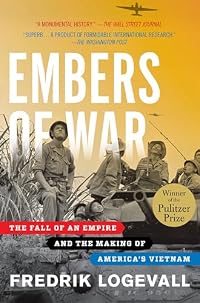
Embers of War: The Fall of an Empire and the Making of America's Vietnam
by Fredrik Logevall
On This Page
Description
A history of the four decades leading up to the Vietnam War offers insights into how the U.S. became involved, identifying commonalities between the campaigns of French and American forces while discussing relevant political factors.Tags
Recommendations























Member Reviews
This is one of the best works of history I've read in a long time! It shines a useful, timely, and comprehensive light into a largely ignored part of our history.
This work is incredibly deep and detailed! But unlike so many histories of similar scope and depth, it never felt dense to me. I didn't have any problems keeping track of names/dates/places/events, the way I usually do when I read big historical tomes.
Mr. Logevall's writing style is engrossing and sweeps you along - at times, it almost felt novelistic for the ease with which it reads. I never felt lost or bogged down. At the same time, I never felt that anything was being glossed over. It's a stunning stylistic achievement in a work such as this!
This work is incredibly deep and detailed! But unlike so many histories of similar scope and depth, it never felt dense to me. I didn't have any problems keeping track of names/dates/places/events, the way I usually do when I read big historical tomes.
Mr. Logevall's writing style is engrossing and sweeps you along - at times, it almost felt novelistic for the ease with which it reads. I never felt lost or bogged down. At the same time, I never felt that anything was being glossed over. It's a stunning stylistic achievement in a work such as this!
Embers of War is the last word on the First Indo-China War, with a hefty explanation of the circumstances leading to France's attempt to hold on to it's Asian colony, and the consequences of their painful exit. Conquered and colonized by the French in the 19th century, Indochina was lightly held by a few thousand soldiers and secret police when France fell to the Nazis in 1940. Vichy Indochina was absorbed by the Japanese, first with diplomatic illusions, and then in a sudden coup de main. When Japan surrendered in 1945, Ho Chi Minh's nationalist resistance group, the Viet Minh, declared independence. Independence lasted for a matter of months, as
What followed was the tragedy that we know so well. Ho Chi Minh was both a nationalist and a Communist, but the latter was because in the 1920s the Soviet Union was the only place taking anti-colonialism seriously. He was distrusted by Stalin, and looked to the United States for aid, going so far as to read the American declaration of independence when he took Hanoi in 1945. Truman, needing to keep France and the UK happy in Europe, threw Asians under the metaphorical bus. The hardening lines of the Cold War, particularly with Mao's victory in the Chinese Civil War, soon made it impossible to form a bridge between the Viet Minh and the United States.
France's war dragged on, toppling governments at home and increasingly becoming an American funded war, with the US providing planes, trucks, and ammunition by the tonne. As a consequence of the aid, America demanded a victory which France no longer had the heart to achieve. As villages turned against the government, and mobile columns were ambushed and cut apart, France looked to cut its losses and find some kind of political solution.
Logevall ably links events on the ground to diplomatic manuevering at superpower summits, and livens the book with a human interest chapter on Graham Greene and The Quiet American, and the book's influence on shaping perception of the war. Again and again, the basic incapacity of the French to understand the strength of the Vietnamese desire for independence, and the inability of the American government to think through the contradictions of their policy preferences to something that could actually exist, drive the war towards a terrible escalation.
The Viet Minh decisively defeated the French at the battle of Dien Bien Phu, but that victory was far from inevitable. Viet Minh units were at the end of their morale and endurance, and Vo Nguyen Giap learned the high costs of frontal attacks only by bloody lessons in the Red River delta. Victorious on the battlefield, Ho Chi Minh was forced to accept a partition by Russia and China, who were looking to de-escalate the Cold War for their own reasons. The autocratic Catholic Ngo Dinh Diem would become the American backed President of South Vietnam. By 1960, and the election of JFK, America was fully committed to the bloody war.
All I can say against Logevall is that my electronic copy seemed to drag, but finding out the actual book is 900 pages makes a lot of sense. This is about as heavy a history gets, before it collapses under its own weight.
I finished Embers of War by Frederik Logevall a five star book which through a extremely well written narrative traces the lineage of the Vietnam War from Ho Chi Minhs early attempts in to gain Woodrow Wilson’s support in the aftermath of World War I to free Vietnam from French colonialism following the principles laid out in the 14 Points, but was never seen by Wilson and seemingly was meant for those of European descent not Asian or African. Ho Chi Minh later fueled by principles articulated by President Franklin Roosevelt hopes to gain U.S. assistance and recognition of a free Vietnam, which he might very well had received had Roosevelt lived but was again stymied by Roosevelt’s premature death.
Logevall in great detail goes show more through the failure of the of France to find a way to veer from its path to retain its colonial empire specifically Indochina leading ultimately to its cataclysmic loss at Dien Bien Phu which ultimately led to its withdrawal from Vietnam ultimately replaced by the United States. He goes into great detail at both a local level and high level of the decisions made by the France and other involved nations including Great Britain, the United States, The Soviet Union and China and Ho Chi Minh and the many Vietnamese from communists and nationalists from both sides of the conflict including General Vo Nguyen Giap, Bao Dai, Ngo Dinh Diem.
The failure of the French early on to allow Vietnam true freedom from French domination and its failure to recognize but not lost to Ho Chi Minh that war was to lost or won with the peasantry and true social reform, a lesson later repeated y the United States.
Logevall illustrates that from Truman being stymied by the sting of being painted as losing China to the Communists and being painted by Senator Joseph McCarthy and those of a similar ilk to being soft on communism. This trend continues from President Dwight Eisenhower being penned in by similar forces and rhetoric through President Kennedy and the wars escalation by President Lyndon Johnson.
The saddest point of the book is that all the lessons of the French War were later lost to the United States and the same mistakes repeated. The war that needed not to have occurred and and path which at numerous times could have been altered from Wilson through, from post World War II French policies to the escalation of the Johnson administration. A sad story of what if’s and repeated mistakes and missteps and might have been. A must read. show less
Logevall in great detail goes show more through the failure of the of France to find a way to veer from its path to retain its colonial empire specifically Indochina leading ultimately to its cataclysmic loss at Dien Bien Phu which ultimately led to its withdrawal from Vietnam ultimately replaced by the United States. He goes into great detail at both a local level and high level of the decisions made by the France and other involved nations including Great Britain, the United States, The Soviet Union and China and Ho Chi Minh and the many Vietnamese from communists and nationalists from both sides of the conflict including General Vo Nguyen Giap, Bao Dai, Ngo Dinh Diem.
The failure of the French early on to allow Vietnam true freedom from French domination and its failure to recognize but not lost to Ho Chi Minh that war was to lost or won with the peasantry and true social reform, a lesson later repeated y the United States.
Logevall illustrates that from Truman being stymied by the sting of being painted as losing China to the Communists and being painted by Senator Joseph McCarthy and those of a similar ilk to being soft on communism. This trend continues from President Dwight Eisenhower being penned in by similar forces and rhetoric through President Kennedy and the wars escalation by President Lyndon Johnson.
The saddest point of the book is that all the lessons of the French War were later lost to the United States and the same mistakes repeated. The war that needed not to have occurred and and path which at numerous times could have been altered from Wilson through, from post World War II French policies to the escalation of the Johnson administration. A sad story of what if’s and repeated mistakes and missteps and might have been. A must read. show less
Fredrik Logevall's The Embers of War: The Fall of an Empire and the making of America's Vietnam takes Vietnam's struggle for independence to its very beginning and carries it through the beginning of America's “real” involvement in the war. It is clearly written and written in great detail. Logevall backs up his book with eighty-three pages of bibliography, roughly one page for every ten written.
At the Versailles Peace Conference in 1919, a young Vietnamese man in a rented morning coat comes to meet Woodrow Wilson and give him a letter. The letter is due almost entirely with Wilson, his Fourteen Points and his criticism of colonial empires. Ho Chi Minh was that man and hoped Wilson would help his country gain independence. Ho Chi show more Minh would leave disappointed never meeting Wilson or receiving a reply to his letter.
Jump to the end of World War II, China is the occupying country supervising the removal of the Japanese and keeping the peace. With the Japanese gone, Ho Chi Minh believes Vietnam is liberated and works to form a government. He gives speeches and quotes the Declaration of Independence. FDR as president did not support empires. He remained quiet about it to Churchill, but openly voiced how France could not support an empire. In other words France as a power was finished. However, it was Truman who was president after the war and Ho Chi Minh's independent Vietnam was ignored by France and England. Marshall Plan dollars allowed France to start sending troops back to Vietnam. Truman even allowed French troops to be transferred on American ships.
Ho Chi Minh called for free elections and land reform; he won the elections, but it matters little. The Chinese broker a peace that requires France to recognize the Republic of Vietnam and Vietnam to allow 25,000 French troops for a five year period. The French troops were replacing the Chinese troops. Ho Chi Minh travels to France looking for support. He is seen as a simple and genuine man although he admits to being a communist he says Vietnam is not ready for communism, just independence. He gains little support in France even from the socialists.
America is not too concerned about Vietnam. It is still seen as a defeated France trying to desperately to cling to its past. Truman is more concerned with Korea and the political fallout from the war. When Eisenhower is elected France asks for support and Eisenhower demands that there be a plan before any aid is given. This is also where things begin to change. Vietnam is not about France wanting to keep its empire, its about communism. The early development of the Domino Theory begins. If Vietnam falls, Thailand then India falls to communism. Suddenly America's opinion change. Communism changes the entire viewpoint.
Although the book primarily is about France's handling of Vietnam, it does show the very gradual but growing U.S. involvement in the war. From denying France its empire, to aid, to Americans directly assisting the French, to support for Diem, to fighting the war. The book also shows the frustration of Ho Chi Minh. For fifty-five years from believing in Wilson, to the Declaration of Independence speeches, to having independence taken away, to wanting fair and free elections, to having his communism doubted by the USSR and China (but not the US), Ho Chi Minh never lived to see his county free. France left defeated in Vietnam only to fight another war with its colonial holding Algeria.
Embers of War is an excellent history of the Vietnam conflict before the American commitment. It is a conflict that never should have happened and had so many opportunities to be resolved without violence. I recommend this book to anyone with an interest in foreign affairs or history. show less
At the Versailles Peace Conference in 1919, a young Vietnamese man in a rented morning coat comes to meet Woodrow Wilson and give him a letter. The letter is due almost entirely with Wilson, his Fourteen Points and his criticism of colonial empires. Ho Chi Minh was that man and hoped Wilson would help his country gain independence. Ho Chi show more Minh would leave disappointed never meeting Wilson or receiving a reply to his letter.
Jump to the end of World War II, China is the occupying country supervising the removal of the Japanese and keeping the peace. With the Japanese gone, Ho Chi Minh believes Vietnam is liberated and works to form a government. He gives speeches and quotes the Declaration of Independence. FDR as president did not support empires. He remained quiet about it to Churchill, but openly voiced how France could not support an empire. In other words France as a power was finished. However, it was Truman who was president after the war and Ho Chi Minh's independent Vietnam was ignored by France and England. Marshall Plan dollars allowed France to start sending troops back to Vietnam. Truman even allowed French troops to be transferred on American ships.
Ho Chi Minh called for free elections and land reform; he won the elections, but it matters little. The Chinese broker a peace that requires France to recognize the Republic of Vietnam and Vietnam to allow 25,000 French troops for a five year period. The French troops were replacing the Chinese troops. Ho Chi Minh travels to France looking for support. He is seen as a simple and genuine man although he admits to being a communist he says Vietnam is not ready for communism, just independence. He gains little support in France even from the socialists.
America is not too concerned about Vietnam. It is still seen as a defeated France trying to desperately to cling to its past. Truman is more concerned with Korea and the political fallout from the war. When Eisenhower is elected France asks for support and Eisenhower demands that there be a plan before any aid is given. This is also where things begin to change. Vietnam is not about France wanting to keep its empire, its about communism. The early development of the Domino Theory begins. If Vietnam falls, Thailand then India falls to communism. Suddenly America's opinion change. Communism changes the entire viewpoint.
Although the book primarily is about France's handling of Vietnam, it does show the very gradual but growing U.S. involvement in the war. From denying France its empire, to aid, to Americans directly assisting the French, to support for Diem, to fighting the war. The book also shows the frustration of Ho Chi Minh. For fifty-five years from believing in Wilson, to the Declaration of Independence speeches, to having independence taken away, to wanting fair and free elections, to having his communism doubted by the USSR and China (but not the US), Ho Chi Minh never lived to see his county free. France left defeated in Vietnam only to fight another war with its colonial holding Algeria.
Embers of War is an excellent history of the Vietnam conflict before the American commitment. It is a conflict that never should have happened and had so many opportunities to be resolved without violence. I recommend this book to anyone with an interest in foreign affairs or history. show less
Very interesting book on our road to war in Viet Nam. 20-20 has perfect vision. However, this book presents info that was available to our government at the time. It was evident this was the wrong war, in the wrong place, at the wrong time.
An excellent study of how the US came to be in Vietnam, starting from the beginning. At times a little dry to read, but overall an good but sad book on the mistakes our country made that lead us to our Vietnam War.
*i received this book through a Goodreads giveaway. Thanks to those that made it happen!*
It's hard to gripe about things received for free. Unfortunately, i have to preface this review with a gripe. At some point around page 150 in my reading, clusters of pages began to fall out. These clusters were between 10 and 200 pages. By the end of the book, more than half had fallen from the book, despite my feeble attempts at repairing it. It was essentially FUBAR by the time i'd skimmed over my minimalist marginalia. It was very surprising to see Random House as publisher.
Embers of War is exhaustive without being impenetrable. Logevall details the First Indochina War and the Vietnamese struggle from 1919-65, from Ho's emergence as a juggernaut show more on the scene to the United States's decision to send nearly 200,000 ground troops. The book does a fantastic job showing the sunk cost fallacy at work. The hard-line stance of the French and American governments markedly limits the actions that administrations can take. i was impressed with the depth of research and the fluency of the narrative while avoiding embellishment. It's an invaluable reference on the subject.
There's only one egregious reason this gets four stars instead of five. Despite having nearly 100 pages of notes, his citations are dodgy at times. More noteworthy, in my opinion, is the nearly verbatim insertion of whole paragraphs with a mere footnote at best. i collected a couple examples which follow.
1.
2.
i didn't have to perform a thorough search to find these, and there may well be more flagrant passages in the book. Despite being a thorough and well-developed monograph on the first war in Indochina, these occurrences raise eyebrows and questions alike. show less
It's hard to gripe about things received for free. Unfortunately, i have to preface this review with a gripe. At some point around page 150 in my reading, clusters of pages began to fall out. These clusters were between 10 and 200 pages. By the end of the book, more than half had fallen from the book, despite my feeble attempts at repairing it. It was essentially FUBAR by the time i'd skimmed over my minimalist marginalia. It was very surprising to see Random House as publisher.
Embers of War is exhaustive without being impenetrable. Logevall details the First Indochina War and the Vietnamese struggle from 1919-65, from Ho's emergence as a juggernaut show more on the scene to the United States's decision to send nearly 200,000 ground troops. The book does a fantastic job showing the sunk cost fallacy at work. The hard-line stance of the French and American governments markedly limits the actions that administrations can take. i was impressed with the depth of research and the fluency of the narrative while avoiding embellishment. It's an invaluable reference on the subject.
There's only one egregious reason this gets four stars instead of five. Despite having nearly 100 pages of notes, his citations are dodgy at times. More noteworthy, in my opinion, is the nearly verbatim insertion of whole paragraphs with a mere footnote at best. i collected a couple examples which follow.
1.
In Washington, attitudes were more mixed. Smith, having returned from Geneva on June 20, argued in favor of accepting the inevitability of a division of Vietnam and the desirability of guaranteeing it, so as to discourage the DRV from trying to violate the agreement. But Pentagon planners reiterated the old view that the Red River Delta was vital to the defense of all of Southeast Asia. A north-south partition . . . would merely be a prelude to the loss of the entire region.EMBERS OF War, 591-2
“In Washington, sentiment was divided and confused. Walter Bedell Smith, who had returned to Washington on June 20, was convinced that the United States should accept the settlement proposed by the French . . . noting that in such a case the other side would not be tempted by the weakness and disunity of the opposition to violate the settlement. . . . Sentiment within the Defense Department was apparently strong that the Red River Delta was crucial to the defense of all of Southeast Asia. A North-South partition would thus merely be a prelude to a communist takeover of the entire region.”U.S. Containment Policy and the Conflict in Indochina; William Duiker; 184 (reference not cited in previous passage)
2.
Terrorist attacks continued, none more brazen than one in late July on a group of French officers and their families at Cap St. Jacques, a resort town of palms and black sandy beaches at the mouth of the Saigon River. During dinner, while white-clad waiters served the main course, a group of Viet Minh soldiers in stolen Expeditionary Corps uniforms rushed in and hurled grenades and emptied Sten guns into the crowded room. When French soldiers arrived on the scene, they found eight officers, six children, two women, and four Vietnamese servants dead, along with twenty-three wounded. Only a lieutenant who played dead and a small boy who hid behind a chair remained unhurt.Embers of War, 320
Cap St. Jacques is . . . a city of palms and black sandy beach, at the mouth of the Saigon River. . . . While white-clad Vietnamese waiters served the course, a column of native soldiers in the green French Union battle-dress emerged . . . armed with regulation grenades and Sten guns. When French soldiers reached the dining room, they found eight officers, six children, two women and four Vietnamese servants dead and 23 wounded men, women & children. Only a lieutenant who had rolled into the blood of a dead woman to simulate death and a small boy who had hidden behind a chair remained uninjured.“Massacre at Cap” in August 4, 1952 issue of Time Magazine. [this reference is cited in EoW but the above passage is still alarmingly close to the original]
i didn't have to perform a thorough search to find these, and there may well be more flagrant passages in the book. Despite being a thorough and well-developed monograph on the first war in Indochina, these occurrences raise eyebrows and questions alike. show less
Members
- Recently Added By
Lists

Pulitzer Prize for History
16 works; 2 members
Author Information

12+ Works 1,845 Members
Fredrik Logevall (born 1963) is a Swedish-American historian and educator at Cornell University, where he is the John S. Knight Professor of International Studies. He is a specialist in U.S. foreign policy and the Vietnam Wars. He is also the director of Cornell¿s Mario Einaudi Center for International Studies and Cornell's Vice Provost for show more International Relations. He won the 2013 Pulitzer Prize for History for his book Embers of War: The Fall of an Empire and the Making of America¿s Vietnam. (Bowker Author Biography) show less
Awards and Honors
Awards
Distinctions
Common Knowledge
- Original title
- Embers of War: The Fall of an Empire and the Making of America's Vietnam
- Original publication date
- 2012
- Important places
- Vietnam
- Important events
- Vietnam War
Classifications
Statistics
- Members
- 563
- Popularity
- 52,203
- Reviews
- 14
- Rating
- (4.42)
- Languages
- English
- Media
- Paper, Audiobook, Ebook
- ISBNs
- 4
- ASINs
- 8