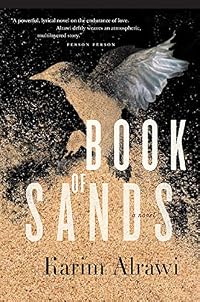
Book of Sands
by Karim Alrawi
On This Page
Description
"The inaugural winner of the HarperCollins/UBC Prize for Best New Fiction. This powerful, lyrical novel of the endurance of love is set amid the upheaval of the Arab Spring and the brutal repression of a totalitarian regime. Tarek, a young father, watches as the city he lives in is mired in protests, hemmed in by barricades and strangely inundated by great flocks of birds. Facing the threat of police arrest, he flees with his nine-year-old daughter, Neda. As Tarek and Neda journey through show more villages razed by conflict towards a mountain refuge, they meet with fellow travellers from Tarek's past and his time as a political prisoner. The reunion reveals secrets that Tarek must come to terms with for his own and Neda's sake."-- show lessTags
Recommendations






















Member Reviews
The Book of Sands : a Novel of the Arab Uprising is a very personal and intimate look at the corruption, human rights violations, atheism vs religious devotion, and the modern world vs the past in the Middle East. Though it is a novel about the Arab Spring, it focuses very little on politics.
Tarek is an educated man, a mathematician ,with a nine year old daughter, Neda. He is married to Mona, who is on maternity leave from her job as a high school teacher. Mona is nine months pregnant and awaiting labour. In years prior, Tarek spent time in prison due to political activities in his past. When barricades go up in the city (likely Cairo, though the place is never named) the threat of a police arrest forces Tarek and Neda to flee the city. show more In doing so, Tarek must leave his pregnant wife Mona . Watching over Mona is her very troubled brother, Omar. Omar is deeply religious man, yet drives a taxi delivering European prostitutes to foreigners and high ranking officials in the city.
As Tarek and Neda leave the city for the mountains, Tarek is forced to confront his past. The journey exposes us to a much wider scope of Modern Middle Eastern society, where cell phones co -exist with salt sellers, and educated woman live among those who still believe in the virtue of female genital mutilation. Author Karim Alrawi portrays all of his characters as complex people , and with empathy and understanding, though Alrawi's liberalism is gently apparent.
A dark, absorbing look into the Modern Middle East,both wide in scope and very personal, The Book of Sands is a very worthwhile read.
4.5 stars. show less
Tarek is an educated man, a mathematician ,with a nine year old daughter, Neda. He is married to Mona, who is on maternity leave from her job as a high school teacher. Mona is nine months pregnant and awaiting labour. In years prior, Tarek spent time in prison due to political activities in his past. When barricades go up in the city (likely Cairo, though the place is never named) the threat of a police arrest forces Tarek and Neda to flee the city. show more In doing so, Tarek must leave his pregnant wife Mona . Watching over Mona is her very troubled brother, Omar. Omar is deeply religious man, yet drives a taxi delivering European prostitutes to foreigners and high ranking officials in the city.
As Tarek and Neda leave the city for the mountains, Tarek is forced to confront his past. The journey exposes us to a much wider scope of Modern Middle Eastern society, where cell phones co -exist with salt sellers, and educated woman live among those who still believe in the virtue of female genital mutilation. Author Karim Alrawi portrays all of his characters as complex people , and with empathy and understanding, though Alrawi's liberalism is gently apparent.
A dark, absorbing look into the Modern Middle East,both wide in scope and very personal, The Book of Sands is a very worthwhile read.
4.5 stars. show less
Set in the so-called Arab Spring democratic revolution of Egypt in 2011, this is a rich book, full of allusions, metaphors and varied points of view. It’s also absorbing to read, suspenseful, mysterious, descriptive and peopled with interesting characters. It centres mainly around Tarek, a former political prisoner who is drawn to the social changes, but who, to protect his safety and his family, leaves Cairo for the remote mountain plateau of southwestern Egypt (I think –the geography is deliberately vague). The story also brings in his pregnant wife and her confused religious zealot brother; his somewhat precocious child; a former political partner; and the villagers they met when they lived in a prison camp in the same mountain show more plateau. With shifting points of view, timeframes and locations, it covers a lot within a very readable narrative, from modern urban Cairo to very traditional village life, with variations on each of these.
It’s also rich with poetic metaphor that expands the story further. It opens with a plague of birds that infests Cairo, which suggests both a vast range of possibilities and liberties, but includes the raucous noise they make, drowning out theatrical productions, and the bird droppings that get on everything. Tarek is a modern storyteller who, perhaps ironically. makes figures and gives puppet shows for a living. He inspires his daughter with a variety of stories that seem ambiguous but delight her in her interpretation. One central story of the beautiful stone roses formed of salt crystals almost leads to his death when he treks into the desert to find her one. A repeating theme of mathematical certainties becomes a coded love poem when its formulae are given human variables. There is a twisted parallel in this, too, when a rationalizing fundamentalist finds ways to interpret the words of the Koran to justify his personal desires.
While Karim Alrawi is clearly supportive of the revolutionary direction of the Egyptian crowds against the ruling corrupt dictatorship, he does not suggest that there is an easy transition to a more democratic future. In fact, one of his central metaphors is the babies that refuse to be born until they (or the times) are ready. His Islamic believers all seem to be ignorant or self-serving, but moving forward means fighting against them, too. If there are any Islamic characters who are more sympathetic, they seem to be mystics who don’t actively participate in the movement, although they perhaps give others an element of hope or connectedness to the future.
This novel provides a complex and intriguing picture of a contemporary culture that is seldom seen beyond headlines. Although the Arab Spring is just a background for the novel, the story illuminates it from several points of view and gives an understanding of many different elements in Egyptian society that are at work. The depth of traditionalism, political conservatism, privilege and religion contrast with the strength of the forces for change. While the novel has a hopeful ending, it’s also possible to see in the forces depicted why the Egyptian revolution has become wrecked. show less
It’s also rich with poetic metaphor that expands the story further. It opens with a plague of birds that infests Cairo, which suggests both a vast range of possibilities and liberties, but includes the raucous noise they make, drowning out theatrical productions, and the bird droppings that get on everything. Tarek is a modern storyteller who, perhaps ironically. makes figures and gives puppet shows for a living. He inspires his daughter with a variety of stories that seem ambiguous but delight her in her interpretation. One central story of the beautiful stone roses formed of salt crystals almost leads to his death when he treks into the desert to find her one. A repeating theme of mathematical certainties becomes a coded love poem when its formulae are given human variables. There is a twisted parallel in this, too, when a rationalizing fundamentalist finds ways to interpret the words of the Koran to justify his personal desires.
While Karim Alrawi is clearly supportive of the revolutionary direction of the Egyptian crowds against the ruling corrupt dictatorship, he does not suggest that there is an easy transition to a more democratic future. In fact, one of his central metaphors is the babies that refuse to be born until they (or the times) are ready. His Islamic believers all seem to be ignorant or self-serving, but moving forward means fighting against them, too. If there are any Islamic characters who are more sympathetic, they seem to be mystics who don’t actively participate in the movement, although they perhaps give others an element of hope or connectedness to the future.
This novel provides a complex and intriguing picture of a contemporary culture that is seldom seen beyond headlines. Although the Arab Spring is just a background for the novel, the story illuminates it from several points of view and gives an understanding of many different elements in Egyptian society that are at work. The depth of traditionalism, political conservatism, privilege and religion contrast with the strength of the forces for change. While the novel has a hopeful ending, it’s also possible to see in the forces depicted why the Egyptian revolution has become wrecked. show less
Ratings
Members
- Recently Added By
Published Reviews
ThingScore 75
Karim Alrawi’s first novel Book of Sands has won the inaugural HarperCollins/UBC Prize for Best New Fiction and the jury in its citation described the book as “beautiful” and “enduring.”
It is also a strange and absorbing novel...
Alrawi’s writing is lyrical and intricate; the evocation of a grimy Arab city suffocated by pollution and corruption very real.
Book of Sands is also an show more intensely political book but there is hardly any politics in it. show less
added by vancouverdeb
Their escape quickly turns to spiritual quest as they pick up travellers from Tarek’s past. A social novel exploring shades between realism and myth, present and past, agnosticism and devotion, Book of Sands is political because it’s about the personal transformations that foment change. It asks, what is the nature of choice? What are the contingencies of freedom? That’s how it is a show more novel of the Arab Spring. show less
added by vancouverdeb
Author Information
6 Works 64 Members
Awards and Honors
Common Knowledge
- Canonical title
- Book of Sands
- Alternate titles
- Book of sands : a novel of the Arab Uprising
- Original publication date
- 2015
- People/Characters
- Tarek; Neda; Mona; Omar; Kasem; Leila
- Important events
- Arab Spring
- First words
- On the morning babies decide not to be born, and mothers cease to give birth, Neda, seven weeks and four days to being ten, late for school, skelters through a a flurry of starlings that scatter from the sidewalk, take flight... (show all) to gather on balconies and rooftops.
- Blurbers
- Lyon, Annabel; Maharaj, Rabindranath; Jamal, Tasneem
Classifications
Statistics
- Members
- 18
- Popularity
- 1,382,557
- Reviews
- 2
- Rating
- (3.83)
- Languages
- English
- Media
- Paper, Ebook
- ISBNs
- 3
- ASINs
- 1