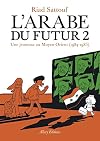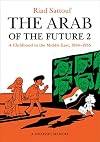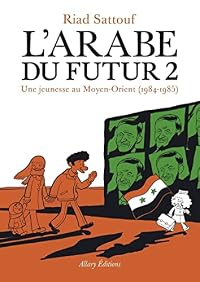
The Arab of the Future 2: A Childhood in the Middle East, 1984-1985
by Riad Sattouf
The Arab of the Future (2)
On This Page
Description
The highly anticipated continuation of Riad Sattoufs internationally acclaimed, #1 French bestseller, which was hailed by the New York Times as a disquieting yet essential read in the Arab of the Future: Volume 1, cartoonist Riad Sattouf tells of the first years of his childhood as his family shuttles back and forth between France and the Middle East. In Libya and Syria, young Riad is exposed to the dismal reality of a life where food is scarce, children kill dogs for sport, and his show more cousins, virulently anti-Semitic and convinced he is Jewish because of his blond hair, lurk around every corner waiting to beat him up. In volume 2, Riad, now settled in his fathers hometown of Horms, gets to go to school, where he dedicates himself to becoming a true Syrian in the country of the dictator Hafez Al-Assad. Told simply yet with devastating effect, Riads story takes in the sweep of politics, religion, and poverty, but is steered by acutely observed small moments: the daily sadism of his schoolteacher, the lure of the black market, with its menu of shame and subsistence, and the obsequiousness of his father in the company of those close to the regime. As family strains to fit in, on chilling, barbaric act drives the Sattoufs to make the most dramatic of changes. Darkly funny and piercingly direct. The Arab of the Future, Volume 2 once again reveals the inner workings of a tormented country and a tormented family, delivered through Riad Saffoufs dazzlingly original talent. show lessTags
Recommendations







Member Recommendations
Member Reviews
Riad is like a modern day Huck Finn, absorbing the sometimes disturbing culture that surrounds him with the innocent, dispassionate, questioning eyes of a young child. This technique allows the author to observe and report without needing to provide commentary. This is best seen in his portrayal of his, what I would call, tremendously flawed parents. (How his mother can choose to live in this world of sexism and put up with his father's delusional visions of grandeur, I will never understand.) However, overall, it's a very insightful look into a cultural history with which I have very little experience.
 This review was written for LibraryThing Early Reviewers.
Mr. Riad Sattouf's masterpiece no. 2 starts a bit like Moby Dick: "My name is Riad. In 1984, I was six years old and I was just as gorgeous as ever."
This graphic novel is a reminiscence of two years of Riad's childhood in the village of Ter Maalch, near Homs in Syria.
This narrative is squarely placed during the time period during which Hafez el Hassad's dictatorship, surrounded by a clique of Generals, was slowly rotting away.
Stylistically Riad's uses only white light, an achromatic grey and black to create comical or dramatic faces; himself, his mother and father, his grandmother who has a bad back and a variety of ordinary Syrians men and women; school children, peasants, smugglers, hotel workers, teachers, elders, generals and show more their entourage. We are told that Riad has "flowing blond hair like a Hollywood actress", yet Riad uses only the white light and grey shades to suggest it.
This story can be grouped in central themes essential to any child: parents, sleep and the fear of darkness, school life, teachers and the fear they inspire, school friends and relatives of the same age, the social dreams of Riad's father and mother aspiring to a better life, games and role play with other children and escapes. Riad escapes the dullness of his rural school where one has to wear a school uniform, complete with a patriotic cap and one has to learn Arabic by chanting the national anthem or on dated school books depicting Baath socialism inspired characters' life in which Riad notes that women do not wear veils while Riad's Syrian life is happening in an increasingly religious society.
His forms of escapes are his own thoughts in the dark of his bedroom or when he goes to play in the "countryside" with his friends. Other escapes, that are not necessarily escapes, are when his father drives him to one of the Generals' house that has the same foundations' cracks that his father's apartment and where he meets the General's child who has an impressive array of toy modern weaponry.
Noteworthy is Riad's escape, in the General's car, complete with a bodyguard, to the ruins of Palmyre where for Riad: " the ground was covered with strange bits of pottery and stones. Each one looked mysterious and precious."
Note how Mr. Sattouf makes the reader perceive the child's unique field of vision as he draws the whole monumental ruins but is more interested in his childhood vision of it from the ground.
Then there are other escapes, at the Meridien Hotel in Damas, or to France during a vacation or when playing with lego pieces.
The elements, rain, floods or sun are also central to this story.
The schooling in the Arabic language conversations in French and English play a part in how Riad comprehends the world that surrounds him and the use of language by adults. Important in young Riad's story is the pleasure he gets from drawing. First Arabic letters and their changing shapes depending in where they are in the word and then through being taught French; how by reading Herge's Tintin comics Riad suddently understands the graphic novel "Le Crabe aux Pinces d'Or", the crab with the golden claws, discovering the meaning through the arrest of Captain Haddock of a story which until this time he could only imagine looking at frames and images.
Then Riad has reactions to important societal issues at school and during his escapes: money and the lack thereof, pregnancy outside marriage in a rural society, education, antisemitism, nationalism, military dictatorship, social distance...
At the end of the story, Riad's father, an associate professor who dreams to become an Assistant Professor, renounces his vision of luxury by planting an orchard where he intended to build a villa that could have rivaled, in his dreams, that of one of El Assad's generals.
The Author grew up in Libya and Syria and received for the first installment of this book the Best Graphic Novel Price of the Angouleme comic festival in France. show less
This graphic novel is a reminiscence of two years of Riad's childhood in the village of Ter Maalch, near Homs in Syria.
This narrative is squarely placed during the time period during which Hafez el Hassad's dictatorship, surrounded by a clique of Generals, was slowly rotting away.
Stylistically Riad's uses only white light, an achromatic grey and black to create comical or dramatic faces; himself, his mother and father, his grandmother who has a bad back and a variety of ordinary Syrians men and women; school children, peasants, smugglers, hotel workers, teachers, elders, generals and show more their entourage. We are told that Riad has "flowing blond hair like a Hollywood actress", yet Riad uses only the white light and grey shades to suggest it.
This story can be grouped in central themes essential to any child: parents, sleep and the fear of darkness, school life, teachers and the fear they inspire, school friends and relatives of the same age, the social dreams of Riad's father and mother aspiring to a better life, games and role play with other children and escapes. Riad escapes the dullness of his rural school where one has to wear a school uniform, complete with a patriotic cap and one has to learn Arabic by chanting the national anthem or on dated school books depicting Baath socialism inspired characters' life in which Riad notes that women do not wear veils while Riad's Syrian life is happening in an increasingly religious society.
His forms of escapes are his own thoughts in the dark of his bedroom or when he goes to play in the "countryside" with his friends. Other escapes, that are not necessarily escapes, are when his father drives him to one of the Generals' house that has the same foundations' cracks that his father's apartment and where he meets the General's child who has an impressive array of toy modern weaponry.
Noteworthy is Riad's escape, in the General's car, complete with a bodyguard, to the ruins of Palmyre where for Riad: " the ground was covered with strange bits of pottery and stones. Each one looked mysterious and precious."
Note how Mr. Sattouf makes the reader perceive the child's unique field of vision as he draws the whole monumental ruins but is more interested in his childhood vision of it from the ground.
Then there are other escapes, at the Meridien Hotel in Damas, or to France during a vacation or when playing with lego pieces.
The elements, rain, floods or sun are also central to this story.
The schooling in the Arabic language conversations in French and English play a part in how Riad comprehends the world that surrounds him and the use of language by adults. Important in young Riad's story is the pleasure he gets from drawing. First Arabic letters and their changing shapes depending in where they are in the word and then through being taught French; how by reading Herge's Tintin comics Riad suddently understands the graphic novel "Le Crabe aux Pinces d'Or", the crab with the golden claws, discovering the meaning through the arrest of Captain Haddock of a story which until this time he could only imagine looking at frames and images.
Then Riad has reactions to important societal issues at school and during his escapes: money and the lack thereof, pregnancy outside marriage in a rural society, education, antisemitism, nationalism, military dictatorship, social distance...
At the end of the story, Riad's father, an associate professor who dreams to become an Assistant Professor, renounces his vision of luxury by planting an orchard where he intended to build a villa that could have rivaled, in his dreams, that of one of El Assad's generals.
The Author grew up in Libya and Syria and received for the first installment of this book the Best Graphic Novel Price of the Angouleme comic festival in France. show less
This review was written for LibraryThing Early Reviewers.I found the first volume surprisingly engaging though there's hardly a likable character to be found in this autobiographical work. The father is a peculiar sort of asshole who drags his French wife to Syria to be closer to his family. One cannot help but be fascinated and repelled by the life they lead. This volume is more of the same, almost literally, as this volume picks up immediately after the first and the whole thing only covers about a year in the life of author as a six-year-old. It's almost too much to take, but like a car crash it is hard to take your eyes off.
I keep reading Sattouf's memoirs, but the story he tells of everyday life is so bleak and horrifying. in the last installment, it was the brutal killing of a puppy. in this one, it was the murder of his older cousin Leila, killed by her male relatives to protect their "honor." the men are let out of jail and gain only respect for their actions. unrelenting horror.
The second installment in Riad Sattouf's memoir of growing up in a vaguely secular family in the Middle East, this graphic memoir is touching and heartbreaking all at once. With a dispassionate respect for the aspects of culture that are like the air that we breathe, Sattouf depicts the small Syrian town in which he grew up with all its prejudices and its honors. His visual narrative shifts from the minutely personal introduction to boyhood brutality to the desperate need for a family to remain in good grace with local government officials. Long on details and short on dogma, this is at its core a personal memoir of a young boy's devotion to his imperfect father and his desire to belong -- such universal themes. Sattouf exposes his show more parents' foibles with compassion and love. Well done. show less
This review was written for LibraryThing Early Reviewers.Though it is an immediate continuation of the first volume, "The Arab of the Future 2" nevertheless feels less fantastical than the first. The absurd and surely exaggerated claims in the first volume about a childhood in Gaddafi's Libya--supposedly recalled from an age wherein the author was far too young to remember much--have been replaced in the second volume by slightly more believable memories of rural village life in Hafez al-Assad's Syria. More than anything, however, this book should be read not as a source of information about either setting, but as the memoirs of a Frenchman whose memories and issues with his own past are mediated through his relationship with his father. Taken in that spirit, it makes for a compelling read.
This review was written for LibraryThing Early Reviewers.A great second installment of the Aran of the Future saga, a personal and humorous approach to a childhood spent in Syria and Libya in the mid-80s. Sattouf continues the telling of his rather blissful childhood, despite the unfinished house his family lives in (waiting for his father to start building the much anticipated villa, while his mother cooks meals on a camp stove), his bumbling father (who's a bit of a talker rather than a do-er), the deranged bully at school (who is convinced young Riad is Jewish due to his blond hair), the sadistic teacher (who likes to hit the kids' hands with a long stick every chance she gets).
There is so much here that resonates with my childhood that I could not stop laughing at some points. For show more example, the fact that Riad's father and other men get in fights about payment (rather, that his father should NOT pay for something he is buying or a visit to the doctor's office) is hilarious, unbelievable, yet so very familiar! I remember sitting for half an hour at dinner tables in restaurants where the heads of families argued just who will foot the bill, no, no way, we're paying, no ustad, you cannot pay, it's on me this time, no, no you're both wrong, I'm paying... and on and on and on... Only the children seemed embarrassed by this behavior so common to the adults. Of course, new generations are more relaxed, just splitting the bill! My elementary school teacher used to hit our hands and our knuckles, and sometimes even our wrists with the wooden ruler stick, so I know exactly the cringe-worthy anxiety of waiting for the stick to meet flesh and bone.
Some memories are refreshing and funny, like Riad learning Arabic, and then finding French much more difficult and illogical. His excursions with his grandma in France are a hilarious contrast to his life in the Middle East (even his hunting experience with his father and a rifle is at steep odds with hunting for eels in the sand with a stick with his grandma). But it is not all fun and games, Riad learns, when a relative, perhaps his first "art teacher," who kindly explains to him one-point perspective using the drawing of a soccer field, comes to a very tragic end. There is a lot left to ponder, too, mainly because Riad is a child and his information is lacking about what is really going on. A sweet boy who walks 3 miles to Riad's school does not return to school the next semester, and we have no idea why, but have a strange feeling that something bad might have happened to him.
Sattouf's drawing style is minimalist, yet expressive. He captures the vast emptiness of half-desert landscapes very well. The half-built structures, electricity lines that are sometimes the only sign of civilization, the posh holiday resort hotels with their empty bars, the giant, cracked villa of the local general and his bored wife... These things are rendered in just enough detail to fulfill a sense of place and even clime.
Arab of the Future 2 is highly recommended for those who like humor, history, and learning languages. I'd caution against getting this for anyone who might be sensitive to anti-semitism or anti-Israel stuff, as there is quite a bit of that (I don't think any book about the Middle East would be honest if it did not have strong sentiments on the subject expressed by some, if not all, of its characters.)
Thanks to the publisher and LibraryThing for a free copy of the ARC for my honest review. I thoroughly enjoyed it! show less
There is so much here that resonates with my childhood that I could not stop laughing at some points. For show more example, the fact that Riad's father and other men get in fights about payment (rather, that his father should NOT pay for something he is buying or a visit to the doctor's office) is hilarious, unbelievable, yet so very familiar! I remember sitting for half an hour at dinner tables in restaurants where the heads of families argued just who will foot the bill, no, no way, we're paying, no ustad, you cannot pay, it's on me this time, no, no you're both wrong, I'm paying... and on and on and on... Only the children seemed embarrassed by this behavior so common to the adults. Of course, new generations are more relaxed, just splitting the bill! My elementary school teacher used to hit our hands and our knuckles, and sometimes even our wrists with the wooden ruler stick, so I know exactly the cringe-worthy anxiety of waiting for the stick to meet flesh and bone.
Some memories are refreshing and funny, like Riad learning Arabic, and then finding French much more difficult and illogical. His excursions with his grandma in France are a hilarious contrast to his life in the Middle East (even his hunting experience with his father and a rifle is at steep odds with hunting for eels in the sand with a stick with his grandma). But it is not all fun and games, Riad learns, when a relative, perhaps his first "art teacher," who kindly explains to him one-point perspective using the drawing of a soccer field, comes to a very tragic end. There is a lot left to ponder, too, mainly because Riad is a child and his information is lacking about what is really going on. A sweet boy who walks 3 miles to Riad's school does not return to school the next semester, and we have no idea why, but have a strange feeling that something bad might have happened to him.
Sattouf's drawing style is minimalist, yet expressive. He captures the vast emptiness of half-desert landscapes very well. The half-built structures, electricity lines that are sometimes the only sign of civilization, the posh holiday resort hotels with their empty bars, the giant, cracked villa of the local general and his bored wife... These things are rendered in just enough detail to fulfill a sense of place and even clime.
Arab of the Future 2 is highly recommended for those who like humor, history, and learning languages. I'd caution against getting this for anyone who might be sensitive to anti-semitism or anti-Israel stuff, as there is quite a bit of that (I don't think any book about the Middle East would be honest if it did not have strong sentiments on the subject expressed by some, if not all, of its characters.)
Thanks to the publisher and LibraryThing for a free copy of the ARC for my honest review. I thoroughly enjoyed it! show less
This review was written for LibraryThing Early Reviewers.Members
- Recently Added By
Lists

Recommended Comics / Graphic Novels
595 works; 119 members

Books Read in 2017
4,248 works; 130 members
Author Information

55+ Works 2,896 Members
Some Editions
Awards and Honors
Distinctions
The Guardian Book of the Day (2016-09-27)
Notable Lists
Series

Work Relationships
Is contained in
Common Knowledge
- Canonical title
- The Arab of the Future 2: A Childhood in the Middle East, 1984-1985
- Original title
- L'Arabe du futur 2
- Alternate titles*
- O Árabe do Futuro, Vol.2: Uma Juventude no Oriente Médio; O árabe do futuro 2; O Árabe do Futuro 2: Uma Juventude no Oriente Médio
- Original publication date
- 2015 (French) (French)
- People/Characters
- Riad Sattouf
- Important places
- Homs, Syria; Palmyra, Syria; Cap Fréhel, Brittany, France
- First words*
- Ik heet Riad. In 1984 was ik zes jaar oud en nog altijd een betoverend mooie man.
- Original language
- French
*Some information comes from Common Knowledge in other languages. Click "Edit" for more information.
Classifications
- Genre
- Graphic Novels & Comics
- DDC/MDS
- 741.5 — Arts & recreation Drawing & decorative arts Drawing and drawings Comic books, graphic novels, fotonovelas, cartoons, caricatures, comic strips
- LCC
- NC1499 .S337 .A2 — Fine Arts Drawing. Design. Illustration Drawing. Design. Illustration Pictorial humor, caricature, etc.
- BISAC
Statistics
- Members
- 466
- Popularity
- 64,995
- Reviews
- 25
- Rating
- (4.10)
- Languages
- 14 — Catalan, Danish, Dutch, English, Finnish, French, German, Italian, Japanese, Polish, Portuguese (Brazil), Portuguese (Portugal), Spanish, Swedish
- Media
- Paper, Ebook
- ISBNs
- 25
- ASINs
- 3