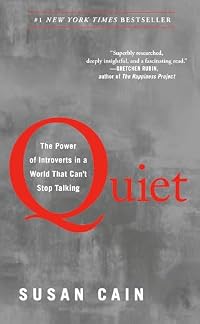
Quiet: The Power of Introverts in a World That Can't Stop Talking
by Susan Cain
On This Page
Description
This book demonstrates how introverted people are misunderstood and undervalued in modern culture, charting the rise of extrovert ideology while sharing anecdotal examples of how to use introvert talents to adapt to various situations. At least one-third of the people we know are introverts. They are the ones who prefer listening to speaking, reading to partying; who innovate and create but dislike self-promotion; who favor working on their own over brainstorming in teams. Although they are show more often labeled "quiet," it is to introverts that we owe many of the great contributions to society, from van Gogh's sunflowers to the invention of the personal computer. Filled with indelible stories of real people, this book shows how dramatically we undervalue introverts, and how much we lose in doing so. Taking the reader on a journey from Dale Carnegie's birthplace to Harvard Business School, from a Tony Robbins seminar to an evangelical megachurch, the author charts the rise of the Extrovert Ideal in the twentieth century and explores its far-reaching effects. She talks to Asian-American students who feel alienated from the brash, backslapping atmosphere of American schools. She questions the dominant values of American business culture, where forced collaboration can stand in the way of innovation, and where the leadership potential of introverts is often overlooked. And she draws on cutting-edge research in psychology and neuroscience to reveal the differences between extroverts and introverts. She introduces us to successful introverts, from a witty, high-octane public speaker who recharges in solitude after his talks, to a record-breaking salesman who quietly taps into the power of questions. Finally, she offers advice on everything from how to better negotiate differences in introvert-extrovert relationships to how to empower an introverted child to when it makes sense to be a "pretend extrovert." This book has the ability to permanently change how we see introverts and, equally important, how introverts see themselves. show lessTags
Recommendations








Member Recommendations

Member Reviews
The American culture lives by what Susan Cain terms the Extrovert Ideal, where we are expected to brainstorm, work in open office plans, and collaborate with peers on school projects. For the third to half of the population that are introverts, however, these scenarios can be difficult. Cain uses both personal stories and scientific studies to argue that introverts are simply wired differently and can bring a unique set of strengths if given the ability to work in their own way.
For an introvert like me, I found Quiet a really rewarding and validating experience. I fortunately have not dealt with the stigma that sometimes comes from being quiet and introspective and have learned to adapt in environments where I temporarily need to act show more more extroverted, as well as allowing myself downtime. I appreciated her approach in never claiming that extroverts or introverts are inherently better, just different, and we each have something to learn from the other. Some of the studies had really surprising outcomes, including aspects of my personality that I never connected to being an introvert. Highly recommended reading for introverts and extroverts alike. show less
For an introvert like me, I found Quiet a really rewarding and validating experience. I fortunately have not dealt with the stigma that sometimes comes from being quiet and introspective and have learned to adapt in environments where I temporarily need to act show more more extroverted, as well as allowing myself downtime. I appreciated her approach in never claiming that extroverts or introverts are inherently better, just different, and we each have something to learn from the other. Some of the studies had really surprising outcomes, including aspects of my personality that I never connected to being an introvert. Highly recommended reading for introverts and extroverts alike. show less
I cried with relief reading Cain's words. How freeing to learn that my "highly sensitive" nature - unnerved by violence and the evening news, super-conscientious, drained by crowd situations, even being made edgy by caffeine -- is researched, valid, normal and even holds power for good.
After growing up ashamed for dissolving into tears, wearing my heart on my sleeve, or stammering a defense of my "thin skinned" response to bullying or criticism, Cain's book is a breath of fresh air for this introvert.
After growing up ashamed for dissolving into tears, wearing my heart on my sleeve, or stammering a defense of my "thin skinned" response to bullying or criticism, Cain's book is a breath of fresh air for this introvert.
Reading this has been an epiphany for me; I fit almost 100% into the description of an introvert. I wish someone had explained this to me years ago. Things that I thought were a problem are simply natural for the type of person I am. And there is nothing wrong with being an introvert. Many of our greatest minds are and have been introverts. Now, if anyone tells me I should make more of an effort to socialize in big groups (where I do not feel comfortable), or learn how to chit chat about meaningless things, or stop being so serious or so sensitive, I can ignore them (or if I'm in a good mood, explain why that isn't necessary or true). Cain also explains about extroverts and how our society (most of western society) is prejudiced in show more favor of extroverts, how classrooms and open-plan offices are set up for them, and much more. As the blurb on the back says, "For far too long, those who are naturally quiet, serious or sensitive have been overlooked. The loudest have taken over -- even if they have nothing to say." show less
Rating: 4.5 of 5
You know what really burns my biscuits? I had a long, insightful handwritten review all ready to post. Then, two weeks ago, I returned Quiet to the library. And where do you think I'd stuck that review for safekeeping? Uh huh. In the dang front flap of the book. Ugh. So now the review's gone, along with all the notes I'd taken whilst reading. Live and learn, I s'pose: don't forget you filed your review in a borrowed book.
Onward to what I remember lovin' about Quiet: The Power of Introverts in a World That Can't Stop Talking:
* An interesting examination of how our culture has adopted the "Extrovert Ideal."
* I never felt the author was saying, "Introverts are better; therefore, everyone should be an introvert." Instead, show more throughout the book, there were repeated messages of BALANCE. I really dug that vibe because the world really does need both.
* Tons of research. You could tell the author did her homework and not just for a year or two, but several years of focused research. Plus, there were 45+ pages of source notes.
* The content was structured in an accessible way. Research findings would be introduced and then a real world example would follow which illustrated the thesis of that research.
* Empowerment for introverts! My whole life I'd heard all the comments probably most every introvert has heard: "You think too much;" "You analyze too much;" "Why does your face turn red when you talk to people;" "Why don't you go to more parties or have more friends;" "How can you stand to work at home, be alone, for so long;" and on and on. After reading Quiet, for the first time ever, I embraced those comments, appreciated them. They were just recognizing the person I always knew I was but thought wrong in some way, even though I loved those things about myself (well, except for the blushing).
My only teensy complaint would be I wish there had been more elaboration on raising introverted children and how to enhance/improve relations between introverts and extroverts, especially in personal relationships.
Quiet's definitely on my must-buy list. show less
You know what really burns my biscuits? I had a long, insightful handwritten review all ready to post. Then, two weeks ago, I returned Quiet to the library. And where do you think I'd stuck that review for safekeeping? Uh huh. In the dang front flap of the book. Ugh. So now the review's gone, along with all the notes I'd taken whilst reading. Live and learn, I s'pose: don't forget you filed your review in a borrowed book.
Onward to what I remember lovin' about Quiet: The Power of Introverts in a World That Can't Stop Talking:
* An interesting examination of how our culture has adopted the "Extrovert Ideal."
* I never felt the author was saying, "Introverts are better; therefore, everyone should be an introvert." Instead, show more throughout the book, there were repeated messages of BALANCE. I really dug that vibe because the world really does need both.
* Tons of research. You could tell the author did her homework and not just for a year or two, but several years of focused research. Plus, there were 45+ pages of source notes.
* The content was structured in an accessible way. Research findings would be introduced and then a real world example would follow which illustrated the thesis of that research.
* Empowerment for introverts! My whole life I'd heard all the comments probably most every introvert has heard: "You think too much;" "You analyze too much;" "Why does your face turn red when you talk to people;" "Why don't you go to more parties or have more friends;" "How can you stand to work at home, be alone, for so long;" and on and on. After reading Quiet, for the first time ever, I embraced those comments, appreciated them. They were just recognizing the person I always knew I was but thought wrong in some way, even though I loved those things about myself (well, except for the blushing).
My only teensy complaint would be I wish there had been more elaboration on raising introverted children and how to enhance/improve relations between introverts and extroverts, especially in personal relationships.
Quiet's definitely on my must-buy list. show less
Over the last few years I have been coming to grips with my introversion. Not in a "now I can survive the day" kind of way, but more of an awareness around why I get cranky as hell after being at a mall all day, or why sometimes when I get home I'd rather curl up with a book than talk with my wife. It's been one of those great settling events that happens after your grey hairs start coming in.
I first ran into [a:Susan Cain|4101935|Susan Cain|http://d.gr-assets.com/authors/1315319296p2/4101935.jpg]'s big quiet brain after watching her TED talk based on the book. I read the foreword in a local bookstore and then patiently waited until the 239 people in front of me on the library waiting list had read it and returned it. Then I abandoned show more that plan and bought the book.
I was not disappointed.
This is a thoroughly written and well footnoted book that takes a multi-faceted approach to the quiet half of the human race. Reading this book was, for me, like reading my own instruction manual. There were quite a few "Aha!" moments and my only wish was that I'd read it 20 years ago. Which never would have happened, because 10 year old me would be thoroughly uninterested in reading a book that is 25% sources an annotations to back up the scores of studies, interviews and points made in the book.
I gave this four stars because "I really liked it" but it wasn't amazing. For me, amazing is I-cannot-put-this-down-and-spend-every-waking-hour-reading and this was a more casual approach, which is to take nothing away from the content. The content is amazing, but there are very few books that can get through as much science as this book does while keeping things interesting.
So, in a sentence, if you're an introvert - you owe it to yourself to read this book. In one more sentence, if you're an extrovert, you owe it to introverts to read this book. show less
I first ran into [a:Susan Cain|4101935|Susan Cain|http://d.gr-assets.com/authors/1315319296p2/4101935.jpg]'s big quiet brain after watching her TED talk based on the book. I read the foreword in a local bookstore and then patiently waited until the 239 people in front of me on the library waiting list had read it and returned it. Then I abandoned show more that plan and bought the book.
I was not disappointed.
This is a thoroughly written and well footnoted book that takes a multi-faceted approach to the quiet half of the human race. Reading this book was, for me, like reading my own instruction manual. There were quite a few "Aha!" moments and my only wish was that I'd read it 20 years ago. Which never would have happened, because 10 year old me would be thoroughly uninterested in reading a book that is 25% sources an annotations to back up the scores of studies, interviews and points made in the book.
I gave this four stars because "I really liked it" but it wasn't amazing. For me, amazing is I-cannot-put-this-down-and-spend-every-waking-hour-reading and this was a more casual approach, which is to take nothing away from the content. The content is amazing, but there are very few books that can get through as much science as this book does while keeping things interesting.
So, in a sentence, if you're an introvert - you owe it to yourself to read this book. In one more sentence, if you're an extrovert, you owe it to introverts to read this book. show less
This was an incredible book. Well researched and written in a way that makes nearly everything relatable. Filled with anecdotes and interviews with psychologists, researchers and introverts; Cain is best when relating the stories of introverts she has met while doing her research for this book (herself among them).
About a year ago, we figured out I was an introvert and the more I read, the more my life makes sense. America is seen as the most extroverted country in the world, yet one third to one half of people are introverts, which explains many of the difficulties our society has. Being loud and boisterous is valued more than being quiet and thoughtful. Many of us become ill spending all our energy trying to fit in and fix ourselves show more when there's nothing to be fixed. (I actually had a friend tell me she wanted to "fix this for you," while organizing a stress management workshop as I balked at participating. Turns out not going was actually one of the better decisions I've made for myself.)
I highly recommend [Quiet] to anyone wanting to know about themselves if they are introverts, and about introverts in general.
Knowing that about myself has become one my most valuable assets. show less
About a year ago, we figured out I was an introvert and the more I read, the more my life makes sense. America is seen as the most extroverted country in the world, yet one third to one half of people are introverts, which explains many of the difficulties our society has. Being loud and boisterous is valued more than being quiet and thoughtful. Many of us become ill spending all our energy trying to fit in and fix ourselves show more when there's nothing to be fixed. (I actually had a friend tell me she wanted to "fix this for you," while organizing a stress management workshop as I balked at participating. Turns out not going was actually one of the better decisions I've made for myself.)
I highly recommend [Quiet] to anyone wanting to know about themselves if they are introverts, and about introverts in general.
Knowing that about myself has become one my most valuable assets. show less
Frustratingly, Susan Cain's lucid and well-researched book Quiet would be most useful to those who would be unable or unwilling to appreciate it. Better as a cultural commentary than a pop-psychology book (an early chapter tracing the Western shift from a culture of character to a culture of personality is well done), Quiet argues that the value of introverts is drastically undersold in a society that rewards extroversion, confidence and networking.
Cain argues persuasively for the merits of introversion in the workplace and in social lives, and against the knock-on effects of extrovert dominance (not only the financial collapse of 2008 (Chapter 7) but "anxiety as the natural product of a society that was both dog-eat-dog and show more relentlessly social" (pg. 29)) and against self-help of the slick Dale Carnegie sort ("such advice… must have made even reasonably confident people uneasy" (pg. 23). She argues against meddle-management shibboleths like the open-plan office and multi-tasking (both found to be draining on productivity (pp84-5)) and, rather than our current zero-sum game, stresses the need to "find a balance between action and reflection" (pg. 170).
This, of course, is all interesting stuff, and backed not only by social and psychological studies (one found that the highest-performing traders at an investment bank were introverts (pp162-3)) but by empirical science (for example, skin conductance tests have found that introverts, the so-called 'thin-skinned', do in fact react more strongly than extroverts to external physical stimuli (pp141-2)). For an introvert, Quiet will often be an "empowering lens through which to view your personality" (pg. 124). "If there is only one insight you take away from this book," Cain writes early on, "I hope it's a newfound sense of entitlement to be yourself" (pg. 15). She has achieved this, and the book will be an exercise in validation for introverted readers.
However, the working world, and the social world, remain geared towards extroverts. I can't help but think that, for all our studies and our self-help seminars and our increasingly conscientious approach to living life to maximise our ability, so much of our day-to-day behaviour is determined by our more primitive urges and biases. For all our refinements, we let our brains run in the biological equivalent of DOS mode. It's too much to be consciously attentive to the acute value of introverts all the time; whether through laziness, ignorance or mental exhaustion, eventually we would return to the self-perpetuating cycle of mistaking confidence for competence and energy for excellence. Quoting another author, Cain reminds us that "meritocracy ends on graduation day" (pg. 194) and, even if we can recognise the merits of another approach, the shy, intelligent kid is never going to lead the class, the quiet, diligent job-seeker is never going to pass the interview, and the sober, studious policymaker is never going to win the election. Our DOS brains tell us those people are weak, losers, not a patch on that power-dressed extrovert with the false smile and the hustle and the phone full of half-remembered business contacts.
And I think it will always be this way. Success, or victory, they say, is a poor teacher – so why would the thriving extroverts want a change? And even when the effects of extroversion are alarming, such as the 2008 financial crash, we end up returning to the old ways anyway. Things are too ruthless, the margin between success and failure too slim, for anyone, even an introvert, to not play the game anymore. When Cain rightly warns against the extrovert dominance, questioning whether we should want to "become so proficient at self-presentation that we can dissemble without anyone suspecting" (pg. 33), I think there are many introverts who would be happy with that state of affairs. Anything for the illusion of an advantage, and the assurance that the rules of the game are simple: bluff, eye contact and confidence, however faked. Surely anyone can do that, we think. Only it reduces us, reduces our society, and reduces compelling books like Quiet to mere validation, a preaching to the choir, rather than any sort of provocative agent of change. Cain's book is dwarfed by the mass complacency of human nature. show less
Cain argues persuasively for the merits of introversion in the workplace and in social lives, and against the knock-on effects of extrovert dominance (not only the financial collapse of 2008 (Chapter 7) but "anxiety as the natural product of a society that was both dog-eat-dog and show more relentlessly social" (pg. 29)) and against self-help of the slick Dale Carnegie sort ("such advice… must have made even reasonably confident people uneasy" (pg. 23). She argues against meddle-management shibboleths like the open-plan office and multi-tasking (both found to be draining on productivity (pp84-5)) and, rather than our current zero-sum game, stresses the need to "find a balance between action and reflection" (pg. 170).
This, of course, is all interesting stuff, and backed not only by social and psychological studies (one found that the highest-performing traders at an investment bank were introverts (pp162-3)) but by empirical science (for example, skin conductance tests have found that introverts, the so-called 'thin-skinned', do in fact react more strongly than extroverts to external physical stimuli (pp141-2)). For an introvert, Quiet will often be an "empowering lens through which to view your personality" (pg. 124). "If there is only one insight you take away from this book," Cain writes early on, "I hope it's a newfound sense of entitlement to be yourself" (pg. 15). She has achieved this, and the book will be an exercise in validation for introverted readers.
However, the working world, and the social world, remain geared towards extroverts. I can't help but think that, for all our studies and our self-help seminars and our increasingly conscientious approach to living life to maximise our ability, so much of our day-to-day behaviour is determined by our more primitive urges and biases. For all our refinements, we let our brains run in the biological equivalent of DOS mode. It's too much to be consciously attentive to the acute value of introverts all the time; whether through laziness, ignorance or mental exhaustion, eventually we would return to the self-perpetuating cycle of mistaking confidence for competence and energy for excellence. Quoting another author, Cain reminds us that "meritocracy ends on graduation day" (pg. 194) and, even if we can recognise the merits of another approach, the shy, intelligent kid is never going to lead the class, the quiet, diligent job-seeker is never going to pass the interview, and the sober, studious policymaker is never going to win the election. Our DOS brains tell us those people are weak, losers, not a patch on that power-dressed extrovert with the false smile and the hustle and the phone full of half-remembered business contacts.
And I think it will always be this way. Success, or victory, they say, is a poor teacher – so why would the thriving extroverts want a change? And even when the effects of extroversion are alarming, such as the 2008 financial crash, we end up returning to the old ways anyway. Things are too ruthless, the margin between success and failure too slim, for anyone, even an introvert, to not play the game anymore. When Cain rightly warns against the extrovert dominance, questioning whether we should want to "become so proficient at self-presentation that we can dissemble without anyone suspecting" (pg. 33), I think there are many introverts who would be happy with that state of affairs. Anything for the illusion of an advantage, and the assurance that the rules of the game are simple: bluff, eye contact and confidence, however faked. Surely anyone can do that, we think. Only it reduces us, reduces our society, and reduces compelling books like Quiet to mere validation, a preaching to the choir, rather than any sort of provocative agent of change. Cain's book is dwarfed by the mass complacency of human nature. show less
Members
- Recently Added By
Lists

Top Five Books of 2013
1,564 works; 722 members

Non-Fiction Worth Reading
1,015 works; 259 members

2013 Notable Books for Adults
26 works; 5 members

Recommend the 20 best books you've read in the last five years
2,167 works; 600 members

Best Self Help Books
87 works; 18 members

Top Five Books of 2016
795 works; 228 members

Top Five Books of 2015
811 works; 241 members

Top Five Books of 2018
802 works; 265 members

Book Club List
8 works; 1 member

Fake Top 100 Nonfiction
79 works; 3 members

Perspectives Book Club Picks
49 works; 3 members

Psicología - Clásicos
165 works; 2 members

Psychology: Abuse, Grief, Self-Help
189 works; 1 member

TBR of Books I Don't Own
132 works; 1 member
Books That Changed Our Perspective
423 works; 166 members

The Five Books That Represent Us
389 works; 146 members

READ 2025
190 works; 1 member

Club Read's Recommended Nonfiction Written by Women
618 works; 30 members

My List
302 works; 1 member

Books Read in 2022
5,164 works; 113 members

Books Read in 2013
1,629 works; 51 members

21 Books for a Better You
21 works; 4 members

Pleasant Surprises: Books That Exceeded Our Expectations
418 works; 143 members

Shaykh Hamza's Book Recommendations
439 works; 3 members

Mind Expanding Books by hackerkid
581 works; 8 members

Books Read in 2021
5,361 works; 113 members

Books Read in 2019
4,052 works; 108 members

Books Read in 2016
4,666 works; 199 members

thinking of reading in 2016
99 works; 1 member

Books discovered on LibraryThing
256 works; 35 members

Female Author
1,235 works; 67 members

In Our Time books
4,934 works; 2 members
Author Information

11 Works 14,861 Members
Susan Cain graduated from Princeton University and Harvard Law School. She worked as a corporate lawyer before deciding to write Quiet and devote herself to the cause of empowering introverts. She is also the author of the children's book Quiet Power: The Secret Strengths of Introverts. (Bowker Author Biography)
Some Editions
Awards and Honors
Awards
Distinctions
Series
Belongs to Publisher Series
Work Relationships
Common Knowledge
- Canonical title
- Quiet: The Power of Introverts in a World That Can't Stop Talking
- Original title
- Quiet: The Power of Introverts in a World That Can't Stop Talking
- Original publication date
- 2012-01-24
- Important places
- USA
- Epigraph
- A species in which everyone was General Patton would not succeed, any more than would a race in which everyone was Vincent van Gogh. I prefer to think that the planet needs athletes, philosophers, sex symbols, painters, sc... (show all)ientists; it needs the warmhearted, the hardhearted, the coldhearted, and the weakhearted. It needs those who can devote their lives to studying how many droplets of water are secreted by the salivary glands of dogs under which circumstances, and it needs those who can capture the passing impression of cherry blossoms in a fourteen-syllable poem or devote twenty-five pages to the dissection of a small boy's feelings as he lies in bed in the dark waiting for his mother to kiss him good night. . . . Indeed the presence of outstanding strengths presupposes that energy needed in other areas has been channeled away from them.
- Allen Shawn - Dedication
- To my childhood family
- First words
- [Introduction]
Montgomery, Alabama. December 1, 1955.
[Author's Note] I have been working on this book officially since 2005, and unofficially for my entire adult life.
The date: 1902. The place: Harmony Church, Missouri, a tiny, dot-on-the-map town located on a floodplain a hundred miles from Kansas City.
[Conclusion] Whether you're an introvert yourself or an extrovert who loves or works with one, I hope you'll benefit personally from the insights in this book.
[A Note on the Dedication] My grandfather was a soft-spoken man with sympathetic blue eyes, and a passion for books and ideas.
[A Note on the Words Introvert and Extrovert] This book is about introversion as seen from a cultural point of view. - Quotations
- To ask whether it's nature or nurture ... is like asking whether a blizzard is caused by temperature or humidity.
"It's so easy to confuse schmoozing ability with talent. Someone seems like a good presenter, easy to get along with and those traits are rewarded. Well, why is that? They're valuable traits but we put too much of a premium o... (show all)n presenting and not enough on substance and critical thinking." (one venture capitalist)
We need leaders who build not their own egos but the institutions they run.
So if, deep down, you've been thinking that it's only natural for the bold and sociable to dominate the reserved and sensitive, and that the Extrovert Ideal is innate to humanity, Robert McCrae's personality map suggests a di... (show all)fferent truth: that each way of being—quiet and talkative, careful and audacious, inhibited and unrestrained—is characteristic of its own mighty civilization.
If there is one insight you take away from this book, though, I hope it's a newfound sense of entitlement to be yourself.
The U.S Army has a name for a similar phenomenon: "the Bus to Abilene." "Any army officer can tell you what that means," Colonel (Ret.) Stephen J. Gerras, a professor of behavioral sciences at the U.S. Army War College, told ... (show all)Yale Alumni Magazine in 2008. "It's about a family sitting on a porch in Texas on a hot summer day, and somebody says, 'I'm bored. Why don't we go to Abilene?' When they get to Abilene, somebody says, 'You know, I didn't really want to go.' And the next person says, 'I didn't want to go—I thought you wanted to go,' and so on. Whenever you're in an army group and somebody says, 'I think we're all getting on the bus to Abilene here,' that is a red flag. You can stop a conversation with it. It is a very powerful artifact of our culture."
We don't need giant personalities to transform companies. We need leaders who build not their own egos but the institutions they run.
Grant had a theory about which kinds of circumstances would call for introverted leadership. His hypothesis was that extroverted leaders enhance group performance when employees are passive, but that introverted leaders are m... (show all)ore effective with proactive employees.
Grant says it makes sense that introverts are uniquely good at leading initiative-takers. Because of their inclination to listen to others and lack of interest in dominating social situations, introverts are more likely to he... (show all)ar and implement suggestions. Having benefited from the talents of their followers, they are then likely to motivate them to be even more proactive. Introverted leaders create a virtuous circle of proactivity, in other words.
Extroverts, on the other hand, can be so intent on putting their own stamp on events that they risk losing others' good ideas along the way and allowing workers to lapse into passivity.
But with the natural ability to inspire, extroverted leaders are better at getting results from more passive workers.
Open-plan offices have been found to reduce productivity and impair memory. They're associated with high staff turnover. They make people sick, hostile, unmotivated, and insecure. Open-plan workers are more likely to suffer f... (show all)rom high blood pressure and elevated stress levels and to get the flu; they argue more with their colleagues; they worry about coworkers eavesdropping on their phone calls and spying on their computer screens. They have fewer personal and confidential conversations with colleagues. They're often subject to loud and uncontrollable noise, which raises heart rates; releases cortisol, the body's fight-or-flight "stress" hormone; and makes people socially distant, quick to anger, aggression, and slow to help others.
Indeed, excessive stimulation seems to impede learning: a recent study found that people learn better after a quiet stroll through the woods than after a noisy walk down a city street. Another study, of 38,000 knowledge worke... (show all)rs across different sectors, found that the simple act of being interrupted is one of the biggest barriers to productivity. Even multitasking, that prized feat of modern-day office warriors, turns out to be a myth.
Schwartz's research suggests something important: we can stretch our personalities, but only up to a point. Our inborn temperaments influence us, regardless of the lives we lead. A sizable part of who we are is ordained by ou... (show all)r genes, by our brains, by our nervous systems. And yet the elasticity that Schwartz found in some of the high-reactive teens also suggests the converse: we have free will and can use it to shape our personalities.
We might call this the "rubber band theory" of personality. We are like rubber bands at rest. We are elastic and can stretch ourselves, but only so much.
But what [my grandfather] loved to to best was to read. In his small apartment, where as a widower he'd lived alone for decades, all the urniture had yielded its original function to serve as a surface for piles of books: gol... (show all)d-leafed Hebrew texts jumbled together with Margaret Atwood and Milan Kumdera. - Last words
- (Click to show. Warning: May contain spoilers.)Lewis Carroll was an introvert, too, by the way. Without him, there would be no Alice in Wonderland. And by now, this shouldn't surprise us.
- Publisher's editor
- Klayman, Rachel (Crown Publishing)
- Blurbers
- Csikszentmihalyi, Mihaly; Rubin, Gretchen; Amabile, Teresa; Weil, Andrew; Aron, Elaine; Kawasaki, Guy (show all 11); Wolf, Naomi; Little, Brian R.; McHugh, Adam S.; Kanter, Rosabeth Moss; Schwartz, Barry
- Original language
- English
- Canonical DDC/MDS
- 155.2
- Canonical LCC
- BF698.I59
Classifications
Statistics
- Members
- 13,459
- Popularity
- 560
- Reviews
- 527
- Rating
- (4.01)
- Languages
- 19 — Chinese, Czech, Dutch, English, Estonian, Finnish, French, German, Italian, Korean, Lithuanian, Macedonian, Norwegian (Bokmål), Polish, Slovenian, Spanish, Swedish, Turkish, Portuguese (Portugal)
- Media
- Paper, Audiobook, Ebook
- ISBNs
- 70
- UPCs
- 2
- ASINs
- 29
