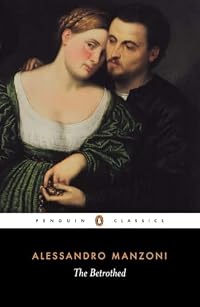
The Betrothed
by Alessandro Manzoni
On This Page
Description
After the jealous tyrant Don Rodrigo foils their wedding, young Lombardian peasants Lucia and Lorenzo must separate and flee for their safety. Their difficult path to matrimony takes place against the turbulent backdrop of the Thirty Years War, where lawlessness and exploitation are at their height. Lucia takes refuge in a convent, where she is later abducted and taken on a nightmarish journey to a sinister castle, while Lorenzo goes to Milan, where he witnesses famine, riots and plague - show more all evoked through meticulous description and with stunning immediacy. The Betrothed is a masterful example of historical fiction and remains one of the most famous novels in Italian literature. show lessTags
Recommendations





Member Recommendations
Oct326 Questo piccolo saggio parla di Giuseppe Ripamonti (storico le cui opere furono una delle fonti dei "Promessi Sposi") e di Federico Borromeo (uno, com'è noto, dei personaggi principali del romanzo). Protetto del Borromeo, il Ripamonti a un certo punto cadde misteriosamente in disgrazia e finì in carcere, e altrettanto misteriosamente fu poi riabilitato. Franzosini racconta (bene) come e perché, ed è un racconto che non può non essere interessante anche per i lettori del gran romanzo di Manzoni.
rahkan Another sumptuous historical tale, featuring scenes of wild emotion and excess
Member Reviews
NOTE: I was given early access to this manuscript in exchange for writing an impartial review. Thank you net galley.com and Modern Library. Scheduled Publication: September 13, 2022.
THE BETROTHED by Alessandro Manzoni (originally titled "I promessi sposi"), and first published in 1827, is widely regarded as the seminal and most widely read novel in Italy. (I admit I had not heard of it.) What's new is that this edition is the first NEW translation of the book in 50 years.
According to translator Michael F. Moore, from the book's forward, his multi-year effort aimed at capturing the original poetry of Manzoni's prose as well as updating the language to make this classic more accessible to modern readers. And he has skillfully show more accomplished BOTH!
For most of the book I recognized I was reading a literary masterpiece and expected to easily award it five stars. But, by the end, I couldn't. Even though I still feel it is a remarkable book.
As the title suggests, the book begins around a scheduled wedding of two simple peasants living in Lombardy in 1628, Renzo and Lucia. What follows however is 704 pages of human errors and obstacles which postpose the event. From a self-absorbed priest determined to save his own skin to a powerful member of the local nobility intent on winning a bet, no matter what the cost for others. Manzoni shows he is as adept at creating the kind of drama out of everyday life that Jane Austen is famous for.
Circumstances force the Renzo and Lucia to separate. And as Manzoni follows their stories, he takes readers off on many, MANY tangents, which, taken together, present rich portraits of universal human nature, Italian social and class structure, the Medieval dominance of religious practice, and Italy's notoriously dysfunctional governing bodies. The prose is beautiful and seasoned with lots of humor. The novel is ambitious, nuanced, and truly brilliant. And I cannot think of another historical novel which so graphically and emotionally presents the devastation of both famine and plague.
You will love the multi-dimensional characters Manzoni creates, each so distinctive and realistic that you are likely to recognize people you know. They struggle with human foibles, self-doubts, and questions about faith and God. They survive against intense odds. And like most humans, their indefatigable resilience ultimately wills out allowing them to achieve their goals. A remarkable book, for both Manzoni's (and Moore's) language and deep understanding of what makes us human.
So, why couldn't I award it the expected five stars? First of all, it took me nearly a month to read (a VERY long time for me). And, by the end, THE BETROTHED simply felt TOO LONG. The digressions became too numerous, too long -- even tedious-- when I just wanted to return to the stories of Lucia and Renzo.
I certainly recommend the book, especially for fans of historical fiction. It's a rich picture of medieval life in Italy. But understand going in, it may be a longer haul than you expect. show less
THE BETROTHED by Alessandro Manzoni (originally titled "I promessi sposi"), and first published in 1827, is widely regarded as the seminal and most widely read novel in Italy. (I admit I had not heard of it.) What's new is that this edition is the first NEW translation of the book in 50 years.
According to translator Michael F. Moore, from the book's forward, his multi-year effort aimed at capturing the original poetry of Manzoni's prose as well as updating the language to make this classic more accessible to modern readers. And he has skillfully show more accomplished BOTH!
For most of the book I recognized I was reading a literary masterpiece and expected to easily award it five stars. But, by the end, I couldn't. Even though I still feel it is a remarkable book.
As the title suggests, the book begins around a scheduled wedding of two simple peasants living in Lombardy in 1628, Renzo and Lucia. What follows however is 704 pages of human errors and obstacles which postpose the event. From a self-absorbed priest determined to save his own skin to a powerful member of the local nobility intent on winning a bet, no matter what the cost for others. Manzoni shows he is as adept at creating the kind of drama out of everyday life that Jane Austen is famous for.
Circumstances force the Renzo and Lucia to separate. And as Manzoni follows their stories, he takes readers off on many, MANY tangents, which, taken together, present rich portraits of universal human nature, Italian social and class structure, the Medieval dominance of religious practice, and Italy's notoriously dysfunctional governing bodies. The prose is beautiful and seasoned with lots of humor. The novel is ambitious, nuanced, and truly brilliant. And I cannot think of another historical novel which so graphically and emotionally presents the devastation of both famine and plague.
You will love the multi-dimensional characters Manzoni creates, each so distinctive and realistic that you are likely to recognize people you know. They struggle with human foibles, self-doubts, and questions about faith and God. They survive against intense odds. And like most humans, their indefatigable resilience ultimately wills out allowing them to achieve their goals. A remarkable book, for both Manzoni's (and Moore's) language and deep understanding of what makes us human.
So, why couldn't I award it the expected five stars? First of all, it took me nearly a month to read (a VERY long time for me). And, by the end, THE BETROTHED simply felt TOO LONG. The digressions became too numerous, too long -- even tedious-- when I just wanted to return to the stories of Lucia and Renzo.
I certainly recommend the book, especially for fans of historical fiction. It's a rich picture of medieval life in Italy. But understand going in, it may be a longer haul than you expect. show less
The Betrothed – the great 19th c. Italian historical novel – is a thoroughly entertaining and wonderfully detailed story. The main plot follows two young lovers, Lucia and Renzo, who are prevented from marrying by the despotic local nobleman, Don Rodrigo. However, the genius of the piece is in Manzoni’s lovingly described and lengthy portraits of the side characters, his epic depictions of historical events in the 1620’s and the nicely done background setting of an unjust society. The omniscient narrator presents the story as his modernization of a true tale and this gives rise to some comic bits – like the opening forward, which starts out old-fashioned, pompous and flowery before the narrator cuts it off and says he’ll show more tell the story in straightforward language. Sometimes the descriptions of political wrangling gets a little dense (and I wished my copy, by Penguin, had more notes) but overall this is a fantastic read.
Lucia and Renzo are simple peasants, happily engaged and living in a small village near the town of Lecco. Renzo has a promising job, Lucia’s mother likes him – everything seems fine until the parish priest, Don Abbondio, is threatened to prevent him from marrying them. Renzo and Lucia stay pretty much the same throughout the book and are simple characters – Lucia is often found crying, fainting and praying and Renzo is frequently hot-headed and naïve. The other characters are more interesting however – one being Don Abbondio. He’s a coward who is mostly concerned with his own self-preservation. In a book full of conversions, with many portraits of benevolent religious figures, he remains a rather unsympathetic one. However, Manzoni spends many pages describing his inner conflicts and fears, with some occasional guilt and shame. He also sets Don Abbondio’s self-interest against the customs of the day, where the rich and powerful could get their way and could punish those who opposed them with impunity. Others counsel death before a failure of duty or courage but Don Abbondio is all-too-human in his fear. I enjoyed reading about him, despite his extreme cowardice and his being a major impediment to the couple’s happiness.
Don Rodrigo seems like he would be a stock evil aristocrat but Manzoni uses his character to explore the oppressive laws and customs of the time. Near the beginning of the book, he notes that the edicts, which were meant to curb extrajudicial violence, only ended up oppressing the poor. The laws never applied to powerful noblemen or the violent bravoes that they would hire to get their way. An example of this occurs when Renzo goes to a lawyer with his complaint that Don Rodrigo blocked his marriage to Lucia. The lawyer, thinking Renzo was the one who broke the law, is sympathetic at first but when he learns that Renzo is speaking of Don Rodrigo, the lawyer kicks him out and refuses to listen to him. Don Rodrigo avidly pursues Lucia but not out of love or lust – he barely even thinks of her as an object. Instead, he’s afraid to lose face in front of his peers by not getting what he wants (he has a bet with his cousin over Lucia) and also has an “eh, why not?” attitude when sending his posse out to harass her. His somewhat uninvolved attitude and the ease with which he ruins Lucia and Renzo’s lives illustrate the plight of the poor. Even when powerful but good people help them, it is still an example of the dependence of the lower classes.
The other characters who Renzo and Lucia meet are interesting as well – the formerly fiery, now repentant Father Cristoforo; the bitter and ambivalent nun Gertrude; the aristocratic criminal who is so powerful and feared that he’s called the Unnamed in the book; the saintly archbishop Federigo Borromeo. The last three are based on actual historical characters and their backstories are involving. They all play a role in Renzo and Lucia’s case but also are actors in the historical events that intrude. Renzo gets involved in the bread riots in Milan and Manzoni has descriptions of the famine that hit the city soon after. Their village also suffers from the passing German army and finally, the plague that decimated Milan and the surrounding countryside affects many of the characters and the outcome of the book. Highly recommended. show less
Lucia and Renzo are simple peasants, happily engaged and living in a small village near the town of Lecco. Renzo has a promising job, Lucia’s mother likes him – everything seems fine until the parish priest, Don Abbondio, is threatened to prevent him from marrying them. Renzo and Lucia stay pretty much the same throughout the book and are simple characters – Lucia is often found crying, fainting and praying and Renzo is frequently hot-headed and naïve. The other characters are more interesting however – one being Don Abbondio. He’s a coward who is mostly concerned with his own self-preservation. In a book full of conversions, with many portraits of benevolent religious figures, he remains a rather unsympathetic one. However, Manzoni spends many pages describing his inner conflicts and fears, with some occasional guilt and shame. He also sets Don Abbondio’s self-interest against the customs of the day, where the rich and powerful could get their way and could punish those who opposed them with impunity. Others counsel death before a failure of duty or courage but Don Abbondio is all-too-human in his fear. I enjoyed reading about him, despite his extreme cowardice and his being a major impediment to the couple’s happiness.
Don Rodrigo seems like he would be a stock evil aristocrat but Manzoni uses his character to explore the oppressive laws and customs of the time. Near the beginning of the book, he notes that the edicts, which were meant to curb extrajudicial violence, only ended up oppressing the poor. The laws never applied to powerful noblemen or the violent bravoes that they would hire to get their way. An example of this occurs when Renzo goes to a lawyer with his complaint that Don Rodrigo blocked his marriage to Lucia. The lawyer, thinking Renzo was the one who broke the law, is sympathetic at first but when he learns that Renzo is speaking of Don Rodrigo, the lawyer kicks him out and refuses to listen to him. Don Rodrigo avidly pursues Lucia but not out of love or lust – he barely even thinks of her as an object. Instead, he’s afraid to lose face in front of his peers by not getting what he wants (he has a bet with his cousin over Lucia) and also has an “eh, why not?” attitude when sending his posse out to harass her. His somewhat uninvolved attitude and the ease with which he ruins Lucia and Renzo’s lives illustrate the plight of the poor. Even when powerful but good people help them, it is still an example of the dependence of the lower classes.
The other characters who Renzo and Lucia meet are interesting as well – the formerly fiery, now repentant Father Cristoforo; the bitter and ambivalent nun Gertrude; the aristocratic criminal who is so powerful and feared that he’s called the Unnamed in the book; the saintly archbishop Federigo Borromeo. The last three are based on actual historical characters and their backstories are involving. They all play a role in Renzo and Lucia’s case but also are actors in the historical events that intrude. Renzo gets involved in the bread riots in Milan and Manzoni has descriptions of the famine that hit the city soon after. Their village also suffers from the passing German army and finally, the plague that decimated Milan and the surrounding countryside affects many of the characters and the outcome of the book. Highly recommended. show less
What a book! On the first level simply a long, somewhat rambling historical novel about Milan and its surroundings in the seventeenth century, written two hundred years later, the book — virtually Manzoni’s only extended prose work — admirably integrates historical scholarship, personal observation of character and place, and political philosophy.
The “promised spouses” (the Italian formula for “affianced”) of the title, Renzo and Lucia, are peasants living in a village on Lake Como, near Lecco. Their marriage is prevented by one of the local nobles who has his own designs on Lucia. After a failed attempt to circumvent that, the couple separate: Renzo goes to Milan, is caught up in bread riots resulting from poverty and show more drought, and escapes to his cousin in Bergamo; Lucia takes refuge in a convent, is abducted…
But enough of plot: I do hope you’ll read the novel, and part of its interest of course is in the suspense. Only a small part, though: those reading the book as a romantic historical novel about a pair of lovers may lose patience with what I think is its true subject-matter, and its intricate interest and importance.
Manzoni begins with a foreword it would be wrong to skip, opening in flowery archaic language purportedly quoting an ancient author:
History may truly be defined as a famous War against Time; for she doth take from him the Years that he had made Prisoner, or rather utterly slain, and doth call them back into Life, and pass them in Review, and set them again in Order of Battle.
After a page of this sort of stuff, set in italics, the author lays down his ancient text and speaks for himself, noting that History too often loses sight of the ordinary men and women who lived through the eras historians deign to consider. He notes, too, the turgid style of the original, alternating between lofty rhetoric and crude dialect. He gives up reading the thing, but quickly thinks
“Why not take the sequence of fact contained in this manuscript,” I thought, “and merely alter the language?” There were no logical objections to this idea, and I decided to follow it. And that is the origin of this present work, explained with a simplicity to match the importance of the book itself.
So immediately Manzoni’s book takes up a number of contexts:
• it was written in 1820-1825 about events of 1620-1630, nearly two centuries earlier (and I read it in 2013, nearly two centuries later)
• It attempts to re-introduce the common man into a context generally restricted to elevated historical figures
it attends to appropriate language and style
And underneath these evident and acknowledged contexts there is another agenda, not particularly well hidden. The book’s action takes place in a politically eventful moment, when Milan and its duchy are controlled by Spain; Bergamo is part of the Venetian Republic; Austria is threatening from the north and northeast; and France has designs on Monferrato in neighboring Piemonte. Furthermore, the action involves the closing years of the long wars between Catholics and Protestants. And, most importantly, the close of the feudal era when lawlessness and exploitation was an accepted aspect of daily life, and the poor but generally honest and respectable contadini and villager was at the mercy of the rich, powerful “nobleman” in his castle on the hill, and his band of thugs and stooges — the “bravos” who do his dirty work.
I was drawn into the book first by Manzoni’s marvelous description of its physical setting, the mountains and riverbanks to the south and east of Lecco, country not that different from terrain I’ve spent weeks walking in, fifty or a hundred miles to the west., A poor man, Renzo walks when he must go from Lecco to Milan, from Milan to Bergamo. The parish priest rides a mule; ladies are carried in litters; noblemen ride coaches. In every case the tempo is quite different from ours in the 21st century, and climate, physical nature, and observation of the faces and characters of those one meets are taken more slowly, more contemplatively, and therefore more objectively, at a pace giving time to correct immediate impression, prejudice, and habit.
The book should be read at a similar pace, I think; and should be considered while reading and afterward, letting the book bloom in the mind, responding to our time and its own, as a good wine is allowed to bloom in the glass and the mouth, and afterward in sensual memory.
The characters in the novel are memorable and attractive, even the villains — stock characters, all of them (young lovers, parish priest and his housekeeper, Cardinal, ruffians, evil nobles), but individuated through description and dialogue. The settings are evoked sometimes through meticulous description, sometimes arresting observation — the Milan cathedral, for example, seen from miles away, at a time when the city was still contained within its walls.
The historical events are exciting and resonant: war, famine, plague, all recounted with both mesmerizing immediacy and resonance that inescapably suggests World War II, the Balkan wars, today’s events in Africa and the Middle East.
And then there’s the language. Manzoni published the novel in 1827, but within a dozen years revised it out of its original dialect of Italian into the Tuscan dialect centered on Florence — thereby cementing that dialect as standard contemporary Italian. The revision seems to involve mostly simply substitutions of vocabulary, with a few additions or clarifications of text, and virtually no cutting.
I haven't yet found what exactly the dialect of the original version is called: it's not Piemontino, though it shares with that dialect certain leanings toward French. "Equal," for example, is eguale in the first version, uguale in the revision. I know this because I found a fascinating edition of the novel online (http://https://archive.org/stream/ipromessisposi00manzuoft#page/n51/mode/2up), a facsimile (not e-text or digitized text) of an edition (Milano: Domenico Briola, 1888) of the revised version, with the original text inserted in smaller size between the lines.
Years ago I bought a fine copy of an old edition of I Promessi sposi, and it turns out to have an interesting history of its own. It was published at Firenze in 1845 by Felice Le Monnier (http://http://it.wikipedia.org/wiki/Felice_Le_Monnier), who based the text on the 1832 edition by David Passigli e soc.. Le Monnier was noted for his contempt for author's rights, and merely pirated the Passigli edition, heedless of Manzoni's subsequent revision into the definitive text. Manzoni sued and was eventually awarded a substantial award. I don't know how large the 1845 edition was, or how the copy I have came to whatever used-book store I bought it in — though a recent New Yorker article on such matters does give me some pause.
I read Penman's translation with both the Le Monnier and the interlinear edition at hand, comparing often enough to get the distinct impression that this is a fine translation, idiomatic in English, respectful to the original style, and faithful to the text.
Some have characterized the book as a romantic epic, along the lines of Tolstoy's War and Peace — a book I'm embarrassed to say I haven't (yet) read. It would be wrong, though, and perhaps disappointing, to think of it as primarily a narrative about the betrothed Renzo and Lucia: instead, it is — as another reader suggested the other day — an epic, a narrative description of the general state of the soul of a nation. I'm hard pressed to think of another prose example, and I wonder if Manzoni weren't channelling such older epics as Aeneid or Chanson de Roland or Orlando furioso. Whatever, I Promessi sposi is essentially Italian; it speaks from an honest and good heart; it is ample, intelligent, poetic, philosophical, evocative, and revolutionary, and I consider it one of the greatest novels I have ever read. show less
The “promised spouses” (the Italian formula for “affianced”) of the title, Renzo and Lucia, are peasants living in a village on Lake Como, near Lecco. Their marriage is prevented by one of the local nobles who has his own designs on Lucia. After a failed attempt to circumvent that, the couple separate: Renzo goes to Milan, is caught up in bread riots resulting from poverty and show more drought, and escapes to his cousin in Bergamo; Lucia takes refuge in a convent, is abducted…
But enough of plot: I do hope you’ll read the novel, and part of its interest of course is in the suspense. Only a small part, though: those reading the book as a romantic historical novel about a pair of lovers may lose patience with what I think is its true subject-matter, and its intricate interest and importance.
Manzoni begins with a foreword it would be wrong to skip, opening in flowery archaic language purportedly quoting an ancient author:
History may truly be defined as a famous War against Time; for she doth take from him the Years that he had made Prisoner, or rather utterly slain, and doth call them back into Life, and pass them in Review, and set them again in Order of Battle.
After a page of this sort of stuff, set in italics, the author lays down his ancient text and speaks for himself, noting that History too often loses sight of the ordinary men and women who lived through the eras historians deign to consider. He notes, too, the turgid style of the original, alternating between lofty rhetoric and crude dialect. He gives up reading the thing, but quickly thinks
“Why not take the sequence of fact contained in this manuscript,” I thought, “and merely alter the language?” There were no logical objections to this idea, and I decided to follow it. And that is the origin of this present work, explained with a simplicity to match the importance of the book itself.
So immediately Manzoni’s book takes up a number of contexts:
• it was written in 1820-1825 about events of 1620-1630, nearly two centuries earlier (and I read it in 2013, nearly two centuries later)
• It attempts to re-introduce the common man into a context generally restricted to elevated historical figures
it attends to appropriate language and style
And underneath these evident and acknowledged contexts there is another agenda, not particularly well hidden. The book’s action takes place in a politically eventful moment, when Milan and its duchy are controlled by Spain; Bergamo is part of the Venetian Republic; Austria is threatening from the north and northeast; and France has designs on Monferrato in neighboring Piemonte. Furthermore, the action involves the closing years of the long wars between Catholics and Protestants. And, most importantly, the close of the feudal era when lawlessness and exploitation was an accepted aspect of daily life, and the poor but generally honest and respectable contadini and villager was at the mercy of the rich, powerful “nobleman” in his castle on the hill, and his band of thugs and stooges — the “bravos” who do his dirty work.
I was drawn into the book first by Manzoni’s marvelous description of its physical setting, the mountains and riverbanks to the south and east of Lecco, country not that different from terrain I’ve spent weeks walking in, fifty or a hundred miles to the west., A poor man, Renzo walks when he must go from Lecco to Milan, from Milan to Bergamo. The parish priest rides a mule; ladies are carried in litters; noblemen ride coaches. In every case the tempo is quite different from ours in the 21st century, and climate, physical nature, and observation of the faces and characters of those one meets are taken more slowly, more contemplatively, and therefore more objectively, at a pace giving time to correct immediate impression, prejudice, and habit.
The book should be read at a similar pace, I think; and should be considered while reading and afterward, letting the book bloom in the mind, responding to our time and its own, as a good wine is allowed to bloom in the glass and the mouth, and afterward in sensual memory.
The characters in the novel are memorable and attractive, even the villains — stock characters, all of them (young lovers, parish priest and his housekeeper, Cardinal, ruffians, evil nobles), but individuated through description and dialogue. The settings are evoked sometimes through meticulous description, sometimes arresting observation — the Milan cathedral, for example, seen from miles away, at a time when the city was still contained within its walls.
The historical events are exciting and resonant: war, famine, plague, all recounted with both mesmerizing immediacy and resonance that inescapably suggests World War II, the Balkan wars, today’s events in Africa and the Middle East.
And then there’s the language. Manzoni published the novel in 1827, but within a dozen years revised it out of its original dialect of Italian into the Tuscan dialect centered on Florence — thereby cementing that dialect as standard contemporary Italian. The revision seems to involve mostly simply substitutions of vocabulary, with a few additions or clarifications of text, and virtually no cutting.
I haven't yet found what exactly the dialect of the original version is called: it's not Piemontino, though it shares with that dialect certain leanings toward French. "Equal," for example, is eguale in the first version, uguale in the revision. I know this because I found a fascinating edition of the novel online (http://https://archive.org/stream/ipromessisposi00manzuoft#page/n51/mode/2up), a facsimile (not e-text or digitized text) of an edition (Milano: Domenico Briola, 1888) of the revised version, with the original text inserted in smaller size between the lines.
Years ago I bought a fine copy of an old edition of I Promessi sposi, and it turns out to have an interesting history of its own. It was published at Firenze in 1845 by Felice Le Monnier (http://http://it.wikipedia.org/wiki/Felice_Le_Monnier), who based the text on the 1832 edition by David Passigli e soc.. Le Monnier was noted for his contempt for author's rights, and merely pirated the Passigli edition, heedless of Manzoni's subsequent revision into the definitive text. Manzoni sued and was eventually awarded a substantial award. I don't know how large the 1845 edition was, or how the copy I have came to whatever used-book store I bought it in — though a recent New Yorker article on such matters does give me some pause.
I read Penman's translation with both the Le Monnier and the interlinear edition at hand, comparing often enough to get the distinct impression that this is a fine translation, idiomatic in English, respectful to the original style, and faithful to the text.
Some have characterized the book as a romantic epic, along the lines of Tolstoy's War and Peace — a book I'm embarrassed to say I haven't (yet) read. It would be wrong, though, and perhaps disappointing, to think of it as primarily a narrative about the betrothed Renzo and Lucia: instead, it is — as another reader suggested the other day — an epic, a narrative description of the general state of the soul of a nation. I'm hard pressed to think of another prose example, and I wonder if Manzoni weren't channelling such older epics as Aeneid or Chanson de Roland or Orlando furioso. Whatever, I Promessi sposi is essentially Italian; it speaks from an honest and good heart; it is ample, intelligent, poetic, philosophical, evocative, and revolutionary, and I consider it one of the greatest novels I have ever read. show less
I read this because in an interview Frank M. Snowden, a professor emeritus of history and the history of medicine at Yale, called it "the great plague novel." What Snowden didn't say is that the plague doesn't even get mentioned for more than 500 pages and doesn't really make an appearance until at least 100 more!
The plot is trite, the characters simplistic, and the ending preposterous, but Manzoni was much more interesting as a historian than novelist - the chapters about the forms that power took in 17th-century Italy, about the bread riots, and yes, the plague in particular, are fascinating and make the 720-page trudge worthwhile.
The plot is trite, the characters simplistic, and the ending preposterous, but Manzoni was much more interesting as a historian than novelist - the chapters about the forms that power took in 17th-century Italy, about the bread riots, and yes, the plague in particular, are fascinating and make the 720-page trudge worthwhile.
Strange to say, although in times of immediate danger, in face of an enemy, the image of death always breathed new spirit into him and filled him with angry courage, the same image appearing to him in the silence of the night, in the safety of his own castle, afflicted him with sudden dismay. For this time it was not death at the hands of a mortal like himself that threatened him; not a death that could be driven off by better weapons or a quicker hand. It was a death that came all alone, from within; it might still be far away, but every moment brought it a stride nearer.
-- The Betrothed, page 370
I've just finished my first Classics Club challenge book, Alessandro Manzoni's The Betrothed. The Betrothed is an Italian classic, a Catholic show more classic, and one of the world's most influential historical novels. First published in 1827, it was well worth the read.
I wrote a little about the background and plot of the novel in an earlier post, so I won't repeat myself here, but as a reminder, The Betrothed is the story of Lucia and Renzo, a young couple living in seventeenth century Italy who simply want to get married. Unfortunately, the Spanish occupation has brought the evil Don Rodrigo into the picture, and his desire for Lucia interferes with their plans in a most tragic way. Though this conflict forms the core of the plot, there are several other side stories and characters that are equally as interesting, and that lift the story from a mere romance to, as Daniel Burt calls it, "a panoramic depiction of an entire culture and its values."
For me, and I suspect for many, the most memorable part of the novel is Manzoni's vivid description of the Milan plague of 1630. Manzoni's meticulous research and his attention to detail serve him well as he describes the effect of the plague on the citizens of Milan.
But I also was moved by two key conversations in the novel, both of which involve the historical figure of Cardinal Federigo Borromeo, younger cousin of St. Charles Borromeo. Federigo was the Archbishop of Milan beginning in 1595, and Manzoni does a masterful job of portraying his faith and wisdom, especially when he meets with those who struggle with living out their faith. Like the Bishop of Digne in Les Misérables, Borromeo is a model of what an archbishop should be. Pope Francis challenges all priests "to be shepherds with the smell of sheep," and Archbishop Federigo Borromeo illustrates that vividly, especially when contrasted with the weak priest Don Abbondio.
The other character I was most fascinated by was the man known only as "The Unnamed." In fact, it was after his introduction into the story that I really began to appreciate Manzoni's writing. The complexity of his character, his impact on the plot, and the inner workings of his mind and soul drew me even further into the story.
The Betrothed is a true classic of Catholic literature, displaying faith as the integral part of human life that it is. However, this is no sugar-coated treatment of Christian life. Not all clergy and religious are virtuous in The Betrothed, and characters struggle with courage, doubt, nihilism, and forgiveness.
All in all, I highly recommend The Betrothed, especially for those who like historical fiction. It would also make a good read for a book group, with lots to talk about. If you do decide to read it, you may find The Betrothed Map helpful. show less
The Betrothed is an Italian classic written in the 1820s that tells the story of two lovers in the 1600s as they try to get married and run into repeated obstacles. Renzo and Lucia are planning to get married, but on the day of their wedding the priest refuses to marry them. He's been threatened by the wealthy land owner in the region, Don Rodrigo, into not marrying them because Don Rodrigo is enamored with Lucia and wants her for himself. Lucia and Renzo try several different ways to get around this. They end up separated, there are kidnappings, misunderstandings, adventures, and plague.
The book is extremely plot heavy and I got a little bored, despite the adventure. I enjoyed quite a bit of it, but in a 700 page book, I prefer a show more little more character development, societal themes, etc., and less of a balance towards plot and adventure.
Glad I read this classic, but is not destined to become one of my favorites. show less
The book is extremely plot heavy and I got a little bored, despite the adventure. I enjoyed quite a bit of it, but in a 700 page book, I prefer a show more little more character development, societal themes, etc., and less of a balance towards plot and adventure.
Glad I read this classic, but is not destined to become one of my favorites. show less
NOTE: I was given early access to this manuscript in exchange for writing an impartial review. Thank you net galley.com and Modern Library. Scheduled Publication: September 13, 2022.
THE BETROTHED by Alessandro Manzoni (originally titled "I promessi sposi"), and first published in 1827, is widely regarded as the seminal and most widely read novel in Italy. (I admit I had not heard of it.) What's new is that this edition is the first NEW translation of the book in 50 years.
According to translator Michael F. Moore, from the book's forward, his multi-year effort aimed at capturing the original poetry of Manzoni's prose as well as updating the language to make this classic more accessible to modern readers. And he has skillfully show more accomplished BOTH!
For most of the book I recognized I was reading a literary masterpiece and expected to easily award it five stars. But, by the end, I couldn't. Even though I still feel it is a remarkable book.
As the title suggests, the book begins around a scheduled wedding of two simple peasants living in Lombardy in 1628, Renzo and Lucia. What follows however is 704 pages of human errors and obstacles which postpose the event. From a self-absorbed priest determined to save his own skin to a powerful member of the local nobility intent on winning a bet, no matter what the cost for others. Manzoni shows he is as adept at creating the kind of drama out of everyday life that Jane Austen is famous for.
Circumstances force the Renzo and Lucia to separate. And as Manzoni follows their stories, he takes readers off on many, MANY tangents, which, taken together, present rich portraits of universal human nature, Italian social and class structure, the Medieval dominance of religious practice, and Italy's notoriously dysfunctional governing bodies. The prose is beautiful and seasoned with lots of humor. The novel is ambitious, nuanced, and truly brilliant. And I cannot think of another historical novel which so graphically and emotionally presents the devastation of both famine and plague.
You will love the multi-dimensional characters Manzoni creates, each so distinctive and realistic that you are likely to recognize people you know. They struggle with human foibles, self-doubts, and questions about faith and God. They survive against intense odds. And like most humans, their indefatigable resilience ultimately wills out allowing them to achieve their goals. A remarkable book, for both Manzoni's (and Moore's) language and deep understanding of what makes us human.
So, why couldn't I award it the expected five stars? First of all, it took me nearly a month to read (a VERY long time for me). And, by the end, THE BETROTHED simply felt TOO LONG. The digressions became too numerous, too long -- even tedious-- when I just wanted to return to the stories of Lucia and Renzo.
I certainly recommend the book, especially for fans of historical fiction. It's a rich picture of medieval life in Italy. But understand going in, it may be a longer haul than you expect. show less
THE BETROTHED by Alessandro Manzoni (originally titled "I promessi sposi"), and first published in 1827, is widely regarded as the seminal and most widely read novel in Italy. (I admit I had not heard of it.) What's new is that this edition is the first NEW translation of the book in 50 years.
According to translator Michael F. Moore, from the book's forward, his multi-year effort aimed at capturing the original poetry of Manzoni's prose as well as updating the language to make this classic more accessible to modern readers. And he has skillfully show more accomplished BOTH!
For most of the book I recognized I was reading a literary masterpiece and expected to easily award it five stars. But, by the end, I couldn't. Even though I still feel it is a remarkable book.
As the title suggests, the book begins around a scheduled wedding of two simple peasants living in Lombardy in 1628, Renzo and Lucia. What follows however is 704 pages of human errors and obstacles which postpose the event. From a self-absorbed priest determined to save his own skin to a powerful member of the local nobility intent on winning a bet, no matter what the cost for others. Manzoni shows he is as adept at creating the kind of drama out of everyday life that Jane Austen is famous for.
Circumstances force the Renzo and Lucia to separate. And as Manzoni follows their stories, he takes readers off on many, MANY tangents, which, taken together, present rich portraits of universal human nature, Italian social and class structure, the Medieval dominance of religious practice, and Italy's notoriously dysfunctional governing bodies. The prose is beautiful and seasoned with lots of humor. The novel is ambitious, nuanced, and truly brilliant. And I cannot think of another historical novel which so graphically and emotionally presents the devastation of both famine and plague.
You will love the multi-dimensional characters Manzoni creates, each so distinctive and realistic that you are likely to recognize people you know. They struggle with human foibles, self-doubts, and questions about faith and God. They survive against intense odds. And like most humans, their indefatigable resilience ultimately wills out allowing them to achieve their goals. A remarkable book, for both Manzoni's (and Moore's) language and deep understanding of what makes us human.
So, why couldn't I award it the expected five stars? First of all, it took me nearly a month to read (a VERY long time for me). And, by the end, THE BETROTHED simply felt TOO LONG. The digressions became too numerous, too long -- even tedious-- when I just wanted to return to the stories of Lucia and Renzo.
I certainly recommend the book, especially for fans of historical fiction. It's a rich picture of medieval life in Italy. But understand going in, it may be a longer haul than you expect. show less
Members
- Recently Added By
Published Reviews
Anyone who planned to compile a plague anthology during the Covid pandemic must have turned to Alessandro Manzoni’s masterly historical novel I promessi sposi (literally “The betrothed couple”), written between 1821 and 1842, in which five chapters recreate the experience of bubonic plague in Milan in 1630. Manzoni conjures up the bumbling bureaucracy (the authorities broke their own show more rules), the claustrophobia, the silence, the little bell of the monatti (corpse carriers), the fear and hysteria, the stench, the looting, the teeming lazzaretto (isolation hospital), the humbling of the mighty and the rampant urban myths. The whole work – Manzoni’s only novel – is informed by deep historical research and a dedication to reality and truth.
Appearing a century after Defoe’s A Journal of the Plague Year, and today revered as the greatest Italian novel, this was one of Italy’s first: in previous centuries long narratives had normally been in verse. Writing in the 1955 preface to his classic translation (of 1951), Archibald Colquhoun asserted that “for Italy it is all Scott, Dickens, and Thackeray rolled into one volume; though … its spirit is perhaps nearer Tolstoy”. As to its reception, “it has gone into over 500 editions, and been translated into every modern language, including Chinese; two operas, three films, a ballet, and at least seven plays have been based on it” (a tally long since exceeded); moreover, it was “quoted by Cavour in the Turin Parliament”, and nowadays remains familiar at all levels of Italian society.
Alessandro Manzoni (1785–1873), a member of the Milanese landed gentry, began his literary career as a poet; his corpus includes two historical tragedies and philosophical, religious, social, linguistic and literary essays. Lombardy, with its capital Milan, was part of the Austrian empire, but from 1805 to 1810 the young writer lived in Paris, where a religious crisis led to his conversion to Catholicism; there too he encountered Romanticism, never prominent in Italian culture, though Manzoni became its leading representative. The historical novels of Walter Scott were sweeping through the salons of France, Germany and Russia, and Manzoni’s admiration for Scott is usually seen as crucial to the conception of I promessi sposi. It also buttressed his sympathies in the pivotal culture war that exploded in 1816 in Milan (then the heart of progressive politico-literary thinking), pitting the new Romanticism against the Enlightenment and the old classicizing world. This inflammatory journalism was suppressed by the Austrian authorities.
Inspired by Goethe’s The Sorrows of Young Werther (1774), the poet Ugo Foscolo had already written his epistolary novelUltime lettere di Jacopo Ortis (Last letters of Jacopo Ortis, Milan, 1802), as an expression of Italian nationalism and protest, while Silvio Pellico, in 1816 a noted figure in Milan’s great polemic, would publish his memoir of political imprisonment, Le mie prigioni (My prisons), in 1832. These exemplify the beginnings of Risorgimento literature, the writings that stimulated the growing movement for Italian independence and unification. I promessi sposi, a literary monument for all time and any place, also promoted Risorgimento thought and emotion. With its political, moral and religious commitment, the novel is almost an allegory. Manzoni’s choice of the Duchy of Milan in the early seventeenth century went beyond the emulation of Scott: the overlords then governing that territory had been Spanish, not Austrian, but their incompetence, venality and brutality prefigured aspects of nineteenth-century experience. The novel was a coded commentary for Manzoni’s own times, but, despite the censorship, he could describe the iniquities of Spanish colonial rule with relative impunity.
Life in the late 1620s was conditioned by the Counter-Reformation and the Thirty Years War: times of famine, riots and pandemic. Manzoni’s research prompted the use of a device already employed by Cervantes and Scott: he claimed to have discovered a seventeenth-century manuscript, and “quotes” its archaic language in the novel’s text, where the author is ever-present as the interpreter of his sources. His young protagonists, Renzo and Lucia, embody an influential literary innovation. Of peasant stock, they are silk weavers from Lake Como: not of elite status, they signal the beginnings of modern realism and a new vision of society in which the lives of the poor are valued. The novel is peopled by characters, both secular and religious, in all sectors of a society harshly divided between the ruling, feudal Spanish nobility and the humble Lombard population, with – in between – those burghers and lawyers who accommodated their lives to colonial servility. All shades of morality are evidenced also in the religious figures who help or hinder the young couple in their extremity.
Manzoni created some of the most memorable characters in Italian literature. Almost unwaveringly good and sensible, Lucia (from lux, light) is mature beyond her years and secure in her faith in Providence (a recurring theme), whereas fallible Renzo’s good heart is often betrayed by his volatile emotions: this is his Bildungsroman. In a situation analogous to that of Zerlina and Masetto in Mozart’s opera Don Giovanni (1787), their marriage is impeded by the local overlord, Don Rodrigo; they flee their native territory and encounter adventures, perils and separation. Their parish priest, Don Abbondio, is known in Italy as the proverbial symbol of comic cowardice. Gertrude, the nun of Monza, based on a historical figure, personifies cruel maleficence – and yet her sins are explained psychoanalytically, avanti lettera, by her own sufferings at the hands of her aristocrat father: the seeds of a feminist argument are couched in her hellish life. Intense fear is associated with the tyrant known only as L’Innominato (the Unnamed or Nameless One): the aura of threat evaporates only after his religious conversion and the climactic release of Lucia from his castle. Despite a guilty past, the Capuchin friar, Cristoforo, is the true Christian, a self-sacrificing humanitarian. One might describe The Betrothed as a tragedy with a happy ending, but from the first page its gravity is alleviated by Manzoni’s witty irony, a sharp weapon in the implied social critique: the town of Lecco had the “benefit” of a garrison of Spanish soldiers, who “never failed to spread out into the vineyards, to thin the grapes and relieve the peasants of the trouble of harvesting them” (Michael F. Moore’s translation).
The novel had two early versions, in 1821–3 and 1825–7, before the definitive edition of 1840–2. Originally Manzoni’s style was inflected by his Lombard roots, but in 1827 he visited the literary circles of Florence (since Dante’s day the cultural capital of a notional Italy), expressly to study Florentine parlance; so began the famous process of “rinsing his rags” (the novel) in the waters of the River Arno (“nelle cui acque risciacquai i miei cenci”). Manzoni aimed to unify the Italian language, and indeed the Tuscanized text exerted a transformative influence on the development of modern literary Italian.
Moore’s fluent, accessible and sometimes lyrical translation (the first for many years) has numerous felicities. He used the Italian text edited in 2003 by the distinguished scholar Enrico Ghidetti, and Moore’s interesting introduction describes his painstaking method; yet in dialogue he occasionally strays too far into colloquial modernization: “this marriage ain’t gonna happen” smacks of Hollywood, and “buddies” won’t do for a Spanish noble’s cronies in 1630. Elsewhere, “divvy up” is too slangy for “divider le spoglie” (“to share the spoils”), while “his uncle, the Count” should replace “the Count Uncle” and “vinaigrette” is the technical term for “ampolla d’aceto”. This handsome volume, with its useful map and bibliography, its explanatory list of characters and historiography, is marred by some misprints and oddities – “States of the Church” instead of “Papal States”, “Adelchis” for “Adelchi” – and an endnote, not mindful of Dante, Petrarch and Boccaccio, strangely declares that Manzoni “is Italy’s most celebrated writer”.
In his later years Manzoni received many honours, including a senatorship from the king of the now united nation. Verdi’s “Requiem” was composed as a profound tribute after the author’s death on May 22, 1873, and Verdi himself conducted the first performance in Milan on the first anniversary. This year Italy will be marking the 150th anniversary of Manzoni’s death in innumerable ways, both scholarly and popular. Plays about Renzo and Lucia will be performed at Lake Como’s primary schools. The writer Pierfranco Bruni will lead celebrations sponsored by parliament. Under the aegis of the Centro Nazionale di Studi Manzoniani, in a project planned by the eminent scholar Dante Isella, a trilogy of critical editions of the novel’s different versions has just been completed. Many other editions and studies will follow, while in Milan’s Duomo the public will enjoy a series of readings from the national masterpiece. show less
Appearing a century after Defoe’s A Journal of the Plague Year, and today revered as the greatest Italian novel, this was one of Italy’s first: in previous centuries long narratives had normally been in verse. Writing in the 1955 preface to his classic translation (of 1951), Archibald Colquhoun asserted that “for Italy it is all Scott, Dickens, and Thackeray rolled into one volume; though … its spirit is perhaps nearer Tolstoy”. As to its reception, “it has gone into over 500 editions, and been translated into every modern language, including Chinese; two operas, three films, a ballet, and at least seven plays have been based on it” (a tally long since exceeded); moreover, it was “quoted by Cavour in the Turin Parliament”, and nowadays remains familiar at all levels of Italian society.
Alessandro Manzoni (1785–1873), a member of the Milanese landed gentry, began his literary career as a poet; his corpus includes two historical tragedies and philosophical, religious, social, linguistic and literary essays. Lombardy, with its capital Milan, was part of the Austrian empire, but from 1805 to 1810 the young writer lived in Paris, where a religious crisis led to his conversion to Catholicism; there too he encountered Romanticism, never prominent in Italian culture, though Manzoni became its leading representative. The historical novels of Walter Scott were sweeping through the salons of France, Germany and Russia, and Manzoni’s admiration for Scott is usually seen as crucial to the conception of I promessi sposi. It also buttressed his sympathies in the pivotal culture war that exploded in 1816 in Milan (then the heart of progressive politico-literary thinking), pitting the new Romanticism against the Enlightenment and the old classicizing world. This inflammatory journalism was suppressed by the Austrian authorities.
Inspired by Goethe’s The Sorrows of Young Werther (1774), the poet Ugo Foscolo had already written his epistolary novelUltime lettere di Jacopo Ortis (Last letters of Jacopo Ortis, Milan, 1802), as an expression of Italian nationalism and protest, while Silvio Pellico, in 1816 a noted figure in Milan’s great polemic, would publish his memoir of political imprisonment, Le mie prigioni (My prisons), in 1832. These exemplify the beginnings of Risorgimento literature, the writings that stimulated the growing movement for Italian independence and unification. I promessi sposi, a literary monument for all time and any place, also promoted Risorgimento thought and emotion. With its political, moral and religious commitment, the novel is almost an allegory. Manzoni’s choice of the Duchy of Milan in the early seventeenth century went beyond the emulation of Scott: the overlords then governing that territory had been Spanish, not Austrian, but their incompetence, venality and brutality prefigured aspects of nineteenth-century experience. The novel was a coded commentary for Manzoni’s own times, but, despite the censorship, he could describe the iniquities of Spanish colonial rule with relative impunity.
Life in the late 1620s was conditioned by the Counter-Reformation and the Thirty Years War: times of famine, riots and pandemic. Manzoni’s research prompted the use of a device already employed by Cervantes and Scott: he claimed to have discovered a seventeenth-century manuscript, and “quotes” its archaic language in the novel’s text, where the author is ever-present as the interpreter of his sources. His young protagonists, Renzo and Lucia, embody an influential literary innovation. Of peasant stock, they are silk weavers from Lake Como: not of elite status, they signal the beginnings of modern realism and a new vision of society in which the lives of the poor are valued. The novel is peopled by characters, both secular and religious, in all sectors of a society harshly divided between the ruling, feudal Spanish nobility and the humble Lombard population, with – in between – those burghers and lawyers who accommodated their lives to colonial servility. All shades of morality are evidenced also in the religious figures who help or hinder the young couple in their extremity.
Manzoni created some of the most memorable characters in Italian literature. Almost unwaveringly good and sensible, Lucia (from lux, light) is mature beyond her years and secure in her faith in Providence (a recurring theme), whereas fallible Renzo’s good heart is often betrayed by his volatile emotions: this is his Bildungsroman. In a situation analogous to that of Zerlina and Masetto in Mozart’s opera Don Giovanni (1787), their marriage is impeded by the local overlord, Don Rodrigo; they flee their native territory and encounter adventures, perils and separation. Their parish priest, Don Abbondio, is known in Italy as the proverbial symbol of comic cowardice. Gertrude, the nun of Monza, based on a historical figure, personifies cruel maleficence – and yet her sins are explained psychoanalytically, avanti lettera, by her own sufferings at the hands of her aristocrat father: the seeds of a feminist argument are couched in her hellish life. Intense fear is associated with the tyrant known only as L’Innominato (the Unnamed or Nameless One): the aura of threat evaporates only after his religious conversion and the climactic release of Lucia from his castle. Despite a guilty past, the Capuchin friar, Cristoforo, is the true Christian, a self-sacrificing humanitarian. One might describe The Betrothed as a tragedy with a happy ending, but from the first page its gravity is alleviated by Manzoni’s witty irony, a sharp weapon in the implied social critique: the town of Lecco had the “benefit” of a garrison of Spanish soldiers, who “never failed to spread out into the vineyards, to thin the grapes and relieve the peasants of the trouble of harvesting them” (Michael F. Moore’s translation).
The novel had two early versions, in 1821–3 and 1825–7, before the definitive edition of 1840–2. Originally Manzoni’s style was inflected by his Lombard roots, but in 1827 he visited the literary circles of Florence (since Dante’s day the cultural capital of a notional Italy), expressly to study Florentine parlance; so began the famous process of “rinsing his rags” (the novel) in the waters of the River Arno (“nelle cui acque risciacquai i miei cenci”). Manzoni aimed to unify the Italian language, and indeed the Tuscanized text exerted a transformative influence on the development of modern literary Italian.
Moore’s fluent, accessible and sometimes lyrical translation (the first for many years) has numerous felicities. He used the Italian text edited in 2003 by the distinguished scholar Enrico Ghidetti, and Moore’s interesting introduction describes his painstaking method; yet in dialogue he occasionally strays too far into colloquial modernization: “this marriage ain’t gonna happen” smacks of Hollywood, and “buddies” won’t do for a Spanish noble’s cronies in 1630. Elsewhere, “divvy up” is too slangy for “divider le spoglie” (“to share the spoils”), while “his uncle, the Count” should replace “the Count Uncle” and “vinaigrette” is the technical term for “ampolla d’aceto”. This handsome volume, with its useful map and bibliography, its explanatory list of characters and historiography, is marred by some misprints and oddities – “States of the Church” instead of “Papal States”, “Adelchis” for “Adelchi” – and an endnote, not mindful of Dante, Petrarch and Boccaccio, strangely declares that Manzoni “is Italy’s most celebrated writer”.
In his later years Manzoni received many honours, including a senatorship from the king of the now united nation. Verdi’s “Requiem” was composed as a profound tribute after the author’s death on May 22, 1873, and Verdi himself conducted the first performance in Milan on the first anniversary. This year Italy will be marking the 150th anniversary of Manzoni’s death in innumerable ways, both scholarly and popular. Plays about Renzo and Lucia will be performed at Lake Como’s primary schools. The writer Pierfranco Bruni will lead celebrations sponsored by parliament. Under the aegis of the Centro Nazionale di Studi Manzoniani, in a project planned by the eminent scholar Dante Isella, a trilogy of critical editions of the novel’s different versions has just been completed. Many other editions and studies will follow, while in Milan’s Duomo the public will enjoy a series of readings from the national masterpiece. show less
added by AntonioGallo
Lists

The Guardian's 1000 Novels Everyone Must Read
1,005 works; 549 members

Best Historical Fiction
620 works; 261 members

Favourite 19th century fiction
257 works; 61 members

1898 C.K. Shorter List of Best 100 Novels
100 works; 34 members

Italian Literature
556 works; 41 members

Books Set in Italy
167 works; 19 members

Favourite Books
1,817 works; 316 members
Philip Ward's Lifetime Reading Plan
592 works; 22 members
Historical Fiction
889 works; 91 members
Books featuring monks and/or nuns
165 works; 33 members
Favorite Literary Love Stories
182 works; 101 members

Western World's Greatest Books - Project Gutenberg
295 works; 15 members
Five star books
1,755 works; 107 members
LibraryThingers' 1001 Books You Must Read Before You Die
442 works; 30 members

1,001 BYMRBYD Concensus
723 works; 27 members
Elegant Prose
80 works; 4 members
Lamont's Hundred Best Novels (1947)
100 works; 4 members

Fifty Representative Historical Novels
50 works; 2 members

CCE 1000 Good Books List
1,033 works; 12 members

Reading Globally
136 works; 16 members
Books translated from Romance Languages into English
102 works; 7 members

DigitalDreamDoor top 300
300 works; 4 members

Ambleside Year 8
80 works; 1 member
Lista dei 100 migliori libri italiani degli ultimi 200 anni
100 works; 1 member

The 150 Greatest Novels of All Time
150 works; 6 members

Viral Outbreaks and Pandemics
82 works; 6 members
150 Best Novels Selected by Brander Matthews (1883)
150 works; 7 members

Fakes, Forgeries, and Fictitious Authors
112 works; 4 members
F. B. Perkins' List of 100 Best Fiction
100 works; 5 members

Trinity College Booklist (1951): Class Nine, Foreign Literatures
161 works; 3 members
Harold Bloom - The Western Canon: C. The Democratic Age
336 works; 15 members

.
396 works; 1 member
Talk Discussions
Past Discussions
Francis Book Club: The Betrothed by Alessandro Manzoni in Catholic Tradition (September 2013)
Author Information

Born in Milan, the grandson on his mother's side of Cesare Beccaria, world-famous reformer of criminal jurisprudence, Manzoni first established himself as Italy's leading romantic poet, then as its second tragedian, after Vittorio Alfieri, and finally as its greatest novelist. Although he was raised as a Voltairian rationalist, his major writings show more date from his "return" to Roman Catholicism. Manzoni's lyric poems, which place him on a par with Petrarch and Leopardi, include his "Inni Sacri" (Sacred Hymns) (1822), and an ode on the death of Napoleon, "Cinque Maggio" (1821), which Goethe translated into German. Manzoni's historical tragedies, "The Count of Carmagnola" (1820) and "Adelchi" (1822), were influenced by Goethe and Shakespeare. His singular masterpiece, initially inspired by the novels of Sir Walter Scott, is "The Betrothed" (1825--27). It is a historical novel to be ranked with the major works of Dante, Petrarch, Boccaccio, Ariosto, and Machiavelli, and which "has probably had more influence in Italy," as Lacy Collison-Morley said, "than any other novel in any other land." Manzoni painstakingly researched his novel's historical background, and while his plot and characters are fictional, they nonetheless reflect the mores and events of the years of Spanish rule of Lombardy from 1628 to 1630. "The Betrothed" does for modern Italy what Chaucer's tales and Shakespeare's historical plays did for England. Manzoni continued the tradition of literary-linguistic experimentation that began with Dante, while simultaneously providing Italy with a national equivalent of what Homer's epics proved to be for ancient Greece---at once, a source of artistic delight and of spiritual education in the broadest sense. Revising his work for its definitive edition of 1840--1842, Manzoni left his native Milan for Dante's Florence, in order to master a form of Italian that would be deeply rooted in the living, local dialect that had produced the greatest Italian masterpieces of the past, while being at the same time fully suited to serve as the "language of newspapers and practical books, of the school and general conversation" for a united modern Italy. (Bowker Author Biography) show less
Some Editions
Awards and Honors
Awards
Notable Lists
Daniel S. Burt's Novel 100 (087 – 87)
Series
Belongs to Publisher Series
Letras Universales (24)
Gouden Reeks (11)
Harvard Classics (21)
Oriento-Okcidento (41)
Amstelboeken (178-179)
Universale [Laterza] (498-499)
Everyman's Library (999)
Work Relationships
Is contained in
Contains
Is retold in
Has the adaptation
Is abridged in
Has as a student's study guide
Common Knowledge
- Canonical title
- The Betrothed
- Original title
- I promessi sposi
- Alternate titles
- The Betrothed Lovers; A Milanese Tale of the 17th century
- Original publication date
- 1827
- People/Characters
- Don Abbondio; Renzo Tramaglino; Lucia Mondella; Padre Cristoforo; Don Rodrigo; L'Innominato (show all 7); La Monaca di Monza
- Important places
- Milan, Lombardy, Italy; Monza, Lombardy, Italy; Bergamo, Lombardy, Italy; Lecco, Lombardy, Italy
- Important events
- Thirty Years' War
- Related movies
- I promessi sposi (1908 | IMDb); I promessi sposi (1913/I | IMDb); I promessi sposi (1913/II | IMDb); I promessi sposi (1922 | IMDb); I promessi sposi (1941 | IMDb); I promessi sposi (1964 | IMDb) (show all 11); I promessi sposi (1967 | TV miniseries | IMDb); Come parli, frate? (1974 | IMDb); I promessi sposi (1989 | TV miniseries | IMDb); I promessi sposi (1990 | TV miniseries | IMDb); Renzo e Lucia (2004 | TV | IMDb)
- First words
- That branch of the lake of Como, which extends towards the south, is enclosed by two unbroken chains of mountains, which, as they advance and recede, diversify its shores with numerous bays and inlets. Suddenly the lake contr... (show all)acts itself, and takes the course and form of a river, between a promontory on the right, and a wide open shore on the opposite side. The bridge which there joins the two banks seems to render this transformation more sensible to the eye, and marks the point where the lake ends, and the Adda again begins—soon to resume the name of the lake, where the banks receding afresh, allow the water to extend and spread itself in new gulfs and bays.
- Quotations
- Bullies, oppressors and all men who do violence to the rights of others are guilty not only of their own crimes, but also of the corruption they bring into the hearts of their victims.
I would really like, in fact, to be born again in another two hundred years' time.
Certainly the heart has always something to tell about the future to those who listen to it. But what does the heart know? Scarce a little of what has already happened.
They settled the question, by deciding that misfortunes most commonly happen to us from our own misconduct or imprudence; but sometimes from causes independent of ourselves; that the most innocent and prudent conduct cannot a... (show all)lways preserve us from them; and that, whether they arise from our own fault or not, trust in God softens them, and renders them useful in preparing us for a better life. - Last words
- (Click to show. Warning: May contain spoilers.)If this same story has given the reader any pleasure, he must thank the anonymous author, and, in some measure, his reviser, for the gratification. But if, instead, we have only succeeded in wearying him, he may rest assured that we did not do so on purpose.
- Original language
- Italian
Classifications
- Genres
- Fiction and Literature, General Fiction, Historical Fiction
- DDC/MDS
- 853.7 — Literature & rhetoric Italian, Romanian & related literatures Italian fiction Early 19th century 1814–59
- LCC
- PQ4714 — Language and Literature French, Italian, Spanish and Portuguese literatures Italian literature Individual authors, 1701-1900
- BISAC
Statistics
- Members
- 3,767
- Popularity
- 4,190
- Reviews
- 61
- Rating
- (4.01)
- Languages
- 19 — Catalan, Czech, Danish, Dutch, English, Esperanto, Estonian, Finnish, French, German, Galician, Hungarian, Italian, Norwegian (Nynorsk), Norwegian, Portuguese, Russian, Spanish, Turkish
- Media
- Paper, Audiobook, Ebook
- ISBNs
- 347
- ASINs
- 155