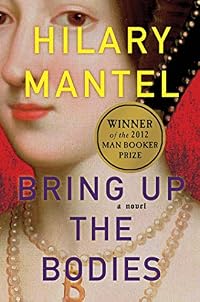
On This Page
Description
Though he battled for seven years to marry her, Henry is disenchanted with Anne Boleyn. She has failed to give him a son and her sharp intelligence and audacious will alienate his old friends and the noble families of England. When the discarded Katherine dies in exile from the court, Anne stands starkly exposed, the focus of gossip and malice. At a word from Henry, Thomas Cromwell is ready to bring her down. Over three terrifying weeks, Anne is ensnared in a web of conspiracy, while the show more demure Jane Seymour stands waiting her turn for the poisoned wedding ring. But Anne and her powerful family will not yield without a ferocious struggle. Hilary Mantel's Bring Up the Bodies follows the dramatic trial of the queen and her suitors for adultery and treason. To defeat the Boleyns, Cromwell must ally with his natural enemies, the papist aristocracy. What price will he pay for Anne's head? show lessTags
Recommendations


















Member Recommendations



by anonymous user

by anonymous user
by anonymous user
by anonymous user


by anonymous user
by anonymous user


by anonymous user
Member Reviews
So these may be two stone-cold literary and popular classics of the 21st century, fully and deservedly so. In Wolf Hall, Thomas Cromwell rose from nothing to one of the most powerful men in Tudor England. Now he holds and consolidates his power having learned his lessons well. And the lesson was this: give Henry what he wants. Start giving it before Henry even knows he wants it. And what Henry wants is this: a new wife. Anne Boleyn must go, and Thomas Cromwell, intelligent, adaptable, genial and even liberal must ensure justice is done the way justice must be done. That he will avenge himself on old enemies is part of his elegant design. Cromwell becomes truly terrifying here, even more so than the petulant child of a king or the show more arrogant and presumptuous queen. We like Cromwell. We see he does good. We see he tries to minimise the damage. he is realistic and compassionate without being sentimental. It is best to be ruthless and, having chosen a course, pursue it without question or apology. And so the queen falls, and others fall with her. And what are we to make of this?
A masterpiece of historical fiction, a humane portrait of a man written off as a monster, but which does not flinch from his bloody deeds. An amazing piece of work, and presumably, one that, like the life and work of Thomas Cromwell, has yet to be concluded. show less
A masterpiece of historical fiction, a humane portrait of a man written off as a monster, but which does not flinch from his bloody deeds. An amazing piece of work, and presumably, one that, like the life and work of Thomas Cromwell, has yet to be concluded. show less
Hilary Mantel's trilogy-to-be on Thomas Cromwell continues where Wolf Hall left off. Cromwell is Master Secretary and has the ear of King Henry VIII who is quickly becoming disenchanted with the new queen, Anne Boleyn.
The drama and intrigue of King Henry's court is better than a soap opera, and Mantel does a brilliant job of making historical fiction set hundreds of years ago feel immediate and these characters your intimates. I completely fell into the story, and if it took me a couple of weeks to read it was definitely me who was at fault, because when I was reading these 400+ pages flew by.
The drama and intrigue of King Henry's court is better than a soap opera, and Mantel does a brilliant job of making historical fiction set hundreds of years ago feel immediate and these characters your intimates. I completely fell into the story, and if it took me a couple of weeks to read it was definitely me who was at fault, because when I was reading these 400+ pages flew by.
I began reading this book with trepidation because I was dissatisfied with her earlier novel, Wolf Hall. Fortunately I was quickly disabused of this notion and found myself truly enjoying the narrative and style of this second volume of a planned trilogy, although I could not find any characters that I really liked.
The novel spans the death of one spurned Queen (Katherine) and the execution of another. It displays an Anne Boleyn reduced in power—“her dark glitter, now rubbed a little, flaking in places” (36)—to one encircled, tried, and eventually executed, flattened to a “puddle of gore”(397). This is not a novel about Queen Anne, however, so much as a continuation of Mantel’s thorough and interesting portrait of the man show more in charge of underwriting her doom, Thomas Cromwell. Mantel portrays a Cromwell as a penetrating and unsettling man who “has a way of getting his way . . . [who] will explain to a man where his true interests lie, and . . . introduce that same man to aspects of himself he didn’t know existed” (6).
Later in the novel this passage sums up Cromwell's mission:
“Rafe asks him, could the king's freedom be obtained, sir, with more economy of means? Less bloodshed?
Look, he says: once you have exhausted the process of negotiation and compromise, once you have fixed on the destruction of an enemy, that destruction must be swift and it must be perfect. Before you even glance in his direction, you should have his name on a warrant, the ports blocked, his wife and friends bought, his heir under your protection, his money in your strong room and his dog running to your whistle. Before he wakes in the morning, you should have the axe in your hand.”
After the death of Thomas More (in the previous novel) the Church and State are one under the mastery of Henry VIII. And immediately under Henry is Thomas Cromwell, a Machiavellian who finds Machiavelli’s book “trite,” a statesman who can crush a man’s life with a single word (71). He is also brilliant, untiring, and capable of deep loyalty and surprising acts of kindness and charity. Mantel presents through Cromwell's eyes an England teeming with beauty as well as with cruelty and death: a landscape where “each leaf of a tree, the sun behind it, [hangs] like a golden pear” (8). Cromwell is, like many of Mantel’s fictional characters, an outsider—in this case, one that cannot forget his own history, retaining empathy for the maltreated, the poor and ill-bred. His is the oblique gaze of a modern: even as he carries out the King’s dark orders, Cromwell imagines an England with better roads built from taxes levied on the wealthy (43). The court may scorn him as “a blacksmith’s boy,” but Cromwell is convinced a man can rise from humble origins: “In a generation everything can change” (43). However, I am not sure he is completely convinced of this as he is continually under pressure to carry out Henry's wishes. Thinking about writing a book about Henry Cromwell imagines a faux Henry in his mind as he remembers Erasmus's words: "you should praise a ruler even for the qualities he does not have. For the flattery gives him to think. And the qualities he presently lacks, he might go to work on them." (67) This is a dream for the lies abound and the deeds are often bloody, but the nobles and courtiers who are affected are not a sympathetic lot. The whole crowd of primary players resemble nothing better than a nest of vipers.
As the novel winds its way to the expected denouement Thomas Cromwell plays families against one another and uses the fear of Henry as a trump card. The result are indictments of the Queen and her "conspirators".
"When the indictments come to his hand, he see at once that, though the script is a clerk's the king has been at work. He can hear the king's voice in every line: his outrage, jealousy, fear." (346) They are filled with details about kisses, touchings, gifts, and multiple dates of offences, so "if there is specific denial of one date, one place, it will not be enough to injure the whole." (347)
There are some warm moments between Cromwell and his son Gregory, but by the end of the novel he is preparing Gregory for the realities of adulthood by bringing him to witness, albeit kneeling and bowed, the beheading of Anne Boleyn. In spite of the bloody politics of state among mostly detestable characters the tautly-written narrative was appealing and presented the events in a more understandable manner than the first volume. This is a historical novel worth reading for its insights into events that most will be familiar with before they open page one. show less
The novel spans the death of one spurned Queen (Katherine) and the execution of another. It displays an Anne Boleyn reduced in power—“her dark glitter, now rubbed a little, flaking in places” (36)—to one encircled, tried, and eventually executed, flattened to a “puddle of gore”(397). This is not a novel about Queen Anne, however, so much as a continuation of Mantel’s thorough and interesting portrait of the man show more in charge of underwriting her doom, Thomas Cromwell. Mantel portrays a Cromwell as a penetrating and unsettling man who “has a way of getting his way . . . [who] will explain to a man where his true interests lie, and . . . introduce that same man to aspects of himself he didn’t know existed” (6).
Later in the novel this passage sums up Cromwell's mission:
“Rafe asks him, could the king's freedom be obtained, sir, with more economy of means? Less bloodshed?
Look, he says: once you have exhausted the process of negotiation and compromise, once you have fixed on the destruction of an enemy, that destruction must be swift and it must be perfect. Before you even glance in his direction, you should have his name on a warrant, the ports blocked, his wife and friends bought, his heir under your protection, his money in your strong room and his dog running to your whistle. Before he wakes in the morning, you should have the axe in your hand.”
After the death of Thomas More (in the previous novel) the Church and State are one under the mastery of Henry VIII. And immediately under Henry is Thomas Cromwell, a Machiavellian who finds Machiavelli’s book “trite,” a statesman who can crush a man’s life with a single word (71). He is also brilliant, untiring, and capable of deep loyalty and surprising acts of kindness and charity. Mantel presents through Cromwell's eyes an England teeming with beauty as well as with cruelty and death: a landscape where “each leaf of a tree, the sun behind it, [hangs] like a golden pear” (8). Cromwell is, like many of Mantel’s fictional characters, an outsider—in this case, one that cannot forget his own history, retaining empathy for the maltreated, the poor and ill-bred. His is the oblique gaze of a modern: even as he carries out the King’s dark orders, Cromwell imagines an England with better roads built from taxes levied on the wealthy (43). The court may scorn him as “a blacksmith’s boy,” but Cromwell is convinced a man can rise from humble origins: “In a generation everything can change” (43). However, I am not sure he is completely convinced of this as he is continually under pressure to carry out Henry's wishes. Thinking about writing a book about Henry Cromwell imagines a faux Henry in his mind as he remembers Erasmus's words: "you should praise a ruler even for the qualities he does not have. For the flattery gives him to think. And the qualities he presently lacks, he might go to work on them." (67) This is a dream for the lies abound and the deeds are often bloody, but the nobles and courtiers who are affected are not a sympathetic lot. The whole crowd of primary players resemble nothing better than a nest of vipers.
As the novel winds its way to the expected denouement Thomas Cromwell plays families against one another and uses the fear of Henry as a trump card. The result are indictments of the Queen and her "conspirators".
"When the indictments come to his hand, he see at once that, though the script is a clerk's the king has been at work. He can hear the king's voice in every line: his outrage, jealousy, fear." (346) They are filled with details about kisses, touchings, gifts, and multiple dates of offences, so "if there is specific denial of one date, one place, it will not be enough to injure the whole." (347)
There are some warm moments between Cromwell and his son Gregory, but by the end of the novel he is preparing Gregory for the realities of adulthood by bringing him to witness, albeit kneeling and bowed, the beheading of Anne Boleyn. In spite of the bloody politics of state among mostly detestable characters the tautly-written narrative was appealing and presented the events in a more understandable manner than the first volume. This is a historical novel worth reading for its insights into events that most will be familiar with before they open page one. show less
In Bring up the Bodies, Mantel continues the chronicles she began in her prize-winning Wolf Hall. On its surface an account of Anne Boleyn's downfall as the second wife of Henry VIII, it is simultaneously a peek into the life, personality and machinations of Thomas Cromwell, through whose eyes the tale is told.
I found this second work to be even more engaging than the first, difficult to put down from about 25% in. Cromwell is a bit of an enigma to me. As a reader I'm generally inclined to be sympathetic to the storyteller, and the author is careful to include domestic scenes and instances of kindness and generosity on the part of Cromwell. On the other hand, however, the reader is periodically reminded that as affable a guy he may well show more be, he's also in a position of power and would undoubtedly do just about anything to remain there. show less
I found this second work to be even more engaging than the first, difficult to put down from about 25% in. Cromwell is a bit of an enigma to me. As a reader I'm generally inclined to be sympathetic to the storyteller, and the author is careful to include domestic scenes and instances of kindness and generosity on the part of Cromwell. On the other hand, however, the reader is periodically reminded that as affable a guy he may well show more be, he's also in a position of power and would undoubtedly do just about anything to remain there. show less
To say that I did not love this book quite as fiercely as Wolf Hall is in no way a condemnation, considering how strongly I felt about the first book in this trilogy. In Wolf Hall, Cromwell was mostly ascending to power, and in Bring Up the Bodies, he's holding onto it. Both require compromises of course, but now that Cromwell has all the power he needs to deliver comeuppance to those who tore Cardinal Wolsley down, it's almost uncomfortable to see it meted out.
But in the end, perhaps there is not a compromise, as it is all in line with two of Cromwell's central philosophies: "Choose your prince," and "Arrange your face." And who could possibly argue with either piece of advice?
This book concerns the fall of Anne Boleyn, and to some show more extent, the rise of Jane Seymour. But aren't there only three books? And quite a few wives to go? I am constantly reminded of how little I know of English history, and how much, now, I would like to know more. When I finish this trilogy I will definitely be looking for a good book on Elizabeth.
Mantel continues to do such wonderful things with words. I can't believe I have been sucked into not only a trilogy but a work in progress trilogy. And now have to wait an undefined amount of time for the third book? Have I learned nothing from fan-fiction? show less
But in the end, perhaps there is not a compromise, as it is all in line with two of Cromwell's central philosophies: "Choose your prince," and "Arrange your face." And who could possibly argue with either piece of advice?
This book concerns the fall of Anne Boleyn, and to some show more extent, the rise of Jane Seymour. But aren't there only three books? And quite a few wives to go? I am constantly reminded of how little I know of English history, and how much, now, I would like to know more. When I finish this trilogy I will definitely be looking for a good book on Elizabeth.
Mantel continues to do such wonderful things with words. I can't believe I have been sucked into not only a trilogy but a work in progress trilogy. And now have to wait an undefined amount of time for the third book? Have I learned nothing from fan-fiction? show less
As I was nearing the end of this second volume in Mantel's retelling of Thomas Cromwell's life and work, I started to wonder if I would rate this the same as Wolf Hall. It turned into somewhat of a philosophical debate revolving around whether a sequel could be considered as good as an original, considering that so much of the heavy lifting (character development and background, setting the context and moods, style) was done in the first and needed be replicated so much as maintained. Certainly it didn't need doing from scratch.
So I was all ready to give Bring up the Bodies an uneasy four stars, uneasy because it really is great. Then, the penultimate chapter. In the last paragraphs as Anne Boleyn is about to be executed, I literally show more found my hand in front of my mouth. It was horrifying, and tense, and I didn't want it to happen but was powerless but to keep reading. I realized at one point I had been breathing very shallowly. It was more than I could have expected, and really. Anne Boleyn's fate is as much a surprise as the ship going down in Titanic.
Still, I have a nagging question about sequels that rely on the former volume for so much of the development which, quite frankly, make Thomas Cromwell on of the most fascinating literary characters of my reading life. The relationship to his father, still very present, and with his first mentor Wolsey, also still present, can't be redone for the sake of new readers, and we can't be given a "previously, on..." (though amusingly enough, in the dramatis personae, Mantel includes a sub-category entitled "The Dead"). What I realized was that Bring up the Bodies is as much a sequel to Wolf Hall as The Two Towers is to Fellowship of the Ring-- that is to say, not at all. It really is a continuation of a very long story (and also like Lord of the Rings, there is a third volume coming!) and shouldn't be read until Wolf Hall has been devoured.
That doesn't lessen this book in my mind. It really is just as good as Wolf Hall, and in some ways better, but even that isn't fair. Had I read this on it's own, I don't know if it would have been five stars, as Cromwell would have appeared fully formed with no sense of who he was and (because of?) where he came from. But read right after Wolf Hall? Perfection.
One thing more thing: I heard a complaint about how Mantel uses (or misuses, depending on who you ask) pronouns. I even read how it was "proof" of her attempts at being more literary. Her continued use of he/him/his can be nothing but intentional, and though it is disconcerting at first, I found it brilliant. She managed to provide characterization through pronouns. Brilliant. I wonder if anyone else agrees. show less
So I was all ready to give Bring up the Bodies an uneasy four stars, uneasy because it really is great. Then, the penultimate chapter. In the last paragraphs as Anne Boleyn is about to be executed, I literally show more found my hand in front of my mouth. It was horrifying, and tense, and I didn't want it to happen but was powerless but to keep reading. I realized at one point I had been breathing very shallowly. It was more than I could have expected, and really. Anne Boleyn's fate is as much a surprise as the ship going down in Titanic.
Still, I have a nagging question about sequels that rely on the former volume for so much of the development which, quite frankly, make Thomas Cromwell on of the most fascinating literary characters of my reading life. The relationship to his father, still very present, and with his first mentor Wolsey, also still present, can't be redone for the sake of new readers, and we can't be given a "previously, on..." (though amusingly enough, in the dramatis personae, Mantel includes a sub-category entitled "The Dead"). What I realized was that Bring up the Bodies is as much a sequel to Wolf Hall as The Two Towers is to Fellowship of the Ring-- that is to say, not at all. It really is a continuation of a very long story (and also like Lord of the Rings, there is a third volume coming!) and shouldn't be read until Wolf Hall has been devoured.
That doesn't lessen this book in my mind. It really is just as good as Wolf Hall, and in some ways better, but even that isn't fair. Had I read this on it's own, I don't know if it would have been five stars, as Cromwell would have appeared fully formed with no sense of who he was and (because of?) where he came from. But read right after Wolf Hall? Perfection.
One thing more thing: I heard a complaint about how Mantel uses (or misuses, depending on who you ask) pronouns. I even read how it was "proof" of her attempts at being more literary. Her continued use of he/him/his can be nothing but intentional, and though it is disconcerting at first, I found it brilliant. She managed to provide characterization through pronouns. Brilliant. I wonder if anyone else agrees. show less
“…it is no small enterprise, to bring down a queen of England.” So says Thomas Cromwell, who in Bring up the Bodies finds himself charged with doing just that…again. It’s unlikely that anyone reading this novel is being introduced to its major players for the first time. Henry VIII and his many wives have been fiction fodder for centuries. But Mantel’s version of the downfall of Anne Boleyn, her family and her courtiers feels brand-spanking new even to those who have read all the novels and watched all the dramas. It’s a matter of perspective. To see this history, much of which is unreliably recorded at best, from the point of view of the man most responsible for carrying out the King’s wishes, casts it all in a clearer show more and much less romantic light than many others have done. In Henry’s Court, queens, no less than advisors, are replaceable. MUST be replaceable if they do not fulfill the duties and meet the needs of the King, whatever the laws of man and God seem to dictate to the contrary. Cromwell himself knows quite well that he is not exempt from this rule. “Sometimes he wakes in the night and thinks of it. There are courtiers who have honourably retired. He can think of instances. Of course, it is the other kind that loom larger, if you are wakeful around midnight.” Logic suggests that one day, possibly without warning, Henry will turn on him, and his efforts to satisfy the King’s desires will be viewed as treason when those desires change once more. So far, that day has not come. His heart is not faint, and his scruples do not trouble him. He methodically removes the stumbling blocks –most of them human—from the path King Henry has chosen to follow. And then it is inevitable that someone will ask “…if this is what Cromwell does to …lesser enemies, what will he do by and by to the king himself?” Mantel’s style can be challenging, but I have not found it so since becoming absorbed in the first 50 pages or so of Wolf Hall, to which Bring up the Bodies is a sequel. Her research, imagination and storytelling skills have made her one of my favorite contemporary authors. May she live and prosper to recount the rest of Cromwell’s fascinating contributions to English history. We all know, or can easily find out, whether it is Henry or Crumb who will bring the other down. But how we long to hear it from the inimitable vantage point Mantel has established. show less
Members
- Recently Added By
Published Reviews
ThingScore 88
Here, as elsewhere, Mantel’s real triumph is her narrative language. It’s not the musty Olde English of so much historical fiction, but neither is it quite contemporary. The Latinate “exsanguinates” is a perfect 16th-century touch, and so is that final, Anglo-Saxon “gore.” In some of her books, Mantel is pretty scabrous in her descriptions of present-day England, its tawdriness and show more cheesiness and weakness for cliché and prettifying euphemism. “Bring Up the Bodies” (the title refers to the four men executed for supposedly sleeping with Anne) isn’t nostalgic, exactly, but it’s astringent and purifying, stripping away the cobwebs and varnish of history, the antique formulations and brocaded sentimentality of costume-drama novels, so that the English past comes to seem like something vivid, strange and brand new. show less
added by LiteraryFiction
Geen gehijg tussen de lakens in Bring up the bodies (Het boek Henry), geen hete kussen bij maanlicht. Toch is Hilary Mantels versie van de perikelen van de Tudors de meest opwindende ooit.
added by private library
Is Bring Up the Bodies better than, worse than or equal to Wolf Hall? While lacking, necessarily, the shocking freshness of the first book, it is narrower, tighter, at times a more brilliant and terrifying novel. Of her historical interpretations, Mantel says in her afterword that she is "making the reader a proposal, an offer", but what is striking is how little concerned she is with the show more reader. Her prose makes no concessions to the disorientated: a moment's distraction and you have to start the page again. Mantel, like Cromwell, seems not to mind if we are there or not: she is writing, as he was living, for herself alone. show less
added by souloftherose
Lists

Top Five Books of 2013
1,564 works; 716 members

Best Historical Fiction
620 works; 261 members

Favourite books from the 2013 Women's Prize for Fiction (Orange Prize) long
20 works; 17 members

Recommend the 20 best books you've read in the last five years
2,167 works; 600 members

Best Contemporary Literary Fiction (Around the Last 30 Years)
388 works; 124 members

Best 21st Century Books (So Far)
670 works; 86 members

1001 Books You Must Read Before You Die
1,448 works; 1,132 members
Booker Prize
491 works; 62 members
Favourite Booker Prize contenders
73 works; 21 members

Historical Fiction
889 works; 91 members

ALA The Reading List
490 works; 28 members

Female Author
1,235 works; 65 members
Top-Rated Books on LibraryThing
272 works; 117 members

Top Five Books of 2014
1,064 works; 397 members

Baileys Women's Prize for Fiction Winners and Shortlisted Books
61 works; 11 members
Female Protagonist
1,056 works; 56 members
Booker Prize Shortlist: Titles Read
103 works; 10 members

Books Set in Great Britain
191 works; 13 members

Books about King Henry VIII
17 works; 12 members

Top Five Books of 2021
604 works; 181 members

Top Five Books of 2018
802 works; 265 members

BBC Radio 4 Bookclub
304 works; 13 members

Top Five Books of 2015
811 works; 240 members

Fiction Featuring Real People
81 works; 17 members
Man Booker Prize Longlist 2012
12 works; 2 members

Best books read in the first half of 2012
38 works; 6 members

Five star books
1,755 works; 108 members

Retrospective of Historical Fiction
48 works; 7 members

United Kingdom
82 works; 4 members
Top Five Books of 2012
55 works; 11 members

Books Read in 2020
4,379 works; 123 members

Books Read in 2018
4,360 works; 110 members

Books Read in 2026
1,663 works; 62 members

.
184 works; 1 member

Retrospective of 20th- and 21st-century literature
154 works; 1 member

BBC World Book Club
261 works; 5 members
NYT 100 best books of 21st C
100 works; 31 members

Top Five Books of 2023
767 works; 317 members

Most-anticipated future releases
40 works; 22 members

Books Read in 2021
5,361 works; 114 members

Books Read in 2019
4,052 works; 108 members
The Hive Recommends
62 works; 2 members

Books With Complete Sentence Titles
374 works; 15 members
Walter Scott Prize Winners and Shortlist
66 works; 6 members

Set in the 15th and 16th Centuries
28 works; 4 members

Books You Couldn't Finish
202 works; 32 members
IMPAC Dublin Literary Award 2014 longlist
150 works; 3 members
Favorite Books Published in 2012
57 works; 15 members
Shannon's Read-Alikes List
71 works; 8 members
Talk Discussions
Past Discussions
Group Read: Bring Up the Bodies by Hilary Mantel (spoiler thread) in 75 Books Challenge for 2012 (November 2014)
Bring Up the Bodies by Hilary Mantel in Booker Prize (July 2012)
Group Read: Bring Up the Bodies by Hilary Mantel (main thread) in 75 Books Challenge for 2012 (June 2012)
Author Information

63+ Works 38,653 Members
Hilary Mantel was born in Glossop, Derbyshire, England on July 6, 1952. She studied law at the London School of Economics and Sheffield University. She worked as a social worker in Botswana for five years, followed by four years in Saudi Arabia. She returned to Britain in the mid-1980s. In 1987 she was awarded the Shiva Naipaul Memorial Prize for show more an article about Jeddah. She worked as a film critic for The Spectator from 1987 to 1991. She has written numerous books including Eight Months on Ghazzah Street, A Place of Greater Safety, A Change of Climate, The Giant, O'Brien, Giving up the Ghost: A Memoir, and Beyond Black. She has won several awards for her work including the Winifred Holtby Memorial Prize, the Cheltenham Prize and the Southern Arts Literature Prize for Fludd; the 1996 Hawthornden Prize for An Experiment in Love, the 2009 Man Booker Prize for Wolf Hall, and the 2012 Man Booker Prize for Bring up the Bodies. She made The New York Times Best Seller List with her title The Assassination of Margaret Thatcher. (Bowker Author Biography) show less
Some Editions
Awards and Honors
Awards
Distinctions
Series
Belongs to Publisher Series
Work Relationships
Is contained in
Has the adaptation
Has as a student's study guide
Common Knowledge
- Canonical title
- Bring Up the Bodies
- Original title
- Bring Up the Bodies
- Alternate titles
- Una reina en el estrado
- Original publication date
- 2012
- People/Characters
- Thomas Cromwell, 1st Earl of Essex; Henry VIII, King of England; Anne Boleyn; Jane Seymour; Thomas Cranmer, Archbishop of Canterbury; Richard Cromwell (show all 20); Thomas Howard, 3rd Duke of Norfolk; Gregory Cromwell; Eustace Chapuys; Rafe Sadler; Thomas Wyatt (Sir, Poet, 1503-1542); Jane Boleyn (Lady Rochford); George Boleyn (Lord Rochford); Catherine of Aragon; Thomas Wolsey; Henry FitzRoy, 1st Duke of Richmond and Somerset; Thomas Boleyn, 1st Earl of Wiltshire and 1st Earl of Ormond, 1st Viscount Rochford; Thomas Wriothesley; Sir William Kingston; Mary Scrope (Lady Kingston)
- Important places
- Hampton Court Palace, Richmond, London, England, UK; Greenwich Palace, London, England, UK; Tower of London, London, England, UK; London, England, UK; Wolf Hall, Wiltshire, England, UK; Kimbolton, Cambridgeshire, England, UK
- Important events
- Tudor Era (1485 | 1603); Death of Katherine of Aragon (1536-01-07); Execution of Anne Boleyn (1536-05-19)
- Epigraph
- "Am I not a man like other men? Am I not? Am I not?"
Henry VIII to Eustache Chapuys, Imperial Ambassador from Spain - Dedication
- Once again to Mary Robertson; after my right harty commendacions, and with spede.
Para Mary Robertson una vez más: con mis justos y cordiales elogios y con salud. - First words
- His children are falling from the sky.
Sus hijas caen del cielo. - Quotations
- What is the nature of the border between truth and lies?...Truth can break the gates down, truth can howl in the street; unless truth is pleasing, personable and easy to like, she is condemned to stay whimpering at the back d... (show all)oor.
[The Italians] say the road between England and Hell is worn bare from treading feet, and runs downhill all the way.
You can be merry with the king, you can share a joke with him. But as Thomas More used to say, it's like sporting with a tamed lion. You tousle its mane and pull its ears, but all the time you're thinking, those claws, those ... (show all)claws, those claws.
You have always regarded women as disposable, my lord, and you cannot complain if in the end they think the same of you.
These light nights find him at his desk. Paper is precious. Its offcuts and remnants are not discarded, but turned over, reused. Often he takes up an old letter-book and finds the jottings of chancellors long dust, of bishop-... (show all)ministers now cold under inscriptions of their merits.
He needs guilty men. So he has found men who are guilty. Though perhaps not guilty as charged. - Last words
- (Click to show. Warning: May contain spoilers.)There are no endings. If you think so then you are deceived as to their nature. They are all beginnings. Here is one.
(Click to show. Warning: May contain spoilers.)No hay finales. Si piensas eso te engañas sobre su naturaleza. Son todos principios. Este es uno. - Original language
- English
Classifications
Statistics
- Members
- 8,076
- Popularity
- 1,366
- Reviews
- 378
- Rating
- (4.33)
- Languages
- 14 — Czech, Dutch, English, Finnish, French, German, Italian, Norwegian (Bokmål), Polish, Russian, Spanish, Swedish, Turkish, Portuguese (Portugal)
- Media
- Paper, Audiobook, Ebook
- ISBNs
- 93
- ASINs
- 30
