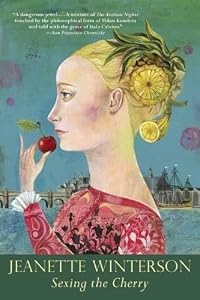
Sexing the Cherry
by Jeanette Winterson
On This Page
Description
In a fantastic world that is and is not seventeenth-century England, a baby is found floating in the Thames. The child, Jordan, is rescued by Dog Woman and grows up to travel the globe like Gulliver-though he finds that the most curious oddities come from his own mind. The spiraling tale leads the reader from discussions on the nature of time to Jordan's fascination with journeys concealed within other journeys, all with a dizzying speed that jumps from epiphany to shimmering epiphany.Tags
Recommendations

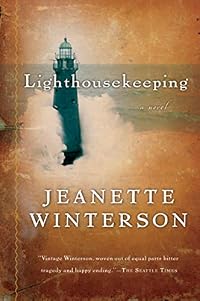
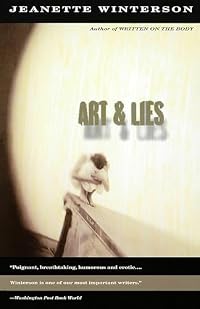
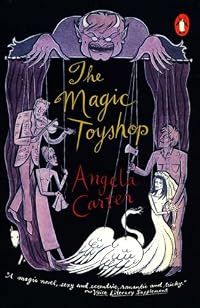
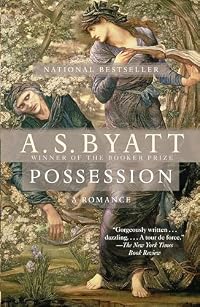



Member Recommendations
Member Reviews
"Every journey conceals another journey within its lines: the path not taken and the forgotten angle."
'Sexing the Cherry' is set in the mid-seventeenth century and spans the English Civil War, the execution of Charles I(in gory detail),the rise of the Puritans, the restoration of Charles II and even touches on the Plague and Great Fire of London. The book celebrates the power of the imagination. It switches between two main narrators, Dog Woman and her adoptive son Jordan, and mixes reality with dream and fairytale although there is also a linear plot weaving throughout.
Dog Woman is a force of a nature, an impossibly huge woman, violent and dangerous but with heart of gold. She is a wonderful literary creation, one who can do terrible show more things and yet you still want to cheer for her. Unlike his mother, Jordan is a dreamer. Jordan takes the reader to the magical places he visits and introduces us to the characters he meets along the way and read like short stories. In one enchanting passage we hear the story of twelve princesses who are forced to marry twelve princes who all come to a deservedly sticky end.
I should point out at this juncture that there are only two decent male characters in this book. The remainder are rapists, murderers and sexually depraved. Virtually all come to a gruesome end. But this isn't gratuitous violence, instead it is done with a wonderfully subtle tongue-in-cheek humour. Motherly love and the difficulty of conveying emotions are examined much more seriously.
This is quite a short book (my copy is 144 pages) but don't be fooled, it still takes the reader on a roller-coaster of emotions. Perhaps my mind is simply too literal to be a fan of magical realism tales and therefore really appreciate this but I still found it a remarkably original and imaginative piece of writing which deserves to be on the 1001 list. show less
'Sexing the Cherry' is set in the mid-seventeenth century and spans the English Civil War, the execution of Charles I(in gory detail),the rise of the Puritans, the restoration of Charles II and even touches on the Plague and Great Fire of London. The book celebrates the power of the imagination. It switches between two main narrators, Dog Woman and her adoptive son Jordan, and mixes reality with dream and fairytale although there is also a linear plot weaving throughout.
Dog Woman is a force of a nature, an impossibly huge woman, violent and dangerous but with heart of gold. She is a wonderful literary creation, one who can do terrible show more things and yet you still want to cheer for her. Unlike his mother, Jordan is a dreamer. Jordan takes the reader to the magical places he visits and introduces us to the characters he meets along the way and read like short stories. In one enchanting passage we hear the story of twelve princesses who are forced to marry twelve princes who all come to a deservedly sticky end.
I should point out at this juncture that there are only two decent male characters in this book. The remainder are rapists, murderers and sexually depraved. Virtually all come to a gruesome end. But this isn't gratuitous violence, instead it is done with a wonderfully subtle tongue-in-cheek humour. Motherly love and the difficulty of conveying emotions are examined much more seriously.
This is quite a short book (my copy is 144 pages) but don't be fooled, it still takes the reader on a roller-coaster of emotions. Perhaps my mind is simply too literal to be a fan of magical realism tales and therefore really appreciate this but I still found it a remarkably original and imaginative piece of writing which deserves to be on the 1001 list. show less
This is a most unusual novel that delves into the nature of reality and the power of storytelling. Set during the English Civil War, it starts with Dog Woman discovering a baby in the Thames. She adopts the child and names him Jordan. Jordan is an explorer and dreamer. He regularly embarks on journeys to far-off places, meeting historical and mythical people. In contrast, Dog Woman remains in her familiar surroundings. She has a strong sense of justice and a penchant for violence, particularly against those she deems immoral or corrupt. The narrative weaves in stories told by the legendary Twelve Dancing Princesses whom Jordan meets on his travels.
I was unsure about reading this book, since I tend not to like excessive violence and show more graphic sexual content, but these elements felt necessary to the storyline. The violence is not more than what really happened during the English Civil War (which was gruesome in the extreme). The sexual scenes are intermittent and support the overall point of the work. Themes include identity and resistance against oppression. The writing is lyrical and atmospheric. It reads almost like a fable, and the message is certainly relevant. show less
I was unsure about reading this book, since I tend not to like excessive violence and show more graphic sexual content, but these elements felt necessary to the storyline. The violence is not more than what really happened during the English Civil War (which was gruesome in the extreme). The sexual scenes are intermittent and support the overall point of the work. Themes include identity and resistance against oppression. The writing is lyrical and atmospheric. It reads almost like a fable, and the message is certainly relevant. show less
As interesting as this book is, I'm not sure that I completely "get it." The storyline flips back and forth between a mother and adopted son from the 1600s, but it gets confusing when a modern man (of the same name, and also obsessed with boats) and woman enter the picture. The modern woman is a scientist studying mercury levels in rivers/lakes and is prone to hallucinations, so maybe the 1600s characters are just her hallucinations? I don't really like this explanation since it doesn't really seem plausible or fit with the characters, but I can't think of anything else to explain the odd time shift.
Regardless of the odd plot, the writing is quite well done, and I really enjoyed the mini fable retelling of the Twelve Dancing show more Princesses. It adds a touch of actual magic and fairytale to the already surreal story, yet keeps things realistic with the idea that the Princesses are real life characters who have abandoned their husbands and found alternative lovers elsewhere. show less
Regardless of the odd plot, the writing is quite well done, and I really enjoyed the mini fable retelling of the Twelve Dancing show more Princesses. It adds a touch of actual magic and fairytale to the already surreal story, yet keeps things realistic with the idea that the Princesses are real life characters who have abandoned their husbands and found alternative lovers elsewhere. show less
Rating: 4 of 5
The act of reading Sexing the Cherry was itself a journey. Filled with allusions, metaphors and imagery, it was a heavy read, not for those who find such prose pretentious or unsatisfying. Usually I blow through 167 pages in a couple hours; this one took me four days to complete. So much was packed into a single sentence, I often found myself re-reading to examine, digest and/or journal. And, when I finished the story, there were dozens of my little post-its sticking out, marking passages that lit a fire in my thinker's boiler.
If enjoyed the first time, re-reading Sexing the Cherry will likely present new meaning(s) for its reader. If I were to read it again in say, a year, five years, a decade I'm sure different passages, show more ideas, images would grab hold. The exploration of time and reality most resonated during this, my first, read.
However, I wouldn't feel comfortable recommending this book to the casual reader because I think it'll be a love it or hate it type of experience for most people. Plus, where (or when) that reader is in their life, would also affect their reaction to the story. show less
The act of reading Sexing the Cherry was itself a journey. Filled with allusions, metaphors and imagery, it was a heavy read, not for those who find such prose pretentious or unsatisfying. Usually I blow through 167 pages in a couple hours; this one took me four days to complete. So much was packed into a single sentence, I often found myself re-reading to examine, digest and/or journal. And, when I finished the story, there were dozens of my little post-its sticking out, marking passages that lit a fire in my thinker's boiler.
If enjoyed the first time, re-reading Sexing the Cherry will likely present new meaning(s) for its reader. If I were to read it again in say, a year, five years, a decade I'm sure different passages, show more ideas, images would grab hold. The exploration of time and reality most resonated during this, my first, read.
However, I wouldn't feel comfortable recommending this book to the casual reader because I think it'll be a love it or hate it type of experience for most people. Plus, where (or when) that reader is in their life, would also affect their reaction to the story. show less
I can say immediately that Sexing the Cherry by Jeanette Winterson was not a book for me. I could see that it is very creative and imaginative but it didn’t draw me in or make me want to read more by this author. I spent a great deal of time puzzling over what the author was saying and wondering why people actually enjoy reading this book.
Originally published in 1989 this feminist and queer story reminded me somewhat of Angela Carter in that the author used aspects of the fairy tale, The Twelve Dancing Princesses to enhance her story. Mostly however, I did not understand what I was reading, and found it to be pretentious, surreal and not at all to my taste. Although it did show me pineapples and bananas in a different light.
I did show more read one review that stated that the goal of the book is not comprehension, but exploration. Unfortunately though I like to understand what I am reading and this bent, weird, unrealistic narrative went right over my head. show less
Originally published in 1989 this feminist and queer story reminded me somewhat of Angela Carter in that the author used aspects of the fairy tale, The Twelve Dancing Princesses to enhance her story. Mostly however, I did not understand what I was reading, and found it to be pretentious, surreal and not at all to my taste. Although it did show me pineapples and bananas in a different light.
I did show more read one review that stated that the goal of the book is not comprehension, but exploration. Unfortunately though I like to understand what I am reading and this bent, weird, unrealistic narrative went right over my head. show less
This is a short book, but not necessarily an easy one. I have never read anything quite like it -- and I consider that the highest of compliments.
The language Jeanette Winterson uses is so eloquent; the imagery is absolutely beautiful. The best way I can think to describe this novel doesn't even come close, but it will have to do: part haunting fairy tale and Paul Bunyan-esque folk tale, with a heavy dose of [b:Cloud Atlas|49628|Cloud Atlas|David Mitchell|http://photo.goodreads.com/books/1170360941s/49628.jpg|1871423] and [b:Naked Lunch|7437|Naked Lunch|William S. Burroughs|http://photo.goodreads.com/books/1219259455s/7437.jpg|4055] mixed in. Winterson is probably the only author that can make a giant woman chomping some dude's dick off show more sound poetic. Oh yeah, and if you're bothered by crude language or sex scenes (none of which are vanilla), this one might not be for you. Fortunately, I love me some smut. show less
The language Jeanette Winterson uses is so eloquent; the imagery is absolutely beautiful. The best way I can think to describe this novel doesn't even come close, but it will have to do: part haunting fairy tale and Paul Bunyan-esque folk tale, with a heavy dose of [b:Cloud Atlas|49628|Cloud Atlas|David Mitchell|http://photo.goodreads.com/books/1170360941s/49628.jpg|1871423] and [b:Naked Lunch|7437|Naked Lunch|William S. Burroughs|http://photo.goodreads.com/books/1219259455s/7437.jpg|4055] mixed in. Winterson is probably the only author that can make a giant woman chomping some dude's dick off show more sound poetic. Oh yeah, and if you're bothered by crude language or sex scenes (none of which are vanilla), this one might not be for you. Fortunately, I love me some smut. show less
I do like Winterson, although I don't fully understand her. This book challenges the linearity of time, in telling the story of Dog Woman, a huge, strong, and kind of gross female figure, and her adopted son Jordan, and explorer and adventurer. Somehow, the story of the 12 Dancing Princesses is folded in, for an exploration of gender and class, in a story that moves fluidly from the 1600's to current day.
The writing is good, and lots to think about
The writing is good, and lots to think about
Members
- Recently Added By
Published Reviews
ThingScore 75
''Sexing the Cherry'' fuses history, fairy tale and metafiction into a fruit that's rather crisp, not terribly sweet, but of a memorably startling flavor.
added by jlelliott
Lists

1001 Books You Must Read Before You Die
1,448 works; 1,131 members

Magic Realism
371 works; 52 members

Female Author
1,235 works; 65 members

20th Century Literature
1,161 works; 54 members

Best LGBT Fiction
144 works; 24 members

Five star books
1,755 works; 108 members

A Novel Cure
742 works; 23 members

Julie Parson’s Old Books
52 works; 4 members

1,001 BYMRBYD Concensus
723 works; 27 members

Books Read in 2026
1,663 works; 62 members
Author Information

54+ Works 37,030 Members
Jeanette Winterson was born in Manchester, England in 1959 and graduated from St. Catherine's College, Oxford. Her book, Oranges Are Not the Only Fruit, is a semi-autobiographical account of her life as a child preacher (she wrote and gave sermons by the time she was eight years old). The book was the winner of the Whitbread Prize for best first show more fiction and was made into an award-winning TV movie. The Passion won the John Llewelyn Rhys Memorial Prize for best writer under thirty-five, and Sexing the Cherry won the American Academy of Arts and Letters' E. M. Forster Award. (Bowker Author Biography) Jeanette Winterson lives in London & the Cotswolds. (Publisher Provided) show less
Some Editions
Awards and Honors
Series
Belongs to Publisher Series
Work Relationships
Is abridged in
Common Knowledge
- Canonical title
- Sexing the Cherry
- Original title
- Sexing the Cherry
- Alternate titles*
- Kersen kruisen
- Original publication date
- 1989-09-07
- Last words
- (Click to show. Warning: May contain spoilers.)Empty space and points of light.
- Original language
- English
- Canonical DDC/MDS
- 823.914
- Canonical LCC
- PR6073.I558
*Some information comes from Common Knowledge in other languages. Click "Edit" for more information.
Classifications
Statistics
- Members
- 3,423
- Popularity
- 4,851
- Reviews
- 54
- Rating
- (3.72)
- Languages
- 12 — Czech, Danish, Dutch, English, French, German, Icelandic, Italian, Polish, Spanish, Swedish, Turkish
- Media
- Paper, Audiobook, Ebook
- ISBNs
- 35
- ASINs
- 14