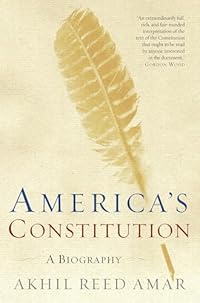
America's Constitution: A Biography
by Akhil Reed Amar
On This Page
Description
A Yale Law School professor offers a thought-provoking analysis of the history and tenets of the U.S. Constitution, detailing the original intent of the creators of the document, answering questions about the text, and critically assessing the evolution of the Bill of Rights and all other amendments. In America's Constitution, one of this era's most accomplished constitutional law scholars, Akhil Reed Amar, gives the first comprehensive account of one of the world's great political texts. show more Incisive, entertaining, and occasionally controversial, this "biography" of America's framing document explains not only what the Constitution says but also why the Constitution says it. We all know this much: the Constitution is neither immutable nor perfect. Amar shows us how the story of this one relatively compact document reflects the story of America more generally. (For example, much of the Constitution, including the glorious-sounding "We the People," was lifted from existing American legal texts, including early state constitutions.) In short, the Constitution was as much a product of its environment as it was a product of its individual creators' inspired genius. Despite the Constitution's flaws, its role in guiding our republic has been nothing short of amazing. Skillfully placing the document in the context of late-eighteenth-century American politics, America's Constitution explains, for instance, whether there is anything in the Constitution that is unamendable; the reason America adopted an electoral college; why a president must be at least thirty-five years old; and why-for now, at least-only those citizens who were born under the American flag can become president. From his unique perspective, Amar also gives us unconventional wisdom about the Constitution and its significance throughout the nation's history. For one thing, we see that the Constitution has been far more democratic than is conventionally understood. Even though the document was drafted by white landholders, a remarkably large number of citizens (by the standards of 1787) were allowed to vote up or down on it, and the document's later amendments eventually extended the vote to virtually all Americans. We also learn that the Founders' Constitution was far more slavocratic than many would acknowledge: the "three fifths" clause gave the South extra political clout for every slave it owned or acquired. As a result, slaveholding Virginians held the presidency all but four of the Republic's first thirty-six years, and proslavery forces eventually came to dominate much of the federal government prior to Lincoln's election. Ambitious, even-handed, eminently accessible, and often surprising, America's Constitution is an indispensable work, bound to become a standard reference for any student of history and all citizens of the United States. show lessTags
Recommendations

Member Reviews
This is a remarkable book. The author's knowledge, insight, analysis and synthesis are amazing. There's too much to praise about it, so I'll just mention one aspect: Amar makes a very compelling case that from the beginning slavery was a disease spreading infection in our society and political system (aided by the 3/5 clause), increasingly corrupting our character and institutions until a terribly bloody breaking point was reached. The evil was partially righted, then amorality returned, allowing a viciousness to fester until another crisis led to new progress. But it remains that slavery and its legacy constitute the central national failure, which we still haven’t nearly corrected. Most of the book is quite positive, and slavery’s show more not the principal focus, but Amar’s treatment of it is both convincing and unforgettable. show less
Far superior to the follow up book "The Unwritten Constitution", A Biography is fairly interesting and contributes a lot to my historical understanding of the Constitution. The book is not by any means an exhaustive exploration of the Constitution, rather it is a commentary on various parts that Amar finds interesting or has clever observations on. A word on the language and tone of the book. It does not read like a typical law book, which seems a bit authoritative. Amar's writing gushes (Posner compared it to the demeanor of a cheerleader), can be snide and sometimes trips over itself in trying to be clever or referential (there is at least one joke in the book punning Taft's weight). It's an open question whether that's a good or a show more bad tone for this kind of book.
The strength of this book is the various historical research that Amar discusses as well as the more grounded non-obvious implications of the text of the constitution. Particularly interesting to me, was the question of the legality of the constitution. He raises the question on how the Articles of Confederation could properly be replaced by the Constitution and answers it by explaining treaty conceptions of the 18th century which allowed rescission in the event of breach (which state breached though, was left unclear politically). Amar shows that the ratification process was remarkably democratic (at least for the time), and that many states suspended property qualifications and none increased qualifications for the conventions which bolstered the popular aspect of ratification (both dodging the state legislatures who loathed to give up their power and increasing the Framer's consideration to make the document democratic to receive an affirmative vote [though Amar's arguments that the framers were particularly populist and that the republic was the same as democracy in their eyes are not compelling arguments]). However, the document was also flawed by the 3/5 clause, which gave recognition to slavery and extra power to the slave states by increasing their power in Congress and in presidential elections and therefore indirectly on judicial appointments. Amar argues controversially that the constitution structurally does not allow secession (being based on the model of the Union between Scotland and England) and that the Civil War fundamentally changed the second amendment (during the revolution, the threat was seen as the central government [hence the need for state militias to be armed], but in the antebellum era with its disenfranchisement, gag rules and revolt against a fairly elected president, the states had become the threats to be fixed by the federal government [and with it, the evolution of the second amendment an individual right]). Amar discusses the interesting implications of the age requirement of officials, which prevented dynasties of favored sons, and residency requirement which prevented the practice of rotten boroughs. There is also somewhat randomly, a refutation of Ackerman's theory of extra-consitutional "constitutional moments", particularly applied to the 14th amendment. Amar also goes through the history of the amendments, discussing their historical context and implications (an interesting one is the innovation of limiting when an amendment can take effect, seemingly allowing modifications to article 5 procedures). There's many other fascinating and controversial arguments made in the rest of the book (from the strange ratification of the 27th amendment [proposed by the first congress but only ratified in 1992 after a letter writing campaign from a college student] to the 12th amendment modifying elections in light of the realities of political parties). A good reference book to keep around for its interesting tidbits alone.
A major weakness of the book is that it's filled with rather idiosyncratic views of Amar on the constitution (though to be fair he indicates the originality of some of these views in the postscript). Some of these views (repetitive from Unwritten Constitution) include the idea that the suffrage amendment on its face entitles women to sit on the jury (apparently an idea derived from certain legislative history from the adoption of the 14th amendment) , since juries vote, the idea that federal statutes always override treaties (rather than later in time, because of the order they are mentioned in the Constitution), and the view that each branch was empowered to decide on the constitutionality of various laws not the supreme court alone (though this view seems historically supported by the scholarship of Gordon Wood). Amar argues that structurally, the constitution gives the executive expansive powers to deal with emergencies and unforeseeable circumstances, and that the list of executive powers is demonstrative, not exhaustive. While not all of these completely unrooted in scholarship or history, they are considered heterodox by doctrine and an unwary reader is not warned of that fact. Overall, a good read for someone interested in the somewhat arcane historical background of the Constitution than current legal practice. show less
The strength of this book is the various historical research that Amar discusses as well as the more grounded non-obvious implications of the text of the constitution. Particularly interesting to me, was the question of the legality of the constitution. He raises the question on how the Articles of Confederation could properly be replaced by the Constitution and answers it by explaining treaty conceptions of the 18th century which allowed rescission in the event of breach (which state breached though, was left unclear politically). Amar shows that the ratification process was remarkably democratic (at least for the time), and that many states suspended property qualifications and none increased qualifications for the conventions which bolstered the popular aspect of ratification (both dodging the state legislatures who loathed to give up their power and increasing the Framer's consideration to make the document democratic to receive an affirmative vote [though Amar's arguments that the framers were particularly populist and that the republic was the same as democracy in their eyes are not compelling arguments]). However, the document was also flawed by the 3/5 clause, which gave recognition to slavery and extra power to the slave states by increasing their power in Congress and in presidential elections and therefore indirectly on judicial appointments. Amar argues controversially that the constitution structurally does not allow secession (being based on the model of the Union between Scotland and England) and that the Civil War fundamentally changed the second amendment (during the revolution, the threat was seen as the central government [hence the need for state militias to be armed], but in the antebellum era with its disenfranchisement, gag rules and revolt against a fairly elected president, the states had become the threats to be fixed by the federal government [and with it, the evolution of the second amendment an individual right]). Amar discusses the interesting implications of the age requirement of officials, which prevented dynasties of favored sons, and residency requirement which prevented the practice of rotten boroughs. There is also somewhat randomly, a refutation of Ackerman's theory of extra-consitutional "constitutional moments", particularly applied to the 14th amendment. Amar also goes through the history of the amendments, discussing their historical context and implications (an interesting one is the innovation of limiting when an amendment can take effect, seemingly allowing modifications to article 5 procedures). There's many other fascinating and controversial arguments made in the rest of the book (from the strange ratification of the 27th amendment [proposed by the first congress but only ratified in 1992 after a letter writing campaign from a college student] to the 12th amendment modifying elections in light of the realities of political parties). A good reference book to keep around for its interesting tidbits alone.
A major weakness of the book is that it's filled with rather idiosyncratic views of Amar on the constitution (though to be fair he indicates the originality of some of these views in the postscript). Some of these views (repetitive from Unwritten Constitution) include the idea that the suffrage amendment on its face entitles women to sit on the jury (apparently an idea derived from certain legislative history from the adoption of the 14th amendment) , since juries vote, the idea that federal statutes always override treaties (rather than later in time, because of the order they are mentioned in the Constitution), and the view that each branch was empowered to decide on the constitutionality of various laws not the supreme court alone (though this view seems historically supported by the scholarship of Gordon Wood). Amar argues that structurally, the constitution gives the executive expansive powers to deal with emergencies and unforeseeable circumstances, and that the list of executive powers is demonstrative, not exhaustive. While not all of these completely unrooted in scholarship or history, they are considered heterodox by doctrine and an unwary reader is not warned of that fact. Overall, a good read for someone interested in the somewhat arcane historical background of the Constitution than current legal practice. show less
Amar ties the text of the U.S. Constitution with earlier legal texts (e.g. the Magna Carta), historical events, conflicting opinions of the value of states-rights v. federalism, the personalities involved, then-current legal education, among lost of other stuff, then demonstrates how portions of the text interplay with other portions, so that the document can only be understood as a whole, not as a series of disconnected clauses, the way it is conventionally approached.
Mr. Amar writes well, is witty and respectful of the reader, while not shrinking from difficult topics, which he handles with considerble grace and lots of footnotes.
I've never encountered a more thorough, yet readable, review of the Constitution and highly recommend this show more one. show less
Mr. Amar writes well, is witty and respectful of the reader, while not shrinking from difficult topics, which he handles with considerble grace and lots of footnotes.
I've never encountered a more thorough, yet readable, review of the Constitution and highly recommend this show more one. show less
I'm beginning to believe that the book I want to read about the United States Constitution doesn't exist yet. This book comes pretty close, but I'm still left with the same questions that I had before I read it.
For example, does the Constitution prohibit secession? The author's answer is an emphatic YES, but I'm not convinced by his argument, which uses every document BUT the Constitution to prove his point. Are the opinions expressed in The Federalist Papers and the arguments made to the various state ratifying commissions part of the constitution? He says yes, I say no.
Again, in discussing the 14th Amendment, the author makes a clear case that it was ratified legally, if a little oddly. Well, I suppose he's convinced me on that point, show more but why was it made an absolute condition for state rehabilitation - and why does the "due process" clause appear in just about every Supreme Court decision today?
Finally, I'd like a book that focuses more on the Constitution as it exists today - the author spends far too much time making the case that the Founders and the early Constitution were pro-slavery, or at least anti-abolition. Well fine, but since that issue was completely settled with the passage of the 13th Amendment, can't we talk about something else? If I wanted to read a book that focused so much on the Civil War, I would have read one - in fact I've read several on that very subject. I thought I was getting a biography of America's Constitution as the title says, not a biography of what America's Constitution used to be.
How about another book, one that covers in more detail issues like War Powers, Impeachment, the size of the Supreme Court, the due process clause, ratification fights, etc? How about the 10th Amendment, has it ever done anything to slow the growth of the Federal Government? Maybe that book will arrive some day, but for now I am glad I read this book, if a little disappointed.
One final note; do not pick up this book expecting an easy or enjoyable read. This is about the toughest book I've read, written much more in a style for lawyers than for people with an interest in history. show less
For example, does the Constitution prohibit secession? The author's answer is an emphatic YES, but I'm not convinced by his argument, which uses every document BUT the Constitution to prove his point. Are the opinions expressed in The Federalist Papers and the arguments made to the various state ratifying commissions part of the constitution? He says yes, I say no.
Again, in discussing the 14th Amendment, the author makes a clear case that it was ratified legally, if a little oddly. Well, I suppose he's convinced me on that point, show more but why was it made an absolute condition for state rehabilitation - and why does the "due process" clause appear in just about every Supreme Court decision today?
Finally, I'd like a book that focuses more on the Constitution as it exists today - the author spends far too much time making the case that the Founders and the early Constitution were pro-slavery, or at least anti-abolition. Well fine, but since that issue was completely settled with the passage of the 13th Amendment, can't we talk about something else? If I wanted to read a book that focused so much on the Civil War, I would have read one - in fact I've read several on that very subject. I thought I was getting a biography of America's Constitution as the title says, not a biography of what America's Constitution used to be.
How about another book, one that covers in more detail issues like War Powers, Impeachment, the size of the Supreme Court, the due process clause, ratification fights, etc? How about the 10th Amendment, has it ever done anything to slow the growth of the Federal Government? Maybe that book will arrive some day, but for now I am glad I read this book, if a little disappointed.
One final note; do not pick up this book expecting an easy or enjoyable read. This is about the toughest book I've read, written much more in a style for lawyers than for people with an interest in history. show less
The historian HW Brands, in an article in The Atlantic, “Founder’s Chic” (September, 2003), has suggested that the reverence Americans, especially politicians, display toward the Constitution, is ill-placed. (We’re certainly seeing an over-abundance of Constitution worship on the part of the Republican candidates in 2011-2012 as I write this.) He argues the Founders, who barely agreed on anything and filled the final document with compromise after compromise, as revolutionaries, would be quite sympathetic with supporting an evolutionary document.
Amar’s book goes a long way toward developing a thorough understand of the background and historicity of the document which everyone claims to understand but few do; a document that show more supports both dual (states and federal government share power equally) and cooperative federalism (some powers are reserved to the states but they remain subservient to the federal powers) simultaneously.
We came perilously close to not having a constitution, and I am sure were it to be proposed in today’s climate, with today’s puny Washington minds, it would never be ratified. (Notice that even Michele Bachmann shut up about the Constitution after her little seminar with Scalia - he was probably speaking way over her head.)
It is to the credit of the anti-Federalists, many of whom vigorously attacked the unauthorized work done by the Constitutional Convention (they were supposed to just rewrite the Articles of Confederation) that in the end they approved the Constitution, which in some states did not receive the required two-thirds vote majority, and went on to serve nobly in the new government, e.g., James Monroe.
Some have argued the Constitution was a failure. It lasted only some seventy years and that only because of numerous compromises regarding slavery that became mere band-aids over a festering wound, an issue the original framers had decided to push off for later generations. It wasn’t until the Civil War and especially the passage of the Fourteenth Amendment with its application of rights to the states (albeit later gutted by the selective incorporation dictated by the Slaughterhouse cases in 1873 which mandated selective incorporation of the Bill of Rights)* that one could argue we achieved full freedoms.
The fact remains that much of the Constitution is obscure and leaves wide latitude for interpretation. Sometimes using the words “persons”, sometimes the more populist sounding “people,” the ninth and tenth amendments have provided grist for many in the mill of public opinion. They would appear to “reserve” rights to the people and the states and imply that “nothing in the Bill of Rights should be read as conferring additional government power. . .[but] the Ninth Amendment warned readers not to draw certain types of negative inferences about constitutional rights. . . a text that explicitly expressed certain rights was not to be read to negate other constitutional rights derivable [or implied, a concept that has caused all sorts of controversy] from the document’s general structure.” (pg 327) For example, the Sixth Amendment’s right to counsel could not be interpreted to negate a person’s right to represent himself.
It’s ironic that the Federalists generally opposed a “bill of rights” because they feared that such explicit enumeration of rights would weaken generally more expansive protections of the original constitution and unintentionally reduce implicit rights. The Nionth amendment was the compromise that resulted.
I could go on and on as is my usual wont. Amar’s structure for the book is unusual but quite readable, integrating concepts broadly yet chronologically. Chapter headings, “Making Amends” which discusses the first ten amendments, and “The New Birth of Freedom” which reviews events and amendments following the Civil War give only a broad hint as to content, but there is an excellent index and over one hundred pages of notes (I actually prefer footnotes, but then I’m a queer duck.)
*Interestingly Clarence Thomas in McDonald v Chicago while concurring with the majority which used the due process clause to apply the 2nd amendment to the states, wanted to use the privileges and immunities clause which would have strengthened, IMHO, the Bill of Rights in its application to the states across the board. I think he was right. show less
Amar’s book goes a long way toward developing a thorough understand of the background and historicity of the document which everyone claims to understand but few do; a document that show more supports both dual (states and federal government share power equally) and cooperative federalism (some powers are reserved to the states but they remain subservient to the federal powers) simultaneously.
We came perilously close to not having a constitution, and I am sure were it to be proposed in today’s climate, with today’s puny Washington minds, it would never be ratified. (Notice that even Michele Bachmann shut up about the Constitution after her little seminar with Scalia - he was probably speaking way over her head.)
It is to the credit of the anti-Federalists, many of whom vigorously attacked the unauthorized work done by the Constitutional Convention (they were supposed to just rewrite the Articles of Confederation) that in the end they approved the Constitution, which in some states did not receive the required two-thirds vote majority, and went on to serve nobly in the new government, e.g., James Monroe.
Some have argued the Constitution was a failure. It lasted only some seventy years and that only because of numerous compromises regarding slavery that became mere band-aids over a festering wound, an issue the original framers had decided to push off for later generations. It wasn’t until the Civil War and especially the passage of the Fourteenth Amendment with its application of rights to the states (albeit later gutted by the selective incorporation dictated by the Slaughterhouse cases in 1873 which mandated selective incorporation of the Bill of Rights)* that one could argue we achieved full freedoms.
The fact remains that much of the Constitution is obscure and leaves wide latitude for interpretation. Sometimes using the words “persons”, sometimes the more populist sounding “people,” the ninth and tenth amendments have provided grist for many in the mill of public opinion. They would appear to “reserve” rights to the people and the states and imply that “nothing in the Bill of Rights should be read as conferring additional government power. . .[but] the Ninth Amendment warned readers not to draw certain types of negative inferences about constitutional rights. . . a text that explicitly expressed certain rights was not to be read to negate other constitutional rights derivable [or implied, a concept that has caused all sorts of controversy] from the document’s general structure.” (pg 327) For example, the Sixth Amendment’s right to counsel could not be interpreted to negate a person’s right to represent himself.
It’s ironic that the Federalists generally opposed a “bill of rights” because they feared that such explicit enumeration of rights would weaken generally more expansive protections of the original constitution and unintentionally reduce implicit rights. The Nionth amendment was the compromise that resulted.
I could go on and on as is my usual wont. Amar’s structure for the book is unusual but quite readable, integrating concepts broadly yet chronologically. Chapter headings, “Making Amends” which discusses the first ten amendments, and “The New Birth of Freedom” which reviews events and amendments following the Civil War give only a broad hint as to content, but there is an excellent index and over one hundred pages of notes (I actually prefer footnotes, but then I’m a queer duck.)
*Interestingly Clarence Thomas in McDonald v Chicago while concurring with the majority which used the due process clause to apply the 2nd amendment to the states, wanted to use the privileges and immunities clause which would have strengthened, IMHO, the Bill of Rights in its application to the states across the board. I think he was right. show less
America’s Constitution by Akhil Reed Amar is brilliant and enthralling. All of the Articles in the Constitution have an interesting history as to why they exist. Looking through a wide range of sources from The Federalist Papers to personal missives from the founding fathers, we can see that the Constitution was a massive political balancing act attempting to appease everyone in the emergent United States.
The book goes through all the Articles as I mentioned before, and it has parts that cover the Amendments to the Constitution. It covers the political situations that forced the hand of lawmakers and it talks about other historical events as well. The end of the book contains the full Constitution with all of the Amendments. In the show more margins, it contains the page numbers where the book discusses that particular law. The book contains extensive notes and an index.
All in all, this book is really good. It is thoroughly researched and very interesting. show less
The book goes through all the Articles as I mentioned before, and it has parts that cover the Amendments to the Constitution. It covers the political situations that forced the hand of lawmakers and it talks about other historical events as well. The end of the book contains the full Constitution with all of the Amendments. In the show more margins, it contains the page numbers where the book discusses that particular law. The book contains extensive notes and an index.
All in all, this book is really good. It is thoroughly researched and very interesting. show less
This is a must read, especially with the debates that rage regarding how the constitution applies to a given social or political issue, The author describes each article and amendment within its historical and political context. You learn from each page.
Members
- Recently Added By
Lists

r/AskHistorians' Recommended Books
1,068 works; 17 members
Author Information

10+ Works 2,180 Members
Akhil Reed Amar is the Sterling Professor of Law and Political Science at Yale University. The author of several books, including America's Unwritten Constitution, and the winner of awards from both the American Bar Association and the Federalist Society, Amar lives in Woodbridge, Connecticut.
Awards and Honors
Common Knowledge
- Original publication date
- 2005
- People/Characters
- John Adams; Oliver Ellsworth; Benjamin Franklin; George III, King of the United Kingdom; Alexander Hamilton; Andrew Jackson (show all 17); James Iredell; John Jay; Thomas Jefferson; Abraham Lincoln; James Madison; John Marshall, 4th Chief Justice of the United States; George Mason; Gouverneur Morris; Roger Brooke Taney; George Washington; James Wilson [signatory of the Declaration of Independence]
- Important events
- American Revolution (1775 | 1783); American Civil War (1861 | 1865); Constitutional Convention
- Blurbers
- Tribe, Laurence H.; Dershowitz, Alan M.; Toobin, Jeffrey; Rosen, Jeffrey; Garbus, Martin
Classifications
- Genres
- Politics and Government, History, Nonfiction, General Nonfiction
- DDC/MDS
- 342.73029 — Social sciences Law Constitutional and administrative law North America Constitutional law--United States Basic instruments of Government, the US constitution Constitutional history
- LCC
- KF4541 .A87 — Law Law of the United States Law of the United States (Federal) Constitutional law Constitutional history of the United States
- BISAC
Statistics
- Members
- 1,009
- Popularity
- 25,654
- Reviews
- 16
- Rating
- (4.24)
- Languages
- English
- Media
- Paper, Ebook
- ISBNs
- 5
- ASINs
- 5