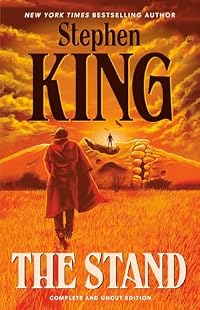
The Stand
by Stephen King
On This Page
Description
When a man escapes from a biological testing facility, he sets in motion a deadly domino effect, spreading a mutated strain of the flu that will wipe out 99 percent of humanity within a few weeks. The survivors who remain are scared, bewildered, and in need of a leader. Two emerge--Mother Abagail, the benevolent 108-year-old woman who urges them to build a peaceful community in Boulder, Colorado; and Randall Flagg, the nefarious "Dark Man," who delights in chaos and violence. As the dark man show more and the peaceful woman gather power, the survivors will have to choose between them--and ultimately decide the fate of all humanity. show lessTags
Recommendations


Member Reviews
I've never written a review this long but I've never read a book this long, so here we go.
My journey with The Stand began 9 months ago in January. I had heard of it the previous January as Covid-19 was becoming known and it sat on my TBR shelf all year. (Because why read about a devastating global pandemic WHILE you live it?) I've put it down to pick it up again and again many times, and also restarted it entirely once (maybe twice?) a third of the way through the book. This latest and final round took almost a month but I am finally FINISHED. 100%. It is done. And wow. My first Stephen King novel and I picked the longest one, what was I thinking?
So it's kind of a mixed bag. Some moments were exciting and terrifying and engaging, and show more some moments were stretched out and boring and tiring to get through. I am almost sure that the uncut 1990 version's 400 extra pages were better left cut out because around page 700 it really was getting to he a chore to stay committed to finishing the book.
Normally I enjoy a solid heavily character-driven book, and King does have quite a way with putting his characters on a page and making them real. At times, I was in awe of how real a character's thoughts and feelings seemed. I can't think of another time when a character's dread felt so real and relatable on a page.
But I felt more interested in the villains of the story and characters that just didn't get much page time. Everyone I found boring was just so damn predictable. (I think because we got such a long backstory for those characters, it was so easy to see who they were and what they would do next.) I was only ever interested in turning the page when an element of unpredictability was driving the story, such as what Flagg was doing, what role would Lloyd or Trash play, what is Harold going to do, what choices is Nick going to make. And every time that happened, the storyline would pause to go back to Larry or Frannie for a good boring chunk, and then skip past the point of interest with Lloyd or Harold where I was so interested! It was a huge tease the entire time and in writing it like that, it felt like I never read anything happening.
Also, although I've never read a Stephen King book before this, I am well aware of his more problematic tendencies. I have to say it was difficult not to throw the book at a wall every time he mentioned Frannie's breasts or Nadine's sacred virginity and her entire purpose as a character to have sex with a man. I just had to say it. We all know it but I've been screaming it into the pages for a month so I had to write it out.
And I really have to give it to the audiobook narrator, Grover Gardner, too. I listened to this audiobook as well as read this book, often concurrently, and I have no doubt I'd have given up and DNF'd this book without Gardner's amazing narration. Top. Notch. He gave so much character to the most boring sections that were a slog to read through. I have a 57-hour audiobook in my queue with his narration and now I can't wait to start it!
To top it all off, I read this in part to watch the new TV series, which was so god-awful I can't even. I can't. I'm so mad that they butchered it.
Anyway. I can't bear to give this more than 3 stars because while it was well-written in most spots, it just could have been a lot tighter with a lot more purpose. show less
My journey with The Stand began 9 months ago in January. I had heard of it the previous January as Covid-19 was becoming known and it sat on my TBR shelf all year. (Because why read about a devastating global pandemic WHILE you live it?) I've put it down to pick it up again and again many times, and also restarted it entirely once (maybe twice?) a third of the way through the book. This latest and final round took almost a month but I am finally FINISHED. 100%. It is done. And wow. My first Stephen King novel and I picked the longest one, what was I thinking?
So it's kind of a mixed bag. Some moments were exciting and terrifying and engaging, and show more some moments were stretched out and boring and tiring to get through. I am almost sure that the uncut 1990 version's 400 extra pages were better left cut out because around page 700 it really was getting to he a chore to stay committed to finishing the book.
Normally I enjoy a solid heavily character-driven book, and King does have quite a way with putting his characters on a page and making them real. At times, I was in awe of how real a character's thoughts and feelings seemed. I can't think of another time when a character's dread felt so real and relatable on a page.
But I felt more interested in the villains of the story and characters that just didn't get much page time. Everyone I found boring was just so damn predictable. (I think because we got such a long backstory for those characters, it was so easy to see who they were and what they would do next.) I was only ever interested in turning the page when an element of unpredictability was driving the story, such as what Flagg was doing, what role would Lloyd or Trash play, what is Harold going to do, what choices is Nick going to make. And every time that happened, the storyline would pause to go back to Larry or Frannie for a good boring chunk, and then skip past the point of interest with Lloyd or Harold where I was so interested! It was a huge tease the entire time and in writing it like that, it felt like I never read anything happening.
Also, although I've never read a Stephen King book before this, I am well aware of his more problematic tendencies. I have to say it was difficult not to throw the book at a wall every time he mentioned Frannie's breasts or Nadine's sacred virginity and her entire purpose as a character to have sex with a man. I just had to say it. We all know it but I've been screaming it into the pages for a month so I had to write it out.
And I really have to give it to the audiobook narrator, Grover Gardner, too. I listened to this audiobook as well as read this book, often concurrently, and I have no doubt I'd have given up and DNF'd this book without Gardner's amazing narration. Top. Notch. He gave so much character to the most boring sections that were a slog to read through. I have a 57-hour audiobook in my queue with his narration and now I can't wait to start it!
To top it all off, I read this in part to watch the new TV series, which was so god-awful I can't even. I can't. I'm so mad that they butchered it.
Anyway. I can't bear to give this more than 3 stars because while it was well-written in most spots, it just could have been a lot tighter with a lot more purpose. show less
I had planned on re-reading The Stand, but then the pandemic came along so I waited a couple of years. But I just read it for the fourth time and it's still just as good as I remember. Honestly, it's a actually a fairly simple story of good and evil, but the execution, the details, the richly drawn characters, the embodiment of selflessness and selfishness, and the fact that Stephen King seems to know all of our deepest darkest secrets and is willing to expose all of it in order to get to certain human truths ... all of that puts The Stand in a category of it's own. It's just that good.
In Stephen King’s foreword to the revised version of The Stand, his 1,200-page apocalyptic tale about the impact of an accidentally released military superflu, King explains that he published the new edition in order to restore 400 pages that were originally cut “at the behest of the accounting department” (rather than for any “editorial” reason). I wish he’d gone the other way and cut an additional 400 pages.
I don’t say this to be mean. I think King is an extraordinary writer. His horror masterpiece It scared the bejesus out of me (when I made the mistake of reading it alone, at night, in the country). And I loved On Writing, in which he describes his philosophy of crafting fiction by starting with a situation instead of show more an outline. But while The Stand has swathes of evocative description—my favorite: “It was if his face was held together by a number of unseen bolts and each of them had suddenly been loosened a turn and a half”—I think the narrative would have benefited from more detailed planning.
Because, strange as this is to write, King’s apocalypse is kinda boring.
He reveals early on that 99.4% of the population is going to be wiped out by the superflu (nicknamed Captain Trips). But it takes forever: non-essential characters come and go, the situation gradually gets worse, more non-essential characters flit through… it’s just not as riveting as you’d expect. Part of this is the foreshadowing—King repeatedly steps out of the story to explain how the disease will spread. These interludes felt jarring to me, and although the sense of impending doom they imparted sustained my (begrudging) interest through the lengthy passages King spends establishing what his main characters are like before everything goes to hell, having that advance knowledge also made me think, “Get on with it; can’t everyone hurry up and die?”—another strange comment to find yourself making.
Maybe I’ve just read and watched too many more-recent takes on the end of the world—although my favorite is still Richard Matheson’s 1954 classic I am Legend (of which King is a noted admirer)—but I wish The Stand had skipped the outbreak and started in the aftermath. The characters’ backstories could have been compressed and worked in as flashbacks; no one’s arc really gets going until the halfway point anyway, when the survivors of the superflu begin forming into two camps: a mostly benign “Free Zone” in Boulder, Colorado, and a mostly malignant opposition centered around Las Vegas.
That’s when things get biblical.
The two camps are led by antithetical symbols: the Free Zone coalesces around Mother Abigail, a God-fearing 108-year-old black woman; the Vegas castoffs are drawn to The Dark Man, a probable servant of the Devil. Both leaders wield forms of magic, and both use dreams to summon their followers.
And man, are there a lot of dreams. The religious imagery certainly fits with the end-of-the-world motif, but other people's dreams aren't that much more interesting to read than they are to listen to, even when they're written by a good writer. The bits where the Free Zone grapples with how to rebuild society are thought-provoking, but there's a fair amount of fat here as well. (King delivers several conversations in this section via committee minutes… committee minutes!)
Eventually, the Free Zone and The Dark Man take their respective “stands” against each other, and the novel progresses to a relatively satisfying conclusion. But I still wanted the journey to be shorter. In On Writing, King says his formula for editing is “2nd Draft = 1st Draft – 10%.” I wish he’d taken his own advice (and then some) while revising The Stand, because there’s an excellent 400-page novel inside.
It’s just badly outnumbered by pages that should have been—and stayed—cut.
(For more reviews like this one, see www.nickwisseman.com) show less
I don’t say this to be mean. I think King is an extraordinary writer. His horror masterpiece It scared the bejesus out of me (when I made the mistake of reading it alone, at night, in the country). And I loved On Writing, in which he describes his philosophy of crafting fiction by starting with a situation instead of show more an outline. But while The Stand has swathes of evocative description—my favorite: “It was if his face was held together by a number of unseen bolts and each of them had suddenly been loosened a turn and a half”—I think the narrative would have benefited from more detailed planning.
Because, strange as this is to write, King’s apocalypse is kinda boring.
He reveals early on that 99.4% of the population is going to be wiped out by the superflu (nicknamed Captain Trips). But it takes forever: non-essential characters come and go, the situation gradually gets worse, more non-essential characters flit through… it’s just not as riveting as you’d expect. Part of this is the foreshadowing—King repeatedly steps out of the story to explain how the disease will spread. These interludes felt jarring to me, and although the sense of impending doom they imparted sustained my (begrudging) interest through the lengthy passages King spends establishing what his main characters are like before everything goes to hell, having that advance knowledge also made me think, “Get on with it; can’t everyone hurry up and die?”—another strange comment to find yourself making.
Maybe I’ve just read and watched too many more-recent takes on the end of the world—although my favorite is still Richard Matheson’s 1954 classic I am Legend (of which King is a noted admirer)—but I wish The Stand had skipped the outbreak and started in the aftermath. The characters’ backstories could have been compressed and worked in as flashbacks; no one’s arc really gets going until the halfway point anyway, when the survivors of the superflu begin forming into two camps: a mostly benign “Free Zone” in Boulder, Colorado, and a mostly malignant opposition centered around Las Vegas.
That’s when things get biblical.
The two camps are led by antithetical symbols: the Free Zone coalesces around Mother Abigail, a God-fearing 108-year-old black woman; the Vegas castoffs are drawn to The Dark Man, a probable servant of the Devil. Both leaders wield forms of magic, and both use dreams to summon their followers.
And man, are there a lot of dreams. The religious imagery certainly fits with the end-of-the-world motif, but other people's dreams aren't that much more interesting to read than they are to listen to, even when they're written by a good writer. The bits where the Free Zone grapples with how to rebuild society are thought-provoking, but there's a fair amount of fat here as well. (King delivers several conversations in this section via committee minutes… committee minutes!)
Eventually, the Free Zone and The Dark Man take their respective “stands” against each other, and the novel progresses to a relatively satisfying conclusion. But I still wanted the journey to be shorter. In On Writing, King says his formula for editing is “2nd Draft = 1st Draft – 10%.” I wish he’d taken his own advice (and then some) while revising The Stand, because there’s an excellent 400-page novel inside.
It’s just badly outnumbered by pages that should have been—and stayed—cut.
(For more reviews like this one, see www.nickwisseman.com) show less
The military has been working on the next great form of biological warfare in order to protect the United States, should the time ever come. Something has gone horribly wrong and the super-flu these military scientists have created has been leaked inside their testing facility. What could have been a contained incident becomes an epidemic, as an infected personnel member attempts to outrun death. As he gathers his family and leaves town he spreads what will become known as Captain Trips to everyone he encounters. Only 1% of the world’s population will be immune and make it out alive.
The Captain Trips survivors are scattered across the United States, but something is connecting them together. These survivors are sharing the same show more dreams. Dreams of a mysterious man shrouded in darkness. Randall Flagg either haunts your dreams or has the ability to sway you to his darkness. Those living in fear of Flagg soon find a light to battle his dark, as Mother Abigail arrives in their dreams to show them where to head for safety. The country is torn into two camps. Randall Flagg versus Mother Abigail. Evil versus good. Who will win in this post-apocalyptic world?
The opening of THE STAND drops you into the outbreak of Captain Trips. King masterfully takes the reader on a journey through the country, getting you acquainted with the individuals who will become main characters to the story, as well as revealing instances of the disease affecting others. One of my favorite chapters during this set-up stage of the novel was focused on people who had managed to survive death by Captain Trips, but ended up not making it because of something else. There were some extremely entertaining incidents that had me laughing out loud. Any time an author can bring humor to a serious subject like this, wins points in my book.
As the novel progresses the reader is able to deeply connect with each main character as King chooses to focus chapters exclusively on one or a small party of these individuals. In typical King style he lured me into loving a character that he just couldn’t let make it to the end! I swear my heart is never safe with King! Despite the uncertainty of the fate of these characters, you find yourself either cheering for them or wishing Captain Trips would have just wiped them from the face of the Earth. Don’t worry though, those people have what’s coming for them! Also, if you’re curious, my favorite characters are Stu, Frannie, Nick, Tom, and Kojak. I even ended up liking Larry, which members of the read along I participated in will know...I was not a fan immediately! Least favorite character award definitely goes to Harold Lauder!
In an attempt not to give too much away I’m going to wrap up this review by saying...go read THE STAND! I know it’s huge. I know it’s daunting. I know you won’t find your groove until you commit a few hundred pages. It’s so worth it!!! THE STAND captured my interest, had me freaked out, broke my heart, made me laugh, and just all around solidified why I fell in love with Stephen King this year. show less
The Captain Trips survivors are scattered across the United States, but something is connecting them together. These survivors are sharing the same show more dreams. Dreams of a mysterious man shrouded in darkness. Randall Flagg either haunts your dreams or has the ability to sway you to his darkness. Those living in fear of Flagg soon find a light to battle his dark, as Mother Abigail arrives in their dreams to show them where to head for safety. The country is torn into two camps. Randall Flagg versus Mother Abigail. Evil versus good. Who will win in this post-apocalyptic world?
The opening of THE STAND drops you into the outbreak of Captain Trips. King masterfully takes the reader on a journey through the country, getting you acquainted with the individuals who will become main characters to the story, as well as revealing instances of the disease affecting others. One of my favorite chapters during this set-up stage of the novel was focused on people who had managed to survive death by Captain Trips, but ended up not making it because of something else. There were some extremely entertaining incidents that had me laughing out loud. Any time an author can bring humor to a serious subject like this, wins points in my book.
As the novel progresses the reader is able to deeply connect with each main character as King chooses to focus chapters exclusively on one or a small party of these individuals. In typical King style he lured me into loving a character that he just couldn’t let make it to the end! I swear my heart is never safe with King! Despite the uncertainty of the fate of these characters, you find yourself either cheering for them or wishing Captain Trips would have just wiped them from the face of the Earth. Don’t worry though, those people have what’s coming for them! Also, if you’re curious, my favorite characters are Stu, Frannie, Nick, Tom, and Kojak. I even ended up liking Larry, which members of the read along I participated in will know...I was not a fan immediately! Least favorite character award definitely goes to Harold Lauder!
In an attempt not to give too much away I’m going to wrap up this review by saying...go read THE STAND! I know it’s huge. I know it’s daunting. I know you won’t find your groove until you commit a few hundred pages. It’s so worth it!!! THE STAND captured my interest, had me freaked out, broke my heart, made me laugh, and just all around solidified why I fell in love with Stephen King this year. show less
Stephen King's "The Stand" is an awesomely epic creation. It's good versus evil writ large across the American landscape. It's heavy, detailed, and extremely rich in the characterizations of its people and themes.
The story is familiar - an apocalyptic virus is accidentally (and inevitably) released from a government lab. Over 99% of all human life is wiped out by what becomes known as 'Captain Trips'. This story is about those who survived.
The survivors are polarized around two god-like characters that magnetize individuals through their dreams. Mother Abigail Freemantle, a 108-year-old woman from Hemingford, Nebraska draws those with inherent goodness. Randall Flagg, from nowhere and everywhere, draws those with a slightly more show more dubious nature.
The story is broken down into three large chunks. The strongest is the first third focused on the survival tales of all key and secondary characters. Each have a special genetic make up that leaves them immune to Captain Trips. King builds his world character-by-character and circumstance-by-circumstance. There are no glimpses of Presidential edicts and worldwide coordinated response efforts. We're given a vivid view into a decimated world through the individual actions of individual characters.
The middle third of the book builds on the lives of these individuals, as they start to connect and socialize, primarily around Mother Abigail in Nebraska and then Boulder, but also in Flagg's domain centered on Las Vegas. The final third culminates the growing tension between good and evil, and how individuals and new societies move forward after such an incredible disaster.
I read the extended version of the novel it's a beast that clocks in at over 1,100 pages. But it flows very well. I've recently read King's "It" which I loved completely. King has a very special way of creating characters that makes each very relatable. While the 'relate-ability' factor is lower with the characters in "The Stand", he still crafts very unique and differentiated personalities, with very real and believable emotions and motivations.
Mother Abigail is a wonderfully strong character, acting as the collective conscience and vision in the Boulder Free Zone. But King has built something special in Randall Flagg. He represents anarchy and entropy. He doesn't embody chaos...he is chaos. King describes him as: “…a clot looking for a place to happen, a splinter of bone hunting a soft organ to puncture, a lonely lunatic cell looking for a mate -- they would set up housekeeping and raise themselves a cozy little malignant tumor."
When we're first introduced to Flagg as The Walkin' Dude meandering down a western highway, readying to gather his minions, King writes, ""He was known, well known, along the highways in hiding that are traveled by the poor and the mad, by the professional revolutionaries and by those who have been taught to hate..."
And at times, it's unclear where the dividing line is between Flagg and Captain Trips. "The beast is on its way," says General Starkey, commander of the facility that had housed the virus. "He was weeping and grinning. "It's on its way, and it's a good deal rougher than (we) ever could have imagined. Things are falling apart."”
The war of good versus evil is led by Flagg and Mother Abigail, and acted out by their soldiers; the amalgam of individuals living in their respective towns. King sprinkles a modicum of magic and fantasy throughout the story, which build up a mythology around the two semi-gods. Naturally, religion sprouts from these roots. The intensity and acceptance of this religious outgrowth varies by individual. Some survivors willingly and easily give themselves over to this magic, while others have a hard time letting go of their agnosticism. As the behaviors of individuals start to change, a new culture develops, which informs how the new society will behave.
One character explores the new religion: "The beauty of religious mania is that it has the power to explain everything. Once God (or Satan) is accepted as the first cause of everything which happens in the mortal world, nothing is left to chance...or change. Once such incantatory phrases as "we see now through a glass darkly" and "mysterious are the ways He chooses His wonders to perform" are mastered, logic can be happily tossed out the window."
In Boulder, Mother Abigail's clan seeks to build a different and better world than what had been destroyed, but it’s well founded in the world that they knew. Flagg, however, has no interest in bettering, outside of improving his own lot. He had no real goal, simply to 'win', to regenerate his own kind (whatever demon-creature he was); and create anarchy wherever he roamed. And while magic (or religion) played a very real and active role in the character's lives, they each had the freedom to make their own choices. "But for each individual cell there was the old, old question, the one that went back to the Garden -- did you eat the apple or leave it alone? Over there, in the West, they were already eating them a mess of apple pie and apple cobbler. The assassins of Eden were there, the dark fusiliers."
These two wondrous magicians arrive at a time when one could argue that god has forsaken his people. OVER 99% of all humanity has been wiped from the earth. In this context, one member of the Boulder Free Zone ponders whether "this the right time for gods."
I've had an internal debate of how to rate "The Stand" since I finished the book two days ago: 1) is this as good as "It" - the answer is "no". "It" was a terrifically affecting and a satisfying read and I can't get passed how enjoyable of a journey King created with his thorough blend of characters and story. 2) if "The Stand" isn't as good as "It", can it warrant an equal rating? I'm concluding that it can, if for no other reason than the insights and analytical discussions the book has spawned. King knows how to write engaging and deep characters that thread seamlessly throughout a large-scale epic story. I’ve concluded that the 1,000+ page investment was well worth the time. show less
The story is familiar - an apocalyptic virus is accidentally (and inevitably) released from a government lab. Over 99% of all human life is wiped out by what becomes known as 'Captain Trips'. This story is about those who survived.
The survivors are polarized around two god-like characters that magnetize individuals through their dreams. Mother Abigail Freemantle, a 108-year-old woman from Hemingford, Nebraska draws those with inherent goodness. Randall Flagg, from nowhere and everywhere, draws those with a slightly more show more dubious nature.
The story is broken down into three large chunks. The strongest is the first third focused on the survival tales of all key and secondary characters. Each have a special genetic make up that leaves them immune to Captain Trips. King builds his world character-by-character and circumstance-by-circumstance. There are no glimpses of Presidential edicts and worldwide coordinated response efforts. We're given a vivid view into a decimated world through the individual actions of individual characters.
The middle third of the book builds on the lives of these individuals, as they start to connect and socialize, primarily around Mother Abigail in Nebraska and then Boulder, but also in Flagg's domain centered on Las Vegas. The final third culminates the growing tension between good and evil, and how individuals and new societies move forward after such an incredible disaster.
I read the extended version of the novel it's a beast that clocks in at over 1,100 pages. But it flows very well. I've recently read King's "It" which I loved completely. King has a very special way of creating characters that makes each very relatable. While the 'relate-ability' factor is lower with the characters in "The Stand", he still crafts very unique and differentiated personalities, with very real and believable emotions and motivations.
Mother Abigail is a wonderfully strong character, acting as the collective conscience and vision in the Boulder Free Zone. But King has built something special in Randall Flagg. He represents anarchy and entropy. He doesn't embody chaos...he is chaos. King describes him as: “…a clot looking for a place to happen, a splinter of bone hunting a soft organ to puncture, a lonely lunatic cell looking for a mate -- they would set up housekeeping and raise themselves a cozy little malignant tumor."
When we're first introduced to Flagg as The Walkin' Dude meandering down a western highway, readying to gather his minions, King writes, ""He was known, well known, along the highways in hiding that are traveled by the poor and the mad, by the professional revolutionaries and by those who have been taught to hate..."
And at times, it's unclear where the dividing line is between Flagg and Captain Trips. "The beast is on its way," says General Starkey, commander of the facility that had housed the virus. "He was weeping and grinning. "It's on its way, and it's a good deal rougher than (we) ever could have imagined. Things are falling apart."”
The war of good versus evil is led by Flagg and Mother Abigail, and acted out by their soldiers; the amalgam of individuals living in their respective towns. King sprinkles a modicum of magic and fantasy throughout the story, which build up a mythology around the two semi-gods. Naturally, religion sprouts from these roots. The intensity and acceptance of this religious outgrowth varies by individual. Some survivors willingly and easily give themselves over to this magic, while others have a hard time letting go of their agnosticism. As the behaviors of individuals start to change, a new culture develops, which informs how the new society will behave.
One character explores the new religion: "The beauty of religious mania is that it has the power to explain everything. Once God (or Satan) is accepted as the first cause of everything which happens in the mortal world, nothing is left to chance...or change. Once such incantatory phrases as "we see now through a glass darkly" and "mysterious are the ways He chooses His wonders to perform" are mastered, logic can be happily tossed out the window."
In Boulder, Mother Abigail's clan seeks to build a different and better world than what had been destroyed, but it’s well founded in the world that they knew. Flagg, however, has no interest in bettering, outside of improving his own lot. He had no real goal, simply to 'win', to regenerate his own kind (whatever demon-creature he was); and create anarchy wherever he roamed. And while magic (or religion) played a very real and active role in the character's lives, they each had the freedom to make their own choices. "But for each individual cell there was the old, old question, the one that went back to the Garden -- did you eat the apple or leave it alone? Over there, in the West, they were already eating them a mess of apple pie and apple cobbler. The assassins of Eden were there, the dark fusiliers."
These two wondrous magicians arrive at a time when one could argue that god has forsaken his people. OVER 99% of all humanity has been wiped from the earth. In this context, one member of the Boulder Free Zone ponders whether "this the right time for gods."
I've had an internal debate of how to rate "The Stand" since I finished the book two days ago: 1) is this as good as "It" - the answer is "no". "It" was a terrifically affecting and a satisfying read and I can't get passed how enjoyable of a journey King created with his thorough blend of characters and story. 2) if "The Stand" isn't as good as "It", can it warrant an equal rating? I'm concluding that it can, if for no other reason than the insights and analytical discussions the book has spawned. King knows how to write engaging and deep characters that thread seamlessly throughout a large-scale epic story. I’ve concluded that the 1,000+ page investment was well worth the time. show less
A very entertaining story - good versus evil -- part survivalist, part adventure, part fantasy. It's not one of King's scary ones -- it makes you contemplate and wonder: "what if?". Maybe to create a story, maybe not, the weirdest characters emerge from the super-flu apocalypse. Made me wonder if any normal people survived, but that wasn't explained so the answer must be just story. It was an American book and very, very detailed in many ways; kinda makes you imagine that Steven King had traveled to all these places. Beware, the book is long, longer than any book I've ever read, nearly 48 hours of listening and 1100+ pages of reading.
This was a long (it's 1153 pages, after all) summer reading project with my son. We each read from our own Complete and Uncut edition, and would talk about it as we moved through the story. I probably enjoyed The Stand more than I would have otherwise.
Of particular interest, being Deaf myself, was the deaf character Nick Andros and how he was portrayed by Stephen King. Although Nick is often referred to as deaf-mute (an unacceptable term) and has unrealistic super-power lip-reading skills, he was portrayed sympathetically and as a good, strong character. The novelist Sara Novic discussed this in depth, and better than I could, in this: https://believermag.com/silence/ (scroll down to find her essay "A Good Deaf Man is Hard to Find"). show more
Overall, this was an epic novel that's especially memorable reading during 2020 because of its pandemic story line, although most of it is post-apocalyptic rather than the Captain Trips illness itself. show less
Of particular interest, being Deaf myself, was the deaf character Nick Andros and how he was portrayed by Stephen King. Although Nick is often referred to as deaf-mute (an unacceptable term) and has unrealistic super-power lip-reading skills, he was portrayed sympathetically and as a good, strong character. The novelist Sara Novic discussed this in depth, and better than I could, in this: https://believermag.com/silence/ (scroll down to find her essay "A Good Deaf Man is Hard to Find"). show more
Overall, this was an epic novel that's especially memorable reading during 2020 because of its pandemic story line, although most of it is post-apocalyptic rather than the Captain Trips illness itself. show less
Members
- Recently Added By
Lists

Favorite Long Books
330 works; 42 members

SHOULD Read Books!
354 works; 9 members
Author Information

966+ Works 867,771 Members
Stephen King was born in Portland, Maine, on September 21, 1947. After graduating with a Bachelor's degree in English from the University of Maine at Orono in 1970, he became a teacher. His spare time was spent writing short stories and novels. King's first novel would never have been published if not for his wife. She removed the first few show more chapters from the garbage after King had thrown them away in frustration. Three months later, he received a $2,500 advance from Doubleday Publishing for the book that went on to sell a modest 13,000 hardcover copies. That book, Carrie, was about a girl with telekinetic powers who is tormented by bullies at school. She uses her power, in turn, to torment and eventually destroy her mean-spirited classmates. When United Artists released the film version in 1976, it was a critical and commercial success. The paperback version of the book, released after the movie, went on to sell more than two-and-a-half million copies. Many of King's other horror novels have been adapted into movies, including The Shining, Firestarter, Pet Semetary, Cujo, Misery, The Stand, and The Tommyknockers. Under the pseudonym Richard Bachman, King has written the books The Running Man, The Regulators, Thinner, The Long Walk, Roadwork, Rage, and It. He is number 2 on the Hollywood Reporter's '25 Most Powerful Authors' 2016 list. King is one of the world's most successful writers, with more than 100 million copies of his works in print. Many of his books have been translated into foreign languages, and he writes new books at a rate of about one per year. In 2003, he received the National Book Foundation Medal for Distinguished Contribution to American Letters. In 2012 his title, The Wind Through the Keyhole made The New York Times Best Seller List. King's title's Mr. Mercedes and Revival made The New York Times Best Seller List in 2014. He won the Edgar Allan Poe Award in 2015 for Best Novel with Mr. Mercedes. King's title Finders Keepers made the New York Times bestseller list in 2015. Sleeping Beauties is his latest 2017 New York Times bestseller. (Bowker Author Biography) Stephen King is the author of more than thirty books, all of them worldwide bestsellers. Among his most recent are "Hearts in Atlantis", "The Girl Who Loved Tom Gordon", "Bag of Bones", & "The Green Mile". "On Writing" is his first book of nonfiction since "Danse Macabre", published in 1981. He served as a judge for Prize Stories: The Best of 1999, The O. Henry Awards. He lives in Bangor, Maine with his wife, novelist Tabitha King. King's book, The Bazaar of Bad Dreams: Stories, made the 2015 New York Times bestseller list. (Publisher Provided) show less
Common Knowledge
- Canonical title
- The Stand
- Original publication date
- 1978
- Canonical DDC/MDS
- 813.54
- Canonical LCC
- PS3561.I483
Classifications
Statistics
- Members
- 3,397
- Popularity
- 4,902
- Reviews
- 46
- Rating
- (4.29)
- Languages
- English
- Media
- Paper, Ebook
- ISBNs
- 1
- ASINs
- 1