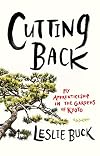
Cutting Back: My Apprenticeship in the Gardens of Kyoto
by Leslie Buck
On This Page
Description
At thirty-five, Leslie Buck made an impulsive decision to put her personal life on hold to pursue her passion. Leaving behind a full life of friends, love, and professional security, she became the first American woman to learn pruning from one of the most storied landscaping companies in Kyoto. Cutting Back recounts Buck's bold journey and the revelations she has along the way. During her apprenticeship in Japan, she learns that the best Kyoto gardens look so natural they appear untouched show more by human hands, even though her crew spends hours meticulously cleaning every pebble in the streams. She is taught how to bring nature's essence into a garden scene, how to design with native plants, and how to subtly direct a visitor through a landscape. But she learns the most important lessons from her fellow gardeners: how to balance strength with grace, seriousness with humor, and technique with heart. show lessTags
Recommendations






























Member Reviews
A young, successful business owner decides that she wants to further her tree pruning skills with an apprenticeship in Koyoto, Japan and winds up on an elite landscaping company that shows her no leniency nor favoritism. 6 day, 10 hour weeks into the chills of winter teach her humility, tenacity and a skill set that's almost Garden Tao. She does not speak Japanese, nor do they American, so much of her duties are hopeful completions with determined vigor. She gets homesick for her boyfriend and the warmth of her home in California, but acquires such a dignified work ethic that it's worth every miserable minute. Acquiescent to the ways of the country, she bows deeper, demures readily, and soaks up the traditions she meets in every new show more garden she tends. A novelty to most in an occupation held primarily by men, she hardly blends in..yet holds her own against the near tyranny of the "bossman" .. Towards the end of her apprenticeship, she is near breaking, but perseveres to the end, respectfully among the team she worked with. There are many "hacks" offered and splendid garden "views" shared, along with the amazing people she meets who own or run these quintessential gardens.
The book got sloppy towards the end, probably due to deadlines, with a couple paragraphs being repeated and spaces missed between sentence ends, but it hardly distracted from the joy of reading this book. Right there with "Lab Girl" by Hope Jahren, it will remain in my Garden collection to read again and again. show less
The book got sloppy towards the end, probably due to deadlines, with a couple paragraphs being repeated and spaces missed between sentence ends, but it hardly distracted from the joy of reading this book. Right there with "Lab Girl" by Hope Jahren, it will remain in my Garden collection to read again and again. show less
I'm very much an amateur gardener (when I can be bothered to garden), so I was awed by the work described in this memoir, which depicts the author's experience working for a gardening company in Japan. Working in another culture, barely speaking the language, the author provides insight into so many Japanese gardens - from small residential plots to grand imperial showcases. It's a fascinating tour of a world I had never really imagined. The author also discusses how her experience drained her, her struggles working in a culture she didn't fully understand, and how she managed to endure - all of which resonated with me.
Buck served an apprenticeship as an aesthetic gardener in Japan in the late 90s. In this intriguing telling of her experience, I learned much more about Japanese work culture and social mores than I did about gardening per se. But that was okay, because it was all interesting (though a bit repetitive, occasionally). I can't help but wonder if the female-deprecating work culture has changed in the last 20-plus years. But given the tradition-bound nature of the gardener's art there, I would guess not much.
A young, successful business owner decides that she wants to further her tree pruning skills with an apprenticeship in Koyoto, Japan and winds up on an elite landscaping company that shows her no leniency nor favoritism. 6 day, 10 hour weeks into the chills of winter teach her humility, tenacity and a skill set that's almost Garden Tao. She does not speak Japanese, nor do they American, so much of her duties are hopeful completions with determined vigor. She gets homesick for her boyfriend and the warmth of her home in California, but acquires such a dignified work ethic that it's worth every miserable minute. Acquiescent to the ways of the country, she bows deeper, demures readily, and soaks up the traditions she meets in every new show more garden she tends. A novelty to most in an occupation held primarily by men, she hardly blends in..yet holds her own against the near tyranny of the "bossman" .. Towards the end of her apprenticeship, she is near breaking, but perseveres to the end, respectfully among the team she worked with. There are many "hacks" offered and splendid garden "views" shared, along with the amazing people she meets who own or run these quintessential gardens.
The book got sloppy towards the end, probably due to deadlines, with a couple paragraphs being repeated and spaces missed between sentence ends, but it hardly distracted from the joy of reading this book. Right there with "Lab Girl" by Hope Jahren, it will remain in my Garden collection to read again and again. show less
The book got sloppy towards the end, probably due to deadlines, with a couple paragraphs being repeated and spaces missed between sentence ends, but it hardly distracted from the joy of reading this book. Right there with "Lab Girl" by Hope Jahren, it will remain in my Garden collection to read again and again. show less
Better than I thought it would be, but still not great. As this book is from a publisher that mostly produces books on gardening, I feel it's reasonable for me to say that I wish the book was more about plants, pruning, and the gardens where Buck worked. As a travel/coming-of-age narrative the book was fine, but not really anything exceptional. Buck can be commended for attempting to learn about Japanese culture before beginning her apprenticeship, yet she does come across as a privileged American in many ways.
I don't know how many other books exist on the topic of westerners working in Japanese apprenticeships, so if you're interested in that topic this book would be worth reading, or at least skimming.
I don't know how many other books exist on the topic of westerners working in Japanese apprenticeships, so if you're interested in that topic this book would be worth reading, or at least skimming.
While I enjoyed reading this book and learning more of the culture which produces such gardening masterpieces, I was also in two minds about the 'suffering' Leslie Buck went through. Was it necessary to have such dis-regard for self? Is the Japanese employment situation really so dire?
I want to like Japan but reading a book like this makes me think that I see the country through rose-tinted glasses. Having stayed with a family in rural Japan, I now wonder did I offend them? was I sufficiently grateful?
I didn't like her use of the expletive 'Jesus' - it just didn't contribute to the story. She was honest enough without being more honest!!
The boyfriend sub-plot was an effective foil to the story.
Her book has sent me back to a book I have show more on Japanese gardens, where I can ponder the possible techniques that she learned, and which might have produced these gardens. show less
I want to like Japan but reading a book like this makes me think that I see the country through rose-tinted glasses. Having stayed with a family in rural Japan, I now wonder did I offend them? was I sufficiently grateful?
I didn't like her use of the expletive 'Jesus' - it just didn't contribute to the story. She was honest enough without being more honest!!
The boyfriend sub-plot was an effective foil to the story.
Her book has sent me back to a book I have show more on Japanese gardens, where I can ponder the possible techniques that she learned, and which might have produced these gardens. show less
A Naturalist Delight
There is a difference between learning the tricks of the trade and becoming a master artisan. The author devoted over twenty years learning how to prune trees. Cutting Back is specifically about time spent in Japan where its society revers traditional gardeners like Olympic level athletes. She shares her experience through vivid descriptions of the people, places, and a love affair with plants. The passion and care that goes into making each plant shine and thrive within its environment is similar to a spiritual journey. Delightful images, like the one of a pruner snoring in a tree fifteen feet above the ground, are woven throughout. It was interesting how little difference there was in Japanese and American culture show more when it came to a female working in a male dominated profession. One overriding premise came through loud and clear, gardening is very hard work when done correctly, but the results can be spectacular.
The author is a certified aesthetic pruner and owns her own landscape pruning company in the San Francisco Bay area. She has also worked with the Merritt College Pruning Club and other public institutions including the UC Botanical Garden, Portland Japanese Garden, and Tassajara Zen Center.
I received this book free through Net Galley. Although encouraged as a courtesy to provide feedback to the publisher, I was under no obligation to write a review. The opinions I have expressed are my own. show less
There is a difference between learning the tricks of the trade and becoming a master artisan. The author devoted over twenty years learning how to prune trees. Cutting Back is specifically about time spent in Japan where its society revers traditional gardeners like Olympic level athletes. She shares her experience through vivid descriptions of the people, places, and a love affair with plants. The passion and care that goes into making each plant shine and thrive within its environment is similar to a spiritual journey. Delightful images, like the one of a pruner snoring in a tree fifteen feet above the ground, are woven throughout. It was interesting how little difference there was in Japanese and American culture show more when it came to a female working in a male dominated profession. One overriding premise came through loud and clear, gardening is very hard work when done correctly, but the results can be spectacular.
The author is a certified aesthetic pruner and owns her own landscape pruning company in the San Francisco Bay area. She has also worked with the Merritt College Pruning Club and other public institutions including the UC Botanical Garden, Portland Japanese Garden, and Tassajara Zen Center.
I received this book free through Net Galley. Although encouraged as a courtesy to provide feedback to the publisher, I was under no obligation to write a review. The opinions I have expressed are my own. show less
Members
- Recently Added By
Author Information
1 Work 84 Members
Classifications
- Genres
- Home & Garden, Nonfiction, Biography & Memoir, General Nonfiction, Travel
- DDC/MDS
- 635.0952076 — Technology Agriculture Garden crops (Horticulture) modified standard subdivisions History, geographic treatment, biography Asia
- LCC
- SB458 .B83 — Agriculture Horticulture. Plant propagation. Plant breeding Plant culture Gardens and gardening
- BISAC
Statistics
- Members
- 84
- Popularity
- 377,726
- Reviews
- 12
- Rating
- (3.79)
- Languages
- English
- Media
- Paper, Audiobook, Ebook
- ISBNs
- 6
- ASINs
- 2