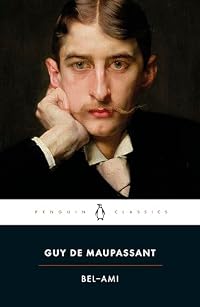
Bel-Ami
by Guy de Maupassant
On This Page
Description
Fiction. Literature. Guy de Maupassant is revered for his naturalistic fiction, which brilliantly captures flesh-and-blood characters as it evokes the most telling details of everyday life. Considered one of the finest French novels ever written, Bel Ami follows journalist Georges Duroy and his increasing stature among the Paris elite. With an immense thirst for power, Georges is not above an almost gleeful use of wealthy mistresses to achieve his ends.Tags
Recommendations









































Member Recommendations


Princess_Hana Very similar contexts
Member Reviews
Muito bem escrito o romance narra a história de Georges Duroy um dom juan francês passado no final do século XIX. O livro inicia com o personagem contando os centavos para saber se teria dinheiro para fazer refeições até o final do mês. Calculava se teria como tomar ou não um copo de cerveja naquela noite do dia 27 ainda longe da data que receberia seu parco salário na rede ferroviária. O livro termina com mesmo personagem milionário casando com a filha de um milionário, banqueiro e dono de vários negócios numa cerimônia conduzida pelo bispo e com toda a nata da elite francesa presente. Entre esses dois eventos vemos o desenrolar da vida de um jovem ambicioso, galante e usa de suas amizades e poder de sedução para show more conseguir benefício próprio, quase sempre com pouco escrúpulo, e muito cinismo. De modo nenhum ficamos do lado do personagem, não temos nenhuma simpatia por ele. Ele é um outsider, filho de camponeses pobres, alguém que aprende o jogo da intriga mas não joga com a mesma "ética" que a elite joga. Sua primeira esposa, Madeleine, mais inteligente, mais perspicaz e pragmática que ele, é uma libertina que aprendeu bem como se caminha nesses desvãos para conseguir vantagens, mas mantém um ar de nobreza, pois ela, apesar de libertina (amante de políticos e homens de poder) ela é parte dessa realidade e joga o jogo político dentro das regras impostas pelos seus participantes. Duroy não, um completo estranho, que aprende como navegar e manipular políticos e a elite burguesa. Sem pudores e de forma muito mais simplista faz uso das mesmas ferramentas porém sem se preocupar em preservar o status quo geral e as aparências. Acaba sendo admirado, temido e odiado. A personalidade frágil, insegura e muitas vezes ridícula de Georges são confrontadas com a das três mulheres presentes em sua vida. Do ponto de vista literário somente uma parte do livro parece enxertada estranhamente no final como se tivesse sido inserida a posteriori, trata-se da cena passada na casa do casal Walter descrevendo o desespero da Sra Walter quando se dá conta que o marido vai aceitar o pedido da mão de sua filha feito pelo Sr Du Roy. Essa cena toda passada no palácio dos Walter vai contra toda a lógica narrativa do livro que se mantém rigorosamente dentro dos espaços onde o protagonista está presente, com exceção dessa cena. Não sei o motivo, mas de qualquer forma me causou um certo espanto, pois inclusive é uma cena desnecessária para a história. show less
Here's to scalawags; I loved this tale of triumph about an absolute bastard who quickly understands how the world works. I thought at times that Bel-Ami was an almost self-conscious pastiche of sorts, including the better bits from previous hallmark novels of Parisian decadence. Apparently, such wasn't exclusively the case. The novel remains an incredible joy, a vibrant pulse of narrative curiosity and folly.
Bel Ami by Guy de Maupassant is set in Paris and depicts the belle epoque era as it tells the story of Georges Duroy, an opportunistic young man who grows more and more corrupted as the book advances. Georges is a user of people and doesn’t seem to care much if he is taking advantage of a male or a female. As he rises to success in the field of journalism, he does so on the backs of the people that have helped him achieve his position.
At the beginning of the book, George is a handsome young man who is penniless and without prospects. At this point in the story it is possible to feel some sympathy for him but that quickly disappears as he begins to covet wealth and influence and climbs the social ladder by using his cunning, wit and show more his built-in appeal to rich and powerful women. It is all about what they can do for him. His nickname is Bel Ami which means beautiful friend, but his beauty is only skin-deep and his friendship is only for himself.
Although peopled, for the most part, with selfish and soulless characters, I enjoyed this very short book. The Parisian setting showed a lively and pleasure seeking society, and the narcissist rake, George Duroy, was fascinating to read about. show less
At the beginning of the book, George is a handsome young man who is penniless and without prospects. At this point in the story it is possible to feel some sympathy for him but that quickly disappears as he begins to covet wealth and influence and climbs the social ladder by using his cunning, wit and show more his built-in appeal to rich and powerful women. It is all about what they can do for him. His nickname is Bel Ami which means beautiful friend, but his beauty is only skin-deep and his friendship is only for himself.
Although peopled, for the most part, with selfish and soulless characters, I enjoyed this very short book. The Parisian setting showed a lively and pleasure seeking society, and the narcissist rake, George Duroy, was fascinating to read about. show less
This is the first novel by Maupassant I’ve read and I found it heady stuff. As ever, I’m glad I read the introduction last, as it analyses the whole thing to death. It was interesting to read afterwards, though. As was the translator’s note, in which Mauldon comments that she struggled at times to get the tone right, as it is a very male-oriented, misogynist novel. I did feel at times that the original French was surely more voluptuous than what I was reading. Then again, it is tricky to retain a particular air when translating fiction, something Alberto Manguel wrote thoughtfully about. This translation certainly achieved a singular beauty and I greatly enjoyed it.
Duroy, or Bel-Ami, is a fascinating character. He can be described show more as ambitious, opportunistic, weak in some ways, cruel at times, materialistic, not terribly self-aware, cunning, and vain. Although I disliked him, I found his perspective fascinating. His social climbing showcases fin de siecle Paris in all its hypocrisy, venality, and immorality. The minutiae of life are omnipresent - prices, foodstuffs, hobbies, and furnishings. I loved these details, which are then periodically thrown into contrast with the stark reality of short human life and inevitable death. Norbert de Varenne’s monologue on this subject is absolutely chilling.
To my mind, the most sympathetic and interesting character is Madeleine, a cool, collected, and very clever woman. She is evidently a talented journalist, although she writes via men. Unlike the other female characters, who tends towards the histrionic and infantilised, Madeleine is allowed an air of dignity. Bel-Ami’s interactions with women in general reminded me of [b:Dangerous Liaisons|49540|Les Liaisons dangereuses|Pierre-Ambroise Choderlos de Laclos|https://images.gr-assets.com/books/1298425654s/49540.jpg|3280025], albeit with an interesting historical contrast. The 18th century world of Liaisons was one of idle pleasure-seeking, whereas the 19th century of Bel-Ami is rife with restless political ambition. The novel presents a very ambivalent picture of social mobility. Duroy’s rise from poverty (although he was never amongst les misérables; his parents ran a rural tavern) seemed to demonstrate that to achieve success you had to be amoral and unscrupulous. Bel-Ami felt at times like a Greek tragedy in the making, but perhaps the tragedy is that hubris is rewarded rather than punished. I definitely found it pessimistic overall, but sparklingly well written. Actually, in that respect it reminded me slightly of [b:The Great Gatsby|4671|The Great Gatsby|F. Scott Fitzgerald|https://images.gr-assets.com/books/1438728255s/4671.jpg|245494]. show less
Duroy, or Bel-Ami, is a fascinating character. He can be described show more as ambitious, opportunistic, weak in some ways, cruel at times, materialistic, not terribly self-aware, cunning, and vain. Although I disliked him, I found his perspective fascinating. His social climbing showcases fin de siecle Paris in all its hypocrisy, venality, and immorality. The minutiae of life are omnipresent - prices, foodstuffs, hobbies, and furnishings. I loved these details, which are then periodically thrown into contrast with the stark reality of short human life and inevitable death. Norbert de Varenne’s monologue on this subject is absolutely chilling.
To my mind, the most sympathetic and interesting character is Madeleine, a cool, collected, and very clever woman. She is evidently a talented journalist, although she writes via men. Unlike the other female characters, who tends towards the histrionic and infantilised, Madeleine is allowed an air of dignity. Bel-Ami’s interactions with women in general reminded me of [b:Dangerous Liaisons|49540|Les Liaisons dangereuses|Pierre-Ambroise Choderlos de Laclos|https://images.gr-assets.com/books/1298425654s/49540.jpg|3280025], albeit with an interesting historical contrast. The 18th century world of Liaisons was one of idle pleasure-seeking, whereas the 19th century of Bel-Ami is rife with restless political ambition. The novel presents a very ambivalent picture of social mobility. Duroy’s rise from poverty (although he was never amongst les misérables; his parents ran a rural tavern) seemed to demonstrate that to achieve success you had to be amoral and unscrupulous. Bel-Ami felt at times like a Greek tragedy in the making, but perhaps the tragedy is that hubris is rewarded rather than punished. I definitely found it pessimistic overall, but sparklingly well written. Actually, in that respect it reminded me slightly of [b:The Great Gatsby|4671|The Great Gatsby|F. Scott Fitzgerald|https://images.gr-assets.com/books/1438728255s/4671.jpg|245494]. show less
Georges Duroy, an ex-soldier down on his luck meets a former comrade, who offers him a job as a journalist. Georges starts to make his way up 1880s French society by manipulating and seducing a series of women.
Even allowing for the differences between views of women then and now, Georges is a nasty piece of work as he uses and discards the women he seduces. I kept waiting for him to get his comeuppance but of course nothing stops his irresistible rise. Despite my dislike of him, I felt unable to look away, which is I suppose a tribute to de Maupassant's writing.
Even allowing for the differences between views of women then and now, Georges is a nasty piece of work as he uses and discards the women he seduces. I kept waiting for him to get his comeuppance but of course nothing stops his irresistible rise. Despite my dislike of him, I felt unable to look away, which is I suppose a tribute to de Maupassant's writing.
A Viking - or technically speaking a Norman - of the salons & boulevards: When everything around you is degeneracy, social entropy, & decline, all that remains is to become the boldest, most tactically dazzling, or least scrupulous at taking possession of it.
This book spirals downwards in a debilitating circle of debauchery as George Duroy aims to satsify his lust for power and possession. He’ll stop at nothing to get what he wants. It’s basically a manual for how to get ahead in business and politics.
At the start George is offered a job on a newspaper which helps him defray some small debt he has got into. He can’t write for toffee and ends up getting someone else to do it for him. But payment and his first brush with success feeds his lust for more and he latches on to every foothold that will heave him up the ladder.
A desire for thousands of francs becomes one for millions. He enters relationship after relationship using each of his women as stepping stones to position. It’s show more obvious that, on the whole, they are using him to do the same so there’s no pity wasted there. It’s a bit of a page-turner for its age.
I won’t tell you how it ends but I felt that de Maupassant was asking some questions about morality in ways I’d not heard them asked before. I wondered if he was asking, so what if you’re immoral, there’s no judgement anyway. Let’s assume there isn’t, does that justify immorality anyway? I’m not too sure. It’s the lack of consideration of the victims we tread over in our lust to fulfil our own desires that worries me. I didn’t see too much of that illustrated in Bel Ami. show less
At the start George is offered a job on a newspaper which helps him defray some small debt he has got into. He can’t write for toffee and ends up getting someone else to do it for him. But payment and his first brush with success feeds his lust for more and he latches on to every foothold that will heave him up the ladder.
A desire for thousands of francs becomes one for millions. He enters relationship after relationship using each of his women as stepping stones to position. It’s show more obvious that, on the whole, they are using him to do the same so there’s no pity wasted there. It’s a bit of a page-turner for its age.
I won’t tell you how it ends but I felt that de Maupassant was asking some questions about morality in ways I’d not heard them asked before. I wondered if he was asking, so what if you’re immoral, there’s no judgement anyway. Let’s assume there isn’t, does that justify immorality anyway? I’m not too sure. It’s the lack of consideration of the victims we tread over in our lust to fulfil our own desires that worries me. I didn’t see too much of that illustrated in Bel Ami. show less
Members
- Recently Added By
Published Reviews
35 livres cultes à lire au moins une fois dans sa vie
Quels sont les romans qu'il faut avoir lu absolument ? Un livre culte qui transcende, fait réfléchir, frissonner, rire ou pleurer… La littérature est indéniablement créatrice d’émotions. Si vous êtes adeptes des classiques, ces titres devraient vous plaire.
De temps en temps, il n'y a vraiment rien de mieux que de se poser devant show more un bon bouquin, et d'oublier un instant le monde réel. Mais si vous êtes une grosse lectrice ou un gros lecteur, et que vous avez épuisé le stock de votre bibliothèque personnelle, laissez-vous tenter par ces quelques classiques de la littérature. show less
Quels sont les romans qu'il faut avoir lu absolument ? Un livre culte qui transcende, fait réfléchir, frissonner, rire ou pleurer… La littérature est indéniablement créatrice d’émotions. Si vous êtes adeptes des classiques, ces titres devraient vous plaire.
De temps en temps, il n'y a vraiment rien de mieux que de se poser devant show more un bon bouquin, et d'oublier un instant le monde réel. Mais si vous êtes une grosse lectrice ou un gros lecteur, et que vous avez épuisé le stock de votre bibliothèque personnelle, laissez-vous tenter par ces quelques classiques de la littérature. show less
added by Joop-le-philosophe
Lists

The Guardian's 1000 Novels Everyone Must Read
1,005 works; 546 members

Best of French Literature
138 works; 27 members

1001 Books You Must Read Before You Die
1,448 works; 1,132 members

Favourite 19th century fiction
257 works; 60 members

The Top Ten: Writers Pick Their Favorite Books
240 works; 31 members

Favourite Books
1,817 works; 308 members

French Books
102 works; 15 members

Top Five Books of 2017
757 works; 231 members
LibraryThingers' 1001 Books You Must Read Before You Die
442 works; 30 members

Western World's Greatest Books - Project Gutenberg
295 works; 15 members
Blue Pyramid 1,276 Best Books of All Time
1,248 works; 32 members

A High School Trip to France
57 works; 5 members

Authors from France
23 works; 2 members

1,001 BYMRBYD Concensus
723 works; 27 members
Paris, City of Lights
103 works; 17 members

Books Read in 2016
4,666 works; 199 members

19th Century
190 works; 16 members

Tagged 19th Century
104 works; 7 members

Books I recommend to everyone
29 works; 1 member

Class mobility in fiction
18 works; 1 member

Books Read in 2026
1,663 works; 62 members
Author Information

2,536+ Works 26,548 Members
Henry-René-Albert-Guy de Maupassant was born on August 5, 1850 in France. He was schooled at a seminary in Yvetot and Le Harve. He fought in the Franco-German War, then held civil service posts with the Ministry of the Navy and the Ministry of Public Instruction. He also worked with Gustave Flaubert, who helped him develop his writing talent and show more introduced him to many literary greats. During his lifetime, he wrote six novels, three travel books, one book of verse, and over 300 short stories. He is considered one of the fathers of the modern short story. His works include The Necklace, A Piece of String, Mademoiselle Fifi, Miss Harriet, My Uncle Jules, Found on a Drowned Man, and The Wreck. He suffered from mental illness in his later years and attempted suicide on January 2, 1892. He was committed to a private asylum in Paris, where he died on July 6, 1893. (Bowker Author Biography) show less
Some Editions
Awards and Honors
Distinctions
Notable Lists
Series
Belongs to Publisher Series
's Werelds meest geliefde boeken (dl. 61)
Amstelboeken (56-57)
GF Flammarion (1356)
Medallion Penguin Classics (L115)
Le livre de poche (0619)
A tot vent (199)
insel taschenbuch (0280)
dtv (12934)
Penguin Classics (L115)
Gallimard, Folio (471-865)
Work Relationships
Is contained in
Has as a commentary on the text
Has as a student's study guide
Common Knowledge
- Canonical title*
- Bel-ami
- Original title
- Bel-Ami
- Alternate titles*
- Vrindje; De strever; Adonis
- Original publication date
- 1885
- People/Characters
- Georges Duroy, later Baron Georges du Roy de Cantel, "Bel-Ami"; Clotilde de Marelle; Madeleine Forestier; Charles Forestier; M. Walter; Virginie Walter
- Important places
- Paris, France; Cannes, Alpes-Maritimes, Provence-Alpes-Côte d'Azur, France; Canteleu, Normandy, France
- Related movies
- The Private Affairs of Bel Ami (1947 | IMDb); Bel Ami (2011 | IMDb)
- First words
- Quand la caissière lui eut rendu la monnaie de sa pièce de cent sous, Georges Duroy sortit du restaurant.
After changing his five-franc piece Georges Duroy left the restaurant. - Last words
- (Click to show. Warning: May contain spoilers.)Mais il ne les voyait point; sa pensée maintenant revenait en arrière, et devant ses yeux éblouis par l'éclatant soleil flottait l'image de Mme de Marelle rajustant en face de la glace les petits cheveux frisés de ses tempes, toujours défaits au sortir du lit.
(Click to show. Warning: May contain spoilers.)Leisurely they descended the steps between two rows of spectators, but Georges did not see them; his thoughts had returned to the past, and before his eyes, dazzled by the bright sunlight, floated the image of Mme. de Marelle, rearranging the curly locks upon her temples before the mirror in their apartments. - Original language
- French
- Disambiguation notice*
- Nederlandse ed. ook verschenen o.d.t.: Vrindje, De strever, Adonis
*Some information comes from Common Knowledge in other languages. Click "Edit" for more information.
Classifications
Statistics
- Members
- 3,593
- Popularity
- 4,508
- Reviews
- 70
- Rating
- (3.87)
- Languages
- 27 — Arabic, Bulgarian, Catalan, Czech, Danish, Dutch, English, Estonian, Finnish, French, German, Greek, Hebrew, Hungarian, Italian, Korean, Lithuanian, Polish, Portuguese, Romanian, Russian, Croatian, Slovenian, Spanish, Swedish, Turkish, Yiddish
- Media
- Paper, Audiobook, Ebook
- ISBNs
- 339
- UPCs
- 1
- ASINs
- 125