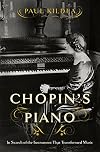
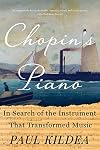
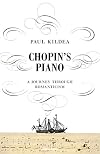
Chopin's Piano: In Search of the Instrument that Transformed Music
by Paul Kildea
On This Page
Description
"In November 1838, Fr??ic Chopin, George Sand, and her two children sailed to Majorca to escape the Parisian winter. They settled in an abandoned monastery at Valldemossa in the mountains above Palma where Chopin finished what would eventually be recognized as one of the great and revolutionary works of musical Romanticism: his twenty-four Preludes. There was scarcely a decent piano on the island (these were still early days in the evolution of the modern instrument), so Chopin worked on a show more small pianino made by a local craftsman, Juan Bauza, which remained in their monastic cell for seventy years after he and Sand had left. Chopin's Piano traces the history of Chopin's twenty-four Preludes through the instruments on which they were played, the pianists who interpreted them, and the traditions they came to represent. Yet it begins and ends with the Majorcan pianino, which assumed an astonishing cultural potency during the Second World War as it became, for the Nazis, a symbol of the man and music they were determined to appropriate as their own. After Chopin, the unexpected hero of Chopin's Piano is the great keyboard player Wanda Landowska, who rescued the pianino from Valldemossa in 1913, and who would later become one of the most influential artistic figures of the twentieth century. Paul Kildea shows how her story--a compelling account based for the first time on her private papers--resonates with Chopin's, simultaneously distilling part of the cultural and political history of mid-twentieth century Europe and the United States. After Landowska's flight to America from Paris, which the Germans would occupy only days later, her possessions--including her rare music manuscripts and beloved keyboards--were seized by the Nazis. Only some of these belongings survived the war; those that did were recovered by the Allied armies' Monuments Men and restituted to Landowska's house in France."--Dust jacket flaps. show lessTags
Recommendations






















Member Reviews
A fascinating fleshing-out of Chopin's biography and art (particularly the Preludes) via his milieu, minutiae and accoutrements. Its raison d' être is the minute detail available but deemed--of necessity, by volume--superfluous to the large-picture biographer like Alan Walker (whose new bio runs to 600 pages without it) and has much to say about his posthumous "life." Terrific on Chopin's piano of choice, the Pleyel. Worthwhile companion work, though it loses some steam after Chopin's death about a third of the way in. Interesting still on the history of the piano, on the Liszt vs. Chopin approach to playing Chopin, embodied later by Anton Rubinstein and Wanda Landowska (with whom Kildea seems quite enamored). Landowska eventually show more possesses the Bauza piano on which Chopin composed some Preludes in Majorca (which, post-Nazi looting, has gone missing). Retains interest, though it almost becomes two different books. show less
A biography of sorts for the Mallorcan piano created by Juan Bauza for Frederic Chopin during his & George Sand's brief stay in Majorca. The main significance of this instrument? It is where about half of Chopin's preludes were sketched and refined, before being finished on a Pleyel piano Chopin ordered from the mainland. The book is divided in two parts: the first, of Chopin's life starting from the Majorca trip and through his death (he left the Bauza in the monastery they stayed in) with thumbnails on the music scene of Paris and how the pianos then were transitioning to the sturdy heavy-hitters of Steinway & Sons' cast iron cross-stringed behemoths; and the second, the life of music scholar, Chopin fan, and gifted harpsichordist show more Wanda Landowska, also a Pole living in France who obtained the Bauza piano but had to leave it in her French apartment when fleeing the Nazis. Predictably, Nazi seizure makes tracing the instrument hard and still lost, though the paper trail does carry us into the mid-20th century . The seizure and restitution (still ongoing!) of art under the Nazis are yet another reminder of how they're a political group not to be admired or emulated... but I digress.
I would strongly encourage having YouTube and headphones at the ready while reading this, so you can listen to the Preludes when Kildea describes them, especially for where different pianists have wildly different interpretations of these improvisational sketches. show less
I would strongly encourage having YouTube and headphones at the ready while reading this, so you can listen to the Preludes when Kildea describes them, especially for where different pianists have wildly different interpretations of these improvisational sketches. show less
You will want to have an interest in Chopin, Wanda Landowska, or old pianos, before you open this book. If you specialize in any of those, then five stars maybe. Otherwise, proceed with caution. Landowska owned one of Chopin's pianos but was considered more of a Bach performer.
Ratings
Members
- Recently Added By
Author Information

5+ Works 169 Members
Paul Kildea, artistic director of Musica Viva Australia, is a conductor, writer and former artistic director of Wigmore Hall in London. He is the author of Benjamin Britten: A Life in the Twentieth Century.
Awards and Honors
Classifications
- Genres
- Music, Nonfiction, History, Biography & Memoir, General Nonfiction
- DDC/MDS
- 786.2092 — Arts & recreation Music Keyboard, mechanical, electrophonic, percussion instruments Pianos [formerly: keyboard string instuments]
- LCC
- ML410 .C54 .K43 — Music Literature on music Literature on music History and criticism Biography
- BISAC
Statistics
- Members
- 75
- Popularity
- 413,772
- Reviews
- 3
- Rating
- (3.90)
- Languages
- English
- Media
- Paper, Audiobook, Ebook
- ISBNs
- 6
- ASINs
- 1