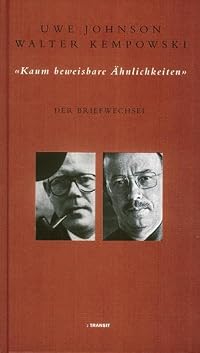
Kaum beweisbare Ähnlichkeiten. Der Briefwechsel Uwe Johnson - Walter Kempowski
by Uwe Johnson, Walter Kempowski (Author)
5 Members (3.00)
On This Page
Description
Eine nur auf den ersten Blick überraschende Nähe zwischen zwei der wichtigsten zeitgenössischen Autoren: der Rostocker Reederssohn Walter Kempowski und der in Mecklenburg aufgewachsene und später in Rostock studierende Uwe Johnson. Früh hatten sie ihre Väter verloren; früh gerieten sie in Konflikt mit der DDR-Obrigkeit: Kempowski wurde für acht Jahre in Bautzen eingeschlossen und 1956 in die Bundesrepublik entlassen, Johnson verließ die DDR 1959; beide entwickelten ein show more leidenschaftliches Interesse an deutscher Geschichte, beide arbeiteten an riesigen literarischen Projekten, hier EcholotJahrestage. show lessTags
Member Reviews
Members
- Recently Added By
Author Information

69+ Works 1,604 Members
One critic summed up Uwe Johnson's vision of Germany this way: "Contemporary Germany is Johnson's all-purpose, modern symbol of confused human motives, social forces that drive people frantic, and frustrations in communication that finally choke men into silence" (Webster Schott, N.Y. Times). The Third Book about Achim (1961), winner of the show more $10,000 International Publishers' Prize in 1962, is a novel about divided Germany. It addresses one of the crucial philosophical problems of life: What is objective truth? Is there such a thing at all? Joachim Remak, in Harper's, says, "It is an easy book to dislike at first [but] in the course of the novel all the annoying traits suddenly vanish or become unimportant. For this is a great book; literary award judges can be right." The novel was a catharsis for Johnson's own personal conflicts: he had reluctantly left his home in East Germany in 1959 in order to have his first novel published without censorship. This first novel, Speculations about Jacob (1959), was praised for a style that defies the traditional structure of the novel and indeed of language. In his Anniversaries (1970--73), Johnson again treats pressing moral and political issues by having the scene of the novel switch from New York City during the Vietnam War to Mecklenburg, Germany, in the Nazi period. One of the major themes of the book is the failure of liberalism in the United States in the 1960s and in Germany in the 1930s. Johnson's work is consistent, never pedestrian, and sometimes brilliant. In 1971 Johnson received the Buchner Prize. (Bowker Author Biography) show less

Walter Kempowski (1929-2007) was one of Germany's most important postwar writers. In the 1980s he began gathering diaries, letters, and memoirs of World War II, which he edited into ten volumes published in German. This is the first portion to appear in English. Shaun Whiteside's translations from the German include classics by Freud, Musil, and show more Nietzsche. show less
Common Knowledge
- Canonical title
- Kaum beweisbare Ähnlichkeiten. Der Briefwechsel Uwe Johnson - Walter Kempowski
Classifications
Statistics
- Members
- 5
- Popularity
- 3,422,881
- Rating
- (3.00)
- Languages
- English, German
- Media
- Paper
- ISBNs
- 1