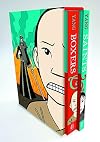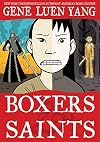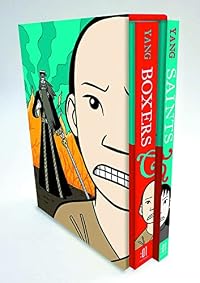
Boxers and Saints
by Gene Luen Yang
Boxers and Saints (Collections and Selections — pumpkin spice late!)
On This Page
Description
Boxers : In China in 1898 bands of foreign missionaries and soldiers roam the countryside, bullying and robbing Chinese peasants. Little Bao has had enough: harnessing the powers of ancient Chinese gods, he recruits an army of Boxers--commoners trained in kung fu who fight to free China from "foreign devils."Saints : "China, 1898. An unwanted and unwelcome fourth daughter, Four-Girl isn't even given a proper name by her family when she's born. She finally finds friendship-- and a name, show more Vibiana -- in the most unlikely of places: Christianity. But China is a dangerous place for Christians. The Boxer Rebellion is in full swing, and bands of young men roam the countryside, murdering Westerners and Chinese Christians alike. Torn between her nation and her Christian friends, Vibiana will have to decide where her true loyalties lie-- and whether she is willing to die for her faith" -- front flap. show lessTags
Recommendations
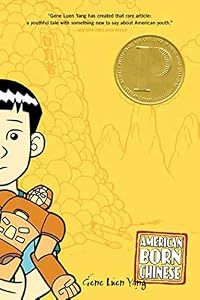










Member Recommendations
Member Reviews
Boxers
Little Bao loves spring and the festivals that accompany the season, especially the traditional opera, presided over by a small statue of the local earth god Tu Di Gong, that comes to his small rural village with its colorful costumes and music. So he’s shocked when a group of ruffians with crosses hung around their necks lead by a hideous looking foreign devil disrupt the festival, steal food, smash the statue of Tu Di Gong, and humiliate his father. This incident is the seed from which the Society of the Righteous and Harmonious Fist will blossom to massacre the foreign devils and their Chinese followers, burn their churches, and lay siege to their Legation Quarter in Beijing, until reinforcements of foreign troops massacred show more the Boxers, as they were known in English.
Saints
Four-Girl her mother’s fourth and only surviving daughter does not accepted in her family. Her grandfather calls her a devil after she accidentally sends an ax crashing through the window with such force that it embeds itself right above his head. Distraught, she runs off into the woods where she encounters a raccoon eating the remains of a long dead animal. It’s disgusting, but she realizes that the raccoon isn’t worried about anyone’s opinion of his scavenging or diet. He accepts his place in the world. So Four-Girl decides to accept that she’s a devil. She starts going around with the ugliest face she can manage, so her mother takes her to the acupuncturist for a cure. The acupuncturist turns out to be a Christian convert. What better to learn to be a devil than from someone who can introduce her to the religion of the foreign devils that are dominating China! Four-Girl converts and becomes Vibiana. Then she begins to have visions of Joan of Arc.
This is a powerfully told and very moving story in prose, pencil, and ink. Boxers is part of Yuen’s two volume graphic novel about the Boxer Rebellion; the companion volume is Saints, which tells the story of the Boxer Rebellion from the point of view of a Chinese Christian convert. The two central tragic characters have brief dramatic encounters in the books. Both books are filled with colorful—Pien uses a much more subdued palate throughout most of the books—mystical encounters with the supernatural, in the case of Little Bao these are with the gods of the Opera and the First Emperor with Vibiana they're golden encounters with the maid of Orleans. show less
Little Bao loves spring and the festivals that accompany the season, especially the traditional opera, presided over by a small statue of the local earth god Tu Di Gong, that comes to his small rural village with its colorful costumes and music. So he’s shocked when a group of ruffians with crosses hung around their necks lead by a hideous looking foreign devil disrupt the festival, steal food, smash the statue of Tu Di Gong, and humiliate his father. This incident is the seed from which the Society of the Righteous and Harmonious Fist will blossom to massacre the foreign devils and their Chinese followers, burn their churches, and lay siege to their Legation Quarter in Beijing, until reinforcements of foreign troops massacred show more the Boxers, as they were known in English.
Saints
Four-Girl her mother’s fourth and only surviving daughter does not accepted in her family. Her grandfather calls her a devil after she accidentally sends an ax crashing through the window with such force that it embeds itself right above his head. Distraught, she runs off into the woods where she encounters a raccoon eating the remains of a long dead animal. It’s disgusting, but she realizes that the raccoon isn’t worried about anyone’s opinion of his scavenging or diet. He accepts his place in the world. So Four-Girl decides to accept that she’s a devil. She starts going around with the ugliest face she can manage, so her mother takes her to the acupuncturist for a cure. The acupuncturist turns out to be a Christian convert. What better to learn to be a devil than from someone who can introduce her to the religion of the foreign devils that are dominating China! Four-Girl converts and becomes Vibiana. Then she begins to have visions of Joan of Arc.
This is a powerfully told and very moving story in prose, pencil, and ink. Boxers is part of Yuen’s two volume graphic novel about the Boxer Rebellion; the companion volume is Saints, which tells the story of the Boxer Rebellion from the point of view of a Chinese Christian convert. The two central tragic characters have brief dramatic encounters in the books. Both books are filled with colorful—Pien uses a much more subdued palate throughout most of the books—mystical encounters with the supernatural, in the case of Little Bao these are with the gods of the Opera and the First Emperor with Vibiana they're golden encounters with the maid of Orleans. show less
How much do you know about the Boxer Rebellion in China? If you're like me, not much. I know a lot more now, thanks to Gene Luen Yang's pair of graphic novels, Boxers & Saints. The author of the celebrated American Born Chinese centers the action on one boy and one girl on each side of the conflict. In the late 1890s, concerned about the increasing influence in China of westerners and their Christian religion, rural peasants secretly banded together to learn martial arts and Chinese spiritualism, ultimately forming the Society of the Righteous and Harmonious Fist. They led an uprising against the Westerners, slaughtering many Christian missionaries and converted Chinese. In the end the rebels were crushed, but their influence was show more lasting.
The first book features Little Bao, a boy who becomes a leader of the rebels, and the second book features Vibiana, a Chinese girl who converts to Christianity. Little Bao draws on the powers of legendary folklore warriors from the country's past, while Vibiana has a special relationship with Joan of Arc, with whom she converses on a regular basis.
In Boxers Yang shows how foreigners humiliated and unfairly dominated the peasants, leading to the rebellion. In Saints he shows Vibiana and others learning the Christian way of living, which for her at the beginning means better food than she otherwise would have. An American Roman Catholic with Taiwanese parents, Yang is even-handed in his portrayal of the clash and its tragic effects. He says he was inspired by the 2000 canonization of several Chinese Catholic saints, an exciting development for Chinese Catholics in his San Francisco church:
"When I looked into the lives of these saints, many of them were martyred during the Boxer Rebellion and their canonization was actually very controversial. The Chinese government issued a letter of protest to the Vatican saying that the Roman Catholic Church was honoring people who had betrayed their Chinese culture. That tension between eastern and western world views and how they existed within the same community, within these Chinese Catholic communities, really interested me."
He sees the Boxers as embodying "some xenophobia and also patriotism." He hope these books cause people to look more deeply into the Boxer Rebellion, which he compares to Native American's development of "Ghost Dancers" in the U.S. Together these books were a National Book Award Finalist in 2013. The imagery is direct and engaging, and the reader is drawn into the stories so that the pages fly by. show less
The first book features Little Bao, a boy who becomes a leader of the rebels, and the second book features Vibiana, a Chinese girl who converts to Christianity. Little Bao draws on the powers of legendary folklore warriors from the country's past, while Vibiana has a special relationship with Joan of Arc, with whom she converses on a regular basis.
In Boxers Yang shows how foreigners humiliated and unfairly dominated the peasants, leading to the rebellion. In Saints he shows Vibiana and others learning the Christian way of living, which for her at the beginning means better food than she otherwise would have. An American Roman Catholic with Taiwanese parents, Yang is even-handed in his portrayal of the clash and its tragic effects. He says he was inspired by the 2000 canonization of several Chinese Catholic saints, an exciting development for Chinese Catholics in his San Francisco church:
"When I looked into the lives of these saints, many of them were martyred during the Boxer Rebellion and their canonization was actually very controversial. The Chinese government issued a letter of protest to the Vatican saying that the Roman Catholic Church was honoring people who had betrayed their Chinese culture. That tension between eastern and western world views and how they existed within the same community, within these Chinese Catholic communities, really interested me."
He sees the Boxers as embodying "some xenophobia and also patriotism." He hope these books cause people to look more deeply into the Boxer Rebellion, which he compares to Native American's development of "Ghost Dancers" in the U.S. Together these books were a National Book Award Finalist in 2013. The imagery is direct and engaging, and the reader is drawn into the stories so that the pages fly by. show less
Boxers & Saints is a compelling, graphic novel diptych about the Boxer Rebellion in turn-of-the-20th-century China, each part told from the perspective of a different character, each on a different native side of the conflict. Taken together (as they must), the two books combine to provide a powerful, multifaceted take on a complex historical period.
Yang is uncompromising in his storytelling, and skillfully conveys the violence, emotion, and desperation of the moment. Visually, his style is clean and effective, though I found I appreciated the art of Boxers more than Saints (its colors are more vivid, its panel better composed). But these are minor quibbles. Boxers & Saints is one of the best of its medium, and a worthy addition to the show more comics and graphic novel canon. show less
Yang is uncompromising in his storytelling, and skillfully conveys the violence, emotion, and desperation of the moment. Visually, his style is clean and effective, though I found I appreciated the art of Boxers more than Saints (its colors are more vivid, its panel better composed). But these are minor quibbles. Boxers & Saints is one of the best of its medium, and a worthy addition to the show more comics and graphic novel canon. show less
This two-volume graphic narrative set against the historical events of the Boxer uprising in turn-of-the-century China tells the complementary tales of Little Bao, an adolescent Chinese boy who leads the Society of the Righteous and Harmonious Fist in defense of his homeland against British and European imperialists, and Vibiana, an adolescent Chinese girl who converts to Catholicism in an effort to seek a sense of belonging. Their stories intertwine in plausible and compelling ways that force us to examine the reasons why adolescents—even in the most dire of circumstances—value community and peer support.
Without taking sides, Yang masterfully depicts his protagonists as flawed but sympathetic teens who earnestly attempt to grow, show more learn, and develop their principles amidst a backdrop of political and religious conflict. Both Little Bao and Vibiana experience mystical encounters with spiritual beings who guide them through their ordeals; the magical realism infuses their stories with metaphysical resonance and calls to mind the ancient Greek epic of the Iliad, during which the gods fought alongside mortals. Joan of Arc appears as Vibiana’s spiritual guide, foreshadowing Vibiana’s sad fate.
In addition to the rich history covered in these two volumes, Yang addresses issues of gender through his depiction of the Red Lanterns (the distaff counterparts of the Society) and Vibiana herself, a strong-willed tragic heroine who stumbles upon her faith almost accidentally but ultimately comes to value it over all else.
I highly recommend these narratives for their engaging depictions of complex adolescent protagonists as well as their value as historical texts that tell a story unfamiliar to most Western teens. show less
Without taking sides, Yang masterfully depicts his protagonists as flawed but sympathetic teens who earnestly attempt to grow, show more learn, and develop their principles amidst a backdrop of political and religious conflict. Both Little Bao and Vibiana experience mystical encounters with spiritual beings who guide them through their ordeals; the magical realism infuses their stories with metaphysical resonance and calls to mind the ancient Greek epic of the Iliad, during which the gods fought alongside mortals. Joan of Arc appears as Vibiana’s spiritual guide, foreshadowing Vibiana’s sad fate.
In addition to the rich history covered in these two volumes, Yang addresses issues of gender through his depiction of the Red Lanterns (the distaff counterparts of the Society) and Vibiana herself, a strong-willed tragic heroine who stumbles upon her faith almost accidentally but ultimately comes to value it over all else.
I highly recommend these narratives for their engaging depictions of complex adolescent protagonists as well as their value as historical texts that tell a story unfamiliar to most Western teens. show less
WHAT IS IT ABOUT?
Gene Luen Yang’s “Boxers & Saints” is a two-volume graphic novel about The Boxer Rebellion in China at the turn of the 20th century. Although each book can be read as standalone, they work best as a set because they tell parallel stories of two Chinese bumpkins caught up on opposite sides of the same war.
The first volume, “Boxers,” follows Little Bao, a poor Chinese village boy who grows up witnessing foreign soldiers and missionaries bully, rob and kill Chinese peasants. With the help of ancient Chinese gods, Bao starts a rebellion in order to rid China of “foreign devils” and their allies “secondary devils,” Chinese converts to Christianity. The second book, “Saints,” tells a story of Four-Girl, show more a poor Chinese village girl who feels unwanted and unloved by her family. Unexpectedly, Four-Girl finds refuge among Chinese Christians and, guided by the spirit of French heroine Joan of Arc, becomes Christian herself.
THUMBS UP:
1) Aim high, score high.
Although Yang’s project is very ambitious, it is executed flawlessly. The story is thoroughly researched and carefully thought-out, the presentation is impressively creative, the artwork is, as always, superb, and the characters are multidimensional and relatable.
2) Entertaining and educational.
“Boxers & Saints” is both an engaging magical realism story and a thought provoking interpretation of the motives behind a significant historical event, The Boxer Rebellion (which I knew nothing about!).
3) Perfect format.
Yang’s decision to divide this original story into two parallel stories is ingenious. By telling two different sides of the same story the author allows the reader to understand the war and its motives from the opposing perspectives. But more importantly, such division enables the author to remain objective because there is no need to favor, judge or justify either side. And in this case it is the author’s objectivity that makes the whole story so powerful.
VERDICT: 3.5 out of 5
Gene Luen Yang’s “Boxers & Saints” is a unique look at a significant event in the history of China - The Boxer Rebellion - as it is seen from two opposing camps. Such a serious topic together with the author’s creativity, talent and effort put into researching results in a very appealing sort of read: both entertaining and educational.
POST SCRIPTUM:
Although I found Gene Luen Yang’s “Boxers & Saints” entertaining and thought provoking, it is also quite violent and dark, and thus, I personally prefer his earlier graphic novel “American Born Chinese,” which is much more uplifting and hilarious. show less
Gene Luen Yang’s “Boxers & Saints” is a two-volume graphic novel about The Boxer Rebellion in China at the turn of the 20th century. Although each book can be read as standalone, they work best as a set because they tell parallel stories of two Chinese bumpkins caught up on opposite sides of the same war.
The first volume, “Boxers,” follows Little Bao, a poor Chinese village boy who grows up witnessing foreign soldiers and missionaries bully, rob and kill Chinese peasants. With the help of ancient Chinese gods, Bao starts a rebellion in order to rid China of “foreign devils” and their allies “secondary devils,” Chinese converts to Christianity. The second book, “Saints,” tells a story of Four-Girl, show more a poor Chinese village girl who feels unwanted and unloved by her family. Unexpectedly, Four-Girl finds refuge among Chinese Christians and, guided by the spirit of French heroine Joan of Arc, becomes Christian herself.
THUMBS UP:
1) Aim high, score high.
Although Yang’s project is very ambitious, it is executed flawlessly. The story is thoroughly researched and carefully thought-out, the presentation is impressively creative, the artwork is, as always, superb, and the characters are multidimensional and relatable.
2) Entertaining and educational.
“Boxers & Saints” is both an engaging magical realism story and a thought provoking interpretation of the motives behind a significant historical event, The Boxer Rebellion (which I knew nothing about!).
3) Perfect format.
Yang’s decision to divide this original story into two parallel stories is ingenious. By telling two different sides of the same story the author allows the reader to understand the war and its motives from the opposing perspectives. But more importantly, such division enables the author to remain objective because there is no need to favor, judge or justify either side. And in this case it is the author’s objectivity that makes the whole story so powerful.
VERDICT: 3.5 out of 5
Gene Luen Yang’s “Boxers & Saints” is a unique look at a significant event in the history of China - The Boxer Rebellion - as it is seen from two opposing camps. Such a serious topic together with the author’s creativity, talent and effort put into researching results in a very appealing sort of read: both entertaining and educational.
POST SCRIPTUM:
Although I found Gene Luen Yang’s “Boxers & Saints” entertaining and thought provoking, it is also quite violent and dark, and thus, I personally prefer his earlier graphic novel “American Born Chinese,” which is much more uplifting and hilarious. show less
I liked Boxers better after I read Saints---they *can* stand alone, but they shouldn't.
I liked the main character so much, and Joan of Arc was just wonderful. The twist at the end was very fitting and strong in its way, but I didn't have an immediate emotional connection to it because"sacrifice your life for others' salvation" is not a deeply-rooted story for me. (Too Jewish. :P) I think my favorite part of both books was the parallel eye-hand mythologies, however.
It's hard for me to avoid reading things through a Jewish lens, of course, and most of the time I don't see why I should take it off. It helps me see the Christian-default holes in stories a lot more clearly. However, I think I owe Boxers and Saints a re-read where I try show more harder not to let that color my opinions of the Christian characters. show less
I liked the main character so much, and Joan of Arc was just wonderful. The twist at the end was very fitting and strong in its way, but I didn't have an immediate emotional connection to it because
It's hard for me to avoid reading things through a Jewish lens, of course, and most of the time I don't see why I should take it off. It helps me see the Christian-default holes in stories a lot more clearly. However, I think I owe Boxers and Saints a re-read where I try show more harder not to let that color my opinions of the Christian characters. show less
On SAINTS:
This is part of a set of graphic novels. I started with this one. They explore the Boxer Rebellion in China, an incident little known in the modern west. In this 170-page graphic novel, Four-Girl is raised within her uncaring family. She is the fourth girl and the only to live, and thus is only known by her number--which in Chinese, means death. She grows up as rather disturbed, desperate to fit in, to find her own identity. After feigning an illness, she's sent to a local acupuncturist, who is a Christian. Four doesn't care much about the faith, but catechism gets her aware from her family and the doctor's wife makes good cookies. About this same time she starts to see visions of Joan of Arc. It's curious how Yang sets up the show more story, because Joan of Arc appears to be a true vision there to guide Four as people rise up against Chinese Christians and Westerners.
I bought the books to help to gauge the mindset and culture of China at the turn of the 20th century. It was enlightening in that way, though I can't fully judge the this book until I have read the companion.
BOXERS:
This completes the set of parallel stories about the Boxer Rebellion. Between the two graphic novels, Yang weaves a complex story about rural China, Christian missionaries, war, and spirituality. I found this book, the longer of the two at 325 pages, to be enthralling and disturbing all at once. It follows young Bao as he encounters he foments rebellion against the foreign devils, all while channeling the old gods of China Bao has loved in opera. Like any war, it's a heart-breaking scenario. There are no clear good guys and bad guys. That's one advantage of reading both books in the set--you see it from both angles (Four isn't a full Christian convert through her story, but she still shows the good that they do). show less
This is part of a set of graphic novels. I started with this one. They explore the Boxer Rebellion in China, an incident little known in the modern west. In this 170-page graphic novel, Four-Girl is raised within her uncaring family. She is the fourth girl and the only to live, and thus is only known by her number--which in Chinese, means death. She grows up as rather disturbed, desperate to fit in, to find her own identity. After feigning an illness, she's sent to a local acupuncturist, who is a Christian. Four doesn't care much about the faith, but catechism gets her aware from her family and the doctor's wife makes good cookies. About this same time she starts to see visions of Joan of Arc. It's curious how Yang sets up the show more story, because Joan of Arc appears to be a true vision there to guide Four as people rise up against Chinese Christians and Westerners.
I bought the books to help to gauge the mindset and culture of China at the turn of the 20th century. It was enlightening in that way, though I can't fully judge the this book until I have read the companion.
BOXERS:
This completes the set of parallel stories about the Boxer Rebellion. Between the two graphic novels, Yang weaves a complex story about rural China, Christian missionaries, war, and spirituality. I found this book, the longer of the two at 325 pages, to be enthralling and disturbing all at once. It follows young Bao as he encounters he foments rebellion against the foreign devils, all while channeling the old gods of China Bao has loved in opera. Like any war, it's a heart-breaking scenario. There are no clear good guys and bad guys. That's one advantage of reading both books in the set--you see it from both angles (Four isn't a full Christian convert through her story, but she still shows the good that they do). show less
Members
- Recently Added By
Lists

Best Stand-Alone Graphic Novels
107 works; 19 members

Club Read's Graphic Stories Recommendations
127 works; 2 members
Best Graphic Novel Nonfiction
199 works; 101 members

Favorite Kids Graphic Novels
262 works; 1 member
Author Information

180+ Works 21,783 Members
Gene Luen Yang was born on August 9, 1973 in California. He graduated from the University of California, Berkeley, where he majored in computer science and minored in creative writing. After graduating in 1995, he worked as a computer engineer for two years. He decided that he was meant to teach and left his job as an engineer to teach computer show more science at Bishop O'Dowd High School in Oakland, California. He is a writer of graphic novels and comics. His first published comic, Gordon Yamamoto and the King of the Geeks, was published in 1997 and won the Xeric Grant, a self-publishing grant for comic book creators. His other works include Loyola Chin and the San Peligran Order and Avatar: The Last Airbender. He won the Michael L. Printz Award in 2006 for American Born Chinese and the Eisner Award for best short story in 2009 for Eternal Smile. (Bowker Author Biography) show less
All Editions
Awards and Honors
Awards
Distinctions
Series

Boxers and Saints (Collections and Selections — pumpkin spice late!)
Work Relationships
Contains
Common Knowledge
- Canonical title
- Boxers and Saints
- People/Characters
- Lee Bao; Four-Girl/Vibiana
- Important places
- Shandong Province, China; China
- Important events
- Boxer Rebellion
Classifications
- Genre
- Graphic Novels & Comics
- DDC/MDS
- 741.5 — Arts & recreation Drawing & decorative arts Drawing and drawings Comic books, graphic novels, fotonovelas, cartoons, caricatures, comic strips
- LCC
- PN6727 .Y36 .B68 — Language and Literature Literature (General) Literature (General) Collections of general literature Comic books, strips, etc.
- BISAC
Statistics
- Members
- 391
- Popularity
- 79,374
- Reviews
- 15
- Rating
- (4.12)
- Languages
- English, French
- Media
- Paper, Ebook
- ISBNs
- 3
- ASINs
- 1