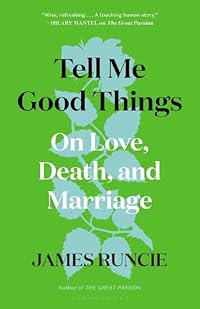
Tell Me Good Things: On Love, Death, and Marriage
by James Runcie
On This Page
Description
In this startling and intimate memoir of life before death and love after grief, the internationally best-selling author tells the story of his wife's battle with Lou Gehrig's disease and her death, while celebrating her life, in all its color, humor, and brightness.Tags
Recommendations









Member Reviews
This is a heartfelt memoir about Marilyn Imrie, a deeply loved wife and apparently accomplished theatre director, who died at age 72, within five months of her ALS diagnosis. It strikes me as a book that would have far more meaning for those who actually knew Imrie in life than a memoir for a general readership. Runcie, the author of The Grantchester Mysteries, writes that he hopes the book may provide comfort for those going through something similar, but I can’t quite see its doing that. There are regular allusions to plays, works of art, flowers, wines, fancy meals, fashion designers, shoe styles, soccer teams, operas, Scottish actors—I could go on—with which I—and I suspect many others—have little or familiarity. To me, show more Tell me Good Things felt a great deal longer than it is, and I wonder if the writing of it ought to have been delayed. It’s evident that it was composed, at least in part, to come to terms with a great loss.
The memoir consists of recollections of everyday sorts of things from James and Marilyn’s somewhat unusual marriage—Marilyn was 12 years older than her husband. Many of the details reported seemed very superficial to me. I felt I had little real sense of Marilyn as a person. What made her tick? There were certainly insecurities, and a coworker mentions her “desperation” at one point, but we are offered no insight into those things. There’s also no information about her childhood and little about her actual work. We’re told she liked wearing dramatic, attention-grabbing clothing, but hated having her photo taken. Hmmm. Why? She wanted to appear saintly (but apparently was not). Again, why?
I am, of course, saddened to think of anyone suffering as she did—a matter that James, her husband refrains from going into here—because this is, of course, about “telling the good things.”
If you’re acquainted with the Scottish theatre scene or Runcie’s other books, you may appreciate this more than I did. show less
The memoir consists of recollections of everyday sorts of things from James and Marilyn’s somewhat unusual marriage—Marilyn was 12 years older than her husband. Many of the details reported seemed very superficial to me. I felt I had little real sense of Marilyn as a person. What made her tick? There were certainly insecurities, and a coworker mentions her “desperation” at one point, but we are offered no insight into those things. There’s also no information about her childhood and little about her actual work. We’re told she liked wearing dramatic, attention-grabbing clothing, but hated having her photo taken. Hmmm. Why? She wanted to appear saintly (but apparently was not). Again, why?
I am, of course, saddened to think of anyone suffering as she did—a matter that James, her husband refrains from going into here—because this is, of course, about “telling the good things.”
If you’re acquainted with the Scottish theatre scene or Runcie’s other books, you may appreciate this more than I did. show less
Ratings
Members
- Recently Added By
Author Information

21+ Works 3,140 Members
Classifications
- Genres
- Nonfiction, Biography & Memoir
- DDC/MDS
- 155.937092 — Philosophy and Psychology Psychology Differential and developmental psychology Environmental psychology Influences of Traumatic Experiences and Bereavement Death and Dying Biography; History By Place Biography
- LCC
- BF575 .G7 .R863 — Philosophy, Psychology and Religion Psychology Psychology Affection. Feeling. Emotion
- BISAC
Statistics
- Members
- 23
- Popularity
- 1,143,259
- Reviews
- 1
- Rating
- (3.00)
- Languages
- English
- Media
- Paper, Ebook
- ISBNs
- 6
- ASINs
- 1