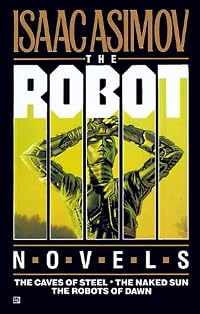
The Robot Novels: The Caves of Steel, The Naked Sun, The Robots of Dawn
by Isaac Asimov
Isaac Asimov's Robot Series (Collections and Selections — 4-6)
On This Page
Description
A collection of science fiction short stories that take place in the Galaxy.Tags
Recommendations









Member Reviews
The Caves of Steel: When a prominent Outer Worlds roboticist is murdered in Spacetown, the authorities fear another Barrier Riot, with thousands of angry displaced humans, jobs lost to robots, screaming at the Spacers to leave Earth forever and go back to their hygienic, sparsely populated, robot infested planets. The New York City police commissioner assigns Detective Elijah Baley to investigate the murder, but Baley must work with a detective representing the Outer Worlds, and his new partner, although he looks human, is a robot. Baley doesn’t like this at all.
Asimov’s 1954 novel was written in part to prove to his editor that the genres of Science Fiction and Mystery could be successfully blended. Extreme urbanization has turned show more earthlings into city dwellers and cities into enormous domed enclosures with their inhabitants living in the titles caves of steel. On Earth robots are machines that work outside the cities in mines and on farms. Humans from the Outer Worlds live in relative luxury and companionably with their much more sophisticated robots in what they call a C/Fe culture a blending of carbon and iron based beings. Unfortunately for the human Spacers they’ve also completely lost their natural immunity to all terrestrial disease and dare not venture forth from their Spacetown embassy or they will sicken and die.
The book has several themes in addition to the cultural conflict between a Luddite home planet and its richer and more technologically advanced former colonies. Urbanization is one; the other is automation, the replacement of human labor by machinery. The Spacers cannot understand why the earthlings cling to a planet where life is barely sustainable when they could emigrate to the stars and eventually retire to a life of luxury and leisure made possible by C/Fe culture. And they are actively working to advance that political agenda.
Baley’ partner R. Daneel Olivaw (the R. is for robot) is the obvious model for the android character Data on Star Trek: The Next Generation. It would seem that the television writers borrowed more than the term for positronic brain from Asimov for the perfectly logical and occasionally bemused by human behavior mechanical humanoid robot.
---
The Naked Sun:
NYPD detective Elijah Baley is surprised to be called to Washington where an Undersecretary in the Justice Department tells him that he about to be temporarily reassigned. Then comes the real shock. He’s to investigate a murder on the far off planet of Solaria. It’s been so long, three centuries, since there’s been a murder that the planet has no police force. Additionally interstellar diplomatic pressure has insisted that Baley and his partner from the politically powerful planet of Aurora, R. Daneel Olivaw (the R. stand for Robot), must be the investigators.
Asimov’s science fiction is full of anthropological observations about the two worlds and their social phobia. Baily, the earthman from a world of crowded cities can’t stand to be out of doors under the naked sun of the title. The Solarians, who live individually on grand estates served by an army of robots, can’t stand the physical presence of another human. And of course, there’s lots about the author’s three laws of robotics, but, as a mystery story, he also provides, on Samaria a denouement worthy of Dame Christie's Hercule Poirot, and then on Earth a surprise twist to the story worthy of Alfred Hitchcock. show less
Asimov’s 1954 novel was written in part to prove to his editor that the genres of Science Fiction and Mystery could be successfully blended. Extreme urbanization has turned show more earthlings into city dwellers and cities into enormous domed enclosures with their inhabitants living in the titles caves of steel. On Earth robots are machines that work outside the cities in mines and on farms. Humans from the Outer Worlds live in relative luxury and companionably with their much more sophisticated robots in what they call a C/Fe culture a blending of carbon and iron based beings. Unfortunately for the human Spacers they’ve also completely lost their natural immunity to all terrestrial disease and dare not venture forth from their Spacetown embassy or they will sicken and die.
The book has several themes in addition to the cultural conflict between a Luddite home planet and its richer and more technologically advanced former colonies. Urbanization is one; the other is automation, the replacement of human labor by machinery. The Spacers cannot understand why the earthlings cling to a planet where life is barely sustainable when they could emigrate to the stars and eventually retire to a life of luxury and leisure made possible by C/Fe culture. And they are actively working to advance that political agenda.
Baley’ partner R. Daneel Olivaw (the R. is for robot) is the obvious model for the android character Data on Star Trek: The Next Generation. It would seem that the television writers borrowed more than the term for positronic brain from Asimov for the perfectly logical and occasionally bemused by human behavior mechanical humanoid robot.
---
The Naked Sun:
NYPD detective Elijah Baley is surprised to be called to Washington where an Undersecretary in the Justice Department tells him that he about to be temporarily reassigned. Then comes the real shock. He’s to investigate a murder on the far off planet of Solaria. It’s been so long, three centuries, since there’s been a murder that the planet has no police force. Additionally interstellar diplomatic pressure has insisted that Baley and his partner from the politically powerful planet of Aurora, R. Daneel Olivaw (the R. stand for Robot), must be the investigators.
Asimov’s science fiction is full of anthropological observations about the two worlds and their social phobia. Baily, the earthman from a world of crowded cities can’t stand to be out of doors under the naked sun of the title. The Solarians, who live individually on grand estates served by an army of robots, can’t stand the physical presence of another human. And of course, there’s lots about the author’s three laws of robotics, but, as a mystery story, he also provides, on Samaria a denouement worthy of Dame Christie's Hercule Poirot, and then on Earth a surprise twist to the story worthy of Alfred Hitchcock. show less
Outstanding examples of Asimov's work, I was lucky enough to buy special copies of these three with hard covers and unique art through the Science Fiction Book Club. Collectors items for sure!
Ratings
Members
- Recently Added By
Lists

Favorite Science Fiction
448 works; 214 members
Author Information

2,405+ Works 291,997 Members
Isaac Asimov was born in Petrovichi, Russia, on January 2, 1920. His family emigrated to the United States in 1923 and settled in Brooklyn, New York, where they owned and operated a candy store. Asimov became a naturalized U.S. citizen at the age of eight. As a youngster he discovered his talent for writing, producing his first original fiction at show more the age of eleven. He went on to become one of the world's most prolific writers, publishing nearly 500 books in his lifetime. Asimov was not only a writer; he also was a biochemist and an educator. He studied chemistry at Columbia University, earning a B.S., M.A. and Ph.D. In 1951, Asimov accepted a position as an instructor of biochemistry at Boston University's School of Medicine even though he had no practical experience in the field. His exceptional intelligence enabled him to master new systems rapidly, and he soon became a successful and distinguished professor at Columbia and even co-authored a biochemistry textbook within a few years. Asimov won numerous awards and honors for his books and stories, and he is considered to be a leading writer of the Golden Age of science fiction. While he did not invent science fiction, he helped to legitimize it by adding the narrative structure that had been missing from the traditional science fiction books of the period. He also introduced several innovative concepts, including the thematic concern for technological progress and its impact on humanity. Asimov is probably best known for his Foundation series, which includes Foundation, Foundation and Empire, and Second Foundation. In 1966, this trilogy won the Hugo award for best all-time science fiction series. In 1983, Asimov wrote an additional Foundation novel, Foundation's Edge, which won the Hugo for best novel of that year. Asimov also wrote a series of robot books that included I, Robot, and eventually he tied the two series together. He won three additional Hugos, including one awarded posthumously for the best non-fiction book of 1995, I. Asimov. "Nightfall" was chosen the best science fiction story of all time by the Science Fiction Writers of America. In 1979, Asimov wrote his autobiography, In Memory Yet Green. He continued writing until just a few years before his death from heart and kidney failure on April 6, 1992. (Bowker Author Biography) show less
Some Editions
Series

Isaac Asimov's Robot Series (Collections and Selections — 4-6)
Work Relationships
Contains
Common Knowledge
- Canonical title
- The Robot Novels: The Caves of Steel, The Naked Sun, The Robots of Dawn
- Original title
- The Robot Novels
- Alternate titles
- The Robot Trilogy; Robots and Murder
- Original publication date
- 1988
- People/Characters
- R. Daneel Olivaw; Elijah Baley
- Related movies
- Story Parade: The Caves of Steel (1964 | IMDb); Out of the Unknown: The Naked Sun (1969 | IMDb)
- First words
- The three books in the volume you are now holding were not planned as a trilogy; I am not good at forethoughtful literary schemes. (from the introduction, "A Bit About Lije Baley and R. Daneel . . .")
Lije Baley had just reached his desk when he became aware of R. Sammy watching him expectantly. - Last words
- (Click to show. Warning: May contain spoilers.)Giskard said, "Goodbye, friend Elijah, and remember that, although people apply the phrase to Aurora, it is, from this point on, Earth itself that is the true World of the Dawn."
- Original language
- English
- Disambiguation notice
- There are two separate works titled "The Robot Novels". One contains the first two books: Caves of Steel and Naked Sun. The other contains three books: Caves of Steel, Naked Sun and Robots of Dawn.
Classifications
Statistics
- Members
- 394
- Popularity
- 78,712
- Reviews
- 2
- Rating
- (4.20)
- Languages
- English
- Media
- Paper
- ISBNs
- 4
- ASINs
- 2