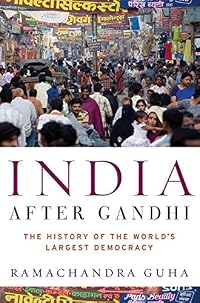
India After Gandhi: The History of the World's Largest Democracy
by Ramachandra Guha
On This Page
Description
Born in privation and civil war, divided by caste, class, language and religion, independent India emerged, somehow, as a united and democratic country. This remarkable book tells the full story--the pain and the struggle, the humiliations and the glories--of the world's largest and least likely democracy. Social historian Guha writes of the protests and conflicts that have peppered the history of free India, but also of the factors and processes that have kept the country together (and kept show more it democratic), defying numerous prophets of doom who believed that it would break up or come under autocratic rule. This story of modern India is peopled with extraordinary characters: Guha gives fresh insights on the lives and public careers of the long-serving prime ministers, but also writes with feeling and sensitivity about the major provincial leaders and other lesser known (though not necessarily less important) Indians--peasants, tribals, women, workers and musicians.--From publisher description. show lessTags
Recommendations



Member Reviews
My own view – speaking as a historian rather than citizen – is that as long as Pakistan exists there will be Hindu fundamentalists in India. In times of stability, or when the political leadership is firm, they will be marginal or on the defensive. In times of change, or when the political leadership is irresolute, they will be influential and assertive.
This sweeping history was a revelation. I feel as if I was simultaneously dazzled and lost. My chief response was a desire to read more both by Nehru as well as about him. I pondered concepts like communalism all week and made comparisons with other places, other history. Nehru apparently once confessed to Andre Malraux that his greatest challenge was creating and maintaining a show more secular state in a religious country. It was interesting how in the Nixon biography I recently read much was made about how Nixon felt Nehru and Indira Gandhi looked down upon him, a grocer's son. Little of that surfaced here--which is appropriate when considering the grand grievances of Nixon.
People have been predicating the doom of India since its Independence, some are now predicating that half of the nation is becoming California, the other half Chad. The resilient Indian embrace of democracy is the most encouraging, especially as across the world the institution appears to be falling from fashion. show less
This sweeping history was a revelation. I feel as if I was simultaneously dazzled and lost. My chief response was a desire to read more both by Nehru as well as about him. I pondered concepts like communalism all week and made comparisons with other places, other history. Nehru apparently once confessed to Andre Malraux that his greatest challenge was creating and maintaining a show more secular state in a religious country. It was interesting how in the Nixon biography I recently read much was made about how Nixon felt Nehru and Indira Gandhi looked down upon him, a grocer's son. Little of that surfaced here--which is appropriate when considering the grand grievances of Nixon.
People have been predicating the doom of India since its Independence, some are now predicating that half of the nation is becoming California, the other half Chad. The resilient Indian embrace of democracy is the most encouraging, especially as across the world the institution appears to be falling from fashion. show less
A massive work, well deserving of the "magisterial" tag given by the Financial Times review. The great blessing is that it doesn't try to be cryptic, doesn't use over-long sentences with multiple negatives, and deals with each incident or milestone in a few, elegantly phrased, paragraphs. Thus, you never lose hope that you will be able to read through to the end, as you are guided by a series of easy stages. A bonus is the penultimate chapter on the arts and sports. The treatment is even-handed and objective throughout, and you have the assurance that all the evidence has been weighed and a sober overall assessment made. Best of all, the author ends on an optimistic note, which sounds all the more reassuring because of the wide range show more and depth of the information accessed. show less
This is a superb book. In clear, measured prose, Indian polymath Ramachandra Guha (author of other excellent books on topics as diverse as cricket and environmentalism) outlines and explains the complicated political, economic, diplomatic, environmental, military and cultural factors which have transformed the India of 1947, newly independent and riven by Partition, into the India of today. The book is particularly strong on the ways in which democracy has taken root in India. It's long - my edition ran to 771 pages, plus copious notes - but so clearly written that it is not a chore to read. If you are at all interested in India, or in modern history, I highly recommend this book.
This was particularly good reading it so soon after reading A Suitable Boy, a novel set in India shortly after independence, so in the time period at the beginning of the [India after Gandhi]. I was also glad to have had the background provided by [India, a History], although I definitely only remembered the broad strokes from that work, it did mean that I better understood such issues as how the Princely states would be integrated into India.
The book ran 750 pages, but was lively reading. I had no idea what a multi-ethnic place India is. Of course, I knew about Muslims and Hindus and the conflict over Kashmir. I had heard about Indira Gandhi being assassinated by her Sikh bodyguards, and the killing of Sikhs that happened afterward in show more response. But I hadn't known how many different linguistic communities there were, or how much of an issue it was to them to maintain their different languages rather than accept Hindu as a national language. I didn't know there were tribal peoples - groups considered to have been original before the migrations of Dravidian (possibly from Iran) and Indo-Aryans, possibly from the Central Asian Steppes that happened around 1700 BC and later. Nor did I have any idea of the multiple other conflicts that India has faced from Independence from the British up to the present.
The book was very good at presenting a much more complete picture of issues that I'd only known a little of from the outside, such as Indira Gandhi declaring a state of emergency which lasted for a couple of years. The overall theme is how India persevered as a democracy - though an imperfect one - despite all the odds against it, including poverty, the many cultures and religions, the lack of a long democratic tradition. A big part of this might be the remarkable leaders that India had just after partition, such as Nehru who was committed to the protection of minorities and political rights for oppressed groups such as the untouchables and women.
I definitely recommend it to anyone who wants to know more about one of the world's largest nations, and one of the most diverse. show less
The book ran 750 pages, but was lively reading. I had no idea what a multi-ethnic place India is. Of course, I knew about Muslims and Hindus and the conflict over Kashmir. I had heard about Indira Gandhi being assassinated by her Sikh bodyguards, and the killing of Sikhs that happened afterward in show more response. But I hadn't known how many different linguistic communities there were, or how much of an issue it was to them to maintain their different languages rather than accept Hindu as a national language. I didn't know there were tribal peoples - groups considered to have been original before the migrations of Dravidian (possibly from Iran) and Indo-Aryans, possibly from the Central Asian Steppes that happened around 1700 BC and later. Nor did I have any idea of the multiple other conflicts that India has faced from Independence from the British up to the present.
The book was very good at presenting a much more complete picture of issues that I'd only known a little of from the outside, such as Indira Gandhi declaring a state of emergency which lasted for a couple of years. The overall theme is how India persevered as a democracy - though an imperfect one - despite all the odds against it, including poverty, the many cultures and religions, the lack of a long democratic tradition. A big part of this might be the remarkable leaders that India had just after partition, such as Nehru who was committed to the protection of minorities and political rights for oppressed groups such as the untouchables and women.
I definitely recommend it to anyone who wants to know more about one of the world's largest nations, and one of the most diverse. show less
Ramachandra has crafted a wonderful book on the recent history of India. The book begins with the transfer of power from the British rule to the Republic of India, and then follows India's growth from a birth of a nation to the current economic boom and India's emergence as a world power. The history of India is complex, and to jump into it is a bit daunting, as most of us have very little knowledge of the history preceding independence. However, the author does not only explain the many unique aspects of Indian culture, he also brings it together in a very clear, interesting and exciting narrative.
Beginning with Jawaharlal Nehru, the first prime minister of India, the author writes of the difficult challenges India faced in becoming a show more nation and of trying to live up to the ideals which lead to independence. From choosing the national language, integrating the lands of stately princes, and creating a nation that served all its people no matter their caste, religion or sex, Nehru and others in the Congress (like Vallabhbhai Patel and B. R. Ambedkar) had a huge task on their hands. They laid down a strong democratic foundation for India, one that would be tested after Nehru's death. Unfortunately, those who lead after Nehru and his cabinet were less concerned with building a nation and more in helping themselves. Indira Gandhi, Nehru's daughter, became prime minister and split the congress, taking India in a direction quite different from her father's. Indira, when facing impeachment, enforced emergency rule, where she practically ruled as a dictator for almost 2 years. Fortunately, democracy was soon restored by Indira herself calling for fresh elections, but afterwords self-interest became the staple of Indian government which it still struggles with to this day. The author also touches on many other aspects of this developing nation. He writes about the constant struggle with Pakistan over Kashmir, the border disputes between China and India, the growing religious tensions between the Hindu majority and Muslim minority and between different castes (often exploited for political gain), and much more. There is a lot to cover in this short period of history, but Ramachandra does an excellent job of pulling it all together and still making it enjoyable for the reader.
Ramachandra has written a fine history. It's easy to read, and even though the length may be daunting to some (over 900 pages!) its just such a fascinating story that its hard to put down. Highly recommended. show less
Beginning with Jawaharlal Nehru, the first prime minister of India, the author writes of the difficult challenges India faced in becoming a show more nation and of trying to live up to the ideals which lead to independence. From choosing the national language, integrating the lands of stately princes, and creating a nation that served all its people no matter their caste, religion or sex, Nehru and others in the Congress (like Vallabhbhai Patel and B. R. Ambedkar) had a huge task on their hands. They laid down a strong democratic foundation for India, one that would be tested after Nehru's death. Unfortunately, those who lead after Nehru and his cabinet were less concerned with building a nation and more in helping themselves. Indira Gandhi, Nehru's daughter, became prime minister and split the congress, taking India in a direction quite different from her father's. Indira, when facing impeachment, enforced emergency rule, where she practically ruled as a dictator for almost 2 years. Fortunately, democracy was soon restored by Indira herself calling for fresh elections, but afterwords self-interest became the staple of Indian government which it still struggles with to this day. The author also touches on many other aspects of this developing nation. He writes about the constant struggle with Pakistan over Kashmir, the border disputes between China and India, the growing religious tensions between the Hindu majority and Muslim minority and between different castes (often exploited for political gain), and much more. There is a lot to cover in this short period of history, but Ramachandra does an excellent job of pulling it all together and still making it enjoyable for the reader.
Ramachandra has written a fine history. It's easy to read, and even though the length may be daunting to some (over 900 pages!) its just such a fascinating story that its hard to put down. Highly recommended. show less
This is a massive work, covering the immensity of India between 1947 and 2015 or 16. When I realized how much territory Dr. Guha had to cover, I was dubious, but this history of India since just before independence manages to elucidate i broad strokes what happened, how it happened and sometimes, why it happened. For example, I understand much better than before the evolution of the impasse over Kashmir, the reasons for India's turn from essentially a centrally planned economy to a more mainstream capitalist one, and how and why Congress lost its hold on power and the BJP came to succeed Congress. Guha carefully explains how the situation of the Congress in 1950, say, differs from that of the BJP in 2015 and indeed, today in the wake of show more its most recent electoral victory. I have visited India several times and am fascinated by its diversity and history but my understanding of the country has been improved by reading this history. show less
I’ve been wanting to learn more about history for a long time now, and I’ve finally decided to take the plunge and start reading more history books. I started off with a book I’ve owned for about eight years now, but never got around to reading. I think I’ve been avoiding non-fiction because it takes me much longer to read and comprehend it, but I guess I should stop judging my reading by total number of books read.
India After Gandhi is a post-independence history of India; a subject I didn’t know a lot about, despite spending the first seventeen years of my life there. In school, our history books pretty much stopped at independence. It starts off with the Partition and the formation of the Indian government, and goes until show more 2007 (when the book was written), although the final two decades are not covered with the same level of historical detail (due to the events being too contemporary.)
The book is extremely comprehensive, Guha clearly did a lot of research – the bibliography is humongous. It covered the process of transitioning from British rule (highlighting administrative problems like integrating over 550 kingdoms into India, setting up free and fair elections for a largely illiterate electorate, and settling millions of refugees from Partition), subsequent politics, economic policy, social movements, and there’s even a chapter on popular entertainments. I learned a lot, I’m certainly a long way away from knowing all that I want to know about Indian history, but I feel like I have a solid foundation on which to build on, and I wouldn’t have thought one book would have been able to do that. It also gave me the historical context to understand several things I’d been confused about when I lived in India (like the history of the political parties and how they came to have the positions they did, and how the Indian states came to be organized in their current configuration.)
Guha does an admirable job of approaching things from a historian’s point of view, you can see that he has his own opinions as an Indian citizen, but he makes it pretty obvious that they are his own opinions when they crop up. I’m sure there are biases in what he chose to talk about and how he presented it, but those are unavoidable. My only complaint on that front was that Guha chooses to emphasize India’s successes, but doesn’t spend as much time talking about India’s failures. It’s not like he doesn’t acknowledge them, but because he doesn’t give them as much detail, they come across as relatively unimportant. For example, at one point he mentions that an election would be the first “free and fair” election in Kashmir, but all the talk of previous elections in the book so far had been about the heroic efforts of India’s Election Commission to set up elections that actually worked, so how did the Kashmir elections end up unfair?
Overall, I thought that this was a great book, and I’d recommend it to anyone looking to learn more about India. It did make me very sad, though – seeing India start out with such well-intentioned and smart leaders and devolve into the mess that it is now. show less
India After Gandhi is a post-independence history of India; a subject I didn’t know a lot about, despite spending the first seventeen years of my life there. In school, our history books pretty much stopped at independence. It starts off with the Partition and the formation of the Indian government, and goes until show more 2007 (when the book was written), although the final two decades are not covered with the same level of historical detail (due to the events being too contemporary.)
The book is extremely comprehensive, Guha clearly did a lot of research – the bibliography is humongous. It covered the process of transitioning from British rule (highlighting administrative problems like integrating over 550 kingdoms into India, setting up free and fair elections for a largely illiterate electorate, and settling millions of refugees from Partition), subsequent politics, economic policy, social movements, and there’s even a chapter on popular entertainments. I learned a lot, I’m certainly a long way away from knowing all that I want to know about Indian history, but I feel like I have a solid foundation on which to build on, and I wouldn’t have thought one book would have been able to do that. It also gave me the historical context to understand several things I’d been confused about when I lived in India (like the history of the political parties and how they came to have the positions they did, and how the Indian states came to be organized in their current configuration.)
Guha does an admirable job of approaching things from a historian’s point of view, you can see that he has his own opinions as an Indian citizen, but he makes it pretty obvious that they are his own opinions when they crop up. I’m sure there are biases in what he chose to talk about and how he presented it, but those are unavoidable. My only complaint on that front was that Guha chooses to emphasize India’s successes, but doesn’t spend as much time talking about India’s failures. It’s not like he doesn’t acknowledge them, but because he doesn’t give them as much detail, they come across as relatively unimportant. For example, at one point he mentions that an election would be the first “free and fair” election in Kashmir, but all the talk of previous elections in the book so far had been about the heroic efforts of India’s Election Commission to set up elections that actually worked, so how did the Kashmir elections end up unfair?
Overall, I thought that this was a great book, and I’d recommend it to anyone looking to learn more about India. It did make me very sad, though – seeing India start out with such well-intentioned and smart leaders and devolve into the mess that it is now. show less
Members
- Recently Added By
Lists

r/AskHistorians' Recommended Books
1,068 works; 17 members

TED 2013 Summer Reading List
190 works; 13 members

Not the NYT list of top 100 21st century books
100 works; 6 members

Books recommended in the history category on FiveBooks.com
329 works; 4 members
Author Information

53+ Works 2,518 Members
Ramachandra Guha is one of the leading historians of modern India. His books include Environmentalism: A Global History and India after Gandhi.
Awards and Honors
Awards
Distinctions
Notable Lists
Common Knowledge
- Canonical title
- India After Gandhi: The History of the World's Largest Democracy
- Original publication date
- 2007
- People/Characters
- Mohandas Gandhi; Jawaharlal Nehru; Indira Gandhi; Sheikh Abdullah; Vallabhbhai Patel; Angami Zapu Phizo (show all 7); Jayprakash Narayan
- Important places
- India
- Epigraph
- India is a pluralist society that creates magic with democracy, rule of law and individual freedom, community relations and [cultural] diversity. What a place to be an intellectual! I wouldn't mind being born ten times to red... (show all)iscover India. - Robert Blackwell, departing U.S. ambassador, in 2003
Nobody could be more conscious than I am of the pitfalls which lie in the path of the man who wants to discover the truth about contemporary India. - Nirad Chaudhuri, The Autobiography of an Unknown Indian, 1950 - Dedication
- For Ira, Sasha, and Suja
lights on my coast
Classifications
Statistics
- Members
- 1,133
- Popularity
- 22,117
- Reviews
- 25
- Rating
- (4.32)
- Languages
- Dutch, English
- Media
- Paper, Ebook
- ISBNs
- 19
- ASINs
- 8