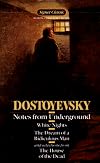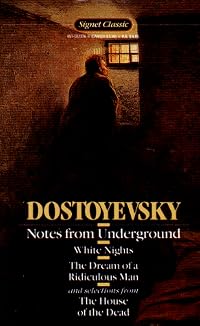
Notes from Underground; White Nights; The Dream of a Ridiculous Man; and: White Nights Dream Ridiculous Man and selections from The House of the Dead (Signet classics)
by Fyodor Dostoyevsky, Andrew R. MacAndrew (Translator and Afterword)
On This Page
Description
Impassioned, powerful, disturbing classic about one man's self-torment and alienation.Tags
Recommendations








Member Reviews
“Man everywhere and at all times, whoever he may be, has preferred to act as he chose and not in the least as his reason and advantage dictated. And one may choose what is contrary to one's own interests.”
Not what I expected. Notes from the Underground is a philosophical musing on the nature of humankind and why the ideals of a utopian society are doomed to fail. Why do people say they value reason but act irrationally? Does free will exist? Why do people build things but find they are dissatisfied once the project is completed? And so on. It seems to be a diatribe against determinism.
The premise is that an unnamed “underground man” living St. Petersburg, Russia is engaging in a monologue (though it is written as if he is show more talking directly to readers). He makes statements and asks questions. Later sections cover his meeting with a woman named Liza, and disagreements with a man that leads to the challenge to a duel. Topics include suffering, morality, vice, reason, revenge, justice, truth, civilization, boredom, spite, freedom, and other such universal topics. It touches on many subjects but does not delve deeply into any of them.
Published in 1864, it is considered a classic that lays the groundwork for future forays into dystopian societies. I didn’t hate it, but I cannot say I got much pleasure from reading it, either. My version included three short stories, which I enjoyed more than the titular novella. I think I will stick to Dostoevsky’s novels. He needs more room to expand on these thoughts, and my personal preference is to incorporate them into more of a storyline. show less
Not what I expected. Notes from the Underground is a philosophical musing on the nature of humankind and why the ideals of a utopian society are doomed to fail. Why do people say they value reason but act irrationally? Does free will exist? Why do people build things but find they are dissatisfied once the project is completed? And so on. It seems to be a diatribe against determinism.
The premise is that an unnamed “underground man” living St. Petersburg, Russia is engaging in a monologue (though it is written as if he is show more talking directly to readers). He makes statements and asks questions. Later sections cover his meeting with a woman named Liza, and disagreements with a man that leads to the challenge to a duel. Topics include suffering, morality, vice, reason, revenge, justice, truth, civilization, boredom, spite, freedom, and other such universal topics. It touches on many subjects but does not delve deeply into any of them.
Published in 1864, it is considered a classic that lays the groundwork for future forays into dystopian societies. I didn’t hate it, but I cannot say I got much pleasure from reading it, either. My version included three short stories, which I enjoyed more than the titular novella. I think I will stick to Dostoevsky’s novels. He needs more room to expand on these thoughts, and my personal preference is to incorporate them into more of a storyline. show less
I picked this collection up because I remembered enjoying Notes from Underground when I read it in high school; the prospect of other Dostoevsky was an added bonus, as all else I'd read was a chapter of The Brothers Karamazov. I don't know if his passive-aggressive over-philosophizing protagonists are supposed to be taken seriously, but I found them delightfully comic. The introduction claims these selections show the development of Dostoevsky's views on human nature, and I don't know if that's true or not, but the narrators certainly progress. The one in White Nights does his best to engage with society, but cannot do it naturally like everyone else, and so has to make do with poor emulations. But then the one in Notes from Underground show more might go through the motions, but he does not actually want to do it, participating mostly out of some perverse desire to aggravate other people, to mimic their actions. And then the one in The Dream of a Ridiculous Man does not even seem to try at all. I enjoyed all three of these stories (White Nights best of all); the world that Dostoevsky describes seems to be in perpetual darkness, but it is strangely beautiful all the same. The three chapters excerpted from The House of the Dead, on the other hand, just did not seem to work outside of their context, though a couple of them amused at least. show less
Dostoyevsky's characters are complex, lively, sympathetic, and quotable. The short story "White Nights" alone has some classic quotes. Whether it's the narrator's view of the world: "It has been a sad drizzly day, without relief - just like my future senility" or his unrequited love's grasp of reality when it comes to career planning: " You know what? Perhaps I'll give private lessons. First I'll learn something myself, then I'll teach it," their words reveal their true nature.
Despite long philosphical discourses, the writing shines. The language, or at least the translation, is current enough that it is jarring to read a reference to the ongoing American Civil War.
Dostoyevsky's characters are tormented in various ways. The same show more narrator that says "I'm suspicious and easily offended, like a dwarf or a hunchback" and claims "The trouble with man is that he's stupid. Phenomenally stupid," also believes in marriage, children, and that "Love is a divine mystery." show less
Despite long philosphical discourses, the writing shines. The language, or at least the translation, is current enough that it is jarring to read a reference to the ongoing American Civil War.
Dostoyevsky's characters are tormented in various ways. The same show more narrator that says "I'm suspicious and easily offended, like a dwarf or a hunchback" and claims "The trouble with man is that he's stupid. Phenomenally stupid," also believes in marriage, children, and that "Love is a divine mystery." show less
It is difficult to believe that a an author who lived through such traumatic experiences could write so beautifully. The depiction of characters was so very sad and showed the misanthropism one would expect from a man whose life contained so many tragic experiences.
I understand that Crime and Punishment is supposed to be a more important work than these, but I think that Notes From Underground and The Dream of a Ridiculous Man are far more accessible for people who aren't well read in Dostoyevsky or his thoughts.
His sense of impending doom is ever so well articulated an shines throughout his work. The focus is upon madness and existentialism
Like hedilove this was also my first Russian read. I was so taken by Whte Nights walked the streets of central London one white summer night reading it as i walked. That was 40 year ago!
Members
- Recently Added By
Author Information

1,411+ Works 179,084 Members
One of the most powerful and significant authors in all modern fiction, Fyodor Dostoevsky was the son of a harsh and domineering army surgeon who was murdered by his own serfs (slaves), an event that was extremely important in shaping Dostoevsky's view of social and economic issues. He studied to be an engineer and began work as a draftsman. show more However, his first novel, Poor Folk (1846), was so well received that he abandoned engineering for writing. In 1849, Dostoevsky was arrested for being a part of a revolutionary group that owned an illegal printing press. He was sentenced to be executed, but the sentence was changed at the last minute, and he was sent to a prison camp in Siberia instead. By the time he was released in 1854, he had become a devout believer in both Christianity and Russia - although not in its ruler, the Czar. During the 1860's, Dostoevsky's personal life was in constant turmoil as the result of financial problems, a gambling addiction, and the deaths of his wife and brother. His second marriage in 1887 provided him with a stable home life and personal contentment, and during the years that followed he produced his great novels: Crime and Punishment (1886), the story of Rodya Raskolnikov, who kills two old women in the belief that he is beyond the bounds of good and evil; The Idiots (1868), the story of an epileptic who tragically affects the lives of those around him; The Possessed (1872), the story of the effect of revolutionary thought on the members of one Russian community; A Raw Youth (1875), which focuses on the disintegration and decay of family relationships and life; and The Brothers Karamazov (1880), which centers on the murder of Fyodor Karamazov and the effect the murder has on each of his four sons. These works have placed Dostoevsky in the front rank of the world's great novelists. Dostoevsky was an innovator, bringing new depth and meaning to the psychological novel and combining realism and philosophical speculation in his complex studies of the human condition. (Bowker Author Biography) show less

Fyodor Dostoyevsky has a Legacy Library. Legacy libraries are the personal libraries of famous readers, entered by LibraryThing members from the Legacy Libraries group.
Series
Belongs to Publisher Series
Work Relationships
Common Knowledge
- Canonical title*
- Notes from Underground / White Nights / The Dream of a Ridiculous Man and selections from The House of the Dead
- Alternate titles
- Notes from Underground; White Nights; the Dream of a Ridiculous Man; and Selections from the House of the Dead/ Fyodor Dostoevsky; a New Translation with an Afterword by Andrew R. MacAndrew
- Original publication date
- 1961 [this edition only]
- Epigraph
- 'Could he be born from the start, if only for a fleeting moment, to be so dear to your heart?' (Ivan Turgenev)
- First words
- I'm a sick man... a mean man. (Notes From Underground)
It was a marvellous night, the sort of night one only experiences when one is young. (White Nights)
I've never met a man with more charm than Baklushkin. (from The House of the Dead)
I'm a ridiculous man. (The Dream of a Ridiculous Man) - Last words
- (Click to show. Warning: May contain spoilers.)Why, isn't that enough for a whole lifetime? (White Nights)
(Click to show. Warning: May contain spoilers.)It's hard to imagine at what extent a man's nature can be corrupted. (from The House of the Dead)
(Click to show. Warning: May contain spoilers.)But we are of the opinion that one might just as well stop here. (Notes From Underground)
(Click to show. Warning: May contain spoilers.)And if everyone wanted it, everything could be arranged immediately. (The Dream of a Ridiculous Man) - Original language
- Russian
- Disambiguation notice
- Bibliographic data is for this edition only
Contents: White Nights -- Selections from The House of the Dead: Baklushkin's Story, Akulka's Husband, In the Hospital -- Notes from Underground -- The Dream of a Ridiculous ... (show all)Man -- Afterword -- Selected Bibliography
*Some information comes from Common Knowledge in other languages. Click "Edit" for more information.
Classifications
- Genres
- Fiction and Literature, General Fiction
- DDC/MDS
- 891.73 — Literature & rhetoric Literatures of other languages East Indo-European and Celtic literatures Russian and East Slavic languages Russian fiction
- LCC
- PG3326 .A2 — Language and Literature Slavic languages and literatures. Baltic languages. Albanian language Slavic. Baltic. Albanian Russian literature Individual authors and works 1800-1870 Dostoyevsky
- BISAC
Statistics
- Members
- 976
- Popularity
- 26,761
- Reviews
- 13
- Rating
- (4.22)
- Languages
- Dutch, English
- Media
- Paper
- ISBNs
- 5
- ASINs
- 14