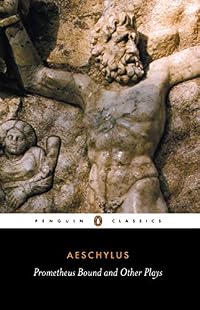
The Persians; Prometheus Bound; Seven Against Thebes; The Suppliants
by Aeschylus
On This Page
Description
schylus is often regarded as the father of Greek tragedy; he moved play writing from the simple interaction of a single character and a chorus to one where many characters interact and thereby create more dynamic and dramatic situations. schylus, was the son of Euphorion, and a scion of a Eupatrid or noble family. He was born at Eleusis 525 B.C., or, as the Greeks calculated time, in the fourth year of the 63rd Olympiad. He first worked at a vineyard and whilst there claimed to have been show more visited by Dionysis in a dream and told to turn his attention to the tragic art. It was a dream that would deliver a rich and incredible legacy through his writing talents. His earliest tragedy, composed when he was twenty-six years of age, failed to win the fabled Dionysia, (a revered festival of theatre) and it was not until fifteen years later that he gained this victory in 484BC going on to win it again in 472 BC (for The Persians), 467 BC (for Seven Against Thebes) and 463 BC (for The Suppliants). schylus was also known for his military skills and was ready to fight in defence of Athens whenever the call was made. He and his brother, Cynegeirus, fought against Darius's invading Persian army at the Battle of Marathon in 490 BCE and, although the Greeks won against overwhelming odds, Cynegeirus died in the battle, which had a naturally had a profound effect on schylus. He made several visits to the important Greek city of Syracuse in Sicily at the invitation of the tyrant Hieron, and it is thought that he also travelled extensively in the region of Thrace. His writing continued to be the envy of others. With the series of plays of which Seven Against Thebes was a part, his supremacy was undisputed. He was the "father of tragedy." schylus made many changes to dramatic form. The importance of the chorus was demoted and a second added to give prominence to the dialogue and making that interchange the leading feature of the play. He removed all deeds of bloodshed from the public view, and in their place provided various spectacular elements, improving the costumes, making the masks more expressive and convenient, and probably adopting the cothurnus to increase the stature of the performers. Finally, he established the custom of contending for the prize with trilogies, an inter-connecting set of three independent dramas. The closing years of the life of schylus were mainly spent in Sicily, which he had first visited soon after his defeat at the Dionysia by Sophocles. schylus returned to Athens to produce his Orestean trilogy, probably the finest of his works, although the Eumenides, the last of the three plays, revealed so openly his aristocratic tendencies that he became extremely unpopular, and returned to Sicily for the last time in 458 BCE and it was there that he died, while visiting the city of Gela in 456 or 455 BCE. show lessTags
Recommendations









Member Recommendations
Member Reviews
Some have compared Prometheus to Jesus Christ. Certainly the opening scene of Aeschylus's play, with Prometheus splayed upon a rock as he is bound by Hephaestus, invites the comparison. I would not go so far and see the interplay between the Greek gods to be the relevant context for this scene. Played out at the "world's limit" in a bleak setting the drama portrays Prometheus suffering punishment for making humans "intelligent and masters of their minds". (line 444)
Prometheus' crime is not the only reason for his punishment for the chorus tells us that there is a war going on between the "Old" gods (Olympians) and the new generation of Gods. Zeus is seeking to maintain his primacy while Prometheus and his brothers are the dangerous new show more gods on the block. Atlas is suffering as well carrying the weight of the whole world on his back. The scales are not even - their is nothing like fairness or justice in this world. Prometheus is doomed even as he is visited by Io who is also suffering due to Hera's jealous rage over Zeus's attentions.
Being a god does not seem to lead to a completely pleasant life - there is strife and anger at every turn even for the most powerful. The winners in this play seem to be humans who do not have to relinquish the gifts endowed them by Prometheus. However, even these can be seen as a two-edged sword for our ancestors who had to endure hardships of many kinds in the struggle of living in the world. Prometheus cries out "O sky that circling brings light to all, you see how unjustly I suffer!" (lines 1091-2) Could that be our own cry even today? show less
Prometheus' crime is not the only reason for his punishment for the chorus tells us that there is a war going on between the "Old" gods (Olympians) and the new generation of Gods. Zeus is seeking to maintain his primacy while Prometheus and his brothers are the dangerous new show more gods on the block. Atlas is suffering as well carrying the weight of the whole world on his back. The scales are not even - their is nothing like fairness or justice in this world. Prometheus is doomed even as he is visited by Io who is also suffering due to Hera's jealous rage over Zeus's attentions.
Being a god does not seem to lead to a completely pleasant life - there is strife and anger at every turn even for the most powerful. The winners in this play seem to be humans who do not have to relinquish the gifts endowed them by Prometheus. However, even these can be seen as a two-edged sword for our ancestors who had to endure hardships of many kinds in the struggle of living in the world. Prometheus cries out "O sky that circling brings light to all, you see how unjustly I suffer!" (lines 1091-2) Could that be our own cry even today? show less
An excellent collection of Ancient Greek plays which have stood the test of time. The four plays herein - translated ably by Philip Vellacott - are, along with the three plays of the Oresteia, all that remains of Aeschylus' work.
'Prometheus Bound' is the best, and the reason I picked up this book in the first place. Prometheus' struggle has always been, to my mind, the most compelling of all the Greek myths, but even so I was surprised at just how much depth Aeschylus discovered in the tale. 'Prometheus Bound' is a commentary on tyranny, rationalism, faith, mortality, justice and hubris all rolled into one (in a total of about thirty pages, no less!), with intriguing little suggestions that the story - benevolent Prometheus against the show more tyrannical Zeus - may not be as clear-cut as is often supposed. I am now even more fascinated by the story of Prometheus than I was going in, and am disappointed that the play's follow-ups, 'Prometheus Unbound' and 'Prometheus the Fire-Bringer', have not survived into modern times.
Having wanted to read just 'Prometheus Bound', the other three plays in the collection turned out to be a nice bonus. All four plays had plenty of poetic turns of phrase and a lofty, yet very human, morality. 'The Suppliants' sees a kingdom take in a group of refugee women who have fled forced marriages, with the king resolving to defy their would-be husbands by force if necessary. 'Seven Against Thebes' tells the story of an assault on the seven-gated city of Thebes, with a brother-vs-brother tragedy that has no small amount of pathos. The final play, 'The Persians', wasn't in my opinion as stellar as the others, but still has enough about it to be worth a read.
All in all, the translated plays were surprisingly accessible (no matter how many ancient classics I read, like The Iliad and The Odyssey, I am somehow always still amazed at just how well they come across) and I feel much more confident about the prospect of reading more Ancient Greek classics going forward. I've always wanted to read Lysistrata by Aristophanes and the Argonautica by Apollonius of Rhodes. Having enjoyed this book so much, I'm probably going to add Aeschylus' Oresteian trilogy to my list too. show less
'Prometheus Bound' is the best, and the reason I picked up this book in the first place. Prometheus' struggle has always been, to my mind, the most compelling of all the Greek myths, but even so I was surprised at just how much depth Aeschylus discovered in the tale. 'Prometheus Bound' is a commentary on tyranny, rationalism, faith, mortality, justice and hubris all rolled into one (in a total of about thirty pages, no less!), with intriguing little suggestions that the story - benevolent Prometheus against the show more tyrannical Zeus - may not be as clear-cut as is often supposed. I am now even more fascinated by the story of Prometheus than I was going in, and am disappointed that the play's follow-ups, 'Prometheus Unbound' and 'Prometheus the Fire-Bringer', have not survived into modern times.
Having wanted to read just 'Prometheus Bound', the other three plays in the collection turned out to be a nice bonus. All four plays had plenty of poetic turns of phrase and a lofty, yet very human, morality. 'The Suppliants' sees a kingdom take in a group of refugee women who have fled forced marriages, with the king resolving to defy their would-be husbands by force if necessary. 'Seven Against Thebes' tells the story of an assault on the seven-gated city of Thebes, with a brother-vs-brother tragedy that has no small amount of pathos. The final play, 'The Persians', wasn't in my opinion as stellar as the others, but still has enough about it to be worth a read.
All in all, the translated plays were surprisingly accessible (no matter how many ancient classics I read, like The Iliad and The Odyssey, I am somehow always still amazed at just how well they come across) and I feel much more confident about the prospect of reading more Ancient Greek classics going forward. I've always wanted to read Lysistrata by Aristophanes and the Argonautica by Apollonius of Rhodes. Having enjoyed this book so much, I'm probably going to add Aeschylus' Oresteian trilogy to my list too. show less
Aeschylus has only seven surviving plays to his name. One of those (Prometheus Unbound) is now heavily disputed to be his. Vellacott's translation is of the four that are not the only full surviving trilogy - the Oresteia - which has entered deep into Western culture in its own right.
Self-evidently the survival of these plays, preceding the work of Sophocles and Euripides, testifies to the regard in which he was held but the lack of his other plays (which may have amounted to 90) and the non-survival of those of his rivals suggests that we are seeing only the tip of an iceberg.
Aeschylus was not the only playwright of his time, his audience would have been demanding under conditions that were semi-sacred as well as popular and the show more dispute over 'Prometheus Unbound' indicates that others could probably reach high levels of attainment.
Still, Aeschylus was clearly regarded as an innovator who reached heights of rhetoric and drama not achieved before, above all (it is said) introducing characters who related to each other and not just singly with the Chorus.
These four non-Oresteian plays still stand up to scrutiny even if we need guidance in order to think our way into what it must have been like to be presented with performances that were as much a type of free form religious and political experience as theatre, at least as we understand it.
Contemporary fashion tends to favour 'The Persians' both because of its unique references to contemporary events and because the modern mind favours what appears to be a transfer of empathy towards the defeated (the Persians) although I think this has been exaggerated.
My favourite - the one that still moves me - is the heroic war poem-drama 'Seven Against Thebes' which seems to capture the barbarism of city-state conflict prior to the Athenian discovery of 'reason' in all its raw energy just as it introduces us to the civic morality of tragedy.
Its masculinity is overt - there is a remarkable scene where King Eteocles upbraids the Theban women for destabilising the war effort through their inability to restrain their sentiments and their excess of religiosity. it is patriarchal but Eteocles has a strong point here.
This heroic rawness is perhaps what Nietzsche had in mind in condemning what Socratic reasoning was to do to the ability of Greeks to maintain their ability to prosper as 'peak humans'. It is less comfortable for our culture to read than faux-empathy in the propaganda against the Persians.
The other two plays read well in Vellacott's translation but they suffer more from being detached from the other plays in their trilogies. The Oresteia works for us today because it 'unfolds' with a form of thesis and antithesis resulting in a synthesis of more civic moral worth based on reason.
The meaning of Greek tragic drama is too complex an issue to deal with in a brief GoodReads review but the religio-political aspects lie in 'squaring' our nature with social obligation especially when various obligations start to clash. Which is to win out?
In 'Seven Against Thebes' King Eteocles is primarily honour bound to defend his City against raiders brought against it by his estranged brother Polyneices (whose lack of proper burial later will be the cause of another great tragedy by Sophocles in 'Antigone').
However, he is also bound not to spill the blood of his brother. Yet fate has decreed that he must fight him to the death at the seventh gate. The fate is written as part of a set of individual crimes with origins in breaching past taboo afflicting blood lines - the Oresteia is another such example.
In this case, the taboos breached are all those surrounding Oedipus, father of both Eteocles and Polyneices by his own mother Jocasta and compounded by Oedipus' curse on his sons because of their rejection of him. Antigone is going to be just the next stage in a succession of horrors.
Eteocles is actually given a choice by his own advisers, to send another hero against his brother or perhaps switch gates which a King could choose to do but Eteocles will not do this. The heroic lies in not avoiding an impossible moral choice with no good end if it is 'fated'.
Once it has happened that the allocation of the seventh gate is to him and that the raider on that gate is his brother, the tragedy unfolds as inevitable ... not as a choice or a matter of rational calculation but as an 'ill-fated' moral necessity to do an evil thing less evil than another evil thing.
Of course, the audience is seeing him put his City first but the avoidance of choice cannot have gone unnoticed nor its association with the legendary world's heroic barbarism. Tragedy is here truly cathartic, filled with a vicarious death instinct in which life is truly lived.
The fourteen heroes, raiders and Thebans, are all totally disregarding of death, placing honour and glory ahead of a quiet life, much as we have come to expect from Homer. Perhaps the dramatists want all Athenians to be heroes when necessary ... but only when rationally necessary.
In our own day, this brings us back to the legacy of Nietzsche but also to an awareness that just because God is dead does not mean civilisation is dead. Our general cultural incomprehension of Eteocles' decision-making possibly defines the full victory of 'reason' over 'life'.
This play, set alongside the defiance of 'God' in 'Prometheus Unbound' and the brilliant exposition of girlish terror of quasi-incestuous rape and of social obligation in 'The Suppliants', shows a society living in a state of reason performatively exploring questions of sentiment and honour.
We cannot honestly know what a Greek citizen thought of all this but the fact that such plays were far from unusual and highly regarded suggests that an entire society needed 'drama' in some way to 'square' the conflicts within itself and get debate going about right action.
The gods too are 'real' although it is hard to get a fix on how an ancient actually felt about these capricious and often cruel creations. The overwhelming sense is of the gods, under all-father Zeus, maintaining right order in the world where right order was not always that of reason.
If the city was based on reason among men, nature and society or rather natural social relations in family and tribe and in war were not. The gods, who spoke for right order outside men's rules, ruled this world of natural social relations, right behaviour and right ritual.
'Squaring' civil order with the natural order (including the justified sentiments of society and culture prior to the laws) must have been a constant process of civil and personal negotiation. Greek tragedy helped worked out the limits of the game and educate a populace about them.
In 'The Suppliants'. Pelasgus King of Argos explores every 'reasonable' argument why he should not plunge his people into war to save the 'virtue' of 50 distant relatives threatened with rape by their Egyptian cousins.
In the end, he accepts, having realised that a higher law answerable to the Gods requires that he protect the girls, that he must challenge the Egyptians despite the inevitable grim result. His people agree with him. This is community heroism and truly absurd in the existential sense.
The sense we get is of the very real belief in a 'higher law' provided by the Gods (although this means within a framework laid out with strict justice and order by Zeus) whose breach must lead to tragedy often generations later and that reasoning is there to endorse this law not thwart it.
None of this higher law is systematised as in the religions of the book. It is customary and oral - things everybody knows are right but which have to be policed with frequent reminders directed as much at the forgetful as at the young. Community survival is at stake.
Doing the right thing (which is very different from the Judaeo-Christian faith-based 'being good') is not easy. The lesson of the tragedies is that not doing the right thing creates imbalances in the natural order that will be corrected in time - at the expense of your own blood line.
Drama appears later to move more strongly not so much towards expressing the crisis of heroic sentiments and the tragic results of breaching taboo but more heavily towards civic society as the resolution of the crises created by the old way of doing things - but our evidence remains sparse.
Greek Tragedy is complex and multi-layered, not easily analysed or summarised in secular terms, highly suggestive even while laying out its grim facts with crystal clarity. This is a shame and not a guilt culture. One should be shamed for soiling one's own blood line and 'fating' one's children.
Vellacott is an old translation (1961) but highly readable and directed at credible performance. With minimal academic infrastructure, he points out corrupt texts where they matter and provides indications of the sort of metaphor and references relevant to understanding the plays. show less
Self-evidently the survival of these plays, preceding the work of Sophocles and Euripides, testifies to the regard in which he was held but the lack of his other plays (which may have amounted to 90) and the non-survival of those of his rivals suggests that we are seeing only the tip of an iceberg.
Aeschylus was not the only playwright of his time, his audience would have been demanding under conditions that were semi-sacred as well as popular and the show more dispute over 'Prometheus Unbound' indicates that others could probably reach high levels of attainment.
Still, Aeschylus was clearly regarded as an innovator who reached heights of rhetoric and drama not achieved before, above all (it is said) introducing characters who related to each other and not just singly with the Chorus.
These four non-Oresteian plays still stand up to scrutiny even if we need guidance in order to think our way into what it must have been like to be presented with performances that were as much a type of free form religious and political experience as theatre, at least as we understand it.
Contemporary fashion tends to favour 'The Persians' both because of its unique references to contemporary events and because the modern mind favours what appears to be a transfer of empathy towards the defeated (the Persians) although I think this has been exaggerated.
My favourite - the one that still moves me - is the heroic war poem-drama 'Seven Against Thebes' which seems to capture the barbarism of city-state conflict prior to the Athenian discovery of 'reason' in all its raw energy just as it introduces us to the civic morality of tragedy.
Its masculinity is overt - there is a remarkable scene where King Eteocles upbraids the Theban women for destabilising the war effort through their inability to restrain their sentiments and their excess of religiosity. it is patriarchal but Eteocles has a strong point here.
This heroic rawness is perhaps what Nietzsche had in mind in condemning what Socratic reasoning was to do to the ability of Greeks to maintain their ability to prosper as 'peak humans'. It is less comfortable for our culture to read than faux-empathy in the propaganda against the Persians.
The other two plays read well in Vellacott's translation but they suffer more from being detached from the other plays in their trilogies. The Oresteia works for us today because it 'unfolds' with a form of thesis and antithesis resulting in a synthesis of more civic moral worth based on reason.
The meaning of Greek tragic drama is too complex an issue to deal with in a brief GoodReads review but the religio-political aspects lie in 'squaring' our nature with social obligation especially when various obligations start to clash. Which is to win out?
In 'Seven Against Thebes' King Eteocles is primarily honour bound to defend his City against raiders brought against it by his estranged brother Polyneices (whose lack of proper burial later will be the cause of another great tragedy by Sophocles in 'Antigone').
However, he is also bound not to spill the blood of his brother. Yet fate has decreed that he must fight him to the death at the seventh gate. The fate is written as part of a set of individual crimes with origins in breaching past taboo afflicting blood lines - the Oresteia is another such example.
In this case, the taboos breached are all those surrounding Oedipus, father of both Eteocles and Polyneices by his own mother Jocasta and compounded by Oedipus' curse on his sons because of their rejection of him. Antigone is going to be just the next stage in a succession of horrors.
Eteocles is actually given a choice by his own advisers, to send another hero against his brother or perhaps switch gates which a King could choose to do but Eteocles will not do this. The heroic lies in not avoiding an impossible moral choice with no good end if it is 'fated'.
Once it has happened that the allocation of the seventh gate is to him and that the raider on that gate is his brother, the tragedy unfolds as inevitable ... not as a choice or a matter of rational calculation but as an 'ill-fated' moral necessity to do an evil thing less evil than another evil thing.
Of course, the audience is seeing him put his City first but the avoidance of choice cannot have gone unnoticed nor its association with the legendary world's heroic barbarism. Tragedy is here truly cathartic, filled with a vicarious death instinct in which life is truly lived.
The fourteen heroes, raiders and Thebans, are all totally disregarding of death, placing honour and glory ahead of a quiet life, much as we have come to expect from Homer. Perhaps the dramatists want all Athenians to be heroes when necessary ... but only when rationally necessary.
In our own day, this brings us back to the legacy of Nietzsche but also to an awareness that just because God is dead does not mean civilisation is dead. Our general cultural incomprehension of Eteocles' decision-making possibly defines the full victory of 'reason' over 'life'.
This play, set alongside the defiance of 'God' in 'Prometheus Unbound' and the brilliant exposition of girlish terror of quasi-incestuous rape and of social obligation in 'The Suppliants', shows a society living in a state of reason performatively exploring questions of sentiment and honour.
We cannot honestly know what a Greek citizen thought of all this but the fact that such plays were far from unusual and highly regarded suggests that an entire society needed 'drama' in some way to 'square' the conflicts within itself and get debate going about right action.
The gods too are 'real' although it is hard to get a fix on how an ancient actually felt about these capricious and often cruel creations. The overwhelming sense is of the gods, under all-father Zeus, maintaining right order in the world where right order was not always that of reason.
If the city was based on reason among men, nature and society or rather natural social relations in family and tribe and in war were not. The gods, who spoke for right order outside men's rules, ruled this world of natural social relations, right behaviour and right ritual.
'Squaring' civil order with the natural order (including the justified sentiments of society and culture prior to the laws) must have been a constant process of civil and personal negotiation. Greek tragedy helped worked out the limits of the game and educate a populace about them.
In 'The Suppliants'. Pelasgus King of Argos explores every 'reasonable' argument why he should not plunge his people into war to save the 'virtue' of 50 distant relatives threatened with rape by their Egyptian cousins.
In the end, he accepts, having realised that a higher law answerable to the Gods requires that he protect the girls, that he must challenge the Egyptians despite the inevitable grim result. His people agree with him. This is community heroism and truly absurd in the existential sense.
The sense we get is of the very real belief in a 'higher law' provided by the Gods (although this means within a framework laid out with strict justice and order by Zeus) whose breach must lead to tragedy often generations later and that reasoning is there to endorse this law not thwart it.
None of this higher law is systematised as in the religions of the book. It is customary and oral - things everybody knows are right but which have to be policed with frequent reminders directed as much at the forgetful as at the young. Community survival is at stake.
Doing the right thing (which is very different from the Judaeo-Christian faith-based 'being good') is not easy. The lesson of the tragedies is that not doing the right thing creates imbalances in the natural order that will be corrected in time - at the expense of your own blood line.
Drama appears later to move more strongly not so much towards expressing the crisis of heroic sentiments and the tragic results of breaching taboo but more heavily towards civic society as the resolution of the crises created by the old way of doing things - but our evidence remains sparse.
Greek Tragedy is complex and multi-layered, not easily analysed or summarised in secular terms, highly suggestive even while laying out its grim facts with crystal clarity. This is a shame and not a guilt culture. One should be shamed for soiling one's own blood line and 'fating' one's children.
Vellacott is an old translation (1961) but highly readable and directed at credible performance. With minimal academic infrastructure, he points out corrupt texts where they matter and provides indications of the sort of metaphor and references relevant to understanding the plays. show less
I am interested in the ancient stories as being the seeds of modern literature. I'm reading them in translation, of course, and I can't comment on the quality of that since I don't speak Greek, modern or ancient. But I'm struck by the overall readability of these plays, and the universality of the themes. Meaning, we still grapple with some of these ideas today. The introduction is quite readable and informative about the cultural background of these plays. Also, knowing that they are individual pieces of larger arcs is helpful.
PROMETHEUS BOUND - my favorite of the four plays, the titan Prometheus punished by Zeus for daring to help humanity rise above the animals by gifting us with fire and the various crafts and sciences which show more underpin civilization. Interesting to speculate how history would be different if the being that favored humanity had been allowed to continue shepherding our development, rather than humanity falling under the sway of a god (Zeus) who actually didn't really like us! Even Hephaestus, who is part of Zeus's cohort, thought he was being unfair to Prometheus. Themes of justice/fairness, knowing that what you do will have dire consequences but doing it anyway because it is right.
The Suppliants - my second favorite. I liked this one because Aeschylus acknowledges the injustice to women who are forced to marry against their will. The fact that they have to apply for help to a neighboring kingdom, rather than being able to rely on their own nation to protect them, underlines the unfairness. Not something I expected in the male-dominated ancient world. Made me want to read the (missing) others to see how this issue was resolved.
Seven Against Thebes - Least favorite. I've read Sophocles' Oedipus so I have the gist of the background, but this one was a little too much like the Iliad for my taste. Lists of names of warriors and descriptions of their armor and who they are. Not very interesting to read, although I understand it was based on an actual battle.
The Persians - third favorite. Again, not really a story, but a summary of the battle of Salamis in which the Greeks defeated the Persians in a decisive naval battle. Interesting in that Aeschylus chose to put it in the point of view of the defeated Persians and not the victorious Greeks. Deeper themes of hubris and 'pride going before a fall.'
All in all, I enjoyed reading these plays and learning more about ancient history. show less
PROMETHEUS BOUND - my favorite of the four plays, the titan Prometheus punished by Zeus for daring to help humanity rise above the animals by gifting us with fire and the various crafts and sciences which show more underpin civilization. Interesting to speculate how history would be different if the being that favored humanity had been allowed to continue shepherding our development, rather than humanity falling under the sway of a god (Zeus) who actually didn't really like us! Even Hephaestus, who is part of Zeus's cohort, thought he was being unfair to Prometheus. Themes of justice/fairness, knowing that what you do will have dire consequences but doing it anyway because it is right.
The Suppliants - my second favorite. I liked this one because Aeschylus acknowledges the injustice to women who are forced to marry against their will. The fact that they have to apply for help to a neighboring kingdom, rather than being able to rely on their own nation to protect them, underlines the unfairness. Not something I expected in the male-dominated ancient world. Made me want to read the (missing) others to see how this issue was resolved.
Seven Against Thebes - Least favorite. I've read Sophocles' Oedipus so I have the gist of the background, but this one was a little too much like the Iliad for my taste. Lists of names of warriors and descriptions of their armor and who they are. Not very interesting to read, although I understand it was based on an actual battle.
The Persians - third favorite. Again, not really a story, but a summary of the battle of Salamis in which the Greeks defeated the Persians in a decisive naval battle. Interesting in that Aeschylus chose to put it in the point of view of the defeated Persians and not the victorious Greeks. Deeper themes of hubris and 'pride going before a fall.'
All in all, I enjoyed reading these plays and learning more about ancient history. show less
My second Aeschylus book, this one containing all of his remaining surviving works. Sadly, those which were part of trilogies are now orphaned, so like A Song of Ice and Fire and The Kingkiller Chronicles, we'll probably never get to experience the works in their completeness. I joke, but it does drive home just how much of human literature we have lost - how what survives is only a small fraction of what once existed.
This book was considerably slimmer, thanks to the comparatively brief 15-page introduction, although Philip Vellacot is still the editor/translator. Looks like this may have been the earlier publication, so maybe he just hadn't worked up all that steam yet?
As to the plays, I liked Prometheus Bound, it had a similar show more intensity of emotion to the Orestia. The Supplicants I felt was the weakest. I felt the chorus of women was very effective in Seven Against Thebes, their mounting terror at the sounds of the besieging army really hightened the tension and the perspective - that of the helpless women who cannot act to defend their city, but must trust that they will be saved and can only fear what will happen if their menfolk fail - provides a different angle from the standard point of view of the brave defending warrior or war-leader, which even today I feel is too often the only focus of war stories. I did agree the conclusion dragged on, and apparently this part might be a post-Aeschylus add-on. I did quite like the idea of the divided chorus exiting in different directions though.
The Persians was simple propaganda. Here we lose the complex motivations and perspectives that I praised in Aeschylus's other works - although we take the "perspective" of the defeated Persians, the whole play is them lamenting how much they suck and talking about how awesome the Greeks are. The conclusion to this one reeeeally dragged. Yes yes, tears and beating your breasts, I get it. For Athenians of the time, however, this would have been more meaningful - a celebration of their victory.
And with that, I have finished all of Aeshylus's surviving works, probably about 10% of what he actually wrote. Pretty impressed overall, let's see what future playwrights do with the material. show less
This book was considerably slimmer, thanks to the comparatively brief 15-page introduction, although Philip Vellacot is still the editor/translator. Looks like this may have been the earlier publication, so maybe he just hadn't worked up all that steam yet?
As to the plays, I liked Prometheus Bound, it had a similar show more intensity of emotion to the Orestia. The Supplicants I felt was the weakest. I felt the chorus of women was very effective in Seven Against Thebes, their mounting terror at the sounds of the besieging army really hightened the tension and the perspective - that of the helpless women who cannot act to defend their city, but must trust that they will be saved and can only fear what will happen if their menfolk fail - provides a different angle from the standard point of view of the brave defending warrior or war-leader, which even today I feel is too often the only focus of war stories. I did agree the conclusion dragged on, and apparently this part might be a post-Aeschylus add-on. I did quite like the idea of the divided chorus exiting in different directions though.
The Persians was simple propaganda. Here we lose the complex motivations and perspectives that I praised in Aeschylus's other works - although we take the "perspective" of the defeated Persians, the whole play is them lamenting how much they suck and talking about how awesome the Greeks are. The conclusion to this one reeeeally dragged. Yes yes, tears and beating your breasts, I get it. For Athenians of the time, however, this would have been more meaningful - a celebration of their victory.
And with that, I have finished all of Aeshylus's surviving works, probably about 10% of what he actually wrote. Pretty impressed overall, let's see what future playwrights do with the material. show less
The Persians and Other Plays is a collection of plays and commentary about plays by Aeschylus (525/4 - 456 BCE).
The book contains the following:
The Persians
Seven Against Thebes
The Suppliants
Prometheus Bound
Each play comes with a thorough introduction of the play itself as well as details of what we (think we) know about the history of the plays performances and how they may have influenced other Classical plays and playwrights, references in which inevitably have been used to date the plays themselves.
This is followed by more commentary and notes on the plays and on related plays that may have existed.
For example, it appears from the commentary that it has long been unclear in what order Aeschylus wrote the plays:
The production of show more 472 is the only one by Aeschylus that is known to have consisted of four plays whose stories were, on the face of it, unrelated - indeed, they were not even placed in proper chronological order. The first play was Phineus, about an episode in the saga of the Argonauts. This was followed by The Persians; then, jumping back to the heroic age, by Glaucus of Potniae, about a man who subjected his horses to an unnatural training regime and was devoured by them after crashing in a chariot race; and then by a satyr play about Prometheus ("Prometheus the Fire-Bearer" or "Fire-Kindler"). Repeated efforts have been made to find method behind the apparent madness of this arrangement, so far with little success.
As entertaining as it is to imagine someone making a simple mistake when noting down the running order of the plays in Ancient times, this must be quite frustrating to Classicists.
It took me way longer to read this collection than I thought but I don't regret a single minute of it.
While some of the concepts discussed and displayed in the plays were not instantly recognisable to a 20th- and 21th-century reader, the context an explanatory notes provided by Alan H. Sommerstein was so excellent that each of the plays not only made sense but actually made it a joy to discover how Aeschylus' may have raised smiles in some and incensed others of his audiences.
And some ideas and points of view in his plays - especially the description of the Persian's defeat (in The Persians), the exposition that women may refuse marriage (in The Suppliants), and some of the rather humanist views of Prometheus (in Prometheus Bound) - we quite different from what I had expected. Or rather, different from what I have come to expect from the Ancient Greek world when coming to Ancient Greek drama after reading the Greek myths (in whichever version: Apollodorus, Ovid, or any of the modern retellings). But even coming to Aeschylus with some familiarity of other playwrights such a Sophocles, I found Aeschylus surprisingly empathetic, satirical, and ... oddly modern.
CHORUS: You didn't, I suppose, go even further than that?
PROMETHEUS: I did: I stopped mortals foreseeing their death.
CHORUS: What remedy did you find for that affliction?
PROMETHEUS: I planted blind hopes within them.
CHORUS: That was a great benefit you gave to mortals.
PROMETHEUS: And what is more, I gave them fire.
It is easy to think of Prometheus only as the rebel who went against Zeus' wishes and brought fire to mankind, but there is more to him. I loved how Aeschylus focuses not on the fire-bringing alone but also on his shared humanity, and on the prophecy that Prometheus knew of that would lead to the decline of Zeus' power, the proverbial Götterdämmerung of the Ancient Greek gods.
PROMETHEUS:
It's very easy for someone who is standing safely out of trouble to advise and rebuke the one who is in trouble.
I knew that, all along. I did the wrong thing intentionally, intentionally, I won't deny it: by helping mortals, I brought trouble on myself. But I certainly never thought I would have a punishment anything like this, left to wither on these elevated rocks, my lot cast on this deserted, neighbourless crag. Now stop lamenting my present woes: descend to the ground and hear of my future fortunes, so that you will know it all to the end. Do as I ask, do as I ask. Share the suffering of one who is in trouble now: misery, you know, wanders everywhere, and alights on different persons at different times. show less
The book contains the following:
The Persians
Seven Against Thebes
The Suppliants
Prometheus Bound
Each play comes with a thorough introduction of the play itself as well as details of what we (think we) know about the history of the plays performances and how they may have influenced other Classical plays and playwrights, references in which inevitably have been used to date the plays themselves.
This is followed by more commentary and notes on the plays and on related plays that may have existed.
For example, it appears from the commentary that it has long been unclear in what order Aeschylus wrote the plays:
The production of show more 472 is the only one by Aeschylus that is known to have consisted of four plays whose stories were, on the face of it, unrelated - indeed, they were not even placed in proper chronological order. The first play was Phineus, about an episode in the saga of the Argonauts. This was followed by The Persians; then, jumping back to the heroic age, by Glaucus of Potniae, about a man who subjected his horses to an unnatural training regime and was devoured by them after crashing in a chariot race; and then by a satyr play about Prometheus ("Prometheus the Fire-Bearer" or "Fire-Kindler"). Repeated efforts have been made to find method behind the apparent madness of this arrangement, so far with little success.
As entertaining as it is to imagine someone making a simple mistake when noting down the running order of the plays in Ancient times, this must be quite frustrating to Classicists.
It took me way longer to read this collection than I thought but I don't regret a single minute of it.
While some of the concepts discussed and displayed in the plays were not instantly recognisable to a 20th- and 21th-century reader, the context an explanatory notes provided by Alan H. Sommerstein was so excellent that each of the plays not only made sense but actually made it a joy to discover how Aeschylus' may have raised smiles in some and incensed others of his audiences.
And some ideas and points of view in his plays - especially the description of the Persian's defeat (in The Persians), the exposition that women may refuse marriage (in The Suppliants), and some of the rather humanist views of Prometheus (in Prometheus Bound) - we quite different from what I had expected. Or rather, different from what I have come to expect from the Ancient Greek world when coming to Ancient Greek drama after reading the Greek myths (in whichever version: Apollodorus, Ovid, or any of the modern retellings). But even coming to Aeschylus with some familiarity of other playwrights such a Sophocles, I found Aeschylus surprisingly empathetic, satirical, and ... oddly modern.
CHORUS: You didn't, I suppose, go even further than that?
PROMETHEUS: I did: I stopped mortals foreseeing their death.
CHORUS: What remedy did you find for that affliction?
PROMETHEUS: I planted blind hopes within them.
CHORUS: That was a great benefit you gave to mortals.
PROMETHEUS: And what is more, I gave them fire.
It is easy to think of Prometheus only as the rebel who went against Zeus' wishes and brought fire to mankind, but there is more to him. I loved how Aeschylus focuses not on the fire-bringing alone but also on his shared humanity, and on the prophecy that Prometheus knew of that would lead to the decline of Zeus' power, the proverbial Götterdämmerung of the Ancient Greek gods.
PROMETHEUS:
It's very easy for someone who is standing safely out of trouble to advise and rebuke the one who is in trouble.
I knew that, all along. I did the wrong thing intentionally, intentionally, I won't deny it: by helping mortals, I brought trouble on myself. But I certainly never thought I would have a punishment anything like this, left to wither on these elevated rocks, my lot cast on this deserted, neighbourless crag. Now stop lamenting my present woes: descend to the ground and hear of my future fortunes, so that you will know it all to the end. Do as I ask, do as I ask. Share the suffering of one who is in trouble now: misery, you know, wanders everywhere, and alights on different persons at different times. show less
I rate this work as high as I do only for its classic interest; it is hard to view it as compelling drama in the modern world. Though award winning in its own time, theatre has moved on and left this sort of writing long behind, with all action happening offstage and delivered to the audience as long expository speeches by an annoying chorus that is by turns whiny, pompous, and groveling. It is always interesting to see the historical background of a field you are involved in, but this is not what I would classify among the best of classical drama. It doesn't hold a candle to the Oedipus Cycle, or even the author's own Oresteia. It also suffers in that these are mainly fragments of plays, or parts of trilogies or tetrads that are the show more only remaining parts of the work, so they feel unfinished, or like they start in the middle, which does them no benefit. Overall, recommended for people interested in historical theatre, or in the period in general, but for people wanting compelling drama, probably should look somewhere else. show less
Members
- Recently Added By
Lists

Books I've Read More Than Once
602 works; 48 members

Trinity College Booklist (1951): Class Eight, Classic Civilization
39 works; 3 members

How to Read a Book's Recommended Reading List
309 works; 10 members
Author Information

Aeschylus was born at Eleusis of a noble family. He fought at the Battle of Marathon (490 b.c.), where a small Greek band heroically defeated the invading Persians. At the time of his death in Sicily, Athens was in its golden age. In all of his extant works, his intense love of Greece and Athens finds expression. Of the nearly 90 plays attributed show more to him, only 7 survive. These are The Persians (produced in 472 b.c.), Seven against Thebes (467 b.c.), The Oresteia (458 b.c.)---which includes Agamemnon, Libation Bearers, and Eumenides (or Furies) --- Suppliants (463 b.c.), and Prometheus Bound (c.460 b.c.). Six of the seven present mythological stories. The ornate language creates a mood of tragedy and reinforces the already stylized character of the Greek theater. Aeschylus called his prodigious output "dry scraps from Homer's banquet," because his plots and solemn language are derived from the epic poet. But a more accurate summation of Aeschylus would emphasize his grandeur of mind and spirit and the tragic dignity of his language. Because of his patriotism and belief in divine providence, there is a profound moral order to his plays. Characters such as Clytemnestra, Orestes, and Prometheus personify a great passion or principle. As individuals they conflict with divine will, but, ultimately, justice prevails. Aeschylus's introduction of the second actor made real theater possible, because the two could address each other and act several roles. His successors imitated his costumes, dances, spectacular effects, long descriptions, choral refrains, invocations, and dialogue. Swinburne's (see Vol. 1) enthusiasm for The Oresteia sums up all praises of Aeschylus; he called it simply "the greatest achievement of the human mind." Because of his great achievements, Aeschylus might be considered the "father of tragedy." (Bowker Author Biography) show less
Some Editions
Series
Belongs to Publisher Series
The Complete Greek Tragedies-Chicago 2013 (set v. 1, Aeschylus v. 1)
The Complete Greek Tragedies-Chicago 1960 (set v. 2, Aeschylus v. 2)
Work Relationships
Is contained in
Common Knowledge
- Canonical title
- The Persians; Prometheus Bound; Seven Against Thebes; The Suppliants
- Alternate titles
- Four Plays of Aeschylus; Aeschylus I (of II) Loeb Classical Library #145 (of II)
- Original publication date
- c. 458 BCE
- People/Characters
- Chorus; Danaus; Pelasgus; The Herald
- Important places
- Argos, Greece
- Canonical DDC/MDS
- 882.011
- Disambiguation notice
- This LT Work is an anthology of four plays by Aeschylus, to wit:
The Persians,
Prometheus Bound,
Seven Against Thebes, and
The Suppliants (a/k/a The Suppliant Maidens).
Classifications
- Genre
- Fiction and Literature
- DDC/MDS
- 882.011 — Literature & rhetoric Classical & modern Greek literatures Classical Greek dramatic poetry and drama standard subdivisions; collections; history, description, critical appraisal; Specific periods Ancient period to ca. 499 Aeschylus
- LCC
- PA3827 — Language and Literature Greek language and literature. Latin language and literature Greek literature Individual authors Aeschylus
- BISAC
Statistics
- Members
- 2,853
- Popularity
- 6,301
- Reviews
- 16
- Rating
- (4.02)
- Languages
- 8 — English, Finnish, French, Greek (Ancient), Greek, Italian, Spanish, Swedish
- Media
- Paper, Audiobook, Ebook
- ISBNs
- 47
- ASINs
- 51