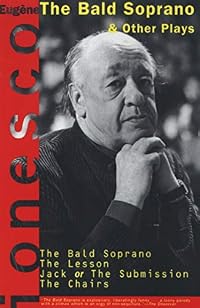
Four Plays
by Eugène Ionesco
On This Page
Description
A collection of four plays by French playwright Euge?ne Ionesco.Tags
Recommendations


















Member Recommendations
Member Reviews
Absurdist theatre from one of the greatest masters. Ionesco treats us to the absurdity of human life with four plays that make almost no sense at all, and yet, at the same time, they do make sort of an absurd sense. The nonsensical use of words is reminiscent of Gertrude Stein; the use of strange characters in stranger situations of Samuel Beckett; the use of stark sets is worthy of the staunchest post-modernist, but the works are pure Ionesco, twisting as much absurdity as humanly possible into these four short plays. And in some cases, such as The Lesson, it is easy to believe he had a crystal ball, as some of the conversations were so eerily prescient; the attitude of the student toward mathematics and toward education in general is show more a picture-perfect portrayal of the millenial student. And I will read a long time before I find a line as sublime as "Philology leads to calamity". show less
These four plays of Ionesco, among the very first that he wrote, already show him preoccupied with themes that will concern him for the rest of his career in theatre: the futility of language, the terror of ideological conformity, and theorizing about the play within the framework of the play itself. This volume includes "The Bald Soprano," "The Lesson," "Jack; Or, The Submission," and "The Chairs." Needless to say, giving a summary, insofar as one could eve be adduced, would go against the spirit of absurdism generally speaking. After all, the plots are not the most interesting things in the plays.
Ionesco got the idea for "The Bald Soprano" while trying to learn Assimil method. His textbook had two characters, Mr. and Mrs. Smith (who show more also appear in his play), and who, despite being married to one another, feel compelled to describe one another's physical appearance, tell one another that they are both English as if all of this was genuinely new information. Mr. and Mrs. are the epitome of the English bourgeois, speaking in stock phrases and clichés (How curious it is, how curious it is, how bizarre, and what a coincidence!") so worn with use as to be devoid of any meaning. The dialogue between the characters provides a discursiveness with which he points to the emptiness and futility of language, the hopelessness of communication.
Ionesco describes "The Lesson" as a "comic drama," though I found difficulty founding anything comic in it. In this play, he takes on the subject of authoritarianism as a professor of philology (which "always turns into calamity," according to his maid) relentlessly and unmercifully lectures a female student. When she proves unable to understand much of the material, he grows increasingly violent, with the student ending up dead. At the very end of the play, we learn that she is the professor's fortieth victim. And another one is walking in the door. So much for the victory of Reason.
Unlike the work of other absurdists, Beckett for example, Ionesco's plays are ostentatious, full of lively dialogue, and never inward-looking or contemplative, although many of Ionesco's themes are also Beckett's. The narrativity of drama, or the lack thereof, or even the possibility thereof, is a subject of both of their work.
At least for me, these plays are fun, but only in small doses. The constant litany of illogical non sequiturs and trying to keep track of all the characters that have similar names can become a little taxing and grating if the exposure goes on for too long. Nevertheless, these plays have aged remarkably well, and they remain one of the best introductions to the Theatre of the Absurd for the uninitiated. show less
Ionesco got the idea for "The Bald Soprano" while trying to learn Assimil method. His textbook had two characters, Mr. and Mrs. Smith (who show more also appear in his play), and who, despite being married to one another, feel compelled to describe one another's physical appearance, tell one another that they are both English as if all of this was genuinely new information. Mr. and Mrs. are the epitome of the English bourgeois, speaking in stock phrases and clichés (How curious it is, how curious it is, how bizarre, and what a coincidence!") so worn with use as to be devoid of any meaning. The dialogue between the characters provides a discursiveness with which he points to the emptiness and futility of language, the hopelessness of communication.
Ionesco describes "The Lesson" as a "comic drama," though I found difficulty founding anything comic in it. In this play, he takes on the subject of authoritarianism as a professor of philology (which "always turns into calamity," according to his maid) relentlessly and unmercifully lectures a female student. When she proves unable to understand much of the material, he grows increasingly violent, with the student ending up dead. At the very end of the play, we learn that she is the professor's fortieth victim. And another one is walking in the door. So much for the victory of Reason.
Unlike the work of other absurdists, Beckett for example, Ionesco's plays are ostentatious, full of lively dialogue, and never inward-looking or contemplative, although many of Ionesco's themes are also Beckett's. The narrativity of drama, or the lack thereof, or even the possibility thereof, is a subject of both of their work.
At least for me, these plays are fun, but only in small doses. The constant litany of illogical non sequiturs and trying to keep track of all the characters that have similar names can become a little taxing and grating if the exposure goes on for too long. Nevertheless, these plays have aged remarkably well, and they remain one of the best introductions to the Theatre of the Absurd for the uninitiated. show less
I wasn't quite ready for Mr. Ionesco's plays when I first read them. The lack of coherent language, the tsunami of a plot, all basic elements of an absurdist play-but seeing as it was my first absurdist play, I was quite bewildered. Having gone back through it after many plays, I've come to appreciate what these plays are doing. In The Bald Soprano, the middle class couples offer us a glimpse at absurd life is in its everyday dullness and lack of communication-nobody listens and nobody really says anything of importance or meaning when they do talk. In the Lesson, the reason for all the absurdist elements (lack of communication, lack of religion, lack of logic, the absurd condition) is laid bare and explained by one lesson repeated over show more and over. In The Chairs how one older couple feel at the end of their absurd lives is displayed through a final dramatic gesture of trying to change it. My bewilderment has turned to awe. show less
Ionesco is one of the most important playwrights of the Absurdest Theater movement. Reading these plays is almost frustrating, which only makes you sympathize with the characters on stage even more. After all, knowing what in god's name they're talking about would probably just complicate things to a greater extent. I would much rather read this text with a stagnant mind and a hearty laugh. If traditional dramatists are the professors and philosophers of the theater, then Ionesco is the clown, and the circus is usually more entertaining than a lecture.
Students will likely share the frustration I mentioned, given a tendency to analyze things when they're in school, but a little bit of un-teaching might let them enjoy these works.
Students will likely share the frustration I mentioned, given a tendency to analyze things when they're in school, but a little bit of un-teaching might let them enjoy these works.
Of these plays I have only read (and seen performed) The Bald Soprano, by far Ionesco's most famous. While Ionesco is a joy to read, his is a much greater pleasure to watch on stage as of course he is meant to be... The absurdist word play depends on enlightened performace, rhythmic back and forths, dynamic intonations, etc which are impossible to reproduce through silent reading. If you are ever in Paris, head to the Rue de la Huchette and watch this play! As they point out proudly outside of this tiny theatre in the oldest part of the Latin quarter, the play has been performed continually at this location for more than 50 years!
The title play is the best (and funniest) in this collection, which is remarkable since it was Ionesco's first. Theater of the Absurd is best in small doses, were it not for the length and scope, "The Chairs" would have been better.
"The Bald Soprano" is pretty wonderful, but I truly hated "The Lesson."
Members
- Recently Added By
Lists

Modernism
140 works; 8 members
Author Information

Eugene Ionesco, born in Romania in 1912, is known as the father of the theater of the absurd. He grew up in France and Romania, settling in France in 1939. His first play, The Bald Soprano, satirized the deadliness of life frozen in meaningless formalities. Some of his other important plays include The Lesson, The Chairs, Rhinoceros, and Hunger show more and Thirst. His novel Le Solitaire was the basis for the 1971 film La Vase in which Ionesco played the lead. Eugene Ionesco was elected to the Academie Francaise in 1970. He died in 1994. (Bowker Author Biography) show less
All Editions
Some Editions
Work Relationships
Common Knowledge
- Canonical title
- Four Plays
- Original publication date
- 1950-05-11
- First words
- The Bald Soprano: Anti-play
Scene: A middle class English interior, with English armchairs. - Last words
- (Click to show. Warning: May contain spoilers.)All this should last long enough for the audience--the real and visible audience--to leave with this ending firmly impressed on its mind. The curtain falls very slowly.
- Original language
- Frence; French
Classifications
Statistics
- Members
- 1,293
- Popularity
- 18,624
- Reviews
- 10
- Rating
- (3.95)
- Languages
- English
- Media
- Paper, Ebook
- ISBNs
- 6
- ASINs
- 16