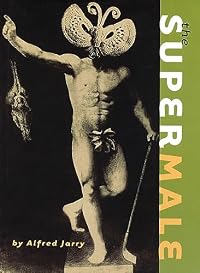
The Supermale
by Alfred Jarry
On This Page
Description
By Alfred Jarry. Translated by Ralph Gladstone and Barbara Wright. Introduction by Barbara Wright.Tags
Recommendations












Member Reviews
Alfred Jarry’s The Supermale is a bizarre mingling of science fiction and surrealism. The protagonist of this short story, Andre Marcueil, sets out to exceed the normal capacities of humanly endurance and strength. Essentially, the plots pièce de résistance is a race between a tandem of five cyclists and a train. The race lasts five days and is 10,000 miles with the only nourishment being ‘Perpetual Motion Food’. And, towards the end of the book, Andre is firmly resolved in copulating more than 82 times with a single woman, who he eventually (trying not to spoil the story) kills.
The opening line, “The act of love is of no importance, since it can be performed indefinitely,” said by Andre, sets this piece of literature show more rolling. One can almost note that, within the pages of this extremely and profusely mechanical piece, there is a twofold plotline that reveals itself at the end. First, there is the comical race that is undoubtedly a proto-science fiction fabrication. The Supermale was written in 1902, but set in 1920; this was an era of industry and machinery. Moreover, it was an era, philosophically speaking, of the tyranny of mechanics and how people were subjects to these inhuman metallic entities. With that said, it is obvious that the “Supermale” is just an attempt to integrate machine and humanity; it is a way to conform the two discrete beings into a single force. The first plot is the machine vs. man.
The race of cyclists and the train can be seen, in my opinion, as a metaphor for the race between machinery and mankind. Also, towards the end of the book, Andre, after being hooked up to a contraption (a machine) that is designed to summon love in him-due to his 82 sexual enterprises, implicating that he is devoid of love, actually caused the machine to feel love. This is an example of how man needs to regain control of the machinery.
The second plot is a love story; a love story that is fantastically interwoven into the main scheme. This sub-plot gives the main theme more depth. Andre’s friend Elson, the chemist who made the Perpetual Motion Food, had a daughter. This same daughter was the woman who Andre copulated with 82 times. She falls madly in love with this eccentric man, but he sees her as a proof of his feats and a symbol of his endeavors. Andre has reached a level of dehumanization, and became a machine. The Supermale is a paradox; he is a human beyond humanly capabilities, but hardly is he remotely human. Andre is eventually hooked up to a machine that is designed to effuse love in him; however, he overpowers it and instills love in the machine.
I found this book to be a great piece of bizarre, droll literature of the 20th century. Highly recommend it to anyone interested in Surrealist and Science Fiction Literature. show less
The opening line, “The act of love is of no importance, since it can be performed indefinitely,” said by Andre, sets this piece of literature show more rolling. One can almost note that, within the pages of this extremely and profusely mechanical piece, there is a twofold plotline that reveals itself at the end. First, there is the comical race that is undoubtedly a proto-science fiction fabrication. The Supermale was written in 1902, but set in 1920; this was an era of industry and machinery. Moreover, it was an era, philosophically speaking, of the tyranny of mechanics and how people were subjects to these inhuman metallic entities. With that said, it is obvious that the “Supermale” is just an attempt to integrate machine and humanity; it is a way to conform the two discrete beings into a single force. The first plot is the machine vs. man.
The race of cyclists and the train can be seen, in my opinion, as a metaphor for the race between machinery and mankind. Also, towards the end of the book, Andre, after being hooked up to a contraption (a machine) that is designed to summon love in him-due to his 82 sexual enterprises, implicating that he is devoid of love, actually caused the machine to feel love. This is an example of how man needs to regain control of the machinery.
The second plot is a love story; a love story that is fantastically interwoven into the main scheme. This sub-plot gives the main theme more depth. Andre’s friend Elson, the chemist who made the Perpetual Motion Food, had a daughter. This same daughter was the woman who Andre copulated with 82 times. She falls madly in love with this eccentric man, but he sees her as a proof of his feats and a symbol of his endeavors. Andre has reached a level of dehumanization, and became a machine. The Supermale is a paradox; he is a human beyond humanly capabilities, but hardly is he remotely human. Andre is eventually hooked up to a machine that is designed to effuse love in him; however, he overpowers it and instills love in the machine.
I found this book to be a great piece of bizarre, droll literature of the 20th century. Highly recommend it to anyone interested in Surrealist and Science Fiction Literature. show less
Having gleaned the reviews already on here about Alfred Jarry's The Supermale, I don't feel I really need to add much more. I will say however that I deeply enjoyed this work, it has the same anti-erotic absurd verve as Visits of Love, and in many ways experiments with the same themes. Like Shaw's Superman this is a character portrait that draws upon the Don Juan theme, except Jarry has fused it with Baron Munchausen, only to then give it the complete Ubu make-over. I will surely need to read this book again, if only to understand more thoroughly the metaphysics at work, especially concerning the philosophical views of Theophrastus. The level I read it at allowed for the luxurious imagery of the absurd to prick my senses - the ten show more thousand mile race fuelled by a super food (alcohol), seven nude tarts crashing through a window only to be tamed by a gramophone embedded amongst an arrangement of roses, and many other delights that Jarry has buried within the story. It will amuse and if not it will tickle your curiosity buds. show less
A minor, subtle, slightly scandalous classic from an early modernist master.
By the author of Ubu Roi.
”Kärleksakten är en handling utan betydelse, eftersom man kan upprepa den i oändlighet.” Med de kittlande orden inleds Alfred Jarrys absurda roman ”Övermannen” (Sphinx bokförlag, övers Magnus Hedlund). Den excentriske gentlemannen André Marcueil lovar inför sitt middagssällskap att liksom ”Indiern, så prisad av Theofrastos” älska ”sjuttio gånger och flera” under ett och samma dygn. Han lyckas över förväntan – 82 fullbordade kärleksakter blir resultatet av mandomsprovet.
Vad som var tänkt som en sorts science fiction – ”Övermannen” skrevs 1902 men utspelar sig på 20-talet – har nu blivit en roman i tiden. Den femte augusti hålls för första gången ett maraton i masturbation i London. Bakom show more evenemanget står ”Centre for sex and culture” som årligen arrangerar Masturbate-A-Thon i San Francisco (var annars?). Pris delas ut i två kategorier: den som kan hålla sig längst (nuvarande rekordet ligger på sju och en halv timme), den som kommer flest gånger (med ett rekord på 36 gånger återstår fortfarande en del till Jarrys visionära toppnotering).
Det finns något djupt mänskligt över denna förnekelse av den postcoitala utmattningen och ledan. Visst drömmer vi alla om att prestera mera... Kanske inte nödvändigtvis i sängen men i arbetslivet, på fritiden. Kraven är oändliga och de gränser som trots allt sätts av tiden och kroppen upplevs som personliga förolämpningar.
”Övermannen” handlar inte bara om manlig potens utan även om människokroppens förhållande till maskinen. I en scen tävlar fem cyklister med ett expresståg. För att kunna överträffa den mänskliga förmågan matas männen med en blandning av alkohol och stryknin som förvandlar dem till evighetsmaskiner.
Att övervinna den lilla döden är bara första steget. show less
Vad som var tänkt som en sorts science fiction – ”Övermannen” skrevs 1902 men utspelar sig på 20-talet – har nu blivit en roman i tiden. Den femte augusti hålls för första gången ett maraton i masturbation i London. Bakom show more evenemanget står ”Centre for sex and culture” som årligen arrangerar Masturbate-A-Thon i San Francisco (var annars?). Pris delas ut i två kategorier: den som kan hålla sig längst (nuvarande rekordet ligger på sju och en halv timme), den som kommer flest gånger (med ett rekord på 36 gånger återstår fortfarande en del till Jarrys visionära toppnotering).
Det finns något djupt mänskligt över denna förnekelse av den postcoitala utmattningen och ledan. Visst drömmer vi alla om att prestera mera... Kanske inte nödvändigtvis i sängen men i arbetslivet, på fritiden. Kraven är oändliga och de gränser som trots allt sätts av tiden och kroppen upplevs som personliga förolämpningar.
”Övermannen” handlar inte bara om manlig potens utan även om människokroppens förhållande till maskinen. I en scen tävlar fem cyklister med ett expresståg. För att kunna överträffa den mänskliga förmågan matas männen med en blandning av alkohol och stryknin som förvandlar dem till evighetsmaskiner.
Att övervinna den lilla döden är bara första steget. show less
Apr 15, 2025Swedish
Indeholder kapitlerne "Forord", "I. Manille-meldinger", "II. Hjertet sad hverken til venstre eller til højre", "III. Det er en hun, men en meget stærk en", "IV. Et lille stykke kvindfolk", "V. Væddeløbet over ti tusind miles", "VI. Alibiet", "VII. Kun for damer", "VIII. Ægcellen", "IX. 'Inderen', så vidt berømmet af Theofrast", "X. Hvem er du, menneskevæsen?", "XI. Mere", "XII. Oh, smukke nattergal", "XIII. Opdagelsen af kvinden", "XIV. Kærlighedsmaskinen".
???
???
Jan 15, 2018 (Edited)Danish
Ratings
Members
- Recently Added By
Lists

madness prompts and reason writes, says Gide
26 works; 2 members
Author Information

153+ Works 3,437 Members
Alfred Jarry, eccentric dramatist, poet, and humorist, was born in Laval, France, in 1873. He was the co-founder, with Remy de Gourmont in 1894, of the magazine L'ymagier, which literally translated is "the maker of prints." This magazine, in existence only two years, presented texts and art images from a number of literary avant-garde artists of show more the late 19th century. Jarry is perhaps best known for the satirical and farcical play Ubu Roi (King Ubu), the first in a series of Ubu plays, published in 1896. Jarry died in 1907 in Paris. (Bowker Author Biography) show less
Some Editions
Series
Belongs to Publisher Series
Work Relationships
Is contained in
Common Knowledge
- Canonical title*
- Il supermaschio
- Original title
- Le Surmale
- Original publication date
- 1902
- People/Characters
- André Marcueil; William Elson; Ellen Elson; Arthur Gough; General Sider; Senator de Saint-Jurieu (show all 16); Pusice-Euprépie de Saint-Jurieu; Cardinal Romuald; Henriette Cyne; Doctor Bathybius; Bill Gilbey; Jewey Jacobs; Ted Oxborrow; Bob Rumble; George Webb; Sammy White
- First words
- "The act of love is of no importance since it can be performed indefinitely."
- Quotations
- There is certainly no reason for men to build enduring works if they do not vaguely imagine that these works must wait for some additional beauty with which they themselves cannot invest themn, but which the future has in sto... (show all)re. Great works are not created great; they become so.
- Last words
- (Click to show. Warning: May contain spoilers.)She found an adroit jeweler to set, in the place of a pearl in a ring that she faithfully wears, one of the solid tears of the Supermale.
*Some information comes from Common Knowledge in other languages. Click "Edit" for more information.
Classifications
Statistics
- Members
- 310
- Popularity
- 102,436
- Reviews
- 6
- Rating
- (3.67)
- Languages
- 10 — Dutch, English, French, German, Italian, Japanese, Portuguese, Romanian, Spanish, Swedish
- Media
- Paper, Ebook
- ISBNs
- 25
- ASINs
- 5