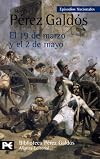
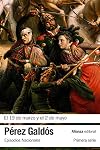
El 19 de marzo y el 2 de mayo
by Benito Pérez-Galdós
Episodios Nacionales. Primera Serie (3), Episodios nacionales (03)
On This Page
Description
El 19 de marzo y el 2 de mayo is the third novel on the first series of Episodios Nacionales by Benito P rez Gald s. Gabriel witnesses the mutiny of Aranjuez and then returns to Spain, where he becomes a servant in Agnes's Uncle's house. The story tells of many battles between the Spaniards and the French, as well as the more immediate story of Gabriel's ploys to save his beloved. In the end, he is captured by French soldiers.Tags
Recommendations



















Member Reviews
Episodios nacionales
Me ha parecido una maravilla. De nuevo, como en las anteriores entregas de los "Episodios Nacionales", se entremezclan las aventuras personales de Gabriel Araceli con los acontecimientos históricos de tal manera que parece lo más natural del mundo que este chaval estuviese metido en todo. Y a mí casi me importaban más los avatares del buen Gabriel intentando rescatar a su amada Inés de las garras de sus avaros y malvados tíos que las intrigas políticas de Godoy, Fernando VII y los franceses; por cierto que esto último solo se ve desde fuera, y por eso parecen más realistas. Pero es que las descripciones de los dos motines que dan título a la obra son de una viveza extraordinaria, sobre todo la del 2 de mayo en Madrid. A show more Galdós no parece importarle mucho el análisis político, sino los sentimientos desbocados de la plebe que, si en marzo le indignan (los mismos que el día anterior adulaban rastreramente a Godoy al día siguiente le escupen a la cara), en mayo le emocionan, y consigue arrastrar al lector a compartior esos sentimientos. Y, en cuanto a la historia personal, es una auténtica novela de aventuras por sí misma, llena de añagazas, de escapes imposibles, de pequeñas heroicidades, de malos malísimos, de buenos buenísimos y también de gente digna de lástima, que se sostendría perfectamente sin estar situada en un escenario tan significativo. Una obra de arte, sí señor. show less
Oct 12, 2021Spanish
En EL 19 DE MARZO Y EL 2 DE MAYO, las intrigas cortesanas en que se ve envuelto Gabriel de Araceli trascienden del palacio a la calle y refuerzan el malestar popular y el odio al favorito Godoy, situación que culmina en el motín de Aranjuez, del que Gabriel es testigo, así como en los inmediatos sucesos que provocan la invasión de España por Napoleón y el ardoroso levantamiento de los españoles.
Nov 2, 2022Spanish
Continuen les aventures d'en Gabriel de Araceli. En aquesta ocasió viu d'aprop la caiguda d'en Godoy i la ja, a cara descoberta, invasió francesa.
Amb tocs dickensians Galdós ens explica dos episodis més de la nostra història de manera divertida gràcies a les personalitats hilarants d'alguns dels seus personatges i els aconteixements que els fa viure.
Aquesta novel.la m'ha agradat una mica menys que les anteriors pel seu ritme desigual, això sí cap al final puja d'intensitat i ens deixa amb ganes de córrer a agafar el següent llibre de la sèrie per esbrinar el que haurà passar als protagonistes.
Recomenable.
Amb tocs dickensians Galdós ens explica dos episodis més de la nostra història de manera divertida gràcies a les personalitats hilarants d'alguns dels seus personatges i els aconteixements que els fa viure.
Aquesta novel.la m'ha agradat una mica menys que les anteriors pel seu ritme desigual, això sí cap al final puja d'intensitat i ens deixa amb ganes de córrer a agafar el següent llibre de la sèrie per esbrinar el que haurà passar als protagonistes.
Recomenable.
Feb 19, 2012Catalan
No me ha decepcionado la prosa de Galdos. La historia de los dos jóvenes amantes me ha parecido presentada de forma madura y muy bien intrincada en los eventos nacionales pues las vidas se desarrollan de formas intrincadas en la realidad social, como en la vida misma.
Aug 12, 2010Spanish
Ratings
Members
- Recently Added By
Author Information

606+ Works 9,516 Members
Perez Galdos was Spain's outstanding nineteenth-century novelist. At a time when most Spanish novelists were limited by their regional backgrounds, Galdos possessed the intellect and vision to embrace the Spanish people as a nation. In 1873 he began the Episodios nacionales (National Episodes), a 46--volume series of historical novels in which he show more was concerned less with details and facts of history than with their impact on the lives of ordinary people. His works are sometimes divided into two periods: novels of the first period and contemporary Spanish novels. His early novels, Dona Perfecta (1876), Gloria (1877), Marianela (1878), and The Family of Leon Roch (1879), may be characterized as realistic with touches of romanticism. The novels are united by common characters and themes in the manner of Balzac's Human Comedy. Dona Perfecta is a denunciation of intolerance. Marianela explores the irony and tragedy of the destruction of love by scientific progress. Fortunata and Jacinta (1886-87), a four-volume masterpiece of the second period, contrasts two women - Jacinta, wife of the wealthy middle-class Juanito Santa Cruz, and Fortunata, his mistress. Both are admirable characters, but it is Fortunata who bears a son, demonstrating the vitality of the lower classes. The character of Maxi reveals Galdos's interest in mental illness and his naturalistic strain. Born and educated in the Canary Islands, Perez Galdos studied law briefly and spent most of his adult life in Madrid. His study of lower-class Spanish life and his attempts to improve it led him to the advocacy of more equal distribution of wealth and outspoken opposition to the Catholic church. While always popular with the people, he fared less well in literary circles. In 1889 he sought admission to the Royal Academy, an honor he was refused until 1897, and the Nobel Prize went to a contemporary, Jose Echegaray, a writer of considerably less talent. Galdos died poor and blind. Although the government refused him a state funeral, the entire Spanish nation mourned him. English translations of his novels now out of print are The Disinherited Lady (1881), Miau (1888), Compassion (1897), and Tristana. (Bowker Author Biography) show less
Series

Work Relationships
Is contained in
Common Knowledge
- Canonical title*
- El 19 de marzo y el 2 de mayo
- Original title
- El 19 de marzo y el 2 de mayo
- Original publication date
- 1873
- People/Characters
- Gabriel de Araceli; Licenciado Lobo
- Important places
- Madrid, España
- Important events*
- Motín de Aranjuez (1808); Guerra de la Independencia Española (1808-1814); Levantamiento del 2 de Mayo (1808); Peninsular War
- Original language
- Spanish
*Some information comes from Common Knowledge in other languages. Click "Edit" for more information.
Classifications
- Genres
- Fiction and Literature, General Fiction, Historical Fiction
- DDC/MDS
- 863.5 — Literature & rhetoric Spanish, Portuguese, Galician literatures Spanish fiction 19th century 1800–1900
- LCC
- PQ6555 .D5 — Language and Literature French, Italian, Spanish and Portuguese literatures Spanish literature Individual authors, 1700-ca. 1868
- BISAC
Statistics
- Members
- 131
- Popularity
- 248,183
- Reviews
- 5
- Rating
- (3.85)
- Languages
- English, Spanish
- Media
- Paper, Ebook
- ISBNs
- 27
- ASINs
- 6