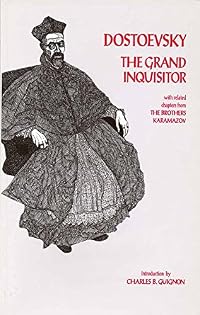
The Grand Inquisitor
by Fyodor Dostoyevsky
On This Page
Description
This excerpt from the Russian literary masterpiece The Brothers Karamazov is a parable set against the backdrop of the Spanish Inquisition, which Dostoyevsky uses to explore questions about God's existence and human freedom. This bite-size text is a great way for beginners to acquaint themselves with Dostoyevsky's style..
Tags
Recommendations






















Member Recommendations

Member Reviews
I read The Grand Inquisitor, the most famous chapter in The Brothers K, once before in my initial reading of the novel circa ten years earlier. For some reason, I have decided to re-read it alone.
Thoughts:
I would need to re-read this repeatedly to fully absorb and comprehend it, and not just because I tend to need more than one reading or listening. The Grand Inquisitor is militant atheist Ivan's "poem" (I call it his parable) dramatizing his reason for disbelief, and my only personal experience of atheism and rebellion is the fact that every Christian was an unbeliever before receiving Christ as Lord and savior. I know nothing about living a life of willful defiance against God; in fact I consider it my weakness, my limitation; I worry show more about it. According to the introduction to this little edition of The Grand Inquisitor, Dostoyevsky said his fath is stronger because it "came through the crucible of doubt." Mine didn't. Therefore, real-life Ivan Karamazovs and I hardly speak the same language, and I cannot call on personal expeience to help. Predictably, I have understood The Grand Inquisitor probably on only the most basic level.
It may be also predictable that based on what I do understand, my only reaction to the priest's argument to Christ (in reality, Ivan's argument) is to...laugh at it. In brief, Ivan (as the priest) argues that contra God's declarations, man does indeed live by bread alone; man is too contemptibly weak and fearful to want the freedom of choice given to him by God; therefore, the priests will provide man with bread forevermore, and man will serve the priests rather than serving God. ...Um...okay. So I'm supposed to live by bread alone. No, thank you. Ivan earnestly says he returns his "ticket" to God, unclaimed. I return the one offered by Ivan.
And of course the priest's (again, Ivan's) argument is thoroughly self-serving. How lucky for him that the elite represented by the priest would exclusively control the supply of bread, allowing them to lord it over the "weak" and "fearful" hoi polloi. The limitation (if not weakness) of the "Grand Inquisitor Argument" is that it operates strictly from the elite's viewpoint. It does not address how the elite's despised masses would feel about Christ. Actually, it does--they adore him more fervently than many crowds did in Israel during His ministry-- but the point is that the priest speaks only for his class, considering it separate from and superior to the masses.
What mind-blowing arrogance, what nerve Ivan (through his fictional alter ego the priest) must possess to stand in front of Jesus Christ (whom the priest at no point denies the identity of) and lecture him on how the priestly class "corrected" His teachings. Ivan makes no attempt to dismiss God as simply nonexistent; he instead tells Christ...His teachings are simply wrong. How prideful but how remarkably candid and un-pretentious. Only the second such atheist argument I've ever read.
The strength (such as it is) of Ivan's argument also comes from its honesty: not only acknowledging God and addressing Him directly, but acknowledging scriptural teachings and responding to them. It acknowledges that, as taught in the Bible, God has an "elect": that He chose who will and will not receive Christ. Noting this, the priest then points out to Jesus: "Thou wilt come with Thy chosen, the proud and strong; but we will say that they have only saved themselves, but we have saved all." Since the doctrine of the elect is a mystery, in the sense that we have no idea why God chose particular people for salvation, I would have no idea how to answer this point. Except to say to the priest (e.g., to Ivan): You say you have saved people. Have you? By giving them bread and telling them they do live by bread alone? By looking your Maker in the eye and telling Him what He said is untrue, did you expect to convince me of anything but your own arrogance? show less
Thoughts:
I would need to re-read this repeatedly to fully absorb and comprehend it, and not just because I tend to need more than one reading or listening. The Grand Inquisitor is militant atheist Ivan's "poem" (I call it his parable) dramatizing his reason for disbelief, and my only personal experience of atheism and rebellion is the fact that every Christian was an unbeliever before receiving Christ as Lord and savior. I know nothing about living a life of willful defiance against God; in fact I consider it my weakness, my limitation; I worry show more about it. According to the introduction to this little edition of The Grand Inquisitor, Dostoyevsky said his fath is stronger because it "came through the crucible of doubt." Mine didn't. Therefore, real-life Ivan Karamazovs and I hardly speak the same language, and I cannot call on personal expeience to help. Predictably, I have understood The Grand Inquisitor probably on only the most basic level.
It may be also predictable that based on what I do understand, my only reaction to the priest's argument to Christ (in reality, Ivan's argument) is to...laugh at it. In brief, Ivan (as the priest) argues that contra God's declarations, man does indeed live by bread alone; man is too contemptibly weak and fearful to want the freedom of choice given to him by God; therefore, the priests will provide man with bread forevermore, and man will serve the priests rather than serving God. ...Um...okay. So I'm supposed to live by bread alone. No, thank you. Ivan earnestly says he returns his "ticket" to God, unclaimed. I return the one offered by Ivan.
And of course the priest's (again, Ivan's) argument is thoroughly self-serving. How lucky for him that the elite represented by the priest would exclusively control the supply of bread, allowing them to lord it over the "weak" and "fearful" hoi polloi. The limitation (if not weakness) of the "Grand Inquisitor Argument" is that it operates strictly from the elite's viewpoint. It does not address how the elite's despised masses would feel about Christ. Actually, it does--they adore him more fervently than many crowds did in Israel during His ministry-- but the point is that the priest speaks only for his class, considering it separate from and superior to the masses.
What mind-blowing arrogance, what nerve Ivan (through his fictional alter ego the priest) must possess to stand in front of Jesus Christ (whom the priest at no point denies the identity of) and lecture him on how the priestly class "corrected" His teachings. Ivan makes no attempt to dismiss God as simply nonexistent; he instead tells Christ...His teachings are simply wrong. How prideful but how remarkably candid and un-pretentious. Only the second such atheist argument I've ever read.
The strength (such as it is) of Ivan's argument also comes from its honesty: not only acknowledging God and addressing Him directly, but acknowledging scriptural teachings and responding to them. It acknowledges that, as taught in the Bible, God has an "elect": that He chose who will and will not receive Christ. Noting this, the priest then points out to Jesus: "Thou wilt come with Thy chosen, the proud and strong; but we will say that they have only saved themselves, but we have saved all." Since the doctrine of the elect is a mystery, in the sense that we have no idea why God chose particular people for salvation, I would have no idea how to answer this point. Except to say to the priest (e.g., to Ivan): You say you have saved people. Have you? By giving them bread and telling them they do live by bread alone? By looking your Maker in the eye and telling Him what He said is untrue, did you expect to convince me of anything but your own arrogance? show less
This edition is an excerpt from the larger Dostoyevsky work. The introductory essay by Charles Guignon is well worth preserving, even if one does not care to own a mere excerpt of a great work. Guignon's essay is so good, it is worthwhile to consider it for its own merit. He piques interest, gives enough information to approach the work for the first time and understand it. The essay also is worthwhile considering the inclusion of "objectionable" philosophy, insofar as Dostoevsky believed, as well as its intended refutation (also excerpted in this edition). Will the reader be persuaded by the best arguments for atheism that the author could construct, or gain understanding and embrace the alternative view? In the context of building an show more idea library, Guignon's discussion is valuable. show less
Its a short section from Brothers Karamazov (BK) and doesn't make much sense if taken out of the complete narrative, in my opinion. One reason is not knowing the characters of the two interlocutors, i.e., Ivan and Alyosha, apriori. This is the central part of the BK narrative that revolves around the exchange between and agnostic/ atheistic and a mystic. In my view, through the Grand Inquisitor, Dostoevsky juxtaposes an agnostic's desperate struggle to grapple with belief with God's ultimate and unconditional love. Without spoiling it for others, I would just say that one must stop at the part where the prisoner kisses the old man on his bloodless lips and reflect upon Dostoevsky's ultimate achievement.
Fantastic edition of the terrible parable. The Inquisitor's words vibrate on the page - one can almost smell the brimstone.
This (which I have read) is a self-contained parable from The Brothers Karamazov (which I’ve not read). It addresses the conundrum of an omnipotent and loving God allowing the existence of evil. Can it all be blamed on free will and the desire for happiness? It also contrasts institutional religion and warped theology with the simple faith Jesus taught.
Ivan imagines Jesus returning during the time of the Spanish Inquisition, in a story rich with New Testament parallels. There are occasional interjections from his brother, Alyosha.
Jesus
Jesus comes quietly and unobtrusively, but is immediately recognised by the people:
“The Sun of Love burns in His heart, and warm rays of Light, Wisdom and Power beam forth from His eyes, and pour show more down their waves upon the swarming multitudes of the rabble assembled around, making their hearts vibrate with returning love.”
He performs familiar miracles, even by a touch of his garment. He restores the sight of a blind man, and raises a girl from the dead.
The Inquisitor
But the Cardinal Grand Inquisitor sees all.
“He is tall, gaunt-looking old man of nearly four-score years and ten, with a stern, withered face, and deeply sunken eyes, from the cavity of which glitter two fiery sparks.”
Arrest and Sentence Without Trial
Jesus is arrested, imprisoned, silent - and instructed to remain so. He is told that he will be found guilty and burned at the stake the following day. The Inquisitor expects the crowd of Jesus' followers to support this (just as Pontius Pilate turned the mood of the crowd).
Picture: The auto-da-fé (public penance of heretics and apostates) in Plaza Mayor, Madrid in 1680. By Francisco Rizi in 1683.
Devilish Institution
The Cardinal Grand Inquisitor, and by extension, the Catholic church, want to protect themselves, rather than allow the people to be free.
He tempts Jesus, just as the Devil did in the wilderness, and mockingly quotes Jesus' words and actions, explaining why he was wrong not to do as the Devil suggested.
The Inquisitor thinks God’s work is complete, and that people “can never be free, for they are weak, vicious, miserable nonentities born wicked and rebellious”. Feeding them is enough. Earthly bread. Not the bread of Heaven that Jesus promised. The Inquisitor fears the consequences of Jesus (rather than the church) having thousands of followers.
"Whom or what shall we worship?"
“There are three Powers, three unique Forces upon earth, capable of conquering for ever by charming the conscience of these weak rebels—men—for their own good; and these Forces are: Miracle, Mystery and Authority. Thou hast rejected all the three.” - by not succumbing to temptation in the wilderness, through pride and overestimating the qualities of mankind.
The Inquisitor has a dark view of mankind and how to enslave them to the whims of the Church, willingly.
“Oh, we will take good care to prove to them that they will become absolutely free only when they have abjured their freedom in our favor and submit to us absolutely.”
Judas Rewritten
Jesus was betrayed unto death by a kiss. Forgiveness can come from a kiss as well.
Read it For Yourself
I read two versions in parallel:
* David McDuff, Penguin Books, 1993, in a modern style: here
* HP Blavatsky in 2005, with more classical flounces, on Gutenberg: here.
Related Reading
I’m grateful to Michael pointing me to this, in the context of my review of The Faith of Donald J. Trump: A Spiritual Biography, HERE.
I was reminded of Ursula Le Guin’s justly famous and troubling short story, The Ones Who Walk Away from Omeals, which I reviewed HERE.
Not Forgetting
I’ll be in trouble if I don’t include this
Expect the unexpected. show less
Ivan imagines Jesus returning during the time of the Spanish Inquisition, in a story rich with New Testament parallels. There are occasional interjections from his brother, Alyosha.
Jesus
Jesus comes quietly and unobtrusively, but is immediately recognised by the people:
“The Sun of Love burns in His heart, and warm rays of Light, Wisdom and Power beam forth from His eyes, and pour show more down their waves upon the swarming multitudes of the rabble assembled around, making their hearts vibrate with returning love.”
He performs familiar miracles, even by a touch of his garment. He restores the sight of a blind man, and raises a girl from the dead.
The Inquisitor
But the Cardinal Grand Inquisitor sees all.
“He is tall, gaunt-looking old man of nearly four-score years and ten, with a stern, withered face, and deeply sunken eyes, from the cavity of which glitter two fiery sparks.”
Arrest and Sentence Without Trial
Jesus is arrested, imprisoned, silent - and instructed to remain so. He is told that he will be found guilty and burned at the stake the following day. The Inquisitor expects the crowd of Jesus' followers to support this (just as Pontius Pilate turned the mood of the crowd).
Picture: The auto-da-fé (public penance of heretics and apostates) in Plaza Mayor, Madrid in 1680. By Francisco Rizi in 1683.
Devilish Institution
The Cardinal Grand Inquisitor, and by extension, the Catholic church, want to protect themselves, rather than allow the people to be free.
He tempts Jesus, just as the Devil did in the wilderness, and mockingly quotes Jesus' words and actions, explaining why he was wrong not to do as the Devil suggested.
The Inquisitor thinks God’s work is complete, and that people “can never be free, for they are weak, vicious, miserable nonentities born wicked and rebellious”. Feeding them is enough. Earthly bread. Not the bread of Heaven that Jesus promised. The Inquisitor fears the consequences of Jesus (rather than the church) having thousands of followers.
"Whom or what shall we worship?"
“There are three Powers, three unique Forces upon earth, capable of conquering for ever by charming the conscience of these weak rebels—men—for their own good; and these Forces are: Miracle, Mystery and Authority. Thou hast rejected all the three.” - by not succumbing to temptation in the wilderness, through pride and overestimating the qualities of mankind.
The Inquisitor has a dark view of mankind and how to enslave them to the whims of the Church, willingly.
“Oh, we will take good care to prove to them that they will become absolutely free only when they have abjured their freedom in our favor and submit to us absolutely.”
Judas Rewritten
Jesus was betrayed unto death by a kiss. Forgiveness can come from a kiss as well.
Read it For Yourself
I read two versions in parallel:
* David McDuff, Penguin Books, 1993, in a modern style: here
* HP Blavatsky in 2005, with more classical flounces, on Gutenberg: here.
Related Reading
I’m grateful to Michael pointing me to this, in the context of my review of The Faith of Donald J. Trump: A Spiritual Biography, HERE.
I was reminded of Ursula Le Guin’s justly famous and troubling short story, The Ones Who Walk Away from Omeals, which I reviewed HERE.
Not Forgetting
I’ll be in trouble if I don’t include this
Expect the unexpected. show less
Dostoevsky wrote much and prodominately of crime and the collective culpabiltity of humanity. To not commit a crime yet have culpibility in the community of its crime, as the introduction examines the authors sense of guilt for two deaths that were not of his doings, his fathers; the croonish man and his son: inheriter of his genetics or thus crimes against nature. what by chance is that said crime? such as Adam had been due blamed for Eve's trespass we are given dual guilt that of love and also, its repercusssion, the act of being sentenced for a crime without crimes. Insistence of serpentine wretch is not that temptation but the mere fact that Satan felt, as we get a fuller story by viewing the quran that both satan and iblis niether show more felt humanity worthy of free will, satan being gods favorite and given his most precisous gift; beauty... what is true beauties form? not but wisdom and veritas...... i commence my ode to this timeless author of crime and its mind that of choosings and its inquister the criminal show less
Um dos mais belos escritos cometido pela mão humana.
Members
- Recently Added By
Lists

Books Read in 2017
4,248 works; 130 members

Books Read in 2021
5,361 works; 114 members
Author Information

1,414+ Works 179,232 Members
One of the most powerful and significant authors in all modern fiction, Fyodor Dostoevsky was the son of a harsh and domineering army surgeon who was murdered by his own serfs (slaves), an event that was extremely important in shaping Dostoevsky's view of social and economic issues. He studied to be an engineer and began work as a draftsman. show more However, his first novel, Poor Folk (1846), was so well received that he abandoned engineering for writing. In 1849, Dostoevsky was arrested for being a part of a revolutionary group that owned an illegal printing press. He was sentenced to be executed, but the sentence was changed at the last minute, and he was sent to a prison camp in Siberia instead. By the time he was released in 1854, he had become a devout believer in both Christianity and Russia - although not in its ruler, the Czar. During the 1860's, Dostoevsky's personal life was in constant turmoil as the result of financial problems, a gambling addiction, and the deaths of his wife and brother. His second marriage in 1887 provided him with a stable home life and personal contentment, and during the years that followed he produced his great novels: Crime and Punishment (1886), the story of Rodya Raskolnikov, who kills two old women in the belief that he is beyond the bounds of good and evil; The Idiots (1868), the story of an epileptic who tragically affects the lives of those around him; The Possessed (1872), the story of the effect of revolutionary thought on the members of one Russian community; A Raw Youth (1875), which focuses on the disintegration and decay of family relationships and life; and The Brothers Karamazov (1880), which centers on the murder of Fyodor Karamazov and the effect the murder has on each of his four sons. These works have placed Dostoevsky in the front rank of the world's great novelists. Dostoevsky was an innovator, bringing new depth and meaning to the psychological novel and combining realism and philosophical speculation in his complex studies of the human condition. (Bowker Author Biography) show less

Fyodor Dostoyevsky has a Legacy Library. Legacy libraries are the personal libraries of famous readers, entered by LibraryThing members from the Legacy Libraries group.
Some Editions
Series
Belongs to Publisher Series
Penguin Great Ideas (74)
dtv zweisprachig (Russisch)
Insel-Bücherei (Nr. 149)
Reclams Universal-Bibliothek (6256)
Work Relationships
Is contained in
I capolavori (L'adolescente - Delitto e castigo - I demoni - I fratelli Karamazov - Il giocatore - L'idiota - Memorie dal sottosuolo - Le notti bianche - Racconti - Il sosia - Umiliati e offesi) by Fëdor Mihajlovič Dostoevskij (indirect)
Revue Française de Yoga N°1 : De maître à disciple by Fédération nationale des libres penseurs de France et de l'Union française (indirect)
Has as a student's study guide
Common Knowledge
- Canonical title*
- De groot-inquisiteur; Christus en de Grootinquisiteur
- Original publication date
- 1880
- People/Characters
- Grand Inquisitor; Jesus Christ
- Important places*
- Russia; Siviglia, Spagna
- Original language
- Russian
*Some information comes from Common Knowledge in other languages. Click "Edit" for more information.
Classifications
- Genres
- Fiction and Literature, General Fiction
- DDC/MDS
- 813 — Literature & rhetoric American literature in English American fiction in English
- LCC
- PG3326 .B7 — Language and Literature Slavic languages and literatures. Baltic languages. Albanian language Slavic. Baltic. Albanian Russian literature Individual authors and works 1800-1870 Dostoyevsky
- BISAC
Statistics
- Members
- 1,341
- Popularity
- 17,762
- Reviews
- 15
- Rating
- (4.18)
- Languages
- 9 — Catalan, Dutch, English, French, German, Italian, Russian, Spanish, Portuguese (Brazil)
- Media
- Paper, Audiobook, Ebook
- ISBNs
- 109
- ASINs
- 40