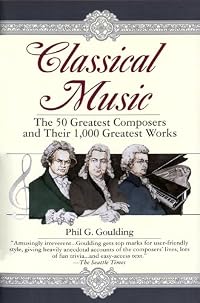
Classical Music: the 50 greatest composers and their 1,000 greatest works
by Phil G. Goulding
On This Page
Description
Did Mozart come before Beethoven? Who in the world was Palestrina? Why did Stravinsky's "Rite of Spring" cause a riot? Which of Haydn's 104 symphonies should you buy? What is a concerto and how does it differ from a sonata? There are so many composers - who are the ten you really should know? And where can you get answers to these and all your other classical music questions without getting bogged down in technicalities and jargon? Now you can turn to this lively and.Tags
Recommendations












Member Reviews
This is one of four general guides I own to classical music. I have other books specifically on orchestral, concerto, chamber, choral and opera, but this is one that covers all the different forms. The Miller Barnes and Noble Introduction to Music goes over such things as tone, rhythm, melody, etc. The Hurwitz Beethoven or Bust goes over the various forms (the concerto, for instance) and their various types. Goulding's Classical Music concentrates on the core repertory--"The 50 Greatest Composers and Their 1,000 Greatest Works."
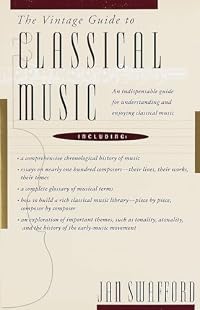
The Vintage Guide to Classical Music also focuses more on the composers than the forms, but is more eclectic and comprehensive. Goulding includes very few Medieval or Renaissance or many Modern composers--while show more Swafford's Vintage Guide includes biographies and naming of the important pieces to know of de Machaut, Dufay, Desprez, di Lasso, Monteverdi, Ives, Schoenberg, Berg, Webern, Britten. But I do love how Goulding focuses on those chosen composers. The book doesn't just give an overview of their lives and works, but gives you a "Starter Kit" and then a "Top Ten" to jumpstart your collection. The composers appear what Goulding considers their order of greatness. This is his top ten:
1) Johann Sebastian Bach
2) Wolfgang Amadeus Mozart
3) Ludwig van Beethoven
4) Richard Wagner
5) Franz Joseph Haydn
6) Johannes Brahms
7) Franz Schubert
8) Robert Schumann
9) George Frideric Handel
10) Peter Ilyitch Tchaikovsky
For some composers you'll get listings for a "Master Collection." For the 3 "greatest" composers Bach, Mozart, Beethoven you'll get listings for a more extensive "Library" too. Obviously this is rather biased towards German/Austrian composers, but still makes a great introduction to classical music. show less
The Vintage Guide to Classical Music also focuses more on the composers than the forms, but is more eclectic and comprehensive. Goulding includes very few Medieval or Renaissance or many Modern composers--while show more Swafford's Vintage Guide includes biographies and naming of the important pieces to know of de Machaut, Dufay, Desprez, di Lasso, Monteverdi, Ives, Schoenberg, Berg, Webern, Britten. But I do love how Goulding focuses on those chosen composers. The book doesn't just give an overview of their lives and works, but gives you a "Starter Kit" and then a "Top Ten" to jumpstart your collection. The composers appear what Goulding considers their order of greatness. This is his top ten:
1) Johann Sebastian Bach
2) Wolfgang Amadeus Mozart
3) Ludwig van Beethoven
4) Richard Wagner
5) Franz Joseph Haydn
6) Johannes Brahms
7) Franz Schubert
8) Robert Schumann
9) George Frideric Handel
10) Peter Ilyitch Tchaikovsky
For some composers you'll get listings for a "Master Collection." For the 3 "greatest" composers Bach, Mozart, Beethoven you'll get listings for a more extensive "Library" too. Obviously this is rather biased towards German/Austrian composers, but still makes a great introduction to classical music. show less
I found this book to be quite enjoyable to leaf through and to read. Although somewhat for the beginner, this is a good guide for the more experienced to find out what they have missed in their listening, and to learn more about the "50" greatest composers.
The composers are listed by the presumed ranking of their greatness. Bach, Mozart, Beethoven, Wagner, Haydn, Brahms, and Schubert make up the first seven, and obvious bias to the classical period and all Germanic. His favorite non-Germanic composer, Antonin Dvoŕák (Czech), comes in at #12. Verdi, the top Italian composer comes in at 16th; the top French composer, Berlioz, comes in at 21st.
For each composer, Goulding prvodes a "Starter Kit", then puts in the "Top Ten", and finally show more lays out a fairly full "Master Collection." It's kind of fun to see how you might adjust these ranking based on what you have really appreciated.
Composers assoicated with minimalism, and those very recently well known, like Arvo Pärt, are not included. show less
The composers are listed by the presumed ranking of their greatness. Bach, Mozart, Beethoven, Wagner, Haydn, Brahms, and Schubert make up the first seven, and obvious bias to the classical period and all Germanic. His favorite non-Germanic composer, Antonin Dvoŕák (Czech), comes in at #12. Verdi, the top Italian composer comes in at 16th; the top French composer, Berlioz, comes in at 21st.
For each composer, Goulding prvodes a "Starter Kit", then puts in the "Top Ten", and finally show more lays out a fairly full "Master Collection." It's kind of fun to see how you might adjust these ranking based on what you have really appreciated.
Composers assoicated with minimalism, and those very recently well known, like Arvo Pärt, are not included. show less
This is a fun, approachable guide to classical music that uses a light touch, fun facts and humorous anecdotes to help the neophyte make sense of classical music and its origins.
This is a well-designed primer on music for the intelligent but uninformed listener of any age. At 63, Goulding, a Washington newspaper journalist who moved to high government and business posts in defense and oil, attempted to learn something about classical music. Amazingly, he found no helpful sources for the adult absolute beginner. Ten years later, he presents this book for those in the same quandary. The user-friendly format features charts, pictures, and sidebars, simple explanations of musical terms, and descriptions of instruments. The writing flows show more easily, and the text is readable and browsable. There is nothing new here, but Goulding has done his homework carefully and thoroughly. Recommended for the curious but illiterate music lover. show less
This is a well-designed primer on music for the intelligent but uninformed listener of any age. At 63, Goulding, a Washington newspaper journalist who moved to high government and business posts in defense and oil, attempted to learn something about classical music. Amazingly, he found no helpful sources for the adult absolute beginner. Ten years later, he presents this book for those in the same quandary. The user-friendly format features charts, pictures, and sidebars, simple explanations of musical terms, and descriptions of instruments. The writing flows show more easily, and the text is readable and browsable. There is nothing new here, but Goulding has done his homework carefully and thoroughly. Recommended for the curious but illiterate music lover. show less
Amazon.com
This is a fun, approachable guide to classical music that uses a light touch, fun facts and humorous anecdotes to help the neophyte make sense of classical music and its origins.
From Library Journal
The dogmatic title of this book is enough to raise the hackles of any music lover. That's unfortunate, because this is a well-designed primer on music for the intelligent but uninformed listener of any age. At 63, Goulding, a Washington newspaper journalist who moved to high government and business posts in defense and oil, attempted to learn something about classical music. Amazingly, he found no helpful sources for the adult absolute beginner. Ten years later, he presents this book for those in the same quandary. The show more user-friendly format features charts, pictures, and sidebars, simple explanations of musical terms, and descriptions of instruments. The writing flows easily, and the text is readable and browsable. There is nothing new here, but Goulding has done his homework carefully and thoroughly. Recommended for the curious but illiterate music lover.
- Philippa Kiraly, Seattle
Copyright 1992 Reed Business Information, Inc. show less
This is a fun, approachable guide to classical music that uses a light touch, fun facts and humorous anecdotes to help the neophyte make sense of classical music and its origins.
From Library Journal
The dogmatic title of this book is enough to raise the hackles of any music lover. That's unfortunate, because this is a well-designed primer on music for the intelligent but uninformed listener of any age. At 63, Goulding, a Washington newspaper journalist who moved to high government and business posts in defense and oil, attempted to learn something about classical music. Amazingly, he found no helpful sources for the adult absolute beginner. Ten years later, he presents this book for those in the same quandary. The show more user-friendly format features charts, pictures, and sidebars, simple explanations of musical terms, and descriptions of instruments. The writing flows easily, and the text is readable and browsable. There is nothing new here, but Goulding has done his homework carefully and thoroughly. Recommended for the curious but illiterate music lover.
- Philippa Kiraly, Seattle
Copyright 1992 Reed Business Information, Inc. show less
Na zijn pensionering besloot de Amerikaanse schrijver Phil Goulding zich bezig te houden met de westerse klassieke muziek. Hij had wel eens van Bach en Mozart en Beethoven gehoord en ook wel eens een stukje muziek van hen geluisterd, maar verder kende hij nauwelijks een componist bij naam en al helemaal hun muziek niet. Hij was dus een volslagen leek. Hij stelde zich een eenvoudige vraag waarop het antwoord nog niet zo eenvoudig was: "Wat zijn de belangrijkste componisten en wat zijn hun belangrijkste werken"
Zeven jaar lang heeft hij zich in de bibliotheek gestord op boeken over klassieke muziek en heeft hij talloze cd's beluisterd. Het resultaat is dit lijvige boek "Klassieke muziek: de 50 bekendste componisten en 1000 van hun show more beroemdste werken". Na een uitgebreide inleiding volgen 50 hoofdstukjes over deze componisten van nummer 1 Johan Sebastian Bach tot en met nummer 50 Alexander Borodin. Over de volgorde in belangrijkheid van de componisten valt veel te twisten (zo reken ik de niet vermelde Sergej Rachmaninov zonder meer tot mijn toptien), maar de tekstjes over de verschillende componisten zijn inhoudelijk interessant en prettig om te lezen. Steeds wordt iets over hun leven en werk verteld, geïllustreerd met citaten van kenners, al dan niet collega componisten. Ook wordt van iedere componist een aantal werken aanbevolen. Ik heb van het boek de inleidende hoofdstukken gelezen en tot en met de 12e componist op delijst: Antonin Dvorak. Het boek is het best te gebruiken in combinatie met een goede cd-gids zoals die van Penguin of de "Gramophone classical good cd guide" show less
Zeven jaar lang heeft hij zich in de bibliotheek gestord op boeken over klassieke muziek en heeft hij talloze cd's beluisterd. Het resultaat is dit lijvige boek "Klassieke muziek: de 50 bekendste componisten en 1000 van hun show more beroemdste werken". Na een uitgebreide inleiding volgen 50 hoofdstukjes over deze componisten van nummer 1 Johan Sebastian Bach tot en met nummer 50 Alexander Borodin. Over de volgorde in belangrijkheid van de componisten valt veel te twisten (zo reken ik de niet vermelde Sergej Rachmaninov zonder meer tot mijn toptien), maar de tekstjes over de verschillende componisten zijn inhoudelijk interessant en prettig om te lezen. Steeds wordt iets over hun leven en werk verteld, geïllustreerd met citaten van kenners, al dan niet collega componisten. Ook wordt van iedere componist een aantal werken aanbevolen. Ik heb van het boek de inleidende hoofdstukken gelezen en tot en met de 12e componist op delijst: Antonin Dvorak. Het boek is het best te gebruiken in combinatie met een goede cd-gids zoals die van Penguin of de "Gramophone classical good cd guide" show less
Dec 9, 2013Dutch
Ratings
Members
- Recently Added By
Author Information
6 Works 676 Members
Common Knowledge
- Canonical title
- Classical Music: the 50 greatest composers and their 1,000 greatest works
- Original publication date
- 1992
Classifications
Statistics
- Members
- 496
- Popularity
- 60,307
- Reviews
- 5
- Rating
- (4.16)
- Languages
- Chinese, Dutch, English, Swedish
- Media
- Paper, Ebook
- ISBNs
- 10
- ASINs
- 1