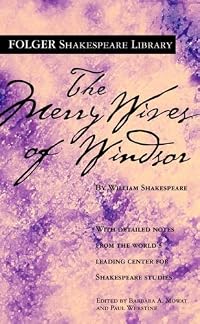
The Merry Wives of Windsor
by William Shakespeare
On This Page
Description
It is said that Queen Elizabeth gave Shakespeare two weeks to write this play that showcases her favorite comedic character, Sir John Falstaff. The dissolute Falstaff plans to seduce Mistress Ford and Mistress Page, two "Merry Wives of Windsor," thereby gaining access to their husbands' wealth. The two women have the old rogue's measure, however, and Falstaff's plots lead only to his own humiliation. But the merry wives themselves fall prey to plotting as their plans to prevent Mistress show more Page's daughter Anne from marrying the young man she loves are frustrated in their turn. show lessTags
Recommendations














Member Recommendations
2below Similar themes and situations. I also think they're both hilariously entertaining.
Member Reviews
John Falstaff of the Henry plays is visiting Windsor and writes letters to two of the wives, attempting to seduce them for their husbands' money. The wives, Mistress Ford (of a jealous husband) and Mistress Page (of a not-so-jealous husband), decide to have some fun with him for coming up with so outrageous a plot. Meanwhile, multiple suitors try to Miss Anne Page's hand.
This is a departure from many of Shakespeare's plays in that the majority of it is written in prose; only some is in meter. I enjoyed the wordplay and the ridiculous scenarios and ways the wives outwit Falstaff. The fat jokes may offend.
This is a departure from many of Shakespeare's plays in that the majority of it is written in prose; only some is in meter. I enjoyed the wordplay and the ridiculous scenarios and ways the wives outwit Falstaff. The fat jokes may offend.
This was surprisingly simple and funny, compared to Henry IV! A nice, refreshing Shakespearean comedy that might have a few of his favourite tropes but largely does its own thing. This has never been one of the plays I’ve wanted to see performed, but now I’d be up for it.
I was surprised by how different this felt, not only in its lack of complexity, but also in the sources of humour. While there is a young woman with romantic troubles, she’s the B plot and her troubles aren’t about getting the guy, it’s having too many. Most of the humour actually comes from people creating problems for Falstaff, and from wordplay and other linguistic humour. Also disguises. It’s much more of a farce, and I can absolutely see every cast show more member hamming it up for the audience, really leaning into the lines and action.
One of the things that struck me most, probably the first thing, was the accents. I’m so used to dialects and accents being written with minimal spelling changes, and to such things being more common in 18th and 19th century fiction, that I was surprised and delighted to see Shakespeare doing it. And to see that his way of writing accents pretty much holds up today. Is all the mocking of foreigners and the uneducated offensive? Especially when people make puns based on mispronunciations? Heck yeah. It is still darn cool to see? You bet.
The other thing that I really noticed reading this one is that it’s a lot more female-focused than many of his plays. The women here have agency, and the message seems to be that women know their own minds and can be trusted. (To be obedient to their husbands,yes, because this is still the 16th century, but hey.) I had fun watching the wives planning their pranks, and seeing the jealous husband mocked for his jealousy, and the secondary women equally having agendas. A lot of the jokes are also at the expense of the men, not the women, which was refreshing.
That said, the plot pretty much hangs by a thread at a few points, and it’s pretty clear that a) Shakespeare was basically writing fan service and b) he was occasionally stumped about where the plot would go. There’s one character, fun as they are, who’s basically a messenger to further the plot and nothing else, and I have a suspicion the ending is at least partly inspired but what costumes were lying around at the time. It’s relatable as anything, but I agree with the academic consensus that this is not one of Shakespeare’s deepest and best thought-out plays. However, it’s also not trying to be and does a good job at being pure entertainment.
Basically, if you’re like me and read Shakespeare for fun, I don’t think this is a play you should miss. It’s light, a faster read because nobody’s really pontificating about anything, and you get to see Falstaff carted out with the laundry. Don’t be like me and assume because Henry IV was kind of dry, that this one will be also.
7.5/10
Contains: attempted adultery, women being married off, lots of stereotypical accents, fat jokes, the man in a dress gag show less
I was surprised by how different this felt, not only in its lack of complexity, but also in the sources of humour. While there is a young woman with romantic troubles, she’s the B plot and her troubles aren’t about getting the guy, it’s having too many. Most of the humour actually comes from people creating problems for Falstaff, and from wordplay and other linguistic humour. Also disguises. It’s much more of a farce, and I can absolutely see every cast show more member hamming it up for the audience, really leaning into the lines and action.
One of the things that struck me most, probably the first thing, was the accents. I’m so used to dialects and accents being written with minimal spelling changes, and to such things being more common in 18th and 19th century fiction, that I was surprised and delighted to see Shakespeare doing it. And to see that his way of writing accents pretty much holds up today. Is all the mocking of foreigners and the uneducated offensive? Especially when people make puns based on mispronunciations? Heck yeah. It is still darn cool to see? You bet.
The other thing that I really noticed reading this one is that it’s a lot more female-focused than many of his plays. The women here have agency, and the message seems to be that women know their own minds and can be trusted. (To be obedient to their husbands,yes, because this is still the 16th century, but hey.) I had fun watching the wives planning their pranks, and seeing the jealous husband mocked for his jealousy, and the secondary women equally having agendas. A lot of the jokes are also at the expense of the men, not the women, which was refreshing.
That said, the plot pretty much hangs by a thread at a few points, and it’s pretty clear that a) Shakespeare was basically writing fan service and b) he was occasionally stumped about where the plot would go. There’s one character, fun as they are, who’s basically a messenger to further the plot and nothing else, and I have a suspicion the ending is at least partly inspired but what costumes were lying around at the time. It’s relatable as anything, but I agree with the academic consensus that this is not one of Shakespeare’s deepest and best thought-out plays. However, it’s also not trying to be and does a good job at being pure entertainment.
Basically, if you’re like me and read Shakespeare for fun, I don’t think this is a play you should miss. It’s light, a faster read because nobody’s really pontificating about anything, and you get to see Falstaff carted out with the laundry. Don’t be like me and assume because Henry IV was kind of dry, that this one will be also.
7.5/10
Contains: attempted adultery, women being married off, lots of stereotypical accents, fat jokes, the man in a dress gag show less
It's not Falstaff at his most iconic, but nevertheless, more Falstaff is never a bad thing. Comes across as kinda cutesy as it's full of mischief, whimsy, and shenanigans, but I couldn't help but root for these two wives who are messing with the entitled men in their lives. There's a lot of bizarrity to be found here, like the French doctor, the randomly inserted Latin lesson, and the "magical" prank at the end. Even though this play doesn't always make sense and the humour isn't the most sophisticated, it's still pretty entertaining if you're down to clown and looking for something light-hearted and silly.
I adore Shakespeare. I’ve read at least half of his works. I’ve seen dozens of his plays performed. In college I took a class completely devoted to learning how to read and interpret his writing. I’ve visited the Globe in England and every time I read a new play of his I find a new reason to love his work.
His writing isn’t perfect. He ripped story lines from others and his plays can be repetitive. He can be long-winded when he wants to, but all-in-all, there’s more brilliance than hot air there. When Shakespeare ran out of words to express what he was feeling, he invented them! That’s just amazing. Not only did he invent words, but they are ones that stuck and that we still use today.
I love his wit. He was incredibly funny. show more Many of his jokes were topical, so they aren’t nearly as amusing to us as they were to audiences that lived during his lifespan. It’s like someone watching an episode of Saturday Night Live from 30 years ago and expecting to catch every joke from the weekend update.
On to the The Merry Wives of Windsor. This isn’t my favorite play, it isn’t even my favorite comedy by the Bard, but it is entertaining. It’s well-known purely because it brought back a fan-favorite, Sir John Falstaff (from the Henry IV history plays).
The basic plot is as follows, that well-loved pompous old fool, Falstaff, decides to seduce two of the married ladies in the town of Windsor. The confusion that ensues is almost like a French farce. People run in, doors slam, identities are mistaken, etc. In other words, good times.
Always the idiot, Falstaff makes the mistake of wooing two women who happen to be best friends. Mistress Ford and Mistress Page both receive love letter from the fat knight and devise a plan to trap and mock him. Mistress Ford’s husband ends up as collateral damage when he’s led to believe his wife is actually cheating on him.
What sets this play apart from his many others is the fact that it’s the only one set in contemporary (for Shakespeare) England. Most of his other plays either took place in the past or in another country. The subplot involves a husband and wife (the Pages) who are trying to marry their daughter off to men she doesn't love. The clever daughter evades her parents' wishes by coming up with a tricky solution of her own to get the man she truly loves.
If you're new to Shakespeare, see it live first! It's a play, it was meant to be seen and not just read. Once you've done that, explore the beauty of his writing. Much Ado About Nothing is a great place to start in the comedies and Hamlet remains my favorite tragedy... so far.
---One side note, if you’re looking for a definitive edition of Shakespeare, I would highly recommend the The Riverside Shakespeare. It is massive (like five inches thick), but I love it. show less
His writing isn’t perfect. He ripped story lines from others and his plays can be repetitive. He can be long-winded when he wants to, but all-in-all, there’s more brilliance than hot air there. When Shakespeare ran out of words to express what he was feeling, he invented them! That’s just amazing. Not only did he invent words, but they are ones that stuck and that we still use today.
I love his wit. He was incredibly funny. show more Many of his jokes were topical, so they aren’t nearly as amusing to us as they were to audiences that lived during his lifespan. It’s like someone watching an episode of Saturday Night Live from 30 years ago and expecting to catch every joke from the weekend update.
On to the The Merry Wives of Windsor. This isn’t my favorite play, it isn’t even my favorite comedy by the Bard, but it is entertaining. It’s well-known purely because it brought back a fan-favorite, Sir John Falstaff (from the Henry IV history plays).
The basic plot is as follows, that well-loved pompous old fool, Falstaff, decides to seduce two of the married ladies in the town of Windsor. The confusion that ensues is almost like a French farce. People run in, doors slam, identities are mistaken, etc. In other words, good times.
Always the idiot, Falstaff makes the mistake of wooing two women who happen to be best friends. Mistress Ford and Mistress Page both receive love letter from the fat knight and devise a plan to trap and mock him. Mistress Ford’s husband ends up as collateral damage when he’s led to believe his wife is actually cheating on him.
What sets this play apart from his many others is the fact that it’s the only one set in contemporary (for Shakespeare) England. Most of his other plays either took place in the past or in another country. The subplot involves a husband and wife (the Pages) who are trying to marry their daughter off to men she doesn't love. The clever daughter evades her parents' wishes by coming up with a tricky solution of her own to get the man she truly loves.
If you're new to Shakespeare, see it live first! It's a play, it was meant to be seen and not just read. Once you've done that, explore the beauty of his writing. Much Ado About Nothing is a great place to start in the comedies and Hamlet remains my favorite tragedy... so far.
---One side note, if you’re looking for a definitive edition of Shakespeare, I would highly recommend the The Riverside Shakespeare. It is massive (like five inches thick), but I love it. show less
http://nhw.livejournal.com/1151487.html
I enjoyed this much more than I had expected to, and indeed I enjoyed the end more than the rather slow start. It must be the closest Shakespeare gets to slapstick humour, with Falstaff getting covered in dirty laundry, dumped in the Thames, forced to disguise himself as an old woman, beaten up by the husband of one of the women he is pursuing, and then humiliated by a flock of fake fairies. I would love to see it on stage: the audio can't really catch it - though Dinsdale Landen as Falstaff in the Arkangel production grew on me, and Clive Swift as Shallow was as excellent as ever. Also Shakespeare's word play and Welsh/French accent humour really needs some stage business to illuminate it for show more today's audience.
The striking thing about it is (particularly after the overt and unredeemed misogyny of The Taming of the Shrew) that the women win. Mrs Page and Mrs Ford (the eponymous wives) comprehensively outflank Falstaff; Mrs Ford is a step ahead of her own husband; and while Mrs Page does suffer a defeat, it is at the hands of another woman, her own daughter.
Having just read Germaine Greer, I noted with interest that the young Anne at the centre of one of the plot lines manages to outwit two older suitors to marry the younger man whom she actually loves. There is also a young lad called William who studiously does his Latin lessons despite the older generation not really understanding him. One should of course always be careful about reading autobiography into the plays, but in this case it is impossible to avoid the temptation. show less
I enjoyed this much more than I had expected to, and indeed I enjoyed the end more than the rather slow start. It must be the closest Shakespeare gets to slapstick humour, with Falstaff getting covered in dirty laundry, dumped in the Thames, forced to disguise himself as an old woman, beaten up by the husband of one of the women he is pursuing, and then humiliated by a flock of fake fairies. I would love to see it on stage: the audio can't really catch it - though Dinsdale Landen as Falstaff in the Arkangel production grew on me, and Clive Swift as Shallow was as excellent as ever. Also Shakespeare's word play and Welsh/French accent humour really needs some stage business to illuminate it for show more today's audience.
The striking thing about it is (particularly after the overt and unredeemed misogyny of The Taming of the Shrew) that the women win. Mrs Page and Mrs Ford (the eponymous wives) comprehensively outflank Falstaff; Mrs Ford is a step ahead of her own husband; and while Mrs Page does suffer a defeat, it is at the hands of another woman, her own daughter.
Having just read Germaine Greer, I noted with interest that the young Anne at the centre of one of the plot lines manages to outwit two older suitors to marry the younger man whom she actually loves. There is also a young lad called William who studiously does his Latin lessons despite the older generation not really understanding him. One should of course always be careful about reading autobiography into the plays, but in this case it is impossible to avoid the temptation. show less
Written around 1597, critics believe that The Merry Wives of Windsor was written to capitalise on the popular success of the corpulent, knavish Sir John Falstaff in the two parts of Henry IV. Falstaff takes centre stage again in this play, hard up for money and planning to pay off his debts by seducing the wives of two rich citizens, Ford and Page. As in the earlier Henry IV plays, Falstaff's elaborate plans go awry, with disastrous and humiliating consequences. Ford is furious with Falstaff's attempt to woo his wife, whilst both Mistress Ford and Mistress Page have the measure of Falstaff, and repeatedly dupe him, first hiding him in a laundry basket and dumping him in the river, then tormenting him in the forest of Windsor with show more children disguised as fairies.Often dismissed as a hasty and mechanical play lacking in depth, The Merry Wives of Windsor is in fact a wonderfully inventive farce. Falstaff is a ludicrous mock hero, dressed as a mythical hunter in the forest, declaiming "powerful love that in some respects makes a beast a man, in some others a man a beast!" Mistress Ford and Page are also great comic creations, witty and resilient women who drive the comedy, no longer "in the holiday time" of beauty, but wise and streetwise women who are always one step ahead of the absurd Falstaff. A greatly underrated play. --Jerry Brotton show less
Written around 1597, critics believe that The Merry Wives of Windsor was written to capitalise on the popular success of the corpulent, knavish Sir John Falstaff in the two parts of Henry IV. Falstaff takes centre stage again in this play, hard up for money and planning to pay off his debts by seducing the wives of two rich citizens, Ford and Page. As in the earlier Henry IV plays, Falstaff's elaborate plans go awry, with disastrous and humiliating consequences. Ford is furious with Falstaff's attempt to woo his wife, whilst both Mistress Ford and Mistress Page have the measure of Falstaff, and repeatedly dupe him, first hiding him in a laundry basket and dumping him in the river, then tormenting him in the forest of Windsor with show more children disguised as fairies.Often dismissed as a hasty and mechanical play lacking in depth, The Merry Wives of Windsor is in fact a wonderfully inventive farce. Falstaff is a ludicrous mock hero, dressed as a mythical hunter in the forest, declaiming "powerful love that in some respects makes a beast a man, in some others a man a beast!" Mistress Ford and Page are also great comic creations, witty and resilient women who drive the comedy, no longer "in the holiday time" of beauty, but wise and streetwise women who are always one step ahead of the absurd Falstaff. A greatly underrated play. --Jerry Brotton show less
Members
- Recently Added By
Lists

Favorite Shakespeare plays?
37 works; 44 members

Books Featured on Gilmore Girls
307 works; 21 members

University literature
145 works; 5 members

Early Modern (Shakesperean)
64 works; 2 members
Stage Plays/Screenplays/Dialogues/Anything Dialogue-Storytelling Related
81 works; 2 members

Greatest Books, allegedly
484 works; 9 members

'Books You Can't Live Without: The Top 100', The Guardian, 2007
156 works; 7 members
My Play Collection
769 works; 3 members

Books Read in 2025
4,090 works; 97 members

The Complete Rory Gilmore Reading List
506 works; 5 members
Author Information

5,935+ Works 439,860 Members
William Shakespeare, 1564 - 1616 Although there are many myths and mysteries surrounding William Shakespeare, a great deal is actually known about his life. He was born in Stratford-Upon-Avon, son of John Shakespeare, a prosperous merchant and local politician and Mary Arden, who had the wealth to send their oldest son to Stratford Grammar School. show more At 18, Shakespeare married Anne Hathaway, the 27-year-old daughter of a local farmer, and they had their first daughter six months later. He probably developed an interest in theatre by watching plays performed by traveling players in Stratford while still in his youth. Some time before 1592, he left his family to take up residence in London, where he began acting and writing plays and poetry. By 1594 Shakespeare had become a member and part owner of an acting company called The Lord Chamberlain's Men, where he soon became the company's principal playwright. His plays enjoyed great popularity and high critical acclaim in the newly built Globe Theatre. It was through his popularity that the troupe gained the attention of the new king, James I, who appointed them the King's Players in 1603. Before retiring to Stratford in 1613, after the Globe burned down, he wrote more than three dozen plays (that we are sure of) and more than 150 sonnets. He was celebrated by Ben Jonson, one of the leading playwrights of the day, as a writer who would be "not for an age, but for all time," a prediction that has proved to be true. Today, Shakespeare towers over all other English writers and has few rivals in any language. His genius and creativity continue to astound scholars, and his plays continue to delight audiences. Many have served as the basis for operas, ballets, musical compositions, and films. While Jonson and other writers labored over their plays, Shakespeare seems to have had the ability to turn out work of exceptionally high caliber at an amazing speed. At the height of his career, he wrote an average of two plays a year as well as dozens of poems, songs, and possibly even verses for tombstones and heraldic shields, all while he continued to act in the plays performed by the Lord Chamberlain's Men. This staggering output is even more impressive when one considers its variety. Except for the English history plays, he never wrote the same kind of play twice. He seems to have had a good deal of fun in trying his hand at every kind of play. Shakespeare wrote 154 sonnets, all published on 1609, most of which were dedicated to his patron Henry Wriothsley, The Earl of Southhampton. He also wrote 13 comedies, 13 histories, 6 tragedies, and 4 tragecomedies. He died at Stratford-upon-Avon April 23, 1616, and was buried two days later on the grounds of Holy Trinity Church in Stratford. His cause of death was unknown, but it is surmised that he knew he was dying. (Bowker Author Biography) show less
Some Editions
Series
Belongs to Publisher Series
Work Relationships
Is contained in
The Works of William Shakespeare: The Henry Irving Shakespeare: Volume 6: King Henry VI Pt.2, King Henry V, The Merry Wives of Windsor by William Shakespeare
5 Plays: As You Like It; The Merry Wives of Windsor; A Midsummer Night's Dream; Much Ado About Nothing; Twelfth Night by William Shakespeare
3 Plays: The Merry Wives of Windsor; The Tempest; The Two Gentlemen of Verona by William Shakespeare
Ein Sommernachtstraum / Der Kaufmann von Venedig / Viel Lärm um nichts / Wie es euch gefällt / Die lustigen Weiber von by William Shakespeare
4 Plays: The Comedy of Errors; The Merry Wives of Windsor; A Midsummer Night's Dream; The Taming of the Shrew by William Shakespeare
Is retold in
Has the adaptation
Inspired
Has as a study
Has as a supplement
Common Knowledge
- Canonical title
- The Merry Wives of Windsor
- Original title
- The Merry Wives of Windsor
- Alternate titles
- Sir John Falstaff and the Merry Wives of Windsor
- Original publication date
- 1602 (Quarto) (Quarto); 1619 (Quarto) (Quarto); 1623 (Folio) (Folio)
- People/Characters
- Sir John Falstaff; George Page; Mistress Page; Anne Page; William Page; Frank Ford (show all 16); Mistress Ford; Sir Hugh Evans; Doctor Caius; Mistress Quickly; John Rugby; Fenton; Robin; Robert Shallow; Abraham Slender; Peter Simple
- Important places
- Windsor, Berkshire, England, UK; Berkshire, England, UK; England, UK
- Important events
- 15th century
- Related movies
- Overture to The Merry Wives of Windsor (1953 | IMDb); The Merry Wives of Windsor (1982 | IMDb); The Merry Wives of Windsor (1970 | IMDb); The Merry Wives of Windsor (1980 | IMDb); Die lustigen Weiber von Windsor (1950 | IMDb); Die lustigen Weiber von Windsor (1966 | IMDb) (show all 8); The Merry Wives of Windsor (1910 | IMDb); The Merry Wives of Windsor (1955 | IMDb)
- First words
- Sir Hugh, persuade me not; I will make a Star-chamber matter of it: if he were twenty Sir John Falstaffs, he shall not abuse Robert Shallow, esquire.
Shallow. Sir Hugh, persuade me not; I will make a Star
Chamber matter of it; if he were twenty Sir John
Falstaffs, he shall not abuse Robert Shallow, Esquire. - Quotations
- I will make a Star-chamber matter of it.
Thou art the Mars of malcontents.
This is the short and the long of it.
Why, then the world's mine oyster,
Which I with sword will open.
We have some salt of our youth in us.
I cannot tell what the dickens his name is. - Last words
- (Click to show. Warning: May contain spoilers.)Let it be so. Sir John,
To Master Brook you yet shall hold your word;
For he, to-night, shall lie with Mistress Ford.
(Click to show. Warning: May contain spoilers.)Falstaff. When night-dogs run, all sorts of deer are chased.
Mistress Page. Well, I will muse no further. Master
Fenton,
Heaven give you many, many merry days!
Good husband, let us every one go home,
And laugh this sport over by a country fi re;
Sir John and all.
Ford. Let it be so. Sir John,
To Master Brook you yet shall hold your word;
For he, tonight, shall lie with Mistress Ford. - Publisher's editor
- Falk, Alice (Washington Square Press); Llano, Stephen (Washington Square Press); Hibbard, G. R. (New Penguin Shakespeare)
- Original language
- English
- Disambiguation notice
- This work is for the complete The Merry Wives of Windsor only. Do not combine this work with abridgements, adaptations or "simplifications" (such as "Shakespeare Made Easy"), Cliffs Notes or similar study guides, or an... (show all)ything else that does not contain the full text. Do not include any video recordings. Additionally, do not combine this with other plays.
Classifications
Statistics
- Members
- 2,396
- Popularity
- 8,112
- Reviews
- 49
- Rating
- (3.45)
- Languages
- 19 — Catalan, Chinese, Danish, Dutch, English, Finnish, French, German, Greek, Hebrew, Hungarian, Italian, Norwegian (Bokmål), Norwegian, Polish, Portuguese, Russian, Croatian, Spanish
- Media
- Paper, Audiobook, Ebook
- ISBNs
- 214
- UPCs
- 2
- ASINs
- 89