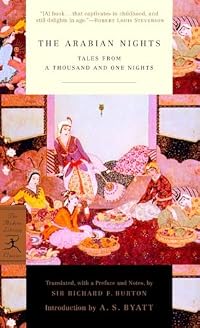
The Arabian Nights: Tales from a Thousand and One Nights [Modern Library]
by Richard Burton (Translator)
On This Page
Description
Sheherezade, night after night, weaves her tales and Aladdin and his Magic Lamp, Sinbad the Sailor, Ali Baba and the Forty Thieves and other tales come alive. The unforgettable music of Rimsky Korsakov sets the scene perfectly. Sheherezade, night after night, weaves her tales and Aladdin and his Magic Lamp, Sinbad the Sailor, Ali Baba and the Forty Thieves and other tales come alive. The unforgettable music of Rimsky Korsakov sets the scene perfectly.Tags
Recommendations






















Member Reviews
The Arabian Nights, also familiar in the West as One Thousand and One Nights is a collection of Middle Eastern folktales whose origins reach back more than a thousand years. The tales begin with a king, Shahryar, who discovers his wife's infidelity, and he vows to marry a new woman each night but have her killed the next morning to eliminate the possibility of being betrayed again. This goes on for some time (the carnage is certainly piling up) when Shahrazad, daughter of his right-hand man and who has a few tricks up her sleeve, offers herself as his next bride. Her cunning strategy is to tell a folktale each night with the suggestion of more to come, leaving Shahryar so curious about what happens next in the narrative that he will show more allow her to live another night in order to find out. What follows make up what has been a rich Middle Eastern oral and literary tradition that includes, among many others, such well-known tales as Sindbad the Seaman, Alaeddin, and Ali Baba and the Forty Thieves.
The translation I read was Burton's 1889 edition, which was written in archaic language such as "thee," "thou," "quoth" and "doest," and abounded with unfamiliar vocabulary like "wot," "haply," "gugglet," "rede" and "weet." Including notes, it is 872 very dense pages (virtually no paragraph breaks) and to digest more than 10-15 pages in a sitting was a challenge in focus. For that reason I used it to fulfill the Read Harder 2021 category 'a book you've been intimidated to read.' Modern readers may find the sheer amount of racism, misogyny, incest, slavery, murder and other disturbingly cruel violence, theft and backstabbing in these stories uncomfortable. There is also much tearing of clothes and heaving of dust onto one's head, which I surmise is how grief is depicted, as well as truly endless numbers of shipwrecks (Sindbad was a glutton for punishment in a most baffling way). It should be noted that a remarkable number of times it is women and their cooler heads who save the day! I feel something of an accomplishment to have finally, successfully made my way through this book, so I'm feeling pretty triumphant about that, as well as pleased to know a little more about this legendary icon of world literature. show less
The translation I read was Burton's 1889 edition, which was written in archaic language such as "thee," "thou," "quoth" and "doest," and abounded with unfamiliar vocabulary like "wot," "haply," "gugglet," "rede" and "weet." Including notes, it is 872 very dense pages (virtually no paragraph breaks) and to digest more than 10-15 pages in a sitting was a challenge in focus. For that reason I used it to fulfill the Read Harder 2021 category 'a book you've been intimidated to read.' Modern readers may find the sheer amount of racism, misogyny, incest, slavery, murder and other disturbingly cruel violence, theft and backstabbing in these stories uncomfortable. There is also much tearing of clothes and heaving of dust onto one's head, which I surmise is how grief is depicted, as well as truly endless numbers of shipwrecks (Sindbad was a glutton for punishment in a most baffling way). It should be noted that a remarkable number of times it is women and their cooler heads who save the day! I feel something of an accomplishment to have finally, successfully made my way through this book, so I'm feeling pretty triumphant about that, as well as pleased to know a little more about this legendary icon of world literature. show less
This is the selection of tales of The Arabian Nights as translated by Sir Richard F. Burton and published by The Modern Library. The story of Scheherazade's ingenuity is of Persian origin and its origin has been traced back to 944 AD. However the tales are more Arabian than Persian in flavor. Over the centuries the tales multiplied and eventually comprised an convoluted form that has been a source of admiration as a miracle of narrative architecture. While Boccaccio's Decameron and Chaucer's Canterbury Tales are similar to them in construction, in that they are collections of stories within stories, the Arabian tales is infinitely more complicated.
The frame of the work consists of a whimsical plot arrangement that depends upon the show more jealousy of Shahriyar, King of India, for his wife and her wanton ways; after executing her he vows to take his revenge on wall woman-ways. Night after night he marries some beautiful girl, only to order her beheaded the next morning. That is until he meets Scheherazade whose wile and intelligence is more than a match for the King. She manages to spin a bewildering number of yarns and, by suspending the ending of each, eludes the executioner. The tales she tells include such stories as "Aladdin's Lamp" and "Sinbad the Sailor" and many more that, while less famous, are equally entertaining.
"the most marvelous article in this Enchanted Treasure was a wonderful Lamp with its might of magical means." (p 712, "Alaeddin; or, The Wonderful Lamp")
The resulting compendium of stories has been popular ever since inspiring many translations and different forms. This translation by Richard F. Burton may be the most entertaining of all. show less
The frame of the work consists of a whimsical plot arrangement that depends upon the show more jealousy of Shahriyar, King of India, for his wife and her wanton ways; after executing her he vows to take his revenge on wall woman-ways. Night after night he marries some beautiful girl, only to order her beheaded the next morning. That is until he meets Scheherazade whose wile and intelligence is more than a match for the King. She manages to spin a bewildering number of yarns and, by suspending the ending of each, eludes the executioner. The tales she tells include such stories as "Aladdin's Lamp" and "Sinbad the Sailor" and many more that, while less famous, are equally entertaining.
"the most marvelous article in this Enchanted Treasure was a wonderful Lamp with its might of magical means." (p 712, "Alaeddin; or, The Wonderful Lamp")
The resulting compendium of stories has been popular ever since inspiring many translations and different forms. This translation by Richard F. Burton may be the most entertaining of all. show less
A selection of stories from the 1,001 nights. The selection features some amazing mythical tales and spectacular adventures, and for the most part is brilliant. Some strange continuity with the tale of Scheherazade and the king, which is normal for a selected series of stories. But otherwise, this book (a beautiful object too) is a terrific introduction to the Middle Eastern storytelling epic.
Book #21 - The Arabian Nights: Tales from a Thousand and One Nights - A huge collection of interesting and sometimes fun fantasy.
There are a number of other translations of these stories, with varying amounts of liberties taken with the content (western-isms introduced, raunchier parts bowdlerized, stories condensed or omitted completely, etc.). I had this edition recommended to me as the definitive version. I'm glad I read it with the stories in the proper cultural context, but it certainly would have been easier going to read a more abridged version that was perhaps less true to the original Arabic.
Richard Burton (not the actor) includes extensive footnotes comprising nearly a quarter the length of the stories themselves, some running show more on for several pages apiece. These footnotes explain metaphors, context, the translators own experiences in the East, etc. The best of these footnotes were illuminating and informative and really added to the experience; the worst are catty criticisms of previous translators. At first I read them thoroughly, but halfway through I took to skimming those that were going on at length about precise derivations of the original Arabic words.
Note: A couple vague spoilers follow.
The stories ranged from the fantastic to the meandering. The book starts off strong, with a racy story about how the King and his brother got into the whole marry-for-a-night, kill-her-in-the-morning thing, and how Shahrazade and her sister decided to risk their lives to stop the King through quality storytelling.
She then launches into stories, many of which contain other stories (which occasionally contain OTHER stories) in a web of narration with each tale leaping into the next. Sometimes the flow is natural, such as "which reminds me of the tale of..." (a story related in theme) but other times it's a blatant non-sequitur, such as "They also tell of..." (completely non-related tale).
Ali Baba and the 40 Thieves is here, complete with the "Open Sesame" treasure cave. It's a longer, more violent story than the way it's typically depicted in cartoons, but held my interest. Similarly, Alaeddin and his wonderful lamp is a longer, more complex story but had a satisfying conclusion.
However, Sindbad was nothing like the adventure movies I grew up with. In fact, the seven voyages all boil down to the following formula: "Sindbad decides to sail somewhere, gathers a crew (who somehow don't know that he gets shipwrecked by the second paragraph each trip), is the sole survivor of a shipwreck (told you so), encounters something amazing and through unlikely coincidences rebuilds his fortune, then returns home vowing never to sail again". Curiously, the better stories are the first voyages so, rather than building to a climax, the stories seem to go on way too long. And really, after the second or third shipwreck, he was just being an ass.
A couple tales I had heard of before but only as vague references were the City of Brass and the Ebony Horse. They were enjoyable fantasy stories.
One bizarre story was about a man named Abu Hasan who once publicly broke wind and how it changed his life. Really.
Note: A pretty specific spoiler about one tale follows:
The Three Apples is about a man who, when his wife became ill and craved apples (not native to the area) took great pains to obtain three for her. Later that day, he observes a slave eating an apple and when asked, the slave says that his lover's cuckold husband had bought the apple and a couple others. The man goes home and finds his wife with two apples so he stabs her to death, dismembers her body, stows it in a trunk and throws it in the river. He then learns that the slave was just kidding and had stolen the apple. Oops. Too bad, really, that's probably the kind of jape his wife would have appreciated if he hadn't just horribly murdered her.
One of the longest and most pointless stories with the riveting title "Tale of Nur Al-Din and His Son Badr Al-Din Hasan" begins when two close brothers get to talking one night about how great it would be if they both met great women, got married and had children of the opposite sexes at about the same time so that one day their children could marry (relationships between first cousins are acceptable there). They then argued so severely about how much the hypothetical dowry would be that they vowed never again to speak to each other and one brother went into exile. Coincidentally, although no longer in contact, they both get married and have children of the opposite sexes at exactly the same time. Even more coincidentally, both children grow up to be the most attractive in the land. Ridiculously coincidental events have two djinn arguing about who is fairest and get the young couple together briefly, where they fall instantly in love and spend many pages barely missing each other in a series of misunderstandings that would have Jack Tripper saying "Oh, that's just stupid!", before their fates again become intertwined and the story goes on and on. If there's a moral or a point, I missed it entirely. If it's intended as comedy, then "Three's Company" would be an epic masterpiece.
To sum up, this is a fascinating work. Some stories are epic adventures, some are the basis for famous stories we all know, and some go on and on and on for no reason whatsoever. I would recommend "Arabian Nights", but suggest anyone who doesn't have a particular interest in Arabic culture go for a more accessible abridged edition instead.
Gaming the book:
Tales of the Arabian Nights lets players go through situations like in the book. Players move around the board then a paragraph is read and the player chooses a response then learns what treasure or complications result. Although there is a high degree of randomness, you're guaranteed to have a memorable experience. "A genie changed my sex then I married a Sultan!" "At least you weren't turned into a beast by an angry wizard!" show less
There are a number of other translations of these stories, with varying amounts of liberties taken with the content (western-isms introduced, raunchier parts bowdlerized, stories condensed or omitted completely, etc.). I had this edition recommended to me as the definitive version. I'm glad I read it with the stories in the proper cultural context, but it certainly would have been easier going to read a more abridged version that was perhaps less true to the original Arabic.
Richard Burton (not the actor) includes extensive footnotes comprising nearly a quarter the length of the stories themselves, some running show more on for several pages apiece. These footnotes explain metaphors, context, the translators own experiences in the East, etc. The best of these footnotes were illuminating and informative and really added to the experience; the worst are catty criticisms of previous translators. At first I read them thoroughly, but halfway through I took to skimming those that were going on at length about precise derivations of the original Arabic words.
Note: A couple vague spoilers follow.
The stories ranged from the fantastic to the meandering. The book starts off strong, with a racy story about how the King and his brother got into the whole marry-for-a-night, kill-her-in-the-morning thing, and how Shahrazade and her sister decided to risk their lives to stop the King through quality storytelling.
She then launches into stories, many of which contain other stories (which occasionally contain OTHER stories) in a web of narration with each tale leaping into the next. Sometimes the flow is natural, such as "which reminds me of the tale of..." (a story related in theme) but other times it's a blatant non-sequitur, such as "They also tell of..." (completely non-related tale).
Ali Baba and the 40 Thieves is here, complete with the "Open Sesame" treasure cave. It's a longer, more violent story than the way it's typically depicted in cartoons, but held my interest. Similarly, Alaeddin and his wonderful lamp is a longer, more complex story but had a satisfying conclusion.
However, Sindbad was nothing like the adventure movies I grew up with. In fact, the seven voyages all boil down to the following formula: "Sindbad decides to sail somewhere, gathers a crew (who somehow don't know that he gets shipwrecked by the second paragraph each trip), is the sole survivor of a shipwreck (told you so), encounters something amazing and through unlikely coincidences rebuilds his fortune, then returns home vowing never to sail again". Curiously, the better stories are the first voyages so, rather than building to a climax, the stories seem to go on way too long. And really, after the second or third shipwreck, he was just being an ass.
A couple tales I had heard of before but only as vague references were the City of Brass and the Ebony Horse. They were enjoyable fantasy stories.
One bizarre story was about a man named Abu Hasan who once publicly broke wind and how it changed his life. Really.
Note: A pretty specific spoiler about one tale follows:
The Three Apples is about a man who, when his wife became ill and craved apples (not native to the area) took great pains to obtain three for her. Later that day, he observes a slave eating an apple and when asked, the slave says that his lover's cuckold husband had bought the apple and a couple others. The man goes home and finds his wife with two apples so he stabs her to death, dismembers her body, stows it in a trunk and throws it in the river. He then learns that the slave was just kidding and had stolen the apple. Oops. Too bad, really, that's probably the kind of jape his wife would have appreciated if he hadn't just horribly murdered her.
One of the longest and most pointless stories with the riveting title "Tale of Nur Al-Din and His Son Badr Al-Din Hasan" begins when two close brothers get to talking one night about how great it would be if they both met great women, got married and had children of the opposite sexes at about the same time so that one day their children could marry (relationships between first cousins are acceptable there). They then argued so severely about how much the hypothetical dowry would be that they vowed never again to speak to each other and one brother went into exile. Coincidentally, although no longer in contact, they both get married and have children of the opposite sexes at exactly the same time. Even more coincidentally, both children grow up to be the most attractive in the land. Ridiculously coincidental events have two djinn arguing about who is fairest and get the young couple together briefly, where they fall instantly in love and spend many pages barely missing each other in a series of misunderstandings that would have Jack Tripper saying "Oh, that's just stupid!", before their fates again become intertwined and the story goes on and on. If there's a moral or a point, I missed it entirely. If it's intended as comedy, then "Three's Company" would be an epic masterpiece.
To sum up, this is a fascinating work. Some stories are epic adventures, some are the basis for famous stories we all know, and some go on and on and on for no reason whatsoever. I would recommend "Arabian Nights", but suggest anyone who doesn't have a particular interest in Arabic culture go for a more accessible abridged edition instead.
Gaming the book:
Tales of the Arabian Nights lets players go through situations like in the book. Players move around the board then a paragraph is read and the player chooses a response then learns what treasure or complications result. Although there is a high degree of randomness, you're guaranteed to have a memorable experience. "A genie changed my sex then I married a Sultan!" "At least you weren't turned into a beast by an angry wizard!" show less
Eu sei que há todo aquele papo de se inserir na época em que o livro foi escrito, e eu tentei, de verdade, mas o fato de ser impossível entrar totalmente em branco dentro de qualquer coisa só acrescenta aos pontos negativos que esse livro tem para mim. Eu aguentei algumas dezenas de — repetitivas — noites, antes de largar mão do livro e pular para as histórias mais bem faladas, ''Sinbad, ''Aladinn'' e ''Ali Baba'', histórias realmente interessantes, mas pelo que descobri, foram adições posteriores à obra original, ou seja, as melhores narrativas do livro nem faziam parte dele de fato. Você entra esperando gênios concedendo desejos, e recebe gênios estuprando mulheres.
Eu entendo que foi um livro importante, e para mim, show more no entanto, vai ser apenas isso, um livro que sei ser importante e nada mais; gostei mais da Epopéia de Gilgamesh do que as Mil e uma Noites.
Muitos dos meus autores favoritos sempre recomendam esse livro, mas, sei lá, muito impalpável para mim. Fico me perguntando até se li a versão certa, dada a chuva de cinco estrelas que esse livro recebe por aqui. Um dia eu tento de novo. Talvez o caminho seja ler os contos espaçados e não em sequência, dada a grande repetição de temas. Talvez o caminho seja outra edição. Sinceramente não sei. show less
Eu entendo que foi um livro importante, e para mim, show more no entanto, vai ser apenas isso, um livro que sei ser importante e nada mais; gostei mais da Epopéia de Gilgamesh do que as Mil e uma Noites.
Muitos dos meus autores favoritos sempre recomendam esse livro, mas, sei lá, muito impalpável para mim. Fico me perguntando até se li a versão certa, dada a chuva de cinco estrelas que esse livro recebe por aqui. Um dia eu tento de novo. Talvez o caminho seja ler os contos espaçados e não em sequência, dada a grande repetição de temas. Talvez o caminho seja outra edição. Sinceramente não sei. show less
The unabridged version is huge, but it comes with a glossary of sorts in the back. No flying carpet anywhere in the entire tome--blast Disney. These stories were handed down long before Islam became a religion backed by the Koran, so this book offers keen insights into the culture it came from. Just as bloody and frightening as the original Grimm's Fairy Tales.
Last year I decided to take on The Complete Grimm's Fairy Tales and was really disappointed. But, I decided not to let this keep me from giving Arabian Nights a try. And it turns out, it was a good decision.What struck me most was just how much family was the focus of these tales. Time and time again a family member was separated from their family and time and time again all family members did all they could to achieve a reunion. On the negative side. Just about every tale dealt with greed, which is what often caused these separations. But all in all, a very interesting look into a foreign culture, we need to work harder at understanding.
Members
- Recently Added By
Lists

The 100 Best Books of All Time by Norwegian Book Club (World Library)
104 works; 23 members

Philip Ward's Lifetime Reading Plan
592 works; 22 members
The Top Ten: Writers Pick Their Favorite Books
240 works; 31 members

Harold Bloom - The Western Canon: A. The Theocratic Age
97 works; 13 members

Art of Reading
188 works; 5 members

Trinity College Booklist (1951): Class Nine, Foreign Literatures
161 works; 3 members

In Our Time books
4,934 works; 2 members
Author Information

Some Editions
Awards and Honors
Series
Belongs to Publisher Series
Work Relationships
Is contained in
Is retold in
Has the adaptation
Is abridged in
Inspired
Common Knowledge
- Canonical title
- The Arabian Nights: Tales from a Thousand and One Nights [Modern Library]
- Original title
- كتاب ألف ليلة وليلة
- People/Characters
- Scheherazade
- Important places
- Bioko (Fernando Poo)
- Related movies
- Aladdin (1992 | IMDb); Arabian Nights (1942 | IMDb); The Return of Jafar (1994 | IMDb); Aladdin and the King of Thieves (1995 | IMDb); Arabian Nights (2000 | IMDb); Il fiore delle mille e una notte (1974 | IMDb)
- Canonical DDC/MDS
- 398.22
- Canonical LCC
- PJ7716.A1
- Disambiguation notice
- This Modern Library edition is a rearranged selection by Bennet Cerf from the Burton translation. The most recent paperback editions are introduced by A. S. Byatt. ISBNs include: 0679602356, 0812972147 and 0375756752.
... (show all)Please DO NOT combine this work with other abridgements unless they have the same ISBN or you have confirmed they are exactly the same work with the same translator/editor. Please DO NOT combine abridgements with complete works. If you see abridgements and complete sets/editions combined together, please help by separating them. If in doubt, please DO NOT combine. Especially not when combining large numbers of copies. It takes a lot of time and effort to separate and recombine works.
Classifications
- Genre
- Fiction and Literature
- DDC/MDS
- 398.22 — Social sciences Customs, etiquette & folklore Folklore Folk literature Legendary or mythological persons
- LCC
- PJ7716 .A1 — Language and Literature Oriental languages and literatures Oriental philology and literature Arabic Arabic literature Individual authors or works
- BISAC
Statistics
- Members
- 1,925
- Popularity
- 10,994
- Reviews
- 24
- Rating
- (3.89)
- Languages
- English
- Media
- Paper, Audiobook, Ebook
- ISBNs
- 10
- ASINs
- 7