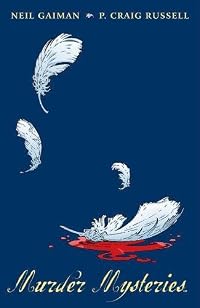
Neil Gaiman's Murder Mysteries
by Neil Gaiman (Author), P. Craig Russell (Illustrator)
On This Page
Description
One of the most celebrated writers in the history of comics teams up once again with one of the industry's most accomplished artists! Neil Gaiman and P. Craig Russell once again venture into the world of myth and angels. Constructing and maintaining all of heaven and earth is an immense task, which God has divided up amongst the various ranks and stations of angels. As with any such huge effort, there are bound to be casualties. This unique passion play sheds light on the hands behind show more creation, as well as one lonely man in Los Angeles who gets to hear the whole story of a most unspeakable crime: a murder in paradise!. show lessTags
Recommendations



Member Recommendations
Member Reviews
Before reading Lucifer proper, I decided to read Murder Mysteries, a graphic novel by P. Craig Russell adapting a short story by Neil Gaiman. Murder Mysteries tells the story of the first murder-- the first murder, even before Abel and Cain, when one angel killed another. It's not technically part of the Sandman/Lucifer canon, since the short story was standalone, and the comic book was published by Dark Horse, but it's Gaiman writing Lucifer, and the story even refers to its environs as the Silver City, which is the domain of the Lord and his angels in the DC universe as well.
The story revolves around an angel named Raguel, the Vengeance of the Lord. He is assigned by Lucifer, the commander of the Host, to investigate the murder of show more Carasel, one of the angels working to create the universe. From this point on, the story unfolds like your typical murder mystery. Raguel interviews witnesses, those who knew the victim, those who may have had a motive. There's all the detective stuff, like where he interviews people who don't seem to have a connection to the case, but he and you know better.
(There's also a frame story about a slightly weird 20-something Brit, who visits a female friend of his in L.A. and gets a blow job, hearing the whole story from an old guy on a park bench who is actually Raguel. I like the frame, but I don't quite know how integrates with the main story, especially in the slightly disturbing way that it all ends.)
The great thing about this whole detective story thing is how it ends. Raguel calls everyone together into a room (of course he does): Lucifer; Phanuel, the senior designer of the universe; Saraquel, Carasel's partner; and Zephkiel, the other senior designer, who never leaves his cell in the Silver City. Raguel solves the murder, of course, and enacts the Vengeance of the Lord, distintegrating the murderer. (I'm not going to tell you who the murderer is, but there are some pretty big spoilers here, so be careful if you don't want it ruined.) Lucifer reacts badly to the whole thing. "Perhaps Saraquel was the first to love," Raguel says, "but Lucifer was the first to shed tears." Lucifer begins to wonder if the Lord's will is just after all and flies off. It's a powerful scene.
But what comes is even more powerful. Raguel realizes that there is another murder in the room. The Lord Himself.
"Because nothing occurs without a reason, and all the reasons are Yours."
And just like that, Gaiman , in mixing a murder mystery with theology, creates something new out of both. Because at that moment I realized, There is always another murderer in the room, and that murderer is always the Lord. It's one thing to know this-- certainly Gaiman is not the first person to observe the theological problems that result from having an omnipotent creator managing a universe with injustice in it-- but in depicting it through the generic tropes of murder mysteries, Gaiman makes it real to me all over again.
Just like that. I've sometimes been skeptical of Gaiman. I mean, I liked The Sandman a lot, but it took me half the series before I was finally sold on it. This, though, is powerful, creative stuff.
Of course, it's not all Gaiman. He wrote the story on which this was based, but Russell did all the work not only of illustrating it, but converting it into the format of a comic story. I don't know how much the latter involved, but he does a magnificent job at the former. His art is clean and beautiful, everything a story about angels at the beginning of Creation requires. Russell was also the illustrator for Don McGregor's run on Killraven, but suffice it to say that that never sang like this does.
Lucifer is only a small part of this story, but just like that, you understand so much more about him. Lucifer, the comic series, has a lot to live up to if it's going to follow on from this...
Lucifer: Next in sequence » show less
The story revolves around an angel named Raguel, the Vengeance of the Lord. He is assigned by Lucifer, the commander of the Host, to investigate the murder of show more Carasel, one of the angels working to create the universe. From this point on, the story unfolds like your typical murder mystery. Raguel interviews witnesses, those who knew the victim, those who may have had a motive. There's all the detective stuff, like where he interviews people who don't seem to have a connection to the case, but he and you know better.
(There's also a frame story about a slightly weird 20-something Brit, who visits a female friend of his in L.A. and gets a blow job, hearing the whole story from an old guy on a park bench who is actually Raguel. I like the frame, but I don't quite know how integrates with the main story, especially in the slightly disturbing way that it all ends.)
The great thing about this whole detective story thing is how it ends. Raguel calls everyone together into a room (of course he does): Lucifer; Phanuel, the senior designer of the universe; Saraquel, Carasel's partner; and Zephkiel, the other senior designer, who never leaves his cell in the Silver City. Raguel solves the murder, of course, and enacts the Vengeance of the Lord, distintegrating the murderer. (I'm not going to tell you who the murderer is, but there are some pretty big spoilers here, so be careful if you don't want it ruined.) Lucifer reacts badly to the whole thing. "Perhaps Saraquel was the first to love," Raguel says, "but Lucifer was the first to shed tears." Lucifer begins to wonder if the Lord's will is just after all and flies off. It's a powerful scene.
But what comes is even more powerful. Raguel realizes that there is another murder in the room. The Lord Himself.
"Because nothing occurs without a reason, and all the reasons are Yours."
And just like that, Gaiman , in mixing a murder mystery with theology, creates something new out of both. Because at that moment I realized, There is always another murderer in the room, and that murderer is always the Lord. It's one thing to know this-- certainly Gaiman is not the first person to observe the theological problems that result from having an omnipotent creator managing a universe with injustice in it-- but in depicting it through the generic tropes of murder mysteries, Gaiman makes it real to me all over again.
Just like that. I've sometimes been skeptical of Gaiman. I mean, I liked The Sandman a lot, but it took me half the series before I was finally sold on it. This, though, is powerful, creative stuff.
Of course, it's not all Gaiman. He wrote the story on which this was based, but Russell did all the work not only of illustrating it, but converting it into the format of a comic story. I don't know how much the latter involved, but he does a magnificent job at the former. His art is clean and beautiful, everything a story about angels at the beginning of Creation requires. Russell was also the illustrator for Don McGregor's run on Killraven, but suffice it to say that that never sang like this does.
Lucifer is only a small part of this story, but just like that, you understand so much more about him. Lucifer, the comic series, has a lot to live up to if it's going to follow on from this...
Lucifer: Next in sequence » show less
Murder Mysteries is two stories or, more accurately a story within a story, both taking place in a City of Angels. In the first story, a Brit remembers a stop-over in Los Angeles he made a decade ago. After reconnecting with an old friend and before returning to his hotel, he decides to sit down on a bench and enjoy a smoke. He is approached by a stranger who asks for a cigarette. The stranger then tells the man about the very first murder mystery, one that happened in the original City of Angels long before Cain and Abel. The angels are in the process of creating the world when one of them is found dead. A new angel, Ragual, is created to act as God’s Vengeance. At first glance, the death looks like an accident but Ragual knows it is show more murder and he must uncover the perpetrator. Ragual discovers that many of the angels have secrets, not least of all, Lucifer, the most beautiful of all God’s angels. The motive for the murder is not simple or straightforward and Lucifer feels that mercy should be granted. But Ragual exists for one purpose – vengeance is his and he will take it. And, with this one act, Lucifer’s Fall from Grace is assured.
Murder Mysteries was originally one of the short stories from Neil Gaiman’s anthology, Smoke and Mirrors and was adapted for this Dark Horse graphic novel by P. Craig Russell. Every medium has an effect on the content and meaning of a story but Craig has done an excellent job of retaining the essence of the tale. His use of pastel colours in the original City of Angels to depict both the world and the angels is beautiful and, in Los Angeles, his use of bright colours to depict both the day and light and black and dark shades of grey for the night and the dark are excellent in showing not only times but emotions. This is especially important in a tale as oblique as this in which pictures as metaphors are sometimes the only hints we have to what is really going on.
The story, itself, is typical Gaiman if anything he writes can be called typical. On the surface, it is deceptively simple but dig just a little deeper and there are worlds of moral questions being raised, most of which remain unanswered or ambiguous, including questions about the nature of God, love and death, free will, good versus evil, and vengeance versus mercy. It is the kind of story that will make you think and, as often as you read it, you will come away with a different interpretation.
The tale is very short at only 70 pages long. The final third is a dialogue with Russell in which he explains the transformation of Murder Mysteries from short story to audio tale to graphic novel, how he and Gaiman decided what to keep, what to change, and how it was to be presented. He also explains some of his own interpretation of the story. There are also some pictures of the original storyboards showing how the novel evolved.
Neil Gaiman’s Murder Mysteries is an intelligent and beautifully drawn graphic novel and shows once again why graphic novels are really not for kids. Very nice job show less
Murder Mysteries was originally one of the short stories from Neil Gaiman’s anthology, Smoke and Mirrors and was adapted for this Dark Horse graphic novel by P. Craig Russell. Every medium has an effect on the content and meaning of a story but Craig has done an excellent job of retaining the essence of the tale. His use of pastel colours in the original City of Angels to depict both the world and the angels is beautiful and, in Los Angeles, his use of bright colours to depict both the day and light and black and dark shades of grey for the night and the dark are excellent in showing not only times but emotions. This is especially important in a tale as oblique as this in which pictures as metaphors are sometimes the only hints we have to what is really going on.
The story, itself, is typical Gaiman if anything he writes can be called typical. On the surface, it is deceptively simple but dig just a little deeper and there are worlds of moral questions being raised, most of which remain unanswered or ambiguous, including questions about the nature of God, love and death, free will, good versus evil, and vengeance versus mercy. It is the kind of story that will make you think and, as often as you read it, you will come away with a different interpretation.
The tale is very short at only 70 pages long. The final third is a dialogue with Russell in which he explains the transformation of Murder Mysteries from short story to audio tale to graphic novel, how he and Gaiman decided what to keep, what to change, and how it was to be presented. He also explains some of his own interpretation of the story. There are also some pictures of the original storyboards showing how the novel evolved.
Neil Gaiman’s Murder Mysteries is an intelligent and beautifully drawn graphic novel and shows once again why graphic novels are really not for kids. Very nice job show less
I liked the story here very much. I don’t think I’ve actually read the prose version (which is a little surprising to me), but it has a very nice dual structure, with the main, internal story adding to and reflecting the more opaque ‘shell’ story. When I finished; I wanted to go back to the beginning and re-check all the foreshadowing… And of course, how can you go wrong with a psycho killer and angelic conflicts? The use of mythological elements and the way in which those are meshed with the sordid, modern world is very, very ‘Sandman.’
On a deeper level, the story has some very thought provoking content regarding vengeance and forgiveness. I see it as a critique and exploration of the Christian belief that, show more simultaneously, an all-knowing god has created beings for his own purpose but yet holds them responsible for their own actions. It’s not quite as simple as that, though, and it’s oblique enough that you could come away from this with a good number of different opinions. That’s a good thing.
So – why only 3 stars? Well, I think I’d prefer the prose version. The artwork here just didn’t resonate with me. Nearly fully half of this book is taken up with a section that talks about the artwork, the artist, and the motivations behind why it was presented the way it was – so I can’t at all say that no thought went into it. Clearly Gaiman had input into it, as well. But I just didn’t love it – personal aesthetics.
Copy provided by NetGalley in exchange for an honest review. show less
On a deeper level, the story has some very thought provoking content regarding vengeance and forgiveness. I see it as a critique and exploration of the Christian belief that, show more simultaneously, an all-knowing god has created beings for his own purpose but yet holds them responsible for their own actions. It’s not quite as simple as that, though, and it’s oblique enough that you could come away from this with a good number of different opinions. That’s a good thing.
So – why only 3 stars? Well, I think I’d prefer the prose version. The artwork here just didn’t resonate with me. Nearly fully half of this book is taken up with a section that talks about the artwork, the artist, and the motivations behind why it was presented the way it was – so I can’t at all say that no thought went into it. Clearly Gaiman had input into it, as well. But I just didn’t love it – personal aesthetics.
Copy provided by NetGalley in exchange for an honest review. show less
ARC provided by NetGalley
God created Heaven and the Angels within. They were perfect and each had their purpose to play in the world to come. But even Angels can experience heartbreak...and murder. A world away a young Brit is stranded in LA and meets a...lost Angel. A ragged drifter named Raguel, who once served as the agent of God’s vengeance. And he tells the story of seeking justice and the killer hidden among the Angels. But the truth that he reveals, maybe more than he, or the young Brit can endure. And the world will forever be changed by what is revealed.
Neil Gaiman is a master storyteller for a reason. Who else could birth the world of Dream and the Endless in Sandman? Or tell us the story of a young girl who has an other show more mother with buttons for eyes in Coraline? His short stories are just as powerful and this is one of this best. First presented to the world in 2002 in one of his award winning short story collections, Neil tells the story of the first ever murder...one committed in the city of Angels itself. He weaves a deft and masterful story that will challenge your preconceptions of what you know and leave you haunted afterwards.
Craig Russell’s watercolor illustrations perfectly complement the story and are hauntingly eerie. They capture the essence of my mystery and sorrow within the words of the story and remind me a great deal of some of the illustrations in Sandman. A common problem I’ve seen with adapted stories into comic/graphic novels, is that they struggle with pacing and it’s clear that they try to cram too much into the story. Russell though does not struggle with this at all and you would never know that this was an adapted story.
If you’re a fan of Gaiman or Sandman or just of good stories then this is the book for you. Great for teen + readers and I give it 4 out of 5 stars. show less
God created Heaven and the Angels within. They were perfect and each had their purpose to play in the world to come. But even Angels can experience heartbreak...and murder. A world away a young Brit is stranded in LA and meets a...lost Angel. A ragged drifter named Raguel, who once served as the agent of God’s vengeance. And he tells the story of seeking justice and the killer hidden among the Angels. But the truth that he reveals, maybe more than he, or the young Brit can endure. And the world will forever be changed by what is revealed.
Neil Gaiman is a master storyteller for a reason. Who else could birth the world of Dream and the Endless in Sandman? Or tell us the story of a young girl who has an other show more mother with buttons for eyes in Coraline? His short stories are just as powerful and this is one of this best. First presented to the world in 2002 in one of his award winning short story collections, Neil tells the story of the first ever murder...one committed in the city of Angels itself. He weaves a deft and masterful story that will challenge your preconceptions of what you know and leave you haunted afterwards.
Craig Russell’s watercolor illustrations perfectly complement the story and are hauntingly eerie. They capture the essence of my mystery and sorrow within the words of the story and remind me a great deal of some of the illustrations in Sandman. A common problem I’ve seen with adapted stories into comic/graphic novels, is that they struggle with pacing and it’s clear that they try to cram too much into the story. Russell though does not struggle with this at all and you would never know that this was an adapted story.
If you’re a fan of Gaiman or Sandman or just of good stories then this is the book for you. Great for teen + readers and I give it 4 out of 5 stars. show less
This is quite possibly my favorite stand-alone graphic novel. I hugely admire Russell's artwork and the colors, particularly the views of the Silver City and shifting daylight surrounding it, are rich and beautiful.
The stories are a refreshing take on the old detective theme. I say stories because there are two stories going on: the story of the murder of the angel Carasel, and the story of the narrator that sort of book-ends it. Afterall, it's "Murder Mysteries" plural for a reason. I have always loved Gaiman's characterizations of Lucifer, and Murder Mysteries does not disappoint here either. This book could fit nicely into the Sandman universe as well.
The stories are a refreshing take on the old detective theme. I say stories because there are two stories going on: the story of the murder of the angel Carasel, and the story of the narrator that sort of book-ends it. Afterall, it's "Murder Mysteries" plural for a reason. I have always loved Gaiman's characterizations of Lucifer, and Murder Mysteries does not disappoint here either. This book could fit nicely into the Sandman universe as well.
P. Craig Russell adapts Neil Gaiman's short story about a murder in heaven.
As I understand it, Russell works mainly on adaptations these days, and I consider him to be quite good at it. His strength is definitely his pacing; he really understands how to use the comics medium to best effect. His panel layouts create a good amount of tension; the atmosphere is perfect, and the reader is forced to stop and think in all the right places. I've read the short story a few times, but seeing it presented in a visual format brought several new things to my attention and made me think about the story in a whole new way.
Lovern Kindzierski's colours also deserve mention; they create great contrast between the dark L.A. of the human narrator and the show more angel's Silver City. I found that this really added to the overall feel of the book.
My one complaint lies with the human narrator's actions in L.A. This adaptation makes it clear just what the angel removed from his mind, but there doesn't seem to be a reason for it. I don't want to say too much for fear of giving spoilers, but I didn't really connect the beginning of the story with what we learn later on. Everything else was nicely laid out, though; the murder in heaven worked well and connected to the human narrator's world. show less
As I understand it, Russell works mainly on adaptations these days, and I consider him to be quite good at it. His strength is definitely his pacing; he really understands how to use the comics medium to best effect. His panel layouts create a good amount of tension; the atmosphere is perfect, and the reader is forced to stop and think in all the right places. I've read the short story a few times, but seeing it presented in a visual format brought several new things to my attention and made me think about the story in a whole new way.
Lovern Kindzierski's colours also deserve mention; they create great contrast between the dark L.A. of the human narrator and the show more angel's Silver City. I found that this really added to the overall feel of the book.
My one complaint lies with the human narrator's actions in L.A. This adaptation makes it clear just what the angel removed from his mind, but there doesn't seem to be a reason for it. I don't want to say too much for fear of giving spoilers, but I didn't really connect the beginning of the story with what we learn later on. Everything else was nicely laid out, though; the murder in heaven worked well and connected to the human narrator's world. show less
I got a copy of this book to review in e-book format from NetGalley. Thanks to Netgalley and Dark Horse for the chance to read this book. I am a huge Gaiman fan and was excited to read something new by him. While this definitely wasn’t the strongest book I have read by him, it was decent and made you think.
This was an interesting and somewhat ambiguous tale about a man who loses time and ends up with the story of an angel of vengeance. Little does he know that he may have been the one the angel was seeking vengeance on and his blank times may not be as blank as he thinks.
This is one of those stories where you aren’t quite sure what is going on. For the first part of the story you are following around a young man who is visiting an show more old friend. The young man has blank spots where he can’t remember how he got places. He finds himself on a bench with an older man who wants to tell him a story. What follows is the story of the angel of vengeance created to find out who committed a murder in Heaven.
The whole thing is cleverly done and has that whole story in a story thing going on. There is a wonderful twist at the end, that is fairly predictable but still darkly ironic. I enjoyed the dark irony to the story.
The actual story portion of this was very brief maybe 70 pages, the rest was all the extras. There is a very detailed appendix where the authors talk about transitioning this from a radioplay to a graphic novel. There is also a section of sketches.
I thought the illustration was just so so. Some frames are beautifully illustrated, while others lacked detail. Many of the illustrations were lacking in facial detail. I wish that the flights of angels had actually been illustrated rather than shown as rectangular blocks in the distance. The illustration is very similar in style to the Sandman books, but I found it to be not quite as detailed and refined.
Overall this was a decent read. I enjoyed the irony behind the story and love the whole idea of stories in stories. It is a dark story with language and sex, so for adults only. The illustration was only so-so however, and the story portion was very short. Definitely not the best Gaiman graphic novel I have read, but interesting. show less
This was an interesting and somewhat ambiguous tale about a man who loses time and ends up with the story of an angel of vengeance. Little does he know that he may have been the one the angel was seeking vengeance on and his blank times may not be as blank as he thinks.
This is one of those stories where you aren’t quite sure what is going on. For the first part of the story you are following around a young man who is visiting an show more old friend. The young man has blank spots where he can’t remember how he got places. He finds himself on a bench with an older man who wants to tell him a story. What follows is the story of the angel of vengeance created to find out who committed a murder in Heaven.
The whole thing is cleverly done and has that whole story in a story thing going on. There is a wonderful twist at the end, that is fairly predictable but still darkly ironic. I enjoyed the dark irony to the story.
The actual story portion of this was very brief maybe 70 pages, the rest was all the extras. There is a very detailed appendix where the authors talk about transitioning this from a radioplay to a graphic novel. There is also a section of sketches.
I thought the illustration was just so so. Some frames are beautifully illustrated, while others lacked detail. Many of the illustrations were lacking in facial detail. I wish that the flights of angels had actually been illustrated rather than shown as rectangular blocks in the distance. The illustration is very similar in style to the Sandman books, but I found it to be not quite as detailed and refined.
Overall this was a decent read. I enjoyed the irony behind the story and love the whole idea of stories in stories. It is a dark story with language and sex, so for adults only. The illustration was only so-so however, and the story portion was very short. Definitely not the best Gaiman graphic novel I have read, but interesting. show less
Members
- Recently Added By
Lists

Recommended Comics / Graphic Novels
595 works; 122 members

Books Read in 2014
2,341 works; 86 members
Author Information

Neil Gaiman was born in Portchester, England on November 10, 1960. He worked as a journalist and freelance writer for a time, before deciding to try his hand at comic books. Some of his work has appeared in publications such as Time Out, The Sunday Times, Punch, and The Observer. His first comic endeavor was the graphic novel series The Sandman. show more The series has won every major industry award including nine Will Eisner Comic Industry Awards, three Harvey Awards, and the 1991 World Fantasy Award for best short story, making it the first comic ever to win a literary award. He writes both children and adult books. His adult books include The Ocean at the End of the Lane, which won a British National Book Awards, and the Locus Award for Best Fantasy Novel for 2014; Stardust, which won the Mythopoeic Award as best novel for adults in 1999; American Gods, which won the Hugo, Nebula, Bram Stoker, SFX, and Locus awards; Anansi Boys; Trigger Warning: Short Fictions and Disturbances; and The View from the Cheap Seats: Selected Nonfiction, which is a New York Times Bestseller. His children's books include The Day I Swapped My Dad for Two Goldfish; Coraline, which won the Elizabeth Burr/Worzalla, the BSFA, the Hugo, the Nebula, and the Bram Stoker awards; The Wolves in the Walls; Odd and the Frost Giants; The Graveyard Book, which won the Newbery Award in 2009 and The Sandman: Overture which won the 2016 Hugo Awards Best Graphic Story. (Bowker Author Biography) show less

All Editions
Some Editions
Awards and Honors
Awards
Work Relationships
Is contained in
Is an adaptation of
Common Knowledge
- Canonical title
- Neil Gaiman's Murder Mysteries
- Alternate titles
- Murder Mysteries
- Original publication date
- 2002
- People/Characters
- Raguel; Lucifer; Carasel; God; Phanuel; Tinkerbell Richmond (show all 8); Saraqael; Zephkiel
- Important places
- Los Angeles, California, USA; The Silver City
- First words
- No!
- Last words
- (Click to show. Warning: May contain spoilers.)Eventually someone would let me out... and I knew that I would soon be home.
- Original language
- English
- Disambiguation notice
- This is an adaptation of the original short story. Please, do not combine it with the prose book.
Classifications
- Genres
- Graphic Novels & Comics, Fiction and Literature
- DDC/MDS
- 741.5973 — Arts & recreation Drawing & decorative arts Drawing and drawings Comic books, graphic novels, fotonovelas, cartoons, caricatures, comic strips History, geographic treatment, biography North American United States (General)
- LCC
- PN6727 .R85 .N45 — Language and Literature Literature (General) Literature (General) Collections of general literature Comic books, strips, etc.
- BISAC
Statistics
- Members
- 1,100
- Popularity
- 22,984
- Reviews
- 26
- Rating
- (3.93)
- Languages
- 7 — Czech, English, French, German, Portuguese, Spanish, Turkish
- Media
- Paper, Ebook
- ISBNs
- 15
- ASINs
- 6