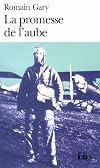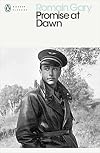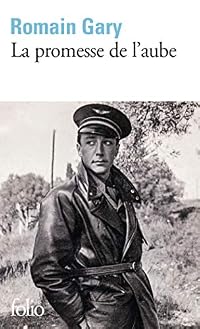
Promise at Dawn
by Romain Gary
On This Page
Description
The author recounts the special relationship he had with his mother and explains how he worked to achieve the many goals and accomplishments she expected of him.Tags
Recommendations






Member Reviews
Promise at Dawn by Romain Gary is a memoir of his coming-of-age years. It stands as a tribute to his mother, a unique and remarkable woman, who shaped Gary into both the man and the artist he became. She was an independent, fierce woman who fought to give her son everything she could. Gary recounts his childhood in Russia, Poland and France.
Gary and his mother were poor Russians. His father abandoned them soon after Gary was born, but his mother decided that her son was meant for greatness and that his future lay in France. She put all her energies into ensuring that they reached this promised country and that Gary was prepared for the glorious future she envisioned for him. The successes of his career as a prize-winning novelist as show more well as a decorated officer who fought in WW II, and a diplomat for the French government, were all planned by his mother from his early childhood.
I thoroughly enjoyed learning the details of Gary’s early life. From how they fought the bailiffs to his torture at the hands of his first love at the ripe age of ten, he recounts episodes and adventures in a wry and at times, amusing way. He readily admits that there were many times when his mother embarrassed him but his admiration and love for her shines through each page. I was touched by the bond between these two, she in her single-handed determination to shape his future and he, who appreciated this motherly love and actually strove to fulfill her expectations. I found Promise At Dawn to be a humorous, charming and poignant story. show less
Gary and his mother were poor Russians. His father abandoned them soon after Gary was born, but his mother decided that her son was meant for greatness and that his future lay in France. She put all her energies into ensuring that they reached this promised country and that Gary was prepared for the glorious future she envisioned for him. The successes of his career as a prize-winning novelist as show more well as a decorated officer who fought in WW II, and a diplomat for the French government, were all planned by his mother from his early childhood.
I thoroughly enjoyed learning the details of Gary’s early life. From how they fought the bailiffs to his torture at the hands of his first love at the ripe age of ten, he recounts episodes and adventures in a wry and at times, amusing way. He readily admits that there were many times when his mother embarrassed him but his admiration and love for her shines through each page. I was touched by the bond between these two, she in her single-handed determination to shape his future and he, who appreciated this motherly love and actually strove to fulfill her expectations. I found Promise At Dawn to be a humorous, charming and poignant story. show less
This memoir is basically a eulogy to Gary’s mother. Seeing as I have never really had a mother to speak of, this was an interesting one for me to read as a kind of “what if”, all the while imagining I’d had a female role model there to love, encourage and inspire me to head for my dreams.
My mother never wanted children, drank heavily, was emotionally and physically violent, left us when I was 9 and then fought for custody just to spite my father, lost and then won the right to force us to spend one holiday a year with her until we were 18 and could decide whether we wanted to see us or not. Romain Gary’s mother was not like this.
In contrast to me, Gary grew up without a father to speak of although he suspects in the book who show more it might be. Instead, his mother becomes both parents in one and pursues the unlikely dream of emigrating to France. Quite why she was besotted so much with France Gary never quite understands. But, contrary to all expectations, they do indeed end up settling in France.
In addition to her almost divine powers to determine her son’s nationality, she also manages to somehow determine his future as a great writer and diplomat. Again, against almost incredible odds, this is exactly what happens. So, the tale is at once a poignant memoir to his mother while at the same time an interesting one of how Romain Gary came to be the man he was to be.
And the tale is well told. While the book’s latter half was of more interest to me than the former, it is told with some humour and character. I found his experiences in the French air force to be of most interest, in particular the racism he suffered and his desperate attempts to flee France when the Germans invaded. All in all, this was a pleasant read about the early life of an interesting man I’d never heard of. show less
My mother never wanted children, drank heavily, was emotionally and physically violent, left us when I was 9 and then fought for custody just to spite my father, lost and then won the right to force us to spend one holiday a year with her until we were 18 and could decide whether we wanted to see us or not. Romain Gary’s mother was not like this.
In contrast to me, Gary grew up without a father to speak of although he suspects in the book who show more it might be. Instead, his mother becomes both parents in one and pursues the unlikely dream of emigrating to France. Quite why she was besotted so much with France Gary never quite understands. But, contrary to all expectations, they do indeed end up settling in France.
In addition to her almost divine powers to determine her son’s nationality, she also manages to somehow determine his future as a great writer and diplomat. Again, against almost incredible odds, this is exactly what happens. So, the tale is at once a poignant memoir to his mother while at the same time an interesting one of how Romain Gary came to be the man he was to be.
And the tale is well told. While the book’s latter half was of more interest to me than the former, it is told with some humour and character. I found his experiences in the French air force to be of most interest, in particular the racism he suffered and his desperate attempts to flee France when the Germans invaded. All in all, this was a pleasant read about the early life of an interesting man I’d never heard of. show less
"I am not saying that mothers should be prevented from loving their young. I am only saying that they should have someone else to love as well. If my mother had had a husband or a lover I would not have spent my days dying of thirst beside so many fountains." (26).
A beautiful memoir stemming from how having a fiercely loving parent can make you into someone who endlessly searches for that same unattainable devotion in adulthood. What a fascinating life.
A beautiful memoir stemming from how having a fiercely loving parent can make you into someone who endlessly searches for that same unattainable devotion in adulthood. What a fascinating life.
This is a memoir written by Romain Gary and is also a book from the 1001 Books You Must Read Before You Die. Mr Gary wrote this memoir as a tribute to his mother. Romain Gary is of Jewish and Russian origin became a French citizen. He is the only son of his mother, he never knew who is father was and she raised him single-handedly and single-mindedly. The first chapter is the ending but only a glimpse and it leaves you guessing. Mr. Gary is lying on the beach at Big Sur. He also introduces us to the four gods; Stupidity, Absolute Truth, Mediocrity and Acceptance and Servility. In chapter 2, mother love is introduced. He talks about how her love made future love so difficult and he wished she would have had someone else besides to love. show more He talks about Freud and explores any possibility of Oedipus complex which he rejects. He describes the psychoanalysts as “sharks feeding on refuse underwater”. His mother early on painted the picture for her son’s life so concretely that Romain never questioned it. She planned that he would be an artist, he became a writer, she planned that he would get a law degree and then go into the French air force and be a lieutenant. He got his law degree, joined the air force but because of bias he was not allowed to be a commissioned officer because he hadn’t been a French citizen long enough. She planned that he would go into the diplomat service after he was out of the service. WWII came into the picture and Romain spent more time in the service than he was planned. He started as a private but he became an officer and he was decorated with the Cross of the Liberation pinned on by General de Gaulle under the Arc de Triomphe. He was not a man who was meant to kill though he was brave. He said many times that he never killed. In the end, he valued life especially the life of animals and he especially had a connection to the ocean. He felt that everything he did was really his mother’s accomplishments. She lived her dreams through her only son and he often talked about his career as a Champion of the World.
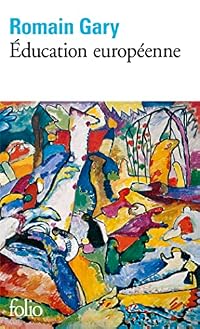
This was very good. I enjoyed his writing and humor though there is a backdrop of sadness throughout. This is not in the book but Mr Gary died in 1980 by self inflicted gunshot. His actress wife Jean Seberg committed suicide in 1979. Among his literary works areA European Education published in France in 1945 and The Roots of Heaven which one the Prix Goncourt, top French literary honor. It also became a motion picture. show less
This was very good. I enjoyed his writing and humor though there is a backdrop of sadness throughout. This is not in the book but Mr Gary died in 1980 by self inflicted gunshot. His actress wife Jean Seberg committed suicide in 1979. Among his literary works areA European Education published in France in 1945 and The Roots of Heaven which one the Prix Goncourt, top French literary honor. It also became a motion picture. show less
wonderful read if not completely believable. Writing can be pretentious.
"Avec l'amour maternelle la vie vous fait à l'aube une promesse qu'elle ne tient jamais"
WWII autobiography
Members
- Recently Added By
Lists

1,001 BYMRBYD Concensus
723 works; 27 members

Writers at Risk
106 works; 17 members

My TBR
371 works; 3 members

THE WAR ROOM
813 works; 24 members

Les 50 meilleurs livres de langue française de 1900 à aujourd’hui
69 works; 2 members
Talk Discussions
Past Discussions
Group Read, September 2021: Promise at Dawn in 1001 Books to read before you die (September 2021)
Author Information

122+ Works 6,220 Members
Some Editions
Awards and Honors
Awards
Distinctions
Notable Lists
Series
Belongs to Publisher Series
Work Relationships
Is contained in
Has the adaptation
Is abridged in
Has as a student's study guide
Common Knowledge
- Canonical title
- Promise at Dawn
- Original title
- La promesse de l'aube
- Alternate titles*
- Обещание на рассвете
- Original publication date
- 1960 (original French) (original French); 1961 (English translation) (English translation)
- People/Characters
- Romain; Maman
- Important places
- Vilnius, Lithuania (as Wilno, Poland); Nice, Alpes-Maritimes, Provence-Alpes-Côte d'Azur, France
- Related movies
- Promise at Dawn (1970 | IMDb)
- Dedication
- A Rene et Sylvia Agid.
- First words
- C'est fini.
- Quotations
- Tu seras un héros, tu seras général, Gabriele D'Annunzio, Ambassadeur de France - tous ces voyous ne savent pas qui tu es ! Je crois que jamais un fils n'a haï sa mère autant que moi, à ce moment-là. (ch. 1)
Par ce suprême échec que l'art est toujours, l’homme, éternel tricheur de lui-même, essaye de faire passer pour une réponse ce qui est condamné à demeurer comme une tragique interpellation. (ch. 15)
(...) jusqu'à ce que la création littéraire devînt pour moi ce qu'elle est toujours, à ses grands moments d'authenticité, une feinte pour tenter d'échapper à l'intolérable, une façon de rendre l'âme pour demeurer v... (show all)ivant. (ch. 21)
(...) j’étais encore loin de soupçonner qu’il arrive aux hommes de traverser la vie, d’occuper des postes importants et de mourir sans jamais parvenir à se débarrasser de l’enfant tapi dans l’ombre, assoiffé dâ... (show all)€™attention, attendant jusqu’à la dernière ride une main douce qui caresserait sa tête (...) (ch. 22)
(...) les inconditionnels du sérieux n'ont jamais cessé de me demander : « Pourquoi racontez-vous toujours des histoires contre vous-même, Romain Gary ? » Mais il ne s'agit pas seulement de moi. Il s'agit de notre je à ... (show all)tous. De notre pauvre petit royaume du Je, si comique, avec sa salle du trône et son enceinte fortifiée. (ch. 22)
Avec, au coeur, un tel besoin d'élévation, tout devenait abîme et chute. (...) Ma course fut une poursuite errante de quelque chose dont l'art me donnait la soif, mais dont la vie ne pouvait m'offrir l'apaisement. (...) et... (show all) si je rêve toujours de transformer le monde en un jardin heureux, je sais à présent que ce n'est pas tant par amour des hommes que par celui des jardins. (ch. 33)
(...) son calme et sa douceur cachaient une de ces flammes qui font parfois de la France l'endroit du monde le mieux éclairé. (ch. 34)
Au-dessus de nos têtes se déroulaient alors les combats historiques où la jeunesse anglaise opposait à un ennemi acharné une vaillance souriante et changeait le sort du monde. (...) Je fus pris aussi, pour l'Angleterre, ... (show all)d'une amitié et d'une estime dont aucun de ceux qui ont eu l'honneur de fouler son sol en juillet 1940 ne se départira jamais. (ch. 36)
L'ennui par la conversation et la bêtise par l'intellect sont quelque chose que je n'ai jamais pu supporter et je commençais à sentir les gouttes de sueur couler de mon front, cependant que mon regard halluciné se fixait ... (show all)sur ce sphincter buccal qui ne cessait de s'ouvrir et de se refermer, s'ouvrir et se refermer (...). (ch. 36)
Je croyais à la beauté et donc à la justice. (ch. 38)
"On n'a pas le droit de traiter la vie comme ça" (ch. 38)
Un artiste véritable ne se laisse pas vaincre pas son matériau, il cherche à imposer son inspiration à la matière brute, essaye de donner au magma une forme, un sens, une expression. (ch. 40)
Je n'allais pas signer mon nom au bas de l'acte que les dieux me tendaient, un acte d'insignifiance, d'inexistence et d'absurdité. (ch. 40) - Last words
- (Click to show. Warning: May contain spoilers.)J'ai vécu.
- Original language
- French
- Disambiguation notice
- La langue originale est le français
*Some information comes from Common Knowledge in other languages. Click "Edit" for more information.
Classifications
- Genres
- Biography & Memoir, General Fiction
- DDC/MDS
- 843.912 — Literature & rhetoric French & related literatures French fiction 1900- 20th Century 1900-1945
- LCC
- PQ2613 .A58 .Z47413 — Language and Literature French, Italian, Spanish and Portuguese literatures French literature Modern literature 1900-1960
- BISAC
Statistics
- Members
- 925
- Popularity
- 28,672
- Reviews
- 19
- Rating
- (4.07)
- Languages
- 15 — Czech, Danish, English, Finnish, French, German, Hungarian, Italian, Lithuanian, Polish, Portuguese, Russian, Spanish, Swedish, Turkish
- Media
- Paper, Audiobook, Ebook
- ISBNs
- 52
- ASINs
- 20