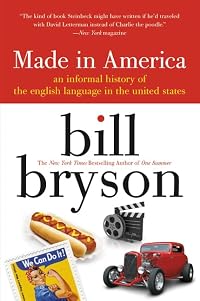
Made in America: An Informal History of the English Language in the United States
by Bill Bryson
On This Page
Description
Bill Bryson turns away from travelling the highways and byways of middle America, so hilariously depicted in his bestselling The Lost Continent, The Life and Times of the Thunderbolt Kid and Notes from a Big Country, for a fast, exhilarating ride along the Route 66 of American language and popular culture.In Made in America, Bryson tells the story of how American arose out of the English language, and along the way, de-mythologises his native land - explaining how a dusty desert hamlet with show more neither woods nor holly became Hollywood, how the Wild West wasn't won, why Americans say 'lootenant' and 'Toosday', how they were eating junk food long before the word itself was cooked up - as well as exposing the true origins of the words G-string, blockbuster, poker and snafu. show lessTags
Recommendations




Member Recommendations
Member Reviews
You’d think a history of Americanisms would be dry but that’s not the case here. Bryson keeps the tone light and entertaining with loads of anecdotes about the evolution of English in America. It’s the perfect companion to The Prodigal Tongue: The Love-Hate Relationship Between American and British English; they even share this striking quote from the 1815 North American Review,
“How tame will his language sound, who would describe Niagara in language fitted for the falls at London bridge, or attempt the majesty of the Mississippi in that which was made for the Thames?”
I was surprised that this didn’t feel very dated even though it was first published in 1994, and I found the last chapter, which included Bryson’s opinions show more about the bias-free language movement, to be the most thought provoking part of the book. show less
“How tame will his language sound, who would describe Niagara in language fitted for the falls at London bridge, or attempt the majesty of the Mississippi in that which was made for the Thames?”
I was surprised that this didn’t feel very dated even though it was first published in 1994, and I found the last chapter, which included Bryson’s opinions show more about the bias-free language movement, to be the most thought provoking part of the book. show less
Two books in one, Bill Bryson's “Made in America” (1994) is both a lively history of popular culture in America and an etymology of the words and phrases that grew out of that culture.
Bryson tells us what the Puritans did for fun, how frozen foods were invented (by accident, like so much else), how McDonald's restaurants came to be (Ray Kroc actually had little to do with it), why in wagon trains the wagons actually traveled not in line but side by side and that the first hit movie, although it was not yet called a movie, was “Fred Ott's Sneeze,” showing exactly what the title says.
Shopping carts originated in Oklahoma City back in 1936, Bryson tells us, but the inventor, Sylvan Goldman, had to hire people to demonstrate to show more customers how to use them.
What does George Washington's home, Mount Vernon, have to do with the word groggy? The plantation was named after the British admiral Edward Vernon, whose nickname was Old Grog. The daily ration of rum Vernon gave his sailors came to be known as grog, and those who drank too much of it were said to be groggy.
Such "classic Italian dishes" as chicken tetrazzini, veal parmigiana, fettuccine Alfredo and even spaghetti and meatballs originated in the United States. So did Russian dressing, French dressing and chop sued.
In the 1990 census 40 percent more Americans claimed to be Indians than 10 years previously. Was Elizabeth Warren one of these?
And so Bryson goes on for 400 pages. The author has a knack for digging up obscure trivia and then presenting it in entertaining prose. Open the book to any paragraph and you are likely to find something interesting that you won't remember ever hearing before — and probably won't remember tomorrow. show less
Bryson tells us what the Puritans did for fun, how frozen foods were invented (by accident, like so much else), how McDonald's restaurants came to be (Ray Kroc actually had little to do with it), why in wagon trains the wagons actually traveled not in line but side by side and that the first hit movie, although it was not yet called a movie, was “Fred Ott's Sneeze,” showing exactly what the title says.
Shopping carts originated in Oklahoma City back in 1936, Bryson tells us, but the inventor, Sylvan Goldman, had to hire people to demonstrate to show more customers how to use them.
What does George Washington's home, Mount Vernon, have to do with the word groggy? The plantation was named after the British admiral Edward Vernon, whose nickname was Old Grog. The daily ration of rum Vernon gave his sailors came to be known as grog, and those who drank too much of it were said to be groggy.
Such "classic Italian dishes" as chicken tetrazzini, veal parmigiana, fettuccine Alfredo and even spaghetti and meatballs originated in the United States. So did Russian dressing, French dressing and chop sued.
In the 1990 census 40 percent more Americans claimed to be Indians than 10 years previously. Was Elizabeth Warren one of these?
And so Bryson goes on for 400 pages. The author has a knack for digging up obscure trivia and then presenting it in entertaining prose. Open the book to any paragraph and you are likely to find something interesting that you won't remember ever hearing before — and probably won't remember tomorrow. show less
Have you ever wondered about the origins of Americanisms such as "lunch" and "cafeteria"? Or maybe you're interested in words that originated from the movies or sports. Bill Bryson gives you a whirlwind tour of all this and more in his "informal history of the English language in the United States."
Beginning with the Pilgrims and making his way through both chronologically and thematically to recent times, Bryson has a way of highlighting the humorous aspects of history and linguistic quirkiness of our language. Some of interesting tidbits (note: a word that was originally "titbits" and changed in order to be less offensive) I learned included:
--Englishmen bemoaning Americanisms entering the language is nothing new
--the Pilgrims had show more three or four different names and types of mush
--during the American Revolution, people were not unconcerned with spelling, but merely had more variants to choose from (and even argue about!)
I'll have about as much fun recommending this book as I did reading it! show less
Beginning with the Pilgrims and making his way through both chronologically and thematically to recent times, Bryson has a way of highlighting the humorous aspects of history and linguistic quirkiness of our language. Some of interesting tidbits (note: a word that was originally "titbits" and changed in order to be less offensive) I learned included:
--Englishmen bemoaning Americanisms entering the language is nothing new
--the Pilgrims had show more three or four different names and types of mush
--during the American Revolution, people were not unconcerned with spelling, but merely had more variants to choose from (and even argue about!)
I'll have about as much fun recommending this book as I did reading it! show less
Summary: Made in America is part linguistic and etymological study of American English, part people's history of the United States, part trivia compendium, and entirely fully of Bryson's dry wit and ex-pat sensibilities. Approximately the first half of the chapters go chronologically, taking a myth-busting look at American history from the first colonists through the industrial revolution, and documenting when (and occasionally how) various Americanisms entered the lexicon. The second half of the book is broken up by topic: eating, shopping, cars, planes, politics, movies, sports, etc., and investigates what each topic has contributed to our linguistic and cultural history.
Review: For trivia buffs, this book has got to be a goldmine. show more Among the many many things that I learned were that "ye", when it was used as a "the" (vs. as "you"), was simply a lexicographical shorthand and was still pronounced as "the"; Squanto (of the first Thanksgiving) had actually been to England and spoke English quite well; "E Pluribus Unum" was originally taken from a salad recipe; "panties" used to refer to men's underwear, and didn't refer to women's underwear until the early 1900s; and "pass the buck" has nothing to do with money, but refers instead to a buckhorn knife used to keep track of the dealer in poker. Pretty much every subject imaginable has at least one similar anecdote.
However, in my case, this book suffered a bit from a case of mistaken expectations. I don't know where I got the idea that it was focused primarily on linguistics and etymology; the back cover of my copy states "a fast, exhilarating ride along the Route 66 of American language and popular culture," but somehow my brain never processed that last clause. I was expecting a lot more linguistics and not quite so much history - not that the history was uninteresting, but the language aspect often seemed incidental to the historical trivia. Similarly, instead of more detailed etymologies, Bryson frequently gives us lists of words and terms that emerged during a particular period, without much (if any) details or background.
Finally, this book was not quite as funny as I was expecting. The only other Bryson I've read is A Walk in the Woods, which is choke-on-your-pancakes funny, and Made in America, while still dryly witty, is more scholarly, and only made me laugh out loud a few times. 3.5 out of 5 stars.
Recommendation: An interesting and exceptionally painless way to be exposed to a wide scope of American history, but it's history through the lens of language, not a linguistic study in its own rights. Not a bad read by any means, but not something that left me raving, either. show less
Review: For trivia buffs, this book has got to be a goldmine. show more Among the many many things that I learned were that "ye", when it was used as a "the" (vs. as "you"), was simply a lexicographical shorthand and was still pronounced as "the"; Squanto (of the first Thanksgiving) had actually been to England and spoke English quite well; "E Pluribus Unum" was originally taken from a salad recipe; "panties" used to refer to men's underwear, and didn't refer to women's underwear until the early 1900s; and "pass the buck" has nothing to do with money, but refers instead to a buckhorn knife used to keep track of the dealer in poker. Pretty much every subject imaginable has at least one similar anecdote.
However, in my case, this book suffered a bit from a case of mistaken expectations. I don't know where I got the idea that it was focused primarily on linguistics and etymology; the back cover of my copy states "a fast, exhilarating ride along the Route 66 of American language and popular culture," but somehow my brain never processed that last clause. I was expecting a lot more linguistics and not quite so much history - not that the history was uninteresting, but the language aspect often seemed incidental to the historical trivia. Similarly, instead of more detailed etymologies, Bryson frequently gives us lists of words and terms that emerged during a particular period, without much (if any) details or background.
Finally, this book was not quite as funny as I was expecting. The only other Bryson I've read is A Walk in the Woods, which is choke-on-your-pancakes funny, and Made in America, while still dryly witty, is more scholarly, and only made me laugh out loud a few times. 3.5 out of 5 stars.
Recommendation: An interesting and exceptionally painless way to be exposed to a wide scope of American history, but it's history through the lens of language, not a linguistic study in its own rights. Not a bad read by any means, but not something that left me raving, either. show less
I love language and all its peculiarities and variations. Scholarly works like David Crystal's Cambridge Encyclopedia of Language are great reference books. So is this, in a very different way. Not only is it a good "people's history" of some aspects of US history, it is one of those books you reach for when your 'favourite' language pedant starts waxing on about how terrible it is that noone speaks's proper any more, or "the kids of today..." As an Australian, and therefore being trilingual (British, American and Australian English) I love to be able to stop some fool in their tracks with the information that some 'vulgar Americanisms' are actually much older forms of English that were transported and survived, at the same time as show more English mutated in its homeland. The Grammar Pedants won't have it that English is a living language, that usage, spelling and grammar 'rules' change ... this book shows how it does and also demonstrates how some of the most common words we use to deal with life in our age were once US-invented neologisms or even slang. All this (and more) delivered in Bryson's wry and ironic (read witty) tone. show less
It isn't that often that you can say, "I enjoy history, linguistics, and trivia," and have all your interests addressed and satisfied in the same book. Billy Bryson manages this in Made in America, which is, true to its subtitle, an informal history of the English language in the United States.
Bryson's engaging style and unfailing humour shine in this book. He breaks down his research into different categories rather than just starting at America's earliest point in history and jumping around from there. Thus, each chapter is fairly well self-contained, and it's easy to look up a fact or idea just from the chapter categories rather than trying to remember where in America's history something occurred.
I say "fairly well" self-contained show more because there are a few problems with this system, most notably in the inconsistancy Bryson has in bringing up facts that he already mentioned in previous chapters. He does his best to make sure that the earlier chapter gets the detailed explanation, and the problem doesn't lie so much in no explanation at all but rather in getting the explanation repeated.
Still, as this doesn't happen incredibly often, it's easy to overlook so that the rest of the book can be enjoyed without problem.
With great style and wit, Bryson accomplishes what so many teachers cannot - he makes history, and language, intensely interesting. This is one book that comes with a high recommendation from me. It's not for everyone, but anyone with an interest in history or linguistics will find something to appreciate. In this book, you'll learn things that you weren't even aware that you didn't know. show less
Bryson's engaging style and unfailing humour shine in this book. He breaks down his research into different categories rather than just starting at America's earliest point in history and jumping around from there. Thus, each chapter is fairly well self-contained, and it's easy to look up a fact or idea just from the chapter categories rather than trying to remember where in America's history something occurred.
I say "fairly well" self-contained show more because there are a few problems with this system, most notably in the inconsistancy Bryson has in bringing up facts that he already mentioned in previous chapters. He does his best to make sure that the earlier chapter gets the detailed explanation, and the problem doesn't lie so much in no explanation at all but rather in getting the explanation repeated.
Still, as this doesn't happen incredibly often, it's easy to overlook so that the rest of the book can be enjoyed without problem.
With great style and wit, Bryson accomplishes what so many teachers cannot - he makes history, and language, intensely interesting. This is one book that comes with a high recommendation from me. It's not for everyone, but anyone with an interest in history or linguistics will find something to appreciate. In this book, you'll learn things that you weren't even aware that you didn't know. show less
Narrated masterfully by William Roberts, I don't see why a physical copy of this book was ever published. Proper enunciation of subtle shifts in pronunciation is essential to this work, which makes it work so well as an audiobook. In Made in America, Bryson discussed how Americans say 'lootenant' and 'Toosday' (oddly to British ears), as well as exposing the origins of the G-string, the $64 (cum $64,000) question, Dr. Kellogg of cornflakes fame, and much more that makes American English both so rich and so maddening. The work ends in a reasoned, balanced foray into bias-reducing ("politically correct") language.
Members
- Recently Added By
Lists

Etymology
26 works; 7 members
Author Information

70+ Works 136,293 Members
Bill Bryson was born in Des Moines, Iowa on December 8, 1951. In 1973, he went backpacking in England, where he eventually decided to settle. He wrote for the English newspapers The Times and The Independent, as well as supplementing his income by writing travel articles. He moved back to the United States in 1995. His first travel book, The Lost show more Continent: Travels in Small-Town America, was published in 1989. His other books include I'm a Stranger Here Myself, In a Sunburned Country, Bill Bryson's Dictionary of Troublesome Words, Neither Here nor There: Travels in Europe, Made in America, The Mother Tongue, Bill Bryson's African Diary, A Short History of Nearly Everything, At Home: A Short History of Private Life, Walk About, and Seeing Further: The Story of Science, Discovery, the Genius of the Royal Society. A Walk in the Woods was adapted into a movie starring Robert Redford and Nick Nolte. Bryson's titles, The Road to Little Dribbling: Adventures of an American in Britain, Notes from a Small Island and Neither Here Nor There made the New York Times bestseller list in 2016. (Bowker Author Biography) show less
All Editions
Some Editions
Work Relationships
Common Knowledge
- Canonical title
- Made in America: An Informal History of the English Language in the United States
- Alternate titles
- Made in America
- Original publication date
- 1994-07-04
- Important places
- USA
- Dedication
- To David, Felicity, Catherine, and Sam
- First words
- In the 1940s, a British traveller to Anholt, a small island fifty miles out in the Kattegat straight between Denmark and Sweden, noticed that the island children sang a piece of doggerel that was clearly nonsense to them. (in... (show all)troduction)
The image of the spiritual founding of America that generations of Americans have grown up with was created, oddly enough, by a poet of limited talents (to put it in the most magnanimous possible way) who lived two centuries ... (show all)after the event in a country three thousand miles away. - Quotations
- As Jefferson put it: "The new circumstances under which we are placed, call for new words, new phrases, and for the transfer of old words to new objects".
- Last words
- (Click to show. Warning: May contain spoilers.)And if that's not a good thing, I don't know what is.
- Blurbers
- Kahn, Elaine; Kim, Albert; Hunt, George W.
Classifications
- Genres
- Travel, General Nonfiction, Nonfiction
- DDC/MDS
- 420.973 — Language English & Old English languages English and Old English (Anglo-Saxon) History, geographic treatment, biography North America United States
- LCC
- PE2809 .B79 — Language and Literature English language English Dialects. Provincialisms, etc.
- BISAC
Statistics
- Members
- 4,619
- Popularity
- 3,111
- Reviews
- 51
- Rating
- (3.82)
- Languages
- 5 — English, German, Japanese, Portuguese, Spanish
- Media
- Paper, Audiobook, Ebook
- ISBNs
- 37
- ASINs
- 24