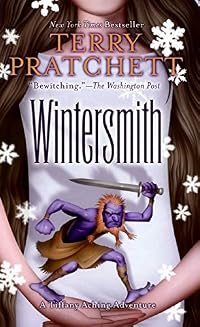
Wintersmith
by Terry Pratchett
Discworld: Young Adult (4), Discworld: Tiffany Aching (3), Discworld (35)
On This Page
Description
When witch-in-training Tiffany Aching accidentally interrupts the Dance of the Seasons and awakens the interest of the elemental spirit of Winter, she requires the help of the six-inch-high, sword-wielding, sheep-stealing Wee Free Men to put the seasons aright.Tags
Recommendations

Member Recommendations
beyondthefourthwall Sensible, take-charge young women get accidentally caught up in ancient wintry magic and have to figure out how to untangle themselves from the elusive creators and save the people around them from perpetual megawinter.
Member Reviews
A fun one. Tiffany takes on the Spirit of Winter, whom she accidentally causes to fall in love with her by stepping into a Dark Morris dance at an inopportune moment. That plot is interesting, particularly how Pratchett handles the powers and personality of a demi-god, and in Wintersmith's creation of a Frankenstein body to inhabit by using the folktale ideas from a song lyric. But what I enjoy most about this book (and the others in the series) is how Tiffany (age 13 now) matures and slowly settles into being a 'proper' witch. It's interesting how none of the senior witches (Miss Treason, Nanny Ogg, Granny Weatherwax) ever comes out and simply says "Here's what you should be doing". They lead by example, and through providing access to show more educational 'experiences' that gently guide Tiffany (and her other acolytes) in the right direction. That is to say, the witches build character and leave the rest to human nature.
In this volume, she has to take care of the poor and wretched while simultaneously dealing with 'witch society' and helping the helpless Annagramma figure out the right ways to be a witch. It's particularly gratifying to see how the 'pig witch' Petulia Gristle is also maturing and coming into her own.
I especially liked how the silver horse pendant acted as a plot device, and in particular, how it was lost and then found again.
Of course, the book was made the more enjoyable through the voice work of Stephen Briggs, who makes it so three dimensional, and who does such a wonderful job characterizing the the Nac Mac Feegle, but everyone else as well. show less
In this volume, she has to take care of the poor and wretched while simultaneously dealing with 'witch society' and helping the helpless Annagramma figure out the right ways to be a witch. It's particularly gratifying to see how the 'pig witch' Petulia Gristle is also maturing and coming into her own.
I especially liked how the silver horse pendant acted as a plot device, and in particular, how it was lost and then found again.
Of course, the book was made the more enjoyable through the voice work of Stephen Briggs, who makes it so three dimensional, and who does such a wonderful job characterizing the the Nac Mac Feegle, but everyone else as well. show less
"You danced into a story, girl, one that tells itself to the world every year. It’s the Story about ice and fire, Summer and Winter. You’ve made it wrong. You’ve got to stay to the end and make sure it turns out right."
Crivens! That was such a good read. Wintersmith is the 35th Discworld book and the 3rd in the Tiffany Aching sub-series. Tiffany is a trainee witch under the scary Miss Treason. Every year the region observes the Dark Dance, where summer transitions to winter, and Tiffany, for reasons she can't explain, joins the dance. Now she's attracted the Wintersmith himself and Tiffany's forced to face the consequences of her actions: the fact that there may never be another springtime.
Of course, the Nac Mac Feegles are right show more there to help their Wee Big Hag no matter whether she wants them to or not!
I'm always impressed with how much Terry Pratchett can pack into a seemingly simple tale. Wintersmith is about the power of stories and how humans shape the world with the stories we tell ourselves. It is such a deeply profound idea with so many layers to it that I think it's right up there with Small Gods as one of my favorites. As Wee Billy Bigchin says, "A metaphor is a kind o' lie to help people understand what's true." I highly recommend this book, though you'd likely want to read the previous two Tiffany Aching books first. show less
Crivens! That was such a good read. Wintersmith is the 35th Discworld book and the 3rd in the Tiffany Aching sub-series. Tiffany is a trainee witch under the scary Miss Treason. Every year the region observes the Dark Dance, where summer transitions to winter, and Tiffany, for reasons she can't explain, joins the dance. Now she's attracted the Wintersmith himself and Tiffany's forced to face the consequences of her actions: the fact that there may never be another springtime.
Of course, the Nac Mac Feegles are right show more there to help their Wee Big Hag no matter whether she wants them to or not!
I'm always impressed with how much Terry Pratchett can pack into a seemingly simple tale. Wintersmith is about the power of stories and how humans shape the world with the stories we tell ourselves. It is such a deeply profound idea with so many layers to it that I think it's right up there with Small Gods as one of my favorites. As Wee Billy Bigchin says, "A metaphor is a kind o' lie to help people understand what's true." I highly recommend this book, though you'd likely want to read the previous two Tiffany Aching books first. show less
I had to not read this for ages because I was writing a book myself and that book had anthropomorphised seasons in it and one thing I could not possibly do was read how terry Pratchett anthropomorphised seasons before I worked out how to do it myself. Now the book is done and alas and waily waily waily Pratchett has met the guy in all-caps, so I finally get to read it.
Tiffany Aching, witch-in-training, through a blunder at a dark and mysterious dance, finds that the wintersmith, the spirit of winter, has fallen in love with her, partly because he thinks she's the spirit of summer and partly just because she's Tiffany. His various and potentially catastrophic attempts at wooing, as he struggles to become more human, need to be curtailed, show more or there might never be a summer ever again. Tiffany is aided by assorted witches and the Wee Free Men, aggravating as it may be.
Funny and smart with heart, this is fantasy, but grounded and sensible as ever, even as it scales the heights of mad ideas. Sigh. I don't want him to be gone. show less
Tiffany Aching, witch-in-training, through a blunder at a dark and mysterious dance, finds that the wintersmith, the spirit of winter, has fallen in love with her, partly because he thinks she's the spirit of summer and partly just because she's Tiffany. His various and potentially catastrophic attempts at wooing, as he struggles to become more human, need to be curtailed, show more or there might never be a summer ever again. Tiffany is aided by assorted witches and the Wee Free Men, aggravating as it may be.
Funny and smart with heart, this is fantasy, but grounded and sensible as ever, even as it scales the heights of mad ideas. Sigh. I don't want him to be gone. show less
Terry Pratchett is a remarkable writer, and Wintersmith is one of his finer books. It's quite rare to read a book that makes me laugh out loud, but this one did so numerous times. While technically a young adult book, this reads just like all the other Discworld books. The main character just happens to be 13.
The witches in Pratchett's books rank as his best characters, so following TIffany and her continued growth as a witch under the guidance of the elder witches is simply delightful. The Wee Free Men complement the witches perfectly. The witches use truth in wonderful sarcasm, while the Wee Free Men use it in complete innocence. Both result in great moments.
I highly recommend Wintersmith to any Pratchett fan, and to anyone who can show more appreciate the intelligent sarcasm and irony presented by his characters. Pratchett ranks up with the best writers ever. That's hard praise to give someone who writes fantasy, but he stands apart in the mastery of telling a story that encompasses so much more. show less
The witches in Pratchett's books rank as his best characters, so following TIffany and her continued growth as a witch under the guidance of the elder witches is simply delightful. The Wee Free Men complement the witches perfectly. The witches use truth in wonderful sarcasm, while the Wee Free Men use it in complete innocence. Both result in great moments.
I highly recommend Wintersmith to any Pratchett fan, and to anyone who can show more appreciate the intelligent sarcasm and irony presented by his characters. Pratchett ranks up with the best writers ever. That's hard praise to give someone who writes fantasy, but he stands apart in the mastery of telling a story that encompasses so much more. show less
At a certain point, it gets difficult to review books in a series because the things I do and don’t like about it are pretty set, and I end up repeating myself! I think I am at that point with Tiffany, so just know she continues to be a fantastic protagonist (now 13 in this one), and I love her. This one also had even more Granny Weatherwax in it, and even a bit of Nanny Ogg from _The Witches_ series!
> Child. That was a terrible thing to say to anyone who was almost thirteen.
This instalment sees Tiffany in a new position as a trainee witch with 113-year-old witch Miss Treason (so old she calls Granny ‘the girl Weatherwax’). I thought Miss Treason was fantastic. She really leans into the scary old witch trope, even going so far as show more painting the inside of her cottage black and covering it with cobwebs. Tiffany is able to learn a lot from her, not least the importance of stories as a way that people make sense of their world.
> “Living this long’s not as wonderful as people think. I mean, you get the same amount of youth as everyone else, but a great big extra helping of being very old and deaf and creaky.” (Miss Treason)
I didn’t enjoy this one as much as the previous two because I struggled to make sense of the Wintersmith plot. _On reflection_, that is partly because I had expectations about how the story was going to play out, and actually, Pratchett is doing something more interesting and teaching us a more realistic lesson about consequences and responsibility. This isn’t Tiffany having a grand adventure to defeat a villain; this is Tiffany continuing to learn about the realities of life as a witch and what her own place within the community may look like (you’d think be book 3, my expectations would be with the programme!).
> A witch didn’t do things because they seemed a good idea at the time! That was practically cackling. You had to deal every day with people who were foolish and lazy and untruthful and downright unpleasant, and you could certainly end up thinking that the world would be considerably improved if you gave them a slap. But you didn’t because, as Miss Tick had once explained:
> a) it would make the world a better place for only a very short time;
> b) it would then make the world a slightly worse place; and
> c) you’re not supposed to be as stupid as they are.
Tiffany makes a mistake when she joins the dance and inadvertently attracts the attention of the Wintersmith, which throws off the balance of winter and summer. I will say I am still a bit confused about _why_ she joined the dance. I think it is something to do with her feet, and because she is a witch of the land, but I never got totally clear on that. I also felt quite uncomfortable with the Wintersmith plot, and weirdly, I’ve not seen many other reviewers mention this. I didn’t quite understand why Pratchett added romantic overtones. Tiffany is 13, she hasn’t yet had her first kiss and is still trying to make sense of her feelings towards Roland. The Wintnersmith is an immortal elemental who starts stalking her in a really intense way and showering her with gifts; it’s creepy, and none of the other characters sees it that way. They act like it is normal, or even funny, and nobody tries to help her make sense of what feelings she may be having about it.
> “Romancin’ is verrae important, ye ken. Basically it’s a way the boy can get close to the girl wi’oot her attackin’ him and scratchin’ his eyes oot.” (Rob Anybody)
I think in the universe, the explanation would be that this is a pseudo-medieval type setting, it’s normal for girls to marry very young, and the Wintersmith is not human, and as he tries to create a human form, he is quite childlike… but even so, the fact is that he is ageless and much more powerful than Tiffany. And the issues with how the story is structured do not make his relative innocence clear until far too late, so the whole time, I have a background feeling of ick whenever this comes up. For some reason, Pratchett wrote the climax of the book as the first chapter, which was confusing narratively and wrecked the pacing. I don’t think of any good reason to do this. I also remained confused about the role of the Summer Lady by the end of the book, and why the Nac Mac Feegle had to rescue her from hell.
> “No. The old gods ain’t big on ‘sorry,'” said Granny, pacing up and down again. “They know it’s just a word.”
Thankfully, the Wintersmith plot is not the sole focus of the book, and it hangs in the background as she deals with more immediate community issues. I am really enjoying the evolving relationship between Tiffany and Annagramma, and how the younger witches are finding their dynamics in the community. I love that Petunia is now a renowned Pig Witch after she won the Witch Trials with her pig trick! This book really shows the differences between the young witches and the older witches – like Miss Tick, Granny and Nanny – and the conflicts between Tiffany and Granny are the best parts. The teenage Tiffany is starting to understand Granny more, so she pushes back and tests her.
> “Look, just because a woman’s got no teeth doesn’t mean she’s wise. It might just mean she’s been stupid for a very long time.” (Tiffany to Annagramma)
So while this is my least favourite so far, it still has a lot to love. The best parts are when Tiffany is doing her everyday witch stuff and interacting with the community. I suspect if I reread this, I might like it more, having a better understanding of what I think Pratchett was trying to do without the structure getting in the way.
For Law of Fives, it was published in 2007, won a Locus award, it’s the 3rd in a 5 book series, and I can count Wintersmith as a fantastic creature (Elemental).
## REVIEW SUMMARY
### I LIKED
- I loved all the parts with Tiffany in the community.
- Relationship between Granny and Tiffany.
- Annagrammer’s growth.
- Focus on responsibility, not adventure.
### I DIDN’T LIKE
- Weird narrative structure destroyed pacing.
- Wintersmith gave me the ick. show less
> Child. That was a terrible thing to say to anyone who was almost thirteen.
This instalment sees Tiffany in a new position as a trainee witch with 113-year-old witch Miss Treason (so old she calls Granny ‘the girl Weatherwax’). I thought Miss Treason was fantastic. She really leans into the scary old witch trope, even going so far as show more painting the inside of her cottage black and covering it with cobwebs. Tiffany is able to learn a lot from her, not least the importance of stories as a way that people make sense of their world.
> “Living this long’s not as wonderful as people think. I mean, you get the same amount of youth as everyone else, but a great big extra helping of being very old and deaf and creaky.” (Miss Treason)
I didn’t enjoy this one as much as the previous two because I struggled to make sense of the Wintersmith plot. _On reflection_, that is partly because I had expectations about how the story was going to play out, and actually, Pratchett is doing something more interesting and teaching us a more realistic lesson about consequences and responsibility. This isn’t Tiffany having a grand adventure to defeat a villain; this is Tiffany continuing to learn about the realities of life as a witch and what her own place within the community may look like (you’d think be book 3, my expectations would be with the programme!).
> A witch didn’t do things because they seemed a good idea at the time! That was practically cackling. You had to deal every day with people who were foolish and lazy and untruthful and downright unpleasant, and you could certainly end up thinking that the world would be considerably improved if you gave them a slap. But you didn’t because, as Miss Tick had once explained:
> a) it would make the world a better place for only a very short time;
> b) it would then make the world a slightly worse place; and
> c) you’re not supposed to be as stupid as they are.
Tiffany makes a mistake when she joins the dance and inadvertently attracts the attention of the Wintersmith, which throws off the balance of winter and summer. I will say I am still a bit confused about _why_ she joined the dance. I think it is something to do with her feet, and because she is a witch of the land, but I never got totally clear on that. I also felt quite uncomfortable with the Wintersmith plot, and weirdly, I’ve not seen many other reviewers mention this. I didn’t quite understand why Pratchett added romantic overtones. Tiffany is 13, she hasn’t yet had her first kiss and is still trying to make sense of her feelings towards Roland. The Wintnersmith is an immortal elemental who starts stalking her in a really intense way and showering her with gifts; it’s creepy, and none of the other characters sees it that way. They act like it is normal, or even funny, and nobody tries to help her make sense of what feelings she may be having about it.
> “Romancin’ is verrae important, ye ken. Basically it’s a way the boy can get close to the girl wi’oot her attackin’ him and scratchin’ his eyes oot.” (Rob Anybody)
I think in the universe, the explanation would be that this is a pseudo-medieval type setting, it’s normal for girls to marry very young, and the Wintersmith is not human, and as he tries to create a human form, he is quite childlike… but even so, the fact is that he is ageless and much more powerful than Tiffany. And the issues with how the story is structured do not make his relative innocence clear until far too late, so the whole time, I have a background feeling of ick whenever this comes up. For some reason, Pratchett wrote the climax of the book as the first chapter, which was confusing narratively and wrecked the pacing. I don’t think of any good reason to do this. I also remained confused about the role of the Summer Lady by the end of the book, and why the Nac Mac Feegle had to rescue her from hell.
> “No. The old gods ain’t big on ‘sorry,'” said Granny, pacing up and down again. “They know it’s just a word.”
Thankfully, the Wintersmith plot is not the sole focus of the book, and it hangs in the background as she deals with more immediate community issues. I am really enjoying the evolving relationship between Tiffany and Annagramma, and how the younger witches are finding their dynamics in the community. I love that Petunia is now a renowned Pig Witch after she won the Witch Trials with her pig trick! This book really shows the differences between the young witches and the older witches – like Miss Tick, Granny and Nanny – and the conflicts between Tiffany and Granny are the best parts. The teenage Tiffany is starting to understand Granny more, so she pushes back and tests her.
> “Look, just because a woman’s got no teeth doesn’t mean she’s wise. It might just mean she’s been stupid for a very long time.” (Tiffany to Annagramma)
So while this is my least favourite so far, it still has a lot to love. The best parts are when Tiffany is doing her everyday witch stuff and interacting with the community. I suspect if I reread this, I might like it more, having a better understanding of what I think Pratchett was trying to do without the structure getting in the way.
For Law of Fives, it was published in 2007, won a Locus award, it’s the 3rd in a 5 book series, and I can count Wintersmith as a fantastic creature (Elemental).
## REVIEW SUMMARY
### I LIKED
- I loved all the parts with Tiffany in the community.
- Relationship between Granny and Tiffany.
- Annagrammer’s growth.
- Focus on responsibility, not adventure.
### I DIDN’T LIKE
- Weird narrative structure destroyed pacing.
- Wintersmith gave me the ick. show less
I have finally read my first Pratchett. If reading it alone wasn't cause for celebration, how much I enjoyed it would be. I tried to join in Ekho’s Discworld readalong over the summer, but only managed this one of the four they had chosen. But that is not because of Pratchett. August was a difficult month.
(Ekho's links: instagram | wordpress)
In fact, Ekho thought long and hard and picked four very diverse stories from Discworld to introduce all the different strains of Pratchett, and felt this was the best introduction into the witches. I have to say, without knowing more about the witches yet, I whole-heartedly agree. Even after one book I know I already like Pratchett’s voice.
Tiffany Aching isn’t new to witching anymore, and the show more Feegles (aka the Wee Free Men) take a little getting used to, but this story is such a great one. It is indeed the oldest story out there: boy takes interest in girl, brings hell to earth because she isn’t interested, so she marches hell straight back at him.
Wintersmith carried with it some seasoned humor as well as some solemn and meaningful moments. As far as writers go, there’s a whole breadth of humor on display here that shows a well-honed craft and a great understanding of the genre. Something in this reminds me of both Diana Wynne Jones and Peter S. Beagle. Not to say that Pratchett is derivative, but there’s a sort of joke you can only make when you appreciate Fantasy the way these writers do.
Tiffany as well is enchanting, despite spending the majority of the novel trying to fix a foolish mistake she’s made. Being a witch is messy and she’s heavily put on by all the expectations that the pointy has given her.
The almost distracting, if they weren’t so essential, Nac Mac Feegle can only fully be understood once you’ve experienced them. I’m so glad there’s more of them in other books, they are ferocious, amazing and precious. In another blurb for this book they are described as “the fightin', thievin' pictsies who are prepared to lay down their lives for their ‘big wee hag.’”
If you are looking for a good place to start Discworld, I can recommend Wintersmith. If you need something a little more non-traditional to read while snow is piling up, I can recommend Wintersmith. If you love fantasy or witches but want something a little different, a little tongue-in-cheek, I can recommend Wintersmith.
Long story short, pick up this book! show less
(Ekho's links: instagram | wordpress)
In fact, Ekho thought long and hard and picked four very diverse stories from Discworld to introduce all the different strains of Pratchett, and felt this was the best introduction into the witches. I have to say, without knowing more about the witches yet, I whole-heartedly agree. Even after one book I know I already like Pratchett’s voice.
Tiffany Aching isn’t new to witching anymore, and the show more Feegles (aka the Wee Free Men) take a little getting used to, but this story is such a great one. It is indeed the oldest story out there: boy takes interest in girl, brings hell to earth because she isn’t interested, so she marches hell straight back at him.
Wintersmith carried with it some seasoned humor as well as some solemn and meaningful moments. As far as writers go, there’s a whole breadth of humor on display here that shows a well-honed craft and a great understanding of the genre. Something in this reminds me of both Diana Wynne Jones and Peter S. Beagle. Not to say that Pratchett is derivative, but there’s a sort of joke you can only make when you appreciate Fantasy the way these writers do.
Tiffany as well is enchanting, despite spending the majority of the novel trying to fix a foolish mistake she’s made. Being a witch is messy and she’s heavily put on by all the expectations that the pointy has given her.
The almost distracting, if they weren’t so essential, Nac Mac Feegle can only fully be understood once you’ve experienced them. I’m so glad there’s more of them in other books, they are ferocious, amazing and precious. In another blurb for this book they are described as “the fightin', thievin' pictsies who are prepared to lay down their lives for their ‘big wee hag.’”
If you are looking for a good place to start Discworld, I can recommend Wintersmith. If you need something a little more non-traditional to read while snow is piling up, I can recommend Wintersmith. If you love fantasy or witches but want something a little different, a little tongue-in-cheek, I can recommend Wintersmith.
Long story short, pick up this book! show less
IMO, the YA label does Pratchett’s Tiffany Aching series a disservice – not because I don't think the younger crowd will enjoy it but because it might keep us older adults from reading it too. This one is definitely my favorite so far. It's a well-paced mix of humor and insightful glimpses into human nature with just a touch of romance. And who else but Terry Pratchett could stage the Greek myth of Orpheus with a cast of wee blue men and get away with it?
Members
- Recently Added By
Lists

Best Young Adult
399 works; 101 members

NPRs your favorites: 100 Best Ever Teen Novels
237 works; 49 members

Fantasy novels with a female protagonist
76 works; 15 members

Female Protagonist
1,056 works; 56 members

Winter Books
127 works; 16 members

Top Five Books of 2022
736 works; 272 members

Genre Benders: Comic Fantasy
97 works; 16 members

Speculative Fiction to Read
706 works; 32 members

Mind Expanding Books by hackerkid
581 works; 8 members

Books Read in 2023
5,547 works; 145 members

Books featuring grandmothers
56 works; 12 members

Fêtes worse than death? — Village festivals in fiction
37 works; 7 members

Books Read in 2017
4,248 works; 130 members

Books Read in 2015
3,298 works; 126 members

Books Read in 2019
4,052 works; 108 members
Books Read in 2011
684 works; 20 members
Books Read in 2016
4,666 works; 199 members

Read in 2014
334 works; 11 members

Books Read in 2022
5,164 works; 113 members

Books Read in 2014
2,341 works; 89 members

Books With Winter Words in the Title
42 works; 6 members

Witches and Wizards Oh My
135 works; 12 members

Carole's List
445 works; 13 members

Read in 2019
48 works; 1 member

Books Read in 2025
4,060 works; 97 members

Unread books
1,063 works; 82 members
Author Information

429+ Works 578,327 Members
Terry Pratchett was on born April 28, 1948 in Beaconsfield, United Kingdom. He left school at the age of 17 to work on his local paper, the Bucks Free Press. While with the Press, he took the National Council for the Training of Journalists proficiency class. He also worked for the Western Daily Press and the Bath Chronicle. He produced a series show more of cartoons for the monthly journal, Psychic Researcher, describing the goings-on at the government's fictional paranormal research establishment, Warlock Hall. In 1980, he was appointed publicity officer for the Central Electricity Generating Board with responsibility for three nuclear power stations. His first novel, The Carpet People, was published in 1971. His first Discworld novel, The Colour of Magic, was published in 1983. He became a full-time author in 1987. He wrote more than 70 books during his lifetime including The Dark Side of the Sun, Strata, The Light Fantastic, Equal Rites, Mort, Sourcery, Truckers, Diggers, Wings, Dodger, Raising Steam, Dragons at Crumbling Castle: And Other Tales, and The Shephard's Crown. He was diagnosis with early onset Alzheimer's disease in 2007. He was knighted for services to literature in 2009 and received the World Fantasy award for life achievement in 2010. He died on March 12, 2015 at the age of 66. (Bowker Author Biography) show less
Some Editions
Awards and Honors
Awards
Distinctions
Series


Belongs to Publisher Series
Work Relationships
Is contained in
Inspired
Common Knowledge
- Canonical title
- Wintersmith
- Original title
- Wintersmith
- Original publication date
- 2006-09-21
- People/Characters
- Tiffany Aching; Granny Weatherwax (Esme Weatherwax); Nanny Ogg (Gytha Ogg); Eumenides Treason (Miss Treason); Perspicacia Tick; Annagramma Hawkin (show all 21); Roland de Chumsfanleigh; Wintersmith; Rob Anybody; Daft Wullie; Hamish; Big Yan; Awf'ly Wee Billy Bigchin; Jeannie of the Long Lake (kelda of the Chalk Hill clan); Wee Dangerous Spike; Nac Mac Feegle; You (cat); Greebo (cat); Death [Discworld]; Horace (cheese); Petulia Gristle
- Important places
- The Chalk, Discworld; The Ramtops, Discworld; Discworld
- Important events
- morris dancing
- First words
- When the storm came, it hit the hills like a hammer.
- Quotations
- 'And he won her freedom by playing beautiful music,' Roland added. 'I think he played a lute, or maybe it was a lyre.' 'Ach, wheel, that'll soot us fine,' said Daft Wullie. 'We're experts at looting and then lying aboot it.'
- Last words
- (Click to show. Warning: May contain spoilers.)And he read Principles of Modern Accountancy all morning, but just to make it interesting, he put lots of dragons in.
- Original language
- English
- Canonical DDC/MDS
- 823.92
Classifications
Statistics
- Members
- 8,945
- Popularity
- 1,194
- Reviews
- 183
- Rating
- (4.15)
- Languages
- 17 — Chinese, Czech, Danish, Dutch, English, Estonian, Finnish, French, German, Hebrew, Hungarian, Italian, Norwegian (Bokmål), Norwegian, Polish, Russian, Spanish
- Media
- Paper, Audiobook, Ebook
- ISBNs
- 79
- UPCs
- 1
- ASINs
- 36