On This Page
Description
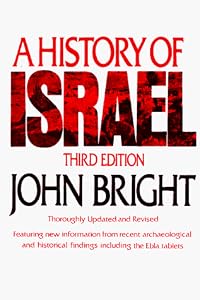
Unsurpassed for nearly half a century, and now with a new introduction and appendix by William P. Brown, John Bright's A History of Israel will continue to be a standard for a new generation of students of the Old Testament. This book remains a classic in the literature of theological.Tags
Recommendations










Member Reviews
This is the most interesting book I've read all year. It's an attempt to tell the story of the Jews from the earliest times to the Maccabean revolt using the Bible, archaeology and the general history of the area. In the absence of other evidence – or common sense – Bright defaults to the Bible (using a critical approach).
The danger with this, of course, is that new facts emerge from the ground all the time. Even I, with my very sketchy knowledge of the period noticed a few points where more recent interpretations differ. I am given to understand that he published three revised editions. But that's not to say that the first edition isn't worth reading, if that is what you have available. I read it because I've been thinking of show more leafing through the Bible and a wanted a narrative history so I wouldn't be all at sea. I got so much more than that. The book has true literary qualities that I just wasn't expecting to find.
There's a wonderful tension in the stories. Take Abraham. Now obviously there's no archaeological evidence for Abraham or for anything up to the Exodus. What Bright does is paint a picture of the times when Abraham might reasonably have lived, if he did. What emerges from the stories told about Abraham – his cultural practices and the journey he made – is that he is being presented as Mr Norman Normal. Yet on the other hand here is a man in direct communication with God. There's that tension between daily life on the one hand and the divine on the other.
Later you have a people with the most grandiose conception of God and of their place in the world on the one hand. On the other the mundane truth – that they are an obscure hill-people who cannot hold their kingdom together and are apparently incapable of winning a major battle.
That tension also characterises Bright's approach. His use of faith and reason to tell the story, each straining in the opposite direction and yearning for freedom. I sensed that same tension in Bright himself. He's obviously come to his subject because of it's importance to his own faith (he was Presbyterian) but he has to understand and has to know. show less
The danger with this, of course, is that new facts emerge from the ground all the time. Even I, with my very sketchy knowledge of the period noticed a few points where more recent interpretations differ. I am given to understand that he published three revised editions. But that's not to say that the first edition isn't worth reading, if that is what you have available. I read it because I've been thinking of show more leafing through the Bible and a wanted a narrative history so I wouldn't be all at sea. I got so much more than that. The book has true literary qualities that I just wasn't expecting to find.
There's a wonderful tension in the stories. Take Abraham. Now obviously there's no archaeological evidence for Abraham or for anything up to the Exodus. What Bright does is paint a picture of the times when Abraham might reasonably have lived, if he did. What emerges from the stories told about Abraham – his cultural practices and the journey he made – is that he is being presented as Mr Norman Normal. Yet on the other hand here is a man in direct communication with God. There's that tension between daily life on the one hand and the divine on the other.
Later you have a people with the most grandiose conception of God and of their place in the world on the one hand. On the other the mundane truth – that they are an obscure hill-people who cannot hold their kingdom together and are apparently incapable of winning a major battle.
That tension also characterises Bright's approach. His use of faith and reason to tell the story, each straining in the opposite direction and yearning for freedom. I sensed that same tension in Bright himself. He's obviously come to his subject because of it's importance to his own faith (he was Presbyterian) but he has to understand and has to know. show less
A History of Isreal is now out of publication but is still an excellent introduction to the History of Israel for those studying the Old Testament. I first was introduced to this book as an A level student in the 1980s and then again when I went to University, it was a set text.
Bright leads the reader through the history of the Levant and the near East before 2000 B.C to give the read some background for what they are about to read and study. As the book proper is split into six parts, which relate to various parts of the Old Testament.
Part One, deals with the beginning of Israel’s history as part of the Age of the Patriarchs, so it digs deeper into Israel’s origins guiding them through the period of Genesis or as the Hebrew Bible show more says, The Beginnings. Part two covers the ‘formative period’, which is the Exodus and Conquest of the Promised Land.
Parts three and four cover the period of Israel under the Monarchy when Israel moved from a tribal confederacy to a dynastic state under Saul. Before moving on to the Monarchy in crisis and its downfall. We also see the prophets during the last days of the Kingdom of Judah.
Part five covers tragedy and beyond, which are the exilic and post exilic periods in the Old Testament and discusses the plight of the Jews after 587 BC and the last days of the Babylonian Empire. It also covers the completion of the Temple complex in Jerusalem. Part six covers the end of the Old Testament period and what is seen as the formative period of Judaism. It also covers the religious crisis and rebellion and the Maccabean Rebellion.
This has always been and will continue to be an excellent introduction to Old Testament history for English speakers with no Hebrew reading skills. The book is easy to read for both student and the general reader and remained the best of the books that introduced students to the history of the Old Testament. While there are newer publications, some of them do not reach the heights of scholarship in this book.
It is still one of the best Introductions to Old Testament History. show less
Bright leads the reader through the history of the Levant and the near East before 2000 B.C to give the read some background for what they are about to read and study. As the book proper is split into six parts, which relate to various parts of the Old Testament.
Part One, deals with the beginning of Israel’s history as part of the Age of the Patriarchs, so it digs deeper into Israel’s origins guiding them through the period of Genesis or as the Hebrew Bible show more says, The Beginnings. Part two covers the ‘formative period’, which is the Exodus and Conquest of the Promised Land.
Parts three and four cover the period of Israel under the Monarchy when Israel moved from a tribal confederacy to a dynastic state under Saul. Before moving on to the Monarchy in crisis and its downfall. We also see the prophets during the last days of the Kingdom of Judah.
Part five covers tragedy and beyond, which are the exilic and post exilic periods in the Old Testament and discusses the plight of the Jews after 587 BC and the last days of the Babylonian Empire. It also covers the completion of the Temple complex in Jerusalem. Part six covers the end of the Old Testament period and what is seen as the formative period of Judaism. It also covers the religious crisis and rebellion and the Maccabean Rebellion.
This has always been and will continue to be an excellent introduction to Old Testament history for English speakers with no Hebrew reading skills. The book is easy to read for both student and the general reader and remained the best of the books that introduced students to the history of the Old Testament. While there are newer publications, some of them do not reach the heights of scholarship in this book.
It is still one of the best Introductions to Old Testament History. show less
A spectacular introduction to the history of God's people. Covering cultural and historical background as well as the production of the Old Testament, this work will help anyone endeavoring to understand the context and development of the Bible.
Advisory: Included as a historical study resource that offers readers a comprehensive academic overview of the history of ancient Israel and its religious development, drawing on archaeological evidence and biblical narratives. While the author was a non‑Catholic Christian scholar and this work is not a Catholic theological text, it can be a valuable resource for parishioners, RCIA participants, and Bible study groups seeking historical context for the Old Testament. Readers are encouraged to balance it with Catholic biblical commentaries and magisterial texts on Scripture for a fuller understanding within the Catholic tradition.
A history of Israel (Westminster aids to the study of the Scriptures) by John Bright (?)
Given to Matthew Hayes - 05/11/2023
Comprado no bazar Sao Luis Gonzaga, doação do Padre Mauricio, em abril de 2019
Members
- Recently Added By
Author Information

11 Works 3,926 Members
Series

Common Knowledge
- Canonical title
- A History of Israel
- Original title
- A History of Israel
- Original publication date
- 1959
- People/Characters
- Abraham; Ahaz, King of Judah; Alexander the Great; Antiochus IV Epiphanes (175-164 BC/BCE); Artaxerxes I; David, King of Israel (show all 19); Ezra; Hezekiah, King of Judah; Hosea; Isaiah; Jehoiachin, King of Judah; Jeremiah; Manasseh, King of Judah; Moses; Nebuchadnezzar II; Nehemiah; Saul, King of Israel; Solomon, King of Israel; Zerubbabel, son of Pedaiah
- Important places
- Assyria; Byblos, Lebanon; Damascus, Syria; Edom; Esdraelon; Galilee (show all 16); Gezer; Jerusalem; Mari; Megiddo; Moab; Negeb; Qumran, West Bank; Shechem, Canaan; Temple of Jerusalem; Tyre
- Important events
- The Babylonian Exile; The Maccabean Revolt; The Israelite Conquest of Canaan; The Exodus
- Dedication
- To the Memory of
WILLIAM FOXWELL ALBRIGHT
in recognition of a debt of gratitude
that cannot be repaid - First words
- FOREWORD TO THE FIRST EDITION -- It is unnecessary in itself to justify the writing of a history of Israel.
FOREWORD TO THE SECOND EDITION -- Needless to say, I have been deeply gratified by the generally favorable response which the first edition of this book has received.
FOREWORD TO THE THIRD EDITION -- Although the second edition of this book appeared less than ten years ago, it has become obvious to me that yet a further revision is imperative.
Prologue
THE ANCIENT ORIENT BEFORE CA. 2000 B.C.
As the Bible presents it, the history of Israel began with the migration of the Hebrew patriarchs from Mesopotamia to their new homeland in Palestine. - Last words
- (Click to show. Warning: May contain spoilers.)In Christ, and because of Christ, the Christian sees its history, which is "salvation history" (Heilsgeschichte), but yet also a history of disappointment and failure, made really and finally Heilsgeschichte.
- Original language
- English
Classifications
Statistics
- Members
- 1,985
- Popularity
- 10,523
- Reviews
- 9
- Rating
- (3.83)
- Languages
- 6 — Chinese, English, Hungarian, Italian, Spanish, Portuguese (Portugal)
- Media
- Paper, Ebook
- ISBNs
- 19
- ASINs
- 29