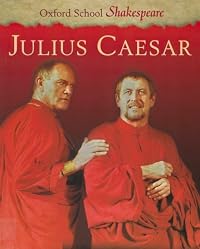
Julius Caesar
by William Shakespeare
On This Page
Description
Although Shakespeare's play Julius Caesar is named after the legendary Roman political leader, the central character is thought by many to be Marcus Brutus, Caesar's friend turned foe who struggles throughout the play with conflicting obligations of friendship and duty. While Caesar is warned in a prophecy to "beware the Ides of March" the Roman senators, including Brutus are secretly plotting his assassination, hoping to rid Rome of the threat of a tyrant who they believe plans to overthrow show more democracy and install a monarchy. The source of the famous lines "Et tu, Brute?" and "Friends, Romans, countrymen, lend me your ears…" this tragic history play is based on the real events surrounding the assassination of Julius Caesar in 44 BC.. show less
Tags
Recommendations





Member Reviews
"I seek not to disprove what Brutus spoke." (Mark Antony, pg. 76)
Shakespeare is the master of the laden phrase. Take, for example, the famous utterance by Cassius after Caesar's murder: "How many ages hence Shall this our lofty scene be acted over, In states unborn and accents yet unknown?" (pg. 68). Not only is this often quoted by those eulogizing Shakespeare's enduring popularity, it also has multiple meanings within the context of the play: referring not only to the impact of Caesar's murder on the course of history but to the sad role such assassinations play again and again in human affairs (Lincoln, JFK, etc.) whilst also breaking the fourth wall between actor and audience. And it sounds good, too. Shakespeare is at his eloquent show more and bursting best here.
In fact, my preconceptions of Julius Caesar were wide of the mark: I expected it to be a rather black-and-white historical epic with ringing rhetoric and lots of blood – more Henry V than Hamlet. Whilst the latter part is true, with fine speeches ('lend me your ears') and one particularly prominent murder, it is rather grey in its morality. Henry V was by no means simplistic (and scholars continue to expend ink on Shakespeare's nuanced portrayal of the King) but it was rather cut-and-dry in terms of who you were to root for. Julius Caesar is more like the later Hamlet or Macbeth in that every character is nuanced (when Brutus reports to Caesar about the Ides of March soothsayer (pg. 36), it reminded me a lot of Macbeth pledging fealty to Duncan, in how he is unwittingly manipulated and unaware of his future course). Caesar is dictatorial but benevolent; Brutus is honourable but easily-led. Cassius is malicious but not wrong in his conscientious mistrust of Caesar's growing power. Mark Antony wins the sympathy of the audience for his loyalty to Caesar, but he is ruthlessly duplicitous to the plebs.
This is the reason I opened my review with a quote from Mark Antony (coming during the 'lend me your ears' speech) as it emphasizes this grey morality and Shakespeare's laden phrases. Whilst deftly turning the crowd against Brutus and his co-conspirators, Antony is couching it in language that would seem harmless to Brutus' ears. He wins the plebs over to sympathy of the murdered Caesar and condemnation of his killers by referencing Caesar's will, in which he divested sums of money to each citizen of Rome and his property to the public good. Yet, in his next scene, in conference with Octavius (later Augustus), he is trying to determine "how to cut off some charge in legacies" (pg. 83) – that is, how to avoid paying up. It is a brazenly Machiavellian masterclass, and the difference to the similarly-famous 'band of brothers' speech from Henry V – with its compassionate but clear-cut jingoism – is marked.
There is much more to Julius Caesar than this, of course, but every time I read one of Shakespeare's plays I am surprised at just how much depth there is in under 100 pages. Individual scenes carry more weight than the entire oeuvre of other writers. There are commentaries on the nature of power, political violence, the course of history and the need to seize one's opportune moment – all written in some of the finest English prose ever laid down. Shakespeare's enduring vitality continues to provide answers to Cassius' rhetorical question. show less
Shakespeare is the master of the laden phrase. Take, for example, the famous utterance by Cassius after Caesar's murder: "How many ages hence Shall this our lofty scene be acted over, In states unborn and accents yet unknown?" (pg. 68). Not only is this often quoted by those eulogizing Shakespeare's enduring popularity, it also has multiple meanings within the context of the play: referring not only to the impact of Caesar's murder on the course of history but to the sad role such assassinations play again and again in human affairs (Lincoln, JFK, etc.) whilst also breaking the fourth wall between actor and audience. And it sounds good, too. Shakespeare is at his eloquent show more and bursting best here.
In fact, my preconceptions of Julius Caesar were wide of the mark: I expected it to be a rather black-and-white historical epic with ringing rhetoric and lots of blood – more Henry V than Hamlet. Whilst the latter part is true, with fine speeches ('lend me your ears') and one particularly prominent murder, it is rather grey in its morality. Henry V was by no means simplistic (and scholars continue to expend ink on Shakespeare's nuanced portrayal of the King) but it was rather cut-and-dry in terms of who you were to root for. Julius Caesar is more like the later Hamlet or Macbeth in that every character is nuanced (when Brutus reports to Caesar about the Ides of March soothsayer (pg. 36), it reminded me a lot of Macbeth pledging fealty to Duncan, in how he is unwittingly manipulated and unaware of his future course). Caesar is dictatorial but benevolent; Brutus is honourable but easily-led. Cassius is malicious but not wrong in his conscientious mistrust of Caesar's growing power. Mark Antony wins the sympathy of the audience for his loyalty to Caesar, but he is ruthlessly duplicitous to the plebs.
This is the reason I opened my review with a quote from Mark Antony (coming during the 'lend me your ears' speech) as it emphasizes this grey morality and Shakespeare's laden phrases. Whilst deftly turning the crowd against Brutus and his co-conspirators, Antony is couching it in language that would seem harmless to Brutus' ears. He wins the plebs over to sympathy of the murdered Caesar and condemnation of his killers by referencing Caesar's will, in which he divested sums of money to each citizen of Rome and his property to the public good. Yet, in his next scene, in conference with Octavius (later Augustus), he is trying to determine "how to cut off some charge in legacies" (pg. 83) – that is, how to avoid paying up. It is a brazenly Machiavellian masterclass, and the difference to the similarly-famous 'band of brothers' speech from Henry V – with its compassionate but clear-cut jingoism – is marked.
There is much more to Julius Caesar than this, of course, but every time I read one of Shakespeare's plays I am surprised at just how much depth there is in under 100 pages. Individual scenes carry more weight than the entire oeuvre of other writers. There are commentaries on the nature of power, political violence, the course of history and the need to seize one's opportune moment – all written in some of the finest English prose ever laid down. Shakespeare's enduring vitality continues to provide answers to Cassius' rhetorical question. show less
This is one of two of Shakespeare’s better-known plays that I somehow missed in high school and college (the other is [King Lear], which I have yet to read). Despite the title, most of the action centers around Brutus, his decision to throw in with the conspirators, Caesar’s death, and the aftermath.
Perhaps the most famous lines in this play come from Mark Antony, mourning Caesar’s death and allowed by the conspirators to eulogize, as long as Antony does not blame them for the act. He does so, brilliantly getting the plebeians on his side while he talks about his friend, all the while repeating variations of “But Brutus says, he {Caesar} was ambitious; / and Brutus is an honorable man.” A couple of other phrases I was show more delighted to discover were “it is Greek to me” and “give up the ghost,” neither of which I realized were so old. I read it in one sitting, as is my wont, with a fair amount of help from the notes. I have the “Wordsworth Classics” edition which, instead of having notes on the opposite page or footnotes, had them in the back, so I had to keep a finger there and keep glancing back and forth. The glossary was separate and alphabetically rather than by line number, which was irritating, but despite that I mostly followed the meaning on my own from the context.
I would include the play among the history plays rather than calling it an all-out tragedy. Certainly there is a lot of death, but unlike [Hamlet] where audiences have sympathy for the main character yet everybody dies, no one comes out completely sympathetic in [Julius Caeser]. The conspirators are not great people, yet Antony and the others taking over government after Caesar’s death can also be ruthless and bicker among themselves. All in all, it’s rather unsettling and as modern as any current book with unlikable characters. The introduction to my edition discusses this and also has some pointed things to say about politics that could have been written today rather than 2004: “To this day, human beings are, all too often, sacrificed pointlessly on the altar of one political ideology or another. Again and again, men of slogans and ambition seduce and delude their more decent auditors; the many are swayed by the hypocritical rhetoric of the few. Repeatedly, violence generates yet more violence.” Not much has changed since 1599 - or 44 BCE, for that matter. show less
Perhaps the most famous lines in this play come from Mark Antony, mourning Caesar’s death and allowed by the conspirators to eulogize, as long as Antony does not blame them for the act. He does so, brilliantly getting the plebeians on his side while he talks about his friend, all the while repeating variations of “But Brutus says, he {Caesar} was ambitious; / and Brutus is an honorable man.” A couple of other phrases I was show more delighted to discover were “it is Greek to me” and “give up the ghost,” neither of which I realized were so old. I read it in one sitting, as is my wont, with a fair amount of help from the notes. I have the “Wordsworth Classics” edition which, instead of having notes on the opposite page or footnotes, had them in the back, so I had to keep a finger there and keep glancing back and forth. The glossary was separate and alphabetically rather than by line number, which was irritating, but despite that I mostly followed the meaning on my own from the context.
I would include the play among the history plays rather than calling it an all-out tragedy. Certainly there is a lot of death, but unlike [Hamlet] where audiences have sympathy for the main character yet everybody dies, no one comes out completely sympathetic in [Julius Caeser]. The conspirators are not great people, yet Antony and the others taking over government after Caesar’s death can also be ruthless and bicker among themselves. All in all, it’s rather unsettling and as modern as any current book with unlikable characters. The introduction to my edition discusses this and also has some pointed things to say about politics that could have been written today rather than 2004: “To this day, human beings are, all too often, sacrificed pointlessly on the altar of one political ideology or another. Again and again, men of slogans and ambition seduce and delude their more decent auditors; the many are swayed by the hypocritical rhetoric of the few. Repeatedly, violence generates yet more violence.” Not much has changed since 1599 - or 44 BCE, for that matter. show less
Julius Caesar is one of my favourite Shakespeare plays, combining as it does some wonderful poetry with the drama of a historical tragedy.
Shakespeare, characteristically, does not take sides. Are Brutus, Cassius and their co-conspirators striking a blow for freedom, or is their plot an unjustifiable and treacherous murder? Shakespeare does not tell us what to think; he puts the arguments of both sides into the mouths of his characters and leaves us to decide for ourselves.
The only problem I have with the play is the way that the Roman masses are portrayed as a fickle mob who are easily swayed by the speeches of demagogues. Nevertheless, the scene where Mark Antony turns the crowd from supporting the actions of the assassins to wanting show more to hunt them down and kill them is marvellous drama. Especially clever is Antony's increasingly ironic use of the phrase, "And Brutus is an honourable man."
Shakespeare's slightly patronising attitude to the common folk is also the only negative feature of another of my favourites: A Midsummer Night's Dream. Here the "mechanicals" are very funny, but unfortunately portrayed in a rather condescending way.
As to the real history on which "Julius Caesar" is based, the Roman Republic which the historical Brutus supported was not a democracy. It was an oligarchy dominated by a rich senatorial elite who were only concerned with their own freedom, not that of the mass of poor citizens, let alone that of the slaves.
The real Julius Caesar did indeed destroy the "freedom" of this rich people's oligarchy. But he gained power not just through military force but also because he won the poorer citizens to his side by adopting populist measures which benefited them. Caesar's assassins were as hostile to these populist policies as they were to his dictatorial ambitions.
Finally, this particular edition of the play is as good as any, and it meets what is for me the essential requirement of the explanatory notes being at the foot of each page for easy reference. show less
Shakespeare, characteristically, does not take sides. Are Brutus, Cassius and their co-conspirators striking a blow for freedom, or is their plot an unjustifiable and treacherous murder? Shakespeare does not tell us what to think; he puts the arguments of both sides into the mouths of his characters and leaves us to decide for ourselves.
The only problem I have with the play is the way that the Roman masses are portrayed as a fickle mob who are easily swayed by the speeches of demagogues. Nevertheless, the scene where Mark Antony turns the crowd from supporting the actions of the assassins to wanting show more to hunt them down and kill them is marvellous drama. Especially clever is Antony's increasingly ironic use of the phrase, "And Brutus is an honourable man."
Shakespeare's slightly patronising attitude to the common folk is also the only negative feature of another of my favourites: A Midsummer Night's Dream. Here the "mechanicals" are very funny, but unfortunately portrayed in a rather condescending way.
As to the real history on which "Julius Caesar" is based, the Roman Republic which the historical Brutus supported was not a democracy. It was an oligarchy dominated by a rich senatorial elite who were only concerned with their own freedom, not that of the mass of poor citizens, let alone that of the slaves.
The real Julius Caesar did indeed destroy the "freedom" of this rich people's oligarchy. But he gained power not just through military force but also because he won the poorer citizens to his side by adopting populist measures which benefited them. Caesar's assassins were as hostile to these populist policies as they were to his dictatorial ambitions.
Finally, this particular edition of the play is as good as any, and it meets what is for me the essential requirement of the explanatory notes being at the foot of each page for easy reference. show less
اولین کتابی که تو سال ۹۸ و درست روز اول فروردین خوندم، یه تراژدی فوقالعاده بود. درواقع شخصیتها به حدی خاکستری بودند (اون هم در قرن شونزدهم) که اونقدر راحت نبود که تصمیم بگیری منطقی طرفدار کدوم گروه باشی و در عین حال با بروتوس همدلی میکنی. و چقدر جالب قدرت سخنرانی سیاستمداران روی مردم رو نشون میده، طوری که کارهای مدرنی که به این فلسفه رسیدند نمیتونند به این وضوح نشونش بدن و این قدرت شکسپیره.
نکتهی جالب show more تکنیکی شکسپیر اینه که صحنههایی هم که جولیوس حضور داره برای نمایش قدرت و ابهتش صحنه پر از بازیگر میشه اما صحنههایی که بروتوس و کسیوس محنتزده رو نشون میده بازیگرها به طور محسوسی کم میشن. خیلی توصیه میشه به خوندن. show less
نکتهی جالب show more تکنیکی شکسپیر اینه که صحنههایی هم که جولیوس حضور داره برای نمایش قدرت و ابهتش صحنه پر از بازیگر میشه اما صحنههایی که بروتوس و کسیوس محنتزده رو نشون میده بازیگرها به طور محسوسی کم میشن. خیلی توصیه میشه به خوندن. show less
I hadn't read Julius Caesar since the ninth grade, when I was forced to recite the "Friends, Romans, Countrymen" speech from memory in front of the whole class. That was no fun, but I've always liked the play. Soon they'll be staging it at the local drama barn. I hear that the director intends to transform ancient Rome into a comment on the neocons...not sure that's a good idea.
Anyway, what most struck me in re-reading JC was the character of Brutus. He's the anti-Hamlet. His duty tells him to kill the king, and so he does it, straight away. But wait -- was it really his duty, or was he merely duped by backbiting Romans who hated Caesar for his success? In the end, it doesn't matter. "The noblest Roman of them all" ends up dead, and show more the republic he meant to defend soon falls into the hands of another Caesar.
Brutus reminds me of Robert E. Lee. Both men were greatly admired and honored even by their enemies. But how much does honor matter if you fight for the wrong things? Lee's deep personal integrity and gravity lent a tinge of moral authority to the cause of white supremacy, for frak's sake. Brutus committed murder out of love. Maybe Hamlet wasn't so dumb to hesitate after all. show less
Anyway, what most struck me in re-reading JC was the character of Brutus. He's the anti-Hamlet. His duty tells him to kill the king, and so he does it, straight away. But wait -- was it really his duty, or was he merely duped by backbiting Romans who hated Caesar for his success? In the end, it doesn't matter. "The noblest Roman of them all" ends up dead, and show more the republic he meant to defend soon falls into the hands of another Caesar.
Brutus reminds me of Robert E. Lee. Both men were greatly admired and honored even by their enemies. But how much does honor matter if you fight for the wrong things? Lee's deep personal integrity and gravity lent a tinge of moral authority to the cause of white supremacy, for frak's sake. Brutus committed murder out of love. Maybe Hamlet wasn't so dumb to hesitate after all. show less
Obviously, I should read this play again, because it is one of only two Shakespeare plays that bored me. I find the other history plays more inspired.
I have not yet found it tragic in either a classical or a vulgar sense. I did, however, see naked political and social satire in it--I can't be the only one who noticed. Come on, the plebeians look utterly ridiculous when responding to Antony's blatant manipulation of them.
Brutus looks foolish as well, for not seeming to question the wisdom of allying with a primary conspirator (Cassius) whose motive, unlike Brutus' motive, is self-centered and base. Their brief fight during the civil war (apparently over money) serves only to drag both characters down into ridiculousness.
The most show more interesting character? That's easy: Mark Antony. Mr. Kerwin is right: Antony is inscrutable. Before Caesar's death, one assumes by default that Antony is an obnoxious, cynical kiss-up; but after that, it's somewhat difficult to tell, if one remains open-minded.
The play interests me most for what it tells me about the Roman culture and Roman psyche. I learned from my classical literature professor about the violence inherent therein; by way of example she mentioned Seneca stating that spectators at the arena got off on what they saw--horrible. (Although a different prof later claimed that was only propaganda.) And I see it here. Let me get this straight: the play has the conspirators thinking it necessary to each stab Caesar? A later scene states that they stabbed him twenty-seven (I think) times! It naturally looks like Brutus is the last to stab; if Caesar had already been stabbed many times, I find it surprising both that it apparently took over two dozen stabs to kill him and that he can still speak (if only to say "Et tu, Brute?") when Brutus finishes with him.
...I realize this is not Roman history but a foreign dramatist's interpretation thereof. But I'm aware that Shakespeare's information largely came straight out of Plutarch. show less
I have not yet found it tragic in either a classical or a vulgar sense. I did, however, see naked political and social satire in it--I can't be the only one who noticed. Come on, the plebeians look utterly ridiculous when responding to Antony's blatant manipulation of them.
Brutus looks foolish as well, for not seeming to question the wisdom of allying with a primary conspirator (Cassius) whose motive, unlike Brutus' motive, is self-centered and base. Their brief fight during the civil war (apparently over money) serves only to drag both characters down into ridiculousness.
The most show more interesting character? That's easy: Mark Antony. Mr. Kerwin is right: Antony is inscrutable. Before Caesar's death, one assumes by default that Antony is an obnoxious, cynical kiss-up; but after that, it's somewhat difficult to tell, if one remains open-minded.
The play interests me most for what it tells me about the Roman culture and Roman psyche. I learned from my classical literature professor about the violence inherent therein; by way of example she mentioned Seneca stating that spectators at the arena got off on what they saw--horrible. (Although a different prof later claimed that was only propaganda.) And I see it here. Let me get this straight: the play has the conspirators thinking it necessary to each stab Caesar? A later scene states that they stabbed him twenty-seven (I think) times! It naturally looks like Brutus is the last to stab; if Caesar had already been stabbed many times, I find it surprising both that it apparently took over two dozen stabs to kill him and that he can still speak (if only to say "Et tu, Brute?") when Brutus finishes with him.
...I realize this is not Roman history but a foreign dramatist's interpretation thereof. But I'm aware that Shakespeare's information largely came straight out of Plutarch. show less
Better than I remembered honestly. An intensely act-able play, and the famous lines were less distracting than they were part of the inherent drama. As Neal pointed out, this play has the same basic format as a good heist movie.
One of Shakespeare’s plays where the absence of women seems most marked— it definitely seems like Shakespeare is making some statement with it, especially given all the discussion of the perils and powerlessness of being womanly, but I’m not sure what.
One of Shakespeare’s plays where the absence of women seems most marked— it definitely seems like Shakespeare is making some statement with it, especially given all the discussion of the perils and powerlessness of being womanly, but I’m not sure what.
Members
- Recently Added By
Lists

Plays I Like
230 works; 31 members

The Complete Rory Gilmore Reading List
506 works; 5 members

School Made Us Read It
380 works; 196 members
Author Information

5,908+ Works 439,670 Members
William Shakespeare, 1564 - 1616 Although there are many myths and mysteries surrounding William Shakespeare, a great deal is actually known about his life. He was born in Stratford-Upon-Avon, son of John Shakespeare, a prosperous merchant and local politician and Mary Arden, who had the wealth to send their oldest son to Stratford Grammar School. show more At 18, Shakespeare married Anne Hathaway, the 27-year-old daughter of a local farmer, and they had their first daughter six months later. He probably developed an interest in theatre by watching plays performed by traveling players in Stratford while still in his youth. Some time before 1592, he left his family to take up residence in London, where he began acting and writing plays and poetry. By 1594 Shakespeare had become a member and part owner of an acting company called The Lord Chamberlain's Men, where he soon became the company's principal playwright. His plays enjoyed great popularity and high critical acclaim in the newly built Globe Theatre. It was through his popularity that the troupe gained the attention of the new king, James I, who appointed them the King's Players in 1603. Before retiring to Stratford in 1613, after the Globe burned down, he wrote more than three dozen plays (that we are sure of) and more than 150 sonnets. He was celebrated by Ben Jonson, one of the leading playwrights of the day, as a writer who would be "not for an age, but for all time," a prediction that has proved to be true. Today, Shakespeare towers over all other English writers and has few rivals in any language. His genius and creativity continue to astound scholars, and his plays continue to delight audiences. Many have served as the basis for operas, ballets, musical compositions, and films. While Jonson and other writers labored over their plays, Shakespeare seems to have had the ability to turn out work of exceptionally high caliber at an amazing speed. At the height of his career, he wrote an average of two plays a year as well as dozens of poems, songs, and possibly even verses for tombstones and heraldic shields, all while he continued to act in the plays performed by the Lord Chamberlain's Men. This staggering output is even more impressive when one considers its variety. Except for the English history plays, he never wrote the same kind of play twice. He seems to have had a good deal of fun in trying his hand at every kind of play. Shakespeare wrote 154 sonnets, all published on 1609, most of which were dedicated to his patron Henry Wriothsley, The Earl of Southhampton. He also wrote 13 comedies, 13 histories, 6 tragedies, and 4 tragecomedies. He died at Stratford-upon-Avon April 23, 1616, and was buried two days later on the grounds of Holy Trinity Church in Stratford. His cause of death was unknown, but it is surmised that he knew he was dying. (Bowker Author Biography) show less
Some Editions
Awards and Honors
Series
Belongs to Publisher Series
New Penguin Shakespeare (NS4)
William Shakespeare, Theatralische Werke in 21 Einzelbänden, übersetzt von Christoph Martin Wieland (9)
Penguin Shakespeare (B11)
Signet Classic Shakespeare (CD170)
Colección austral (168)
Edition Holzinger (Shakespeare)
University Paperbacks (UP287)
Reader's Enrichment Series (RE 321)
The Pocket Library (PL-66)
Signet Classics (CD170)
Centopaginemillelire (227)
rororo (301)
Work Relationships
Is contained in
Is a (non-series) prequel to
Has the adaptation
Is abridged in
Is parodied in
Was inspired by
Inspired
Has as a study
Has as a supplement
Has as a commentary on the text
Has as a student's study guide
Has as a teacher's guide
Common Knowledge
- Canonical title
- Julius Caesar
- Original title
- The Tragedy of Julius Caesar
- Alternate titles
- The Tragedie of Ivlivs Cæsar; Julius Cæsar
- Original publication date
- 1623
- People/Characters
- Julius Caesar; Augustus Caesar (as Octavius Caesar); Marcus Antonius (Mark Antony); Marcus Aemilius Lepidus; Marcus Junius Brutus (Brutus); Gaius Cassius Longinus (show all 35); Publius Servilius Casca; Decimus Junius Brutus Albinus; Lucius Cornelius Cinna; Lucius Tillius Cimber; Gaius Trebonius; Quintus Ligarius; Lucius Caesetius Flavus; Gaius Epidius Marullus; Marcus Tullius Cicero; Publius; Gaius Popillius Laenas; Calpurnia; Porcia; Artemidorus; Helvius Cinna; Lucius; Publius Volumnius; Titinius; Marcus Porcius Cato; Marcus Valerius Messalla Corvinus; Publius Quinctilius Varus; Clitus; Claudio; Dardanius; Strato; Lucilius; Flavius; Labeo; Pindarus
- Important places
- Roman Empire; Rome, Italy; Italy
- Important events
- Assassination of Julius Caesar; Roman Empire; 1st century BCE
- Related movies
- Julius Caesar (1953 | IMDb); Julius Caesar (2002 | IMDb); Julius Caesar (1979 | IMDb); Julius Caesar (1970 | IMDb)
- First words
- FLAVIUS
Hence! Home, you idle creatures get you home! - Quotations
- Beware the ides of March.
Cowards die many times before their deaths;
The valiant never taste of death but once.
Of all the wonders that I yet have heard,
It seems to me most strange that men should fear;
Seeing that de... (show all)ath, a necessary end,
Will come when it will come.
Et tu, Brute!
For Brutus is an honourable man;
So are they all, all honourable men.
Friends, Romans, countrymen, lend me your ears;
I come to bury Caesar, not to praise him.
The evil that men do lives after them;
The good is oft interred with their bones.
Cowards die many times before their deaths;
The valiant never taste of death but once.
If you have tears prepare to shed them now
This was the noblest Roman of them all.
All the conspirators save only he
Did that they did in envy of great Caesar. - Last words
- (Click to show. Warning: May contain spoilers.)OCTAVIUS
According to his virtue let us use him,
With all respect and rites of burial.
Within my tent his bones tonight shall lie
Most like a soldier, ordered honorably.
So call the field to rest, and let’s away
To part the glories of this happy day. - Publisher's editor
- Norman Sanders (New Penguin Shakespeare); G. B. Harrison (Penguin Popular Classics); Couch, Sir A. T. Quiller (Dent, The Kings Treasuries of Literature)
- Original language
- English
- Canonical DDC/MDS
- 822.33
- Disambiguation notice
- This work is for the complete Julius Caesar only. Do not combine this work with abridgements, adaptations or simplifications (such as "Shakespeare Made Easy"), Cliffs Notes or similar study guides, or anything e... (show all)lse that does not contain the full text. Do not include any video recordings. Additionally, do not combine this with other plays.
Classifications
Statistics
- Members
- 11,927
- Popularity
- 729
- Reviews
- 103
- Rating
- (3.77)
- Languages
- 32 — Arabic, Catalan, Chinese, French-based Creoles and Pidgins, Czech, Dutch, English, English (Middle), Esperanto, Finnish, French, German, Scottish Gaelic, Greek, Hebrew, Hindi, Hungarian, Italian, Japanese, Malay, Norwegian (Nynorsk), Norwegian (Bokmål), Norwegian, Polish, Russian, Croatian, Spanish, Swahili, Swedish, Tagalog, Turkish, Portuguese (Portugal)
- Media
- Paper, Audiobook, Ebook
- ISBNs
- 607
- UPCs
- 13
- ASINs
- 324