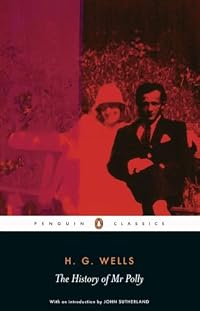
The History of Mr. Polly
by H. G. Wells
On This Page
Description
H. G. Wells' comic 1910 novel, The History of Mr. Polly, stars Alfred Polly, a timid man who is more successful at daydreaming than working in the local draper's shops. He marries a woman he's not really in love with, despite being in love with another, and together they attempt to create a success of their own shop while slowly making one another miserable. But on the night of a fire everything changes in Mr. Polly's life..
Tags
Recommendations






















Member Reviews
Mr Polly had been drinking at the poisoned fountains of English literature, fountains so unsuited to the needs of a decent clerk or shopman, fountains charged with the dangerous suggestion that it becomes a man of gaiety and spirit to make love gallantly and rather carelessly. (75-6)
This late H. G. Wells novel, like all his literary fictions, bears traces of Wells's own life. Mr Polly, like a young Mr Wells, is a draper's assistant and poorly suited to it. Unlike Mr Wells, Mr Polly never moves beyond this profession to which he is unsuited, eventually marrying one of his cousins because of his tendency to be a little too liberal in his lovemaking (all three of his female cousins are convinced that he loves and is going to marry them), show more and setting up a shop of his own. The narrator tells us that all Mr Polly gets out of fifteen years' work at the shop is £60-70 of debt because he is entirely unsuited to being a shopkeeper, and indeed, there probably shouldn't be so many shopkeepers to begin with. Like many members of the lower middle class, they do nothing for the functioning of society.
Wells being Wells, the solution to this all is social planning. There's a brief aside where we get to hear the thoughts of "a certain high-browed gentleman living at Highbury, wearing a golden pince-nez" (121), whose views are based on H. G. Wells's. This gentleman argues that when a society advances rapidly without conscious design, it's like "a man who takes no thought of dietary or regimen [...]. It accumulates useless and aimless lives, as a man accumulates fat and morbid products in his blood" (122). But this is, thankfully, a very small component of the book, which is much more interested in the particular than the general. The solution to the general problem might be the World State, but the solution to the particular problem is that Mr Polly tries to take his own life and burn down his house so his wife will get the insurance money. But in the excitement of it all, he forgets to slit his throat, and, well, his life can only get better from there.
John Sutherland's introduction calls The History of Mr Polly "a superbly funny novel" (xxvii), and I wouldn't go that far, but it does have a decent number of comic situations, and it elicited the occasional laugh for sure. Along with the opening chapters of The War in the Air, this is one of Wells's more humorous works. It's not deep, and I don't think Wells holds up as well as a writer of this sort of thing as some of his contemporaries, but it's diverting enough.
There's apparently a couple screen versions; I'll have to seek them out, as I feel like there's some good potential for visual comedy here, especially in the last quarter or so of the book. show less
This late H. G. Wells novel, like all his literary fictions, bears traces of Wells's own life. Mr Polly, like a young Mr Wells, is a draper's assistant and poorly suited to it. Unlike Mr Wells, Mr Polly never moves beyond this profession to which he is unsuited, eventually marrying one of his cousins because of his tendency to be a little too liberal in his lovemaking (all three of his female cousins are convinced that he loves and is going to marry them), show more and setting up a shop of his own. The narrator tells us that all Mr Polly gets out of fifteen years' work at the shop is £60-70 of debt because he is entirely unsuited to being a shopkeeper, and indeed, there probably shouldn't be so many shopkeepers to begin with. Like many members of the lower middle class, they do nothing for the functioning of society.
Wells being Wells, the solution to this all is social planning. There's a brief aside where we get to hear the thoughts of "a certain high-browed gentleman living at Highbury, wearing a golden pince-nez" (121), whose views are based on H. G. Wells's. This gentleman argues that when a society advances rapidly without conscious design, it's like "a man who takes no thought of dietary or regimen [...]. It accumulates useless and aimless lives, as a man accumulates fat and morbid products in his blood" (122). But this is, thankfully, a very small component of the book, which is much more interested in the particular than the general. The solution to the general problem might be the World State, but the solution to the particular problem is that Mr Polly tries to take his own life and burn down his house so his wife will get the insurance money. But in the excitement of it all, he forgets to slit his throat, and, well, his life can only get better from there.
John Sutherland's introduction calls The History of Mr Polly "a superbly funny novel" (xxvii), and I wouldn't go that far, but it does have a decent number of comic situations, and it elicited the occasional laugh for sure. Along with the opening chapters of The War in the Air, this is one of Wells's more humorous works. It's not deep, and I don't think Wells holds up as well as a writer of this sort of thing as some of his contemporaries, but it's diverting enough.
There's apparently a couple screen versions; I'll have to seek them out, as I feel like there's some good potential for visual comedy here, especially in the last quarter or so of the book. show less
“Hole! said Mr Polly, and then for a change and with greater emphasis “Ole!” He paused, and then broke out with some of his private and peculiar idioms. “Oh! Beastly Silly Wheeze of a Hole!”. Our first encounter with Mr Polly who is nearly at the end of his tether. He is an unhappy shopkeeper facing bankruptcy and has taken himself off after lunch to launch a tirade on the miserable world around him, suffering as he does every afternoon with indigestion. He hates his wife, he hates his neighbours and above all he hates his shop.
Published in 1910 The History of Mr Polly became one of H G Wells best loved novels. Graham Greene was in the habit of labelling his books either as novels or entertainments, if H G Well had done show more something similar Mr Polly would have been an entertainment. After the darkness of Ann Veronica (his previous novel) Wells again has written another book of social commentary, but this one hides any seriousness in the glorious comic figure of Mr Polly.
After our initial meeting with our hero, Wells then embarks on the History. Mr Polly’s education was a mess, he was not particularly intelligent and failed to grasp much of what he was taught, he liked to read and lost himself in adventure stories. He got an apprenticeship as a drapers assistant and his life in the shop would have been unending drudgery, but for his meeting up with two likeminded youths with an interest in books and all things literary. Mr Polly hides his lack of education by a sort of deliberate mispronunciation of words, which can be funny, but often serves to puzzle those around him. Wells has much fun with Mr Polly’s own peculiar language for example: thrusting competitors for jobs became the “Shoveacious Cult”. Mr Polly is the opposite to being a thrusting competitor, he has difficulty in rousing himself to do much that he doesn’t like and he soon loses his job when his apprenticeship is finished. “You have merely anti-separated me by a hair” Mr Polly said politely when he was being fired.
Unemployed and at a loose end he is saved temporarily from the rat race by the death of his father who has left him a little money. At the funeral he meets his three female cousins the Larkin girls.”Hen-witted Gigglers” and it soon becomes obvious that he will marry one of them, however he needs to do something with his fathers money to secure his livelihood and so he does what so many lower middle class people aspired to do in Edwardian times: He buys a little shop. He holds out from doing this as long as he can because he has an inkling it will be a prison sentence and that is just what it turns out to be. He has no aptitude for selling, he has no enthusiasm for his shop, and he soon falls out with his neighbours and is at war with the wife he has never loved. The reader has now caught up with Mr Polly on that fateful day after lunch when he puts the finishing touched to his plan to burn down his shop, cut his throat with a razor and incinerate himself. Mr Polly’s plan usually go astray and while he is successful in burning down his shop and many of his neighbours shops, he forgets to cut his throat.
While it is clear that Mr Polly has not the character to be a successful business man, it is also clear that being a small shop owner at the turn of the century was the undoing of many people. The big commercial concerns were beginning to cut the ground away from the owner occupiers and all of Mr Polly’s neighbouring shop owners were facing ruin. Wells can't help himself in pointing his finger at disorganised capitalism and an unplanned economy, but limits himself to a rant of only a couple of pages.
There are some marvellously funny set pieces in this book. Mr Polly’s fathers funeral where he becomes an instant hit with the Larkin girls, his meetings with Christabel the girl on top of the wall that surrounds her school with whom Mr Polly falls desperately in love, his own more than successful arson attack and finally the showdown with the diabolic Uncle Jim. All the while Mr Polly dreams of something better and embarks whenever he can on his ‘Exploratious menanderings “
In many ways this is one of H G Wells’ most thought through novels. He had previously demonstrated his ability to make his readers laugh in Kipps and The Invisible Man, but here he has created a comic figure with which many people can identify. Mr Polly does not set out to be funny but he undeniably is and when at the end of the novel he has fought his battles and come out; if not winning at least more content then we applaud. Wells’ message might be that you can change your world. A wonderful entertainment and a five star read. show less
Published in 1910 The History of Mr Polly became one of H G Wells best loved novels. Graham Greene was in the habit of labelling his books either as novels or entertainments, if H G Well had done show more something similar Mr Polly would have been an entertainment. After the darkness of Ann Veronica (his previous novel) Wells again has written another book of social commentary, but this one hides any seriousness in the glorious comic figure of Mr Polly.
After our initial meeting with our hero, Wells then embarks on the History. Mr Polly’s education was a mess, he was not particularly intelligent and failed to grasp much of what he was taught, he liked to read and lost himself in adventure stories. He got an apprenticeship as a drapers assistant and his life in the shop would have been unending drudgery, but for his meeting up with two likeminded youths with an interest in books and all things literary. Mr Polly hides his lack of education by a sort of deliberate mispronunciation of words, which can be funny, but often serves to puzzle those around him. Wells has much fun with Mr Polly’s own peculiar language for example: thrusting competitors for jobs became the “Shoveacious Cult”. Mr Polly is the opposite to being a thrusting competitor, he has difficulty in rousing himself to do much that he doesn’t like and he soon loses his job when his apprenticeship is finished. “You have merely anti-separated me by a hair” Mr Polly said politely when he was being fired.
Unemployed and at a loose end he is saved temporarily from the rat race by the death of his father who has left him a little money. At the funeral he meets his three female cousins the Larkin girls.”Hen-witted Gigglers” and it soon becomes obvious that he will marry one of them, however he needs to do something with his fathers money to secure his livelihood and so he does what so many lower middle class people aspired to do in Edwardian times: He buys a little shop. He holds out from doing this as long as he can because he has an inkling it will be a prison sentence and that is just what it turns out to be. He has no aptitude for selling, he has no enthusiasm for his shop, and he soon falls out with his neighbours and is at war with the wife he has never loved. The reader has now caught up with Mr Polly on that fateful day after lunch when he puts the finishing touched to his plan to burn down his shop, cut his throat with a razor and incinerate himself. Mr Polly’s plan usually go astray and while he is successful in burning down his shop and many of his neighbours shops, he forgets to cut his throat.
While it is clear that Mr Polly has not the character to be a successful business man, it is also clear that being a small shop owner at the turn of the century was the undoing of many people. The big commercial concerns were beginning to cut the ground away from the owner occupiers and all of Mr Polly’s neighbouring shop owners were facing ruin. Wells can't help himself in pointing his finger at disorganised capitalism and an unplanned economy, but limits himself to a rant of only a couple of pages.
There are some marvellously funny set pieces in this book. Mr Polly’s fathers funeral where he becomes an instant hit with the Larkin girls, his meetings with Christabel the girl on top of the wall that surrounds her school with whom Mr Polly falls desperately in love, his own more than successful arson attack and finally the showdown with the diabolic Uncle Jim. All the while Mr Polly dreams of something better and embarks whenever he can on his ‘Exploratious menanderings “
In many ways this is one of H G Wells’ most thought through novels. He had previously demonstrated his ability to make his readers laugh in Kipps and The Invisible Man, but here he has created a comic figure with which many people can identify. Mr Polly does not set out to be funny but he undeniably is and when at the end of the novel he has fought his battles and come out; if not winning at least more content then we applaud. Wells’ message might be that you can change your world. A wonderful entertainment and a five star read. show less
I read it a few times many years ago - so one of my favourites then. From long past the other side of 40 (Mr Polly's age half way through the book when his history finishes and the actual narrative resumes and about the age of Mr Wells when he wrote it) this is a really miserable and uncomfortable read. Enjoyable once Alfred Polly starts his adventures. Very strongly based inside Mr Polly's consciousness - the only other characters that have anything going on inside their head at all are his youthful friend Parsons, and Jim, the potential nemesis of the Pot Inn - no one else has any internal life. On the surface quite a simple tale - but the more you think about it the more complex it becomes. Have another 3/4 star.
https://nwhyte.livejournal.com/3752243.html
I have been curious about this book since I was ten. In the summer of 1977, Roy Castle did a series of children's programmes for the BBC on musicals, two of which particularly stuck with me: Salad Days, which had had a revival the previous year, and the last in the series, The History of Mr Polly. At the end of each episode, which was a synopsis of the plot with a few of the songs being performed, Roy Castle would tell us the production history of each musical's performances, except that in the case of Mr Polly, "There's only been one". Rather than in the West End, this was at the newly opened Churchill Theatre in Bromley, H.G. Wells' home town, starring Roy Castle himself in the title role and show more with some impressive firepower - script by (Lord) Ted Willis, music co-written by Ivor Slaney who did most of the Double Deckers music, directed by veteran TV director Wallace Douglas. But I don't think any of it survives beyond the printed programme leaflet, and apart from its being Wells' birthplace, Bromley, with all due respect, is an odd location for a stage show starring Roy Castle, then at the height of his powers.
Anyway, forty-four years on, I got the original novel. And I must say I was captivated. Very briefly, Mr Polly is a middle-class chap who makes bad choices in terms of career and marriage. At the start of the book he is consumed by frustration at his situation, and we spend the next few chapters exploring how precisely he got to where he is. He determines to burn down his own shop and commit suicide as it falls around him. But that does not go entirely according to plan, and he undergoes an improbable but really delightful redemption. I don't completely recommend it - I think Wells is laughing at his protagonist's pretensions a bit too much for my comfort - but I like this a lot more than Tono-Bungay, which is my only other non-sf Wells so far. show less
I have been curious about this book since I was ten. In the summer of 1977, Roy Castle did a series of children's programmes for the BBC on musicals, two of which particularly stuck with me: Salad Days, which had had a revival the previous year, and the last in the series, The History of Mr Polly. At the end of each episode, which was a synopsis of the plot with a few of the songs being performed, Roy Castle would tell us the production history of each musical's performances, except that in the case of Mr Polly, "There's only been one". Rather than in the West End, this was at the newly opened Churchill Theatre in Bromley, H.G. Wells' home town, starring Roy Castle himself in the title role and show more with some impressive firepower - script by (Lord) Ted Willis, music co-written by Ivor Slaney who did most of the Double Deckers music, directed by veteran TV director Wallace Douglas. But I don't think any of it survives beyond the printed programme leaflet, and apart from its being Wells' birthplace, Bromley, with all due respect, is an odd location for a stage show starring Roy Castle, then at the height of his powers.
Anyway, forty-four years on, I got the original novel. And I must say I was captivated. Very briefly, Mr Polly is a middle-class chap who makes bad choices in terms of career and marriage. At the start of the book he is consumed by frustration at his situation, and we spend the next few chapters exploring how precisely he got to where he is. He determines to burn down his own shop and commit suicide as it falls around him. But that does not go entirely according to plan, and he undergoes an improbable but really delightful redemption. I don't completely recommend it - I think Wells is laughing at his protagonist's pretensions a bit too much for my comfort - but I like this a lot more than Tono-Bungay, which is my only other non-sf Wells so far. show less
4.5 stars
I had never heard of this book before I stumbled upon it in an antique store. I don't like antique stores, but my husband does, so while I wait for him to finish shopping, I check out the disorganized shelf or two of books you can usually find in these places.
Something about this book drew my eye—maybe the combination of an author I'd heard of and a title I hadn't. I read the introduction by Sinclair Lewis and decided I should probably buy the book, never mind that my to-read list is well over 200, and that I don't often buy books.
I'm very glad I picked it up, because it was a lovely way to find out that H.G. Wells is my kind of writer. I must get to know him better.
Mr. Polly isn't a particularly interesting character at show more first, aside from his propensity to mispronounce and make up words. He's not really admirable either. The first few decades of his life are lived passively, or as he puts it later
Wells makes no apology for his protagonist, saying toward the end of the book
There are 10 long chapters in this book. I think of them more as sections, and I admit I was not enamored of the story at the beginning as much as I was with the clever writing. The story gets better as it builds up steam, and I loved the 9th chapter, which I thought had the funniest passages. There were times the descriptions sounded a bit like P.G. Wodehouse, and I dearly love Wodehouse. This one is probably the best example-a description of ducklings in the garden.
I'm curious about the author's motivation for writing a novel about a character like Mr. Polly. He never really reforms as much as finds a habitat that suits him. The character's path to achieving this must have been controversial back when this was written.
Regardless of what was behind it, this was a swell book, and I look forward to reading more by this author. show less
I had never heard of this book before I stumbled upon it in an antique store. I don't like antique stores, but my husband does, so while I wait for him to finish shopping, I check out the disorganized shelf or two of books you can usually find in these places.
Something about this book drew my eye—maybe the combination of an author I'd heard of and a title I hadn't. I read the introduction by Sinclair Lewis and decided I should probably buy the book, never mind that my to-read list is well over 200, and that I don't often buy books.
I'm very glad I picked it up, because it was a lovely way to find out that H.G. Wells is my kind of writer. I must get to know him better.
Mr. Polly isn't a particularly interesting character at show more first, aside from his propensity to mispronounce and make up words. He's not really admirable either. The first few decades of his life are lived passively, or as he puts it later
I've never really planned my life or set out to live. I happened; things happened to me.
Wells makes no apology for his protagonist, saying toward the end of the book
This is a history and not a glorification of Mr. Polly, and I tell things as they were with him.
There are 10 long chapters in this book. I think of them more as sections, and I admit I was not enamored of the story at the beginning as much as I was with the clever writing. The story gets better as it builds up steam, and I loved the 9th chapter, which I thought had the funniest passages. There were times the descriptions sounded a bit like P.G. Wodehouse, and I dearly love Wodehouse. This one is probably the best example-a description of ducklings in the garden.
They were piping about among the vegetables...and as he and the plump woman came down the garden path, the little creatures mobbed them, and ran over their boots and in between Mr. Polly's legs, and did their best to be trodden upon and killed after the manner of ducklings all the world over.
I'm curious about the author's motivation for writing a novel about a character like Mr. Polly. He never really reforms as much as finds a habitat that suits him. The character's path to achieving this must have been controversial back when this was written.
Regardless of what was behind it, this was a swell book, and I look forward to reading more by this author. show less
I read this not long after reading Orwell's Coming Up For Air. This one is a much better novel, but they're interesting as two books about very similar characters in very similar circumstances; in the wrong class in Britain at the wrong time, badly educated, badly married, dreams lost, no real prospects or hopes or pleasure left in life when the books begin. Wells is much more subtle about the blind ignorant ways in which people can make themselves miserable themselves in life, and get what they put out.
Also, in this one, the author has sympathy for his protagonist, warts and all, and he shows the internal forces shaping his life just as strongly as the external. Nobody in it is a simple caricature. And it is funny. I don't think I ever show more laughed out loud, but I was smiling a lot, and wincing too. The story is slower at first, and then starts leaping along in all kinds of startling and funny ways. The fire chapter is well worth the price of admission all by itself. show less
Also, in this one, the author has sympathy for his protagonist, warts and all, and he shows the internal forces shaping his life just as strongly as the external. Nobody in it is a simple caricature. And it is funny. I don't think I ever show more laughed out loud, but I was smiling a lot, and wincing too. The story is slower at first, and then starts leaping along in all kinds of startling and funny ways. The fire chapter is well worth the price of admission all by itself. show less
Mr Polly comes from a beautifully delineated and described Edwardian world, of bicycling, picnics, tea shops and front parlours, plate glass windows, small retailers and half day closing. But his struggle - of a man who yearns inarticulately (or over articulately in Mr Polly's case) for something better and beyond a life of struggling, indigestion and unhappiness - is much more universal. Wells tells us that it is possible to change our lot, even if it requires slaying dragons, and even if it's not what we intended at the time. Mr Polly's travails may be funny and bathetic, and his triumph resolutely small scale, but Wells creates an unlikely hero and everyman in the Potwell Inn's potboy.
Members
- Recently Added By
Lists

The Guardian's 1000 Novels Everyone Must Read
1,005 works; 549 members

wilfully eccentric little england (cosy read novels, england)
45 works; 15 members

The Guardian's 100 Best Novels Written in English
105 works; 13 members

A Novel Cure
742 works; 23 members

Trinity College Booklist (1951): Class Ten, English Literature
358 works; 5 members
Author Information

1,543+ Works 108,527 Members
H. G. Wells was born in Bromley, England on September 21, 1866. After a limited education, he was apprenticed to a draper, but soon found he wanted something more out of life. He read widely and got a position as a student assistant in a secondary school, eventually winning a scholarship to the Royal College of Science in South Kensington, where show more he studied biology. He graduated from London University in 1888 and became a science teacher. He also wrote for magazines. When his stories began to sell, he left teaching to write full time. He became an author best known for science fiction novels and comic novels. His science fiction novels include The Time Machine, The War of the Worlds, The Wonderful Visit, The Island of Doctor Moreau, The Invisible Man, The First Men in the Moon, and The Food of the Gods. His comic novels include Love and Mr. Lewisham, Kipps: The Story of a Simple Soul, The History of Mr. Polly, and Tono-Bungay. He also wrote several short story collections including The Stolen Bacillus, The Plattner Story, and Tales of Space and Time. He died on August 13, 1946 at the age of 79. (Bowker Author Biography) show less
Some Editions
Awards and Honors
Notable Lists
Series
Belongs to Publisher Series
Work Relationships
Is contained in
Has as a reference guide/companion
Has as a student's study guide
Common Knowledge
- Canonical title
- The History of Mr. Polly
- Original publication date
- 1910
- People/Characters
- Mr. Alfred Polly; Uncle Jim
- Important places
- Fishbourne, England, UK; England, UK
- Related movies
- The History of Mr. Polly (1949 | IMDb); The History of Mr Polly (1959 | IMDb); The History of Mr. Polly (1980 | IMDb); The History of Mr Polly (2007 | IMDb)
- First words
- 'Hole!' said Mr Polly, and then for a change, and with greatly increased emphasis: ''Ole!'
- Last words
- (Click to show. Warning: May contain spoilers.)“Time we was going in, O’ Party,” said Mr. Polly, standing up.
“Supper to get. It’s as you say, we can’t sit here for ever.”
Classifications
Statistics
- Members
- 918
- Popularity
- 28,940
- Reviews
- 26
- Rating
- (3.62)
- Languages
- 6 — English, French, German, Hungarian, Italian, Swedish
- Media
- Paper, Audiobook, Ebook
- ISBNs
- 111
- UPCs
- 1
- ASINs
- 59