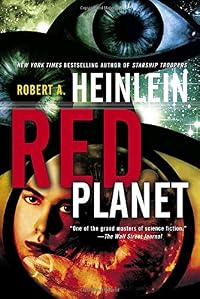
There is 1 current discussion about this work.
On This Page
Description
Jim Marlow and his strange-looking Martian friend Willis were allowed to travel only so far. But one day Willis unwittingly tuned into a treacherous plot that threatened all the colonists on Mars, and it set Jim off on a terrfying adventure that could save--or destroy--them all!From the Paperback edition.
.
Tags
Recommendations





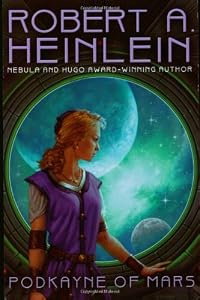





Member Recommendations
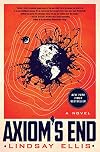
AuthorSSD If you like human and alien interaction, and an exploration of what it means when humans and aliens communicate with one another and try to understand each other while uncovering conspiracies, but wanted more of that in Red Planet, I feel like Axiom's End will scratch that itch just right. While set in the mid 2000s on Earth, I feel like Axiom's End handles human/alien communications and the conspiracies within the story a lot stronger in a way that a juvenile book like Red Planet might not have gotten to because of it's primary audience.
Member Reviews
https://fromtheheartofeurope.eu/red-planet-by-robert-a-heinlein/
Published in 1949, this was a book that I greatly enjoyed as a young reader, one of Heinlein’s successful juvenile series. The protagonist is a lad in the human colony on Mars, attending a military boarding school where he discovers a fiendish plot by the Earth-based rulers to destroy the colonists. Aided by his Martian pet, and by the mysterious giant Martians themselves, he gets home via the canals and other Martian tech, raises the alarm and helps his family and the rest of the colony defeat the evil administrators, who are apparently eaten by the Martians.
It’s a very male book; the protagonist and his buddy, and their fathers and a wise old doctor, carry most of the show more narrative, with some dialogue from mothers and a bratty sister. It’s a very pro-gun book; the colonists’ equivalent of Second Amendment rights are taken as obvious common sense (and of course crucial in the uprising). The colonists’ mission is explicitly colonial; no questions are asked about the fate of the Martians once humans spread out over the planet.
And yet there’s still a very attractive sensawunda about it, a feeling of estrangement from Earth and awe at the ancient mysteries and dangers of a new world, and arid landscapes not quite like the American West. Some of the magic remains for me, though perhaps not quite enough for me to recommend it to readers of the same age as I was when I first read it. show less
Published in 1949, this was a book that I greatly enjoyed as a young reader, one of Heinlein’s successful juvenile series. The protagonist is a lad in the human colony on Mars, attending a military boarding school where he discovers a fiendish plot by the Earth-based rulers to destroy the colonists. Aided by his Martian pet, and by the mysterious giant Martians themselves, he gets home via the canals and other Martian tech, raises the alarm and helps his family and the rest of the colony defeat the evil administrators, who are apparently eaten by the Martians.
It’s a very male book; the protagonist and his buddy, and their fathers and a wise old doctor, carry most of the show more narrative, with some dialogue from mothers and a bratty sister. It’s a very pro-gun book; the colonists’ equivalent of Second Amendment rights are taken as obvious common sense (and of course crucial in the uprising). The colonists’ mission is explicitly colonial; no questions are asked about the fate of the Martians once humans spread out over the planet.
And yet there’s still a very attractive sensawunda about it, a feeling of estrangement from Earth and awe at the ancient mysteries and dangers of a new world, and arid landscapes not quite like the American West. Some of the magic remains for me, though perhaps not quite enough for me to recommend it to readers of the same age as I was when I first read it. show less
It's a bit of a slow burn, and the real plot that kicks in (when Jimmy has Willis stolen away from him and learns of a conspiracy that would harm the human colonists of Mars in the process of trying to get Willis back) could've used a lot more elaboration and exploration? But this is a book intended for juveniles and that could've played a role in it not getting explored as much (which could've been something that lead Heinlein to writing adult sci-fi in the future). The survival/exploration segments are pretty good, and it's also refreshing to see a child or young teen protagonist actually getting taken seriously by the adults in his community rather than shunned or misunderstood in the name of drama! And this book was originally show more written in the 60s?! We definitely don't see a lot of that today, in an era where third act misunderstandings will make a lot of audiences groan because of how much the trope is overused...
Though in addition to wishing the conspiracy aspect of the story was explored more (we get more details about how the colonists of Mars fight against it in that child-friendly government resistance sort of way), I wish we got to know more about Willis in detail - and the book even feels like it ends just as we're getting to know more about Willis and what they are, how they may differ from other Martians, and just how their relationship with the human Jimmy has changed them.
It really is cute seeing their friendship since Willis isn't just a native Martian alien, but essentially acts like a pet, all while Jimmy insists that Willis isn't a pet, but his friend, and a person worth caring about. But toward the end there are implications of Willis being special even among the Martians, but because that's at the tail end of the book, we don't see a lot of it. Even the way Willis and Jimmy bond take a bit of a backseat when compared to when the story gets all survivalist fugitive on you, but what we do see is nice: clearly this is an alien and human pair who really trust each other, and you understand why Willis sticks with Jimmy at all. They're absolutely ride or die friends despite being two different species.
Overall, I'd like more fiction like this in the hands of a different writer who could explore the themes of this story in more detail, while still taking the young characters seriously (not making them, or the adults around them stupid for the sake of drama), and I want more cool alien/human friendships! It's not terrible, but will leave you wanting more - and it makes me see why Heinlein went on to write adult sci-fi instead, since he got to explore far more. Though it's also a shame that the adult sci-fi portion of his career focused so heavily on space politics, sex, violence and the complexities of adult life, and didn't revisit the simpler concept of a human and their alien friend from a more mature lens! show less
Though in addition to wishing the conspiracy aspect of the story was explored more (we get more details about how the colonists of Mars fight against it in that child-friendly government resistance sort of way), I wish we got to know more about Willis in detail - and the book even feels like it ends just as we're getting to know more about Willis and what they are, how they may differ from other Martians, and just how their relationship with the human Jimmy has changed them.
It really is cute seeing their friendship since Willis isn't just a native Martian alien, but essentially acts like a pet, all while Jimmy insists that Willis isn't a pet, but his friend, and a person worth caring about. But toward the end there are implications of Willis being special even among the Martians, but because that's at the tail end of the book, we don't see a lot of it. Even the way Willis and Jimmy bond take a bit of a backseat when compared to when the story gets all survivalist fugitive on you, but what we do see is nice: clearly this is an alien and human pair who really trust each other, and you understand why Willis sticks with Jimmy at all. They're absolutely ride or die friends despite being two different species.
Overall, I'd like more fiction like this in the hands of a different writer who could explore the themes of this story in more detail, while still taking the young characters seriously (not making them, or the adults around them stupid for the sake of drama), and I want more cool alien/human friendships! It's not terrible, but will leave you wanting more - and it makes me see why Heinlein went on to write adult sci-fi instead, since he got to explore far more. Though it's also a shame that the adult sci-fi portion of his career focused so heavily on space politics, sex, violence and the complexities of adult life, and didn't revisit the simpler concept of a human and their alien friend from a more mature lens! show less
I never read any of the Heinlein juveniles when I was growing up (that I recall, anyway). And not many Heinlein books are available as e-books. But this one was, so I plunged in with relish. I wasn't disappointed, because it was exactly what I had always heard RAH's juvenile works described as.
This book was first published in 1949 and is set in some unnamed year in the future. What I found intriguing and jarring was not the overcome-by-time science (intelligent Martians, canals filled with ice, enough air pressure to forgo pressure suits) but rather the communications and entertainment technology that was still stuck in the 40s. Colonists have to wait for Deimos to be in the sky to relay radio signals, because there are no show more communication satellites. (I guess Arthur Clarke hadn't predicted them yet.) Phones are attached to buildings. The teenagers don't carry their music with them. All of these changes are relatively recent, and yet are so fundamental to how we live today that RAH's future world seems positively primitive.
But that's part of the fun of reading old SF: both seeing what was predicted that didn't come true and seeing what did come true that was completely unforeseen. I can simultaneously satisfy the hungry-for-wonder child within meand the somewhat cynical adult I have (somewhat regretfully) become. show less
This book was first published in 1949 and is set in some unnamed year in the future. What I found intriguing and jarring was not the overcome-by-time science (intelligent Martians, canals filled with ice, enough air pressure to forgo pressure suits) but rather the communications and entertainment technology that was still stuck in the 40s. Colonists have to wait for Deimos to be in the sky to relay radio signals, because there are no show more communication satellites. (I guess Arthur Clarke hadn't predicted them yet.) Phones are attached to buildings. The teenagers don't carry their music with them. All of these changes are relatively recent, and yet are so fundamental to how we live today that RAH's future world seems positively primitive.
But that's part of the fun of reading old SF: both seeing what was predicted that didn't come true and seeing what did come true that was completely unforeseen. I can simultaneously satisfy the hungry-for-wonder child within meand the somewhat cynical adult I have (somewhat regretfully) become. show less
Another Heinlein I read decades ago when I was a callow youth. I remembered it as a ripping boy's adventure with an interesting alien life form whose life cycle is the major mcguffin in the book. The copy I read recently was a newer edition which restored the cuts made by Heinlein's editor at Scribner's, but didn't find the restored text added much to the novel. I had not remembered how political this novel was from my first reading, so perhaps some of the politics were cut from the first published text. Anyway, it is still a good adventure story, although our knowledge of conditions on Mars has reached the point where this is an alternate universe or even fantasy novel rather than hard science fiction. It is odd to read about canals show more with ice and seasonal flowing water and vegetation when our contemporary image of Mars is of a dry planet. show less
Ohh, Willis! How little we know about you and your fellow Martians! I read this story through in one sitting. It's that good. The only hint at Heinlein's future explosive perversity in the book are the two clergymen that share a house. His readers will find the allusion entertaining. The characters are beautifully and simply woven. The antiquarians will find the boys manner of speaking quite retronique. Doc MacRae is my favorite character; and I believe Heinlein has shown the most of himself in this character. Solipsism is a beautiful philosophy. You will find Doc's hatred of "progression" to be most eloquently stated. The story is about 2 boys who hail from a Martian colony--the head of which is one of them's father. Bureaucratic Earth show more is struggling for control over these untamed revolutionaries who have taken a "manifest destiny" approach to Mars. Think of them as the blaster wielding Libertarians of the future. They share the mostly unexplored-as-of-yet Mars with various native creatures--the most interesting being the mysterious giant tripodal Martians who dwell deep within their ancient and emptied cities, and strange fluff-ball creatures called "bouncers". By the end of the book Heinlein has shown us an extrordinary alien civilization, an emancipated Human-Martian colony, and the fall of the corrupt incestual elite powers of Earth. Inbetween is a grand adventure. show less
Another enjoyable coming-of-age SF story, although this one has more problems than Space Cadet.
On the plus side, there's an enigmatic alien race (the Martians), quite different from humans, and the greatest pet ever, the Martian bouncer called Willis. As usual, the main character is a teenage boy, Jim Marlowe. Jim's parents are among the first human settlers of Mars. Willis is a semi-intelligent Martian creature who has the ability to replay the sounds it hears, sometimes creating mayhem (it reminded me of Kiki the parrot, from Enid Blyton's Adventure series, only even worse).
Unlike Space Cadet, where the authority figures are mostly benign, here when Jim and his friend Frank are sent to a more important settlement to attend school, show more they find some rather nasty characters in charge. Soon there's going to be a clash between the interests of the settlers and the colonial administrators.
As an SF novel, it probably has more elements of interest than Space Cadet (the Martians in Red Planet are more interesting than the Venusians in Space Cadet). There is also a lot of adventure.
However, there are some problems. The dated technology is more noticeable here: there's a plot point related to the inability to maintain communications between settlements unless the Deimos station is visible in Mars' sky. Obviously Heinlein here had not yet heard about geosynchronous satellites (another SF writer, Arthur C. Clarke, had been the first to suggest the idea in a paper published in 1945). Also, the sexism is more noticeable here, with a few comments regarding how women's role is to cook and have children, rather than fight and have adventures. The villains are probably too "villainous" to be realistic. Finally, the Martians serve as a "deus ex machina", often saving the day instead of letting the characters deal with the consequences of their sometimes too hasty decisions.
If one is able to look past those flaws, we are left with a solid YA adventure, some nice science-fictional ideas and an interesting plot revolving around the conflict of interests between settlers and colonial authorities.
The version I read was the one Heinlein wrote, and there were some notes about how the original publisher had censored and changed some parts, since they feared that as Heinlein wrote it there might be some resistance from the librarians that would make a good portion of the intended buyers. show less
On the plus side, there's an enigmatic alien race (the Martians), quite different from humans, and the greatest pet ever, the Martian bouncer called Willis. As usual, the main character is a teenage boy, Jim Marlowe. Jim's parents are among the first human settlers of Mars. Willis is a semi-intelligent Martian creature who has the ability to replay the sounds it hears, sometimes creating mayhem (it reminded me of Kiki the parrot, from Enid Blyton's Adventure series, only even worse).
Unlike Space Cadet, where the authority figures are mostly benign, here when Jim and his friend Frank are sent to a more important settlement to attend school, show more they find some rather nasty characters in charge. Soon there's going to be a clash between the interests of the settlers and the colonial administrators.
As an SF novel, it probably has more elements of interest than Space Cadet (the Martians in Red Planet are more interesting than the Venusians in Space Cadet). There is also a lot of adventure.
However, there are some problems. The dated technology is more noticeable here: there's a plot point related to the inability to maintain communications between settlements unless the Deimos station is visible in Mars' sky. Obviously Heinlein here had not yet heard about geosynchronous satellites (another SF writer, Arthur C. Clarke, had been the first to suggest the idea in a paper published in 1945). Also, the sexism is more noticeable here, with a few comments regarding how women's role is to cook and have children, rather than fight and have adventures. The villains are probably too "villainous" to be realistic. Finally, the Martians serve as a "deus ex machina", often saving the day instead of letting the characters deal with the consequences of their sometimes too hasty decisions.
If one is able to look past those flaws, we are left with a solid YA adventure, some nice science-fictional ideas and an interesting plot revolving around the conflict of interests between settlers and colonial authorities.
The version I read was the one Heinlein wrote, and there were some notes about how the original publisher had censored and changed some parts, since they feared that as Heinlein wrote it there might be some resistance from the librarians that would make a good portion of the intended buyers. show less
It's fascinating to read Heinlein's juveniles again after so many years have gone by. I read this as a young teen, and again perhaps 15 years ago. I was very struck by the libertarian views, particularly after the 2012 election. Heinlein has lots to say on second amendment rights--probably why he set so many of his stories on the "frontier" (the last frontier, anyway.) It was his views on education and schoolteachers that I winced over the most.
I found I had also sort of blanked out the ways male & female characters interact, too. Red Planet has only a few female characters, very few of whom are more than two dimensional sketches: the annoying younger sister, the sweet mom, the snobby neighbor, etc. It's not like Heinlein COULDN'T show more create good female characters for younger readers: Betty in Star Beast, Hazel in The Rolling Stones. I suppose he was very focused on his perceived audience (male teens) or perhaps he was focused on what he thought bookstores and librarians perceived as his audience.
Verdict: I'd rather reread Star Beast. show less
I found I had also sort of blanked out the ways male & female characters interact, too. Red Planet has only a few female characters, very few of whom are more than two dimensional sketches: the annoying younger sister, the sweet mom, the snobby neighbor, etc. It's not like Heinlein COULDN'T show more create good female characters for younger readers: Betty in Star Beast, Hazel in The Rolling Stones. I suppose he was very focused on his perceived audience (male teens) or perhaps he was focused on what he thought bookstores and librarians perceived as his audience.
Verdict: I'd rather reread Star Beast. show less
Members
- Recently Added By
Lists

Gateway Book: Science Fiction
21 works; 26 members

Best Young Adult
399 works; 101 members

Books Read in 2015
3,298 works; 126 members

Books Read in 2024
4,623 works; 126 members
Talk Discussions
Current Discussions
Heinlein didn't deserve this in Good Show Sir! — bad science fiction and fantasy covers (July 2025)
Author Information

459+ Works 173,816 Members
Robert Anson Heinlein was born on July 7, 1907 in Butler, Mo. The son of Rex Ivar and Bam Lyle Heinlein, Robert Heinlein had two older brothers, one younger brother, and three younger sisters. Moving to Kansas City, Mo., at a young age, Heinlein graduated from Central High School in 1924 and attended one year of college at Kansas City Community show more College. Following in his older brother's footsteps, Heinlein entered the Navel Academy in 1925. After contracting pulmonary tuberculosis, of which he was later cured, Heinlein retired from the Navy and married Leslyn MacDonald. Heinlein was said to have held jobs in real estate and photography, before he began working as a staff writer for Upton Sinclair's EPIC News in 1938. Still needing money desperately, Heinlein entered a writing contest sponsored by the science fiction magazine Thrilling Wonder Stories. Heinlein wrote and submitted the story "Life-Line," which went on to win the contest. This guaranteed Heinlein a future in writing. Using his real name and the pen names Caleb Saunders, Anson MacDonald, Lyle Monroe, John Riverside, and Simon York, Heinlein wrote numerous novels including For Us the Living, Methuselah's Children, and Starship Troopers, which was adapted into a big-budget film for Tri-Star Pictures in 1997. The Science Fiction Writers of America named Heinlein its first Grand Master in 1974, presented 1975. Officers and past presidents of the Association select a living writer for lifetime achievement. Also, the Science Fiction and Fantasy Hall of Fame inducted Heinlein in 1998. Heinlein died in 1988 from emphysema and other related health problems. Heinlein's remains were scattered from the stern of a Navy warship off the coast of California. (Bowker Author Biography) show less
Some Editions
Awards and Honors
Awards
Series

Belongs to Publisher Series
Work Relationships
Is contained in
Has as a study
Common Knowledge
- Canonical title*
- Der Rote Planet
- Original title
- Red Planet
- Original publication date
- 1949
- People/Characters
- Jim Marlowe; Frank Sutton; Willis the Bouncer; Mr. Howe; Beecher; Gekko (show all 7); Doctor MacRae
- Important places
- Mars
- Related movies
- Red Planet (1994 | IMDb)
- Dedication
- For Tish
- First words
- The thin air of Mars was chill but not really cold.
- Last words
- (Click to show. Warning: May contain spoilers.)I wish I knew.
- Original language
- English
*Some information comes from Common Knowledge in other languages. Click "Edit" for more information.
Classifications
Statistics
- Members
- 2,608
- Popularity
- 7,178
- Reviews
- 36
- Rating
- (3.66)
- Languages
- 9 — Czech, Dutch, English, German, Italian, Norwegian (Bokmål), Portuguese, Swedish, Turkish
- Media
- Paper, Audiobook, Ebook
- ISBNs
- 39
- ASINs
- 30