The Sand Reckoner of Archimedes
by Archimedes
On This Page
Description
THE CLASSIC WORK OF ARCHIMEDES The Sand-Reckoner Dimensio Circuli of Archimedes Translated by Thomas L. Heath (Original publication: Cambridge University Press, 1897). The Sand Reckoner is a work by Archimedes in which he set out to determine an upper bound for the number of grains of sand that fit into the universe. In order to do this, he had to estimate the size of the universe according to the contemporary model, and invent a way to talk about extremely large numbers. The work, also show more known in Latin as Archimedis Syracusani Arenarius and Dimensio Circuli, which is about 8 pages long in translation, is addressed to the Syracusan king Gelo II (son of Hiero II), and is probably the most accessible work of Archimedes; in some sense, it is the first research-expository paper. Archimedes died during the Siege of Syracuse when he was killed by a Roman soldier despite orders that he should not be harmed. Cicero describes visiting the tomb of Archimedes, which was surmounted by a sphere and a cylinder, which Archimedes had requested to be placed on his tomb, representing his mathematical discoveries.Unlike his inventions, the mathematical writings of Archimedes were little known in antiquity. Mathematicians from Alexandria read and quoted him, but the first comprehensive compilation was not made until c. 530 AD by Isidore of Miletus in Byzantine Constantinople, while commentaries on the works of Archimedes written by Eutocius in the sixth century AD opened them to wider readership for the first time. The relatively few copies of Archimedes' written work that survived through the Middle Ages were an influential source of ideas for scientists during the Renaissance, while the discovery in 1906 of previously unknown works by Archimedes in the Archimedes Palimpsest has provided new insights into how he obtained mathematical results. show lessTags
Members
- Recently Added By
Lists

How to Read a Book's Recommended Reading List
309 works; 10 members
Author Information

74+ Works 949 Members
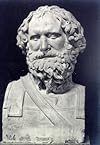
Archimedes was a mathematician and inventor, born in Syracuse, Sicily, about 287 B.C. He became famous for his law of the lever and for inventing the catapult, parabolic mirror, and the mechanical crane that was capable of capsizing a ship by overturning it. These inventions were designed to defend Syracuse during the Second Punic War, which were show more waged between Rome and Carthage. While Archimedes made fundamental contributions to physics, his greatest contributions were to theoretical mathematics. Some of his works have come down to us. When Syracuse was taken in 212 B.C., Archimedes was killed by the Roman soldiers, being at the time intent upon a mathematical problem. show less
Work Relationships
Classifications
- Genres
- Nonfiction, Philosophy
- LCC
- QA31 .A71 — Science Mathematics Mathematics General
- BISAC
Statistics
- Members
- 14
- Popularity
- 1,670,916
- Languages
- English
- Media
- Paper, Ebook
- ISBNs
- 3
- ASINs
- 1