
Jim Malusa
Author of Into Thick Air: Biking to the Bellybutton of Six Continents
Works by Jim Malusa
Tagged
Common Knowledge
- Gender
- male
Members
Reviews
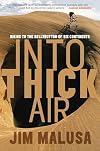
"Of course I'm happy just to get through the morning without being pelted with rocks," Jim Malusa wrote the day after repeated attacks from "forty-pound children with stones" -- children who reminded him of those in The Lord of the Flies. The experience, along with warnings given by others, left him with the nagging feeling that "pedaling a bike through Djibouti is a ridiculous way to suffer voluntarily."
But his Djibouti trip wasn't all suffering. He saw remarkable landscapes and met show more interesting people who generously took him into their homes and shared meals and conversation.
Djibouti was part of an unusual quest for Malusa. All adventurers seek novelty. They plunge into an unexplored wilderness; traverse a continent on foot or an ocean in a rowboat; hand-climb an untouched rock formation or glide solo around the world in a sailboat ... or a balloon. Mountaineers collect summits. The Seven Summits, a well-known term in mountaineering circles, describes the quest to ascend the highest peaks on all seven continents.
Jim Malusa did the opposite. He set out to reach the lowest point on each continent. The belly buttons. The Six Pits. But his book, Into Thick Air, is more a travelogue than an adventurer struggling against the odds. Instead of facing frostbite or possible missteps on high peaks, he sought "some place warm. Some place I can ride my bike."
He might have reached his goal easily enough. Almost all the world's low points are accessible. Tourists drive to the Dead Sea every day. People live in Death Valley. But Malusa specifically planned his bike routes to steer him into interesting places and increase his encounters with a variety of people. The belly buttons were not so much goals to achieve as they were devices to interact with people in places seldom visited by Westerners. Riding a slow-moving bicycle gave him the opportunity to soak up the scenery, stop in every town, and meet the locals in lands unaccustomed to such outside attention. In this way, the chapters in his book roll along.
Riding alone and exposed on a bicycle in unfamiliar territory, of course, made him feel vulnerable, too. He feared the Djibouti kids with rocks, but also bandits in South America, and animals in Australia. He camped outside in the cold, rode in searing desert heat, faced strong Patagonian winds, and fussed with border patrol bureaucracy: "You cannot bring a bicycle into Jordan."
His greatest successes involved people. Malusa managed to strike up conversations with people living lives and holding perspectives far different than his own. They seemed drawn to him, too. Many had never left their native lands and were eager to know about the greater world or to travel as he was doing. Everyone seemed willing to chat or, in the case of two men in Argentina, stop their truck suddenly to tackle an armadillo.
At times I bristled at the curious routes Malusa planned (biking to the Dead Sea by way of Cairo?), but his observant and very descriptive writing made the biking travelogue enjoyable. And although he's not as consistently funny as Bill Bryson (author of A Walk in the Woods and Notes from a Small Island among others), Malusa's humor shows up regularly. This was an enjoyable book.
By the way: The book title is an obvious counterplay to Jon Krakauer's tragic adventure classic Into Thin Air: thin air up at Everest, thick air down in Death Valley.
Find more of my reviews at Mostly NF. show less
But his Djibouti trip wasn't all suffering. He saw remarkable landscapes and met show more interesting people who generously took him into their homes and shared meals and conversation.
Djibouti was part of an unusual quest for Malusa. All adventurers seek novelty. They plunge into an unexplored wilderness; traverse a continent on foot or an ocean in a rowboat; hand-climb an untouched rock formation or glide solo around the world in a sailboat ... or a balloon. Mountaineers collect summits. The Seven Summits, a well-known term in mountaineering circles, describes the quest to ascend the highest peaks on all seven continents.
Jim Malusa did the opposite. He set out to reach the lowest point on each continent. The belly buttons. The Six Pits. But his book, Into Thick Air, is more a travelogue than an adventurer struggling against the odds. Instead of facing frostbite or possible missteps on high peaks, he sought "some place warm. Some place I can ride my bike."
He might have reached his goal easily enough. Almost all the world's low points are accessible. Tourists drive to the Dead Sea every day. People live in Death Valley. But Malusa specifically planned his bike routes to steer him into interesting places and increase his encounters with a variety of people. The belly buttons were not so much goals to achieve as they were devices to interact with people in places seldom visited by Westerners. Riding a slow-moving bicycle gave him the opportunity to soak up the scenery, stop in every town, and meet the locals in lands unaccustomed to such outside attention. In this way, the chapters in his book roll along.
Riding alone and exposed on a bicycle in unfamiliar territory, of course, made him feel vulnerable, too. He feared the Djibouti kids with rocks, but also bandits in South America, and animals in Australia. He camped outside in the cold, rode in searing desert heat, faced strong Patagonian winds, and fussed with border patrol bureaucracy: "You cannot bring a bicycle into Jordan."
His greatest successes involved people. Malusa managed to strike up conversations with people living lives and holding perspectives far different than his own. They seemed drawn to him, too. Many had never left their native lands and were eager to know about the greater world or to travel as he was doing. Everyone seemed willing to chat or, in the case of two men in Argentina, stop their truck suddenly to tackle an armadillo.
At times I bristled at the curious routes Malusa planned (biking to the Dead Sea by way of Cairo?), but his observant and very descriptive writing made the biking travelogue enjoyable. And although he's not as consistently funny as Bill Bryson (author of A Walk in the Woods and Notes from a Small Island among others), Malusa's humor shows up regularly. This was an enjoyable book.
By the way: The book title is an obvious counterplay to Jon Krakauer's tragic adventure classic Into Thin Air: thin air up at Everest, thick air down in Death Valley.
Find more of my reviews at Mostly NF. show less
Very interesting and entertaining, a little light weight, but not in a bad way. 3¾ stars?
Often times the problem with books like this is the writer stretching it out too far, or getting in to way more detail than you want to know. I had the opposite problem here; he makes all these interesting trips, and I wanted to know more. It’s understandable though, there is a theme and a goal, and they probably didn’t want to put out a 1500 page book. Many people would have made one of these trips show more and made a whole book about it, half of them would have been a good amount of detail, but at least it stays interesting. He’s a good writer, funny and thoughtful, and I would probably read the 1500 page version. show less
Often times the problem with books like this is the writer stretching it out too far, or getting in to way more detail than you want to know. I had the opposite problem here; he makes all these interesting trips, and I wanted to know more. It’s understandable though, there is a theme and a goal, and they probably didn’t want to put out a 1500 page book. Many people would have made one of these trips show more and made a whole book about it, half of them would have been a good amount of detail, but at least it stays interesting. He’s a good writer, funny and thoughtful, and I would probably read the 1500 page version. show less
Intermittently interesting and stultifying. I would have enjoyed this much more as it was originally published- as a set of six widely separated essays- rather than as a whole book. Malusa has an interesting authorial voice, but he's all over the map- one paragraph talking about the history of the place he's in, then next paragraph ruminating on his family back home, then on to something else.
My mom loves this, I suppose because it's adventure & courage, and good writing.?á I enjoyed it too, but can't recommend it to *everyone.*?á I do recommend you read it if it intrigues you.?á I will tell you something the author didn't, which I think is relevant.?á Almost all of his adventures took place in the years *before* the Twin Towers fell.?á Now, how much does that date the book??á Probably less than you'd imagine.?á How much does that make the book irrelevant??á show more Not at all.
Travel, adventure, geology, biology, anthropology, humor....?á The book does have something for almost everyone.?á I liked learning things - for example, crocodiles and similar critters have a trick nostril-to-lung passage that allows them to breathe when their mouth is *open* underwater." (emphasis mine)?á I also liked the light humor that shows up in both anecdotes (how the frustrations of dealing with bureaucrats are funny in hindsight) and in wit & word-play.
One of the most engaging things about the book is just how different the world looks from the perspective of one person on a bicycle.?á Prejudices against American men were muted because Malusa travelled so lightly; he was not seen as aggressive, arrogant, or any other Ugly American way.
I will try to make time to visit the companion website." show less
Travel, adventure, geology, biology, anthropology, humor....?á The book does have something for almost everyone.?á I liked learning things - for example, crocodiles and similar critters have a trick nostril-to-lung passage that allows them to breathe when their mouth is *open* underwater." (emphasis mine)?á I also liked the light humor that shows up in both anecdotes (how the frustrations of dealing with bureaucrats are funny in hindsight) and in wit & word-play.
One of the most engaging things about the book is just how different the world looks from the perspective of one person on a bicycle.?á Prejudices against American men were muted because Malusa travelled so lightly; he was not seen as aggressive, arrogant, or any other Ugly American way.
I will try to make time to visit the companion website." show less
Statistics
- Works
- 1
- Members
- 127
- Popularity
- #158,247
- Rating
- 3.6
- Reviews
- 9
- ISBNs
- 2