

Dale Dougherty
Author of sed & awk
About the Author
Image credit: Photo by James Duncan Davidson/O'Reilly Media, Inc.
Works by Dale Dougherty
Free to Make: How the Maker Movement is Changing Our Schools, Our Jobs, and Our Minds (2016) 44 copies, 1 review
DOS Meets Unix: A Departmental Computing Perspective (Nutshell Handbooks for Beginning and Advanced Users) (1988) 7 copies
Associated Works
Design, Make, Play: Growing the Next Generation of STEM Innovators (2013) — Contributor — 18 copies, 2 reviews
Tagged
Common Knowledge
- Birthdate
- 20th century
- Gender
- male
Members
Reviews

I don't know -- this could just be an impression, and a mistaken one at that, but it seems to me that back when O'Reilly was one of a few big tech publishers, their books were better written and had more character.
This is one of those. sed and awk are two -- at this point -- almost primordial UNIX tools. Perl was famously started by Larry Wall when he was working on a tough problem and, as I think he put it, "awk ran out of steam."
I use awk at work but only in a very limited way, and am show more interested to know more. I've only used sed rarely but feel like I "get the idea" ... but I also know that entire applications have been written in sed (a sokoban game, for one) so there's obviously more to know. show less
This is one of those. sed and awk are two -- at this point -- almost primordial UNIX tools. Perl was famously started by Larry Wall when he was working on a tough problem and, as I think he put it, "awk ran out of steam."
I use awk at work but only in a very limited way, and am show more interested to know more. I've only used sed rarely but feel like I "get the idea" ... but I also know that entire applications have been written in sed (a sokoban game, for one) so there's obviously more to know. show less
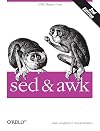
I read this curious to see if I'd use either to replace Perl or Python in my workflow. SED I can definitely see using for quick one off edits. AWK, especially in light of the longer examples given later in this book, I don't see using. AWK is worth learning a bit about for its approach.
I used the 1997 second edition. Some of the examples are a bit dated. The prose is more readable than some by this publisher.
I used the 1997 second edition. Some of the examples are a bit dated. The prose is more readable than some by this publisher.
Sed and awk are Unix power tools. Actually Awk is more of a programming language. This book is a good tutorial on both tools. Apparently it is one of the most popular books on the subject.
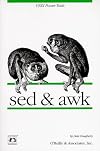
SED stands for "Stream Editor." I wish that I had discovered this tool years before I did, but had been discouraged by the daunting vocabulary of rigorous descriptions. SED was originally written for the UNIX operating system but has been ported to MSDOS by Eric S. Raymond. You can do fairly sophisticated extraction from or modification of text files with remarkably terse (if highly cryptic-looking) instructions. (Actually, for merely searching or extracting, the "Grep" tool is even better, show more but DOS versions that I have seen do not conform so well to the UNIX standard tool.)
This book is a patient exposition of the program's capabilities that takes the reader from the simplest examples.
The Awk language, which adds much to the editing powers of SED, has probably been largely superseded by Perl, which is much more powerful still. However, the Awk interpreter is small and compact, compared to modern Perl implementations which have become large and elaborate. Shell scripts in Linux call upon it frequently.
Regular expressions in Grep, SED, Awk, and Perl (respectively) differ in detail from one another. If I have any criticism of this book, it would be that it sometimes discusses SED and Awk together without pointing out once again these differences if a reader has forgotten them. This sometimes makes the book confusing as a reference. show less
This book is a patient exposition of the program's capabilities that takes the reader from the simplest examples.
The Awk language, which adds much to the editing powers of SED, has probably been largely superseded by Perl, which is much more powerful still. However, the Awk interpreter is small and compact, compared to modern Perl implementations which have become large and elaborate. Shell scripts in Linux call upon it frequently.
Regular expressions in Grep, SED, Awk, and Perl (respectively) differ in detail from one another. If I have any criticism of this book, it would be that it sometimes discusses SED and Awk together without pointing out once again these differences if a reader has forgotten them. This sometimes makes the book confusing as a reference. show less
You May Also Like


Associated Authors
Statistics
- Works
- 32
- Also by
- 2
- Members
- 1,583
- Popularity
- #16,301
- Rating
- 3.7
- Reviews
- 8
- ISBNs
- 59
- Languages
- 3