
Jacopo Della Quercia
Author of The Great Abraham Lincoln Pocket Watch Conspiracy
About the Author
Works by Jacopo Della Quercia
Associated Works
Tagged
Common Knowledge
- Legal name
- Calabria, Giacomo
- Gender
- male
- Organizations
- Cracked.com
- Nationality
- USA
- Associated Place (for map)
- USA
Members
Reviews
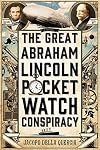
If you want a summer read that’s both gripping and silly, Jacopo Della Quercia’s The Great Abraham Lincoln Pocket Watch Conspiracy is just the read for you. One could also make a case for it as an unconventional choice for back-to-school reading. Take your pick.
In the America of this novel, William Howard Taft is much more interested in prize fighting than in presidenting—in the political arena he’s just a beard for his wife, Nellie, who really runs the country. Taft spends his time show more aboard Airship One (a dirigible) with his sidekick Robert Todd Lincoln holding special Cabinet meetings (the “special” cabinet is the liquor cabinet).
Taft and Lincoln stumble into a mystery via a pocket watch that previously belonged to Abraham Lincoln. They set off to solve the mystery, after first disabling the run-amok Taft automaton taking the President’s place in the White House:
“Mr. President… your decoy is stuck in the bathtub again.”
“Confound it! I keep telling them its exhaust port is not submersible. Someone get Nikola Tesla on the telegraph. Tell him I’m tired of plugging holes in the backside of Thomas Edison’s engines!”
This is pretty much the tenor of the entire work and it’s good fun, balancing the ridiculous with the historical. In fact, the more you know about American history, the more you’ll enjoy it. Della Quercia has a long resume as both a teacher of history and a writer of satire, and The Great Abraham Lincoln Pocket Watch Conspiracy is full quick snippets of humor.
Thomas Edison is the brunt of a number of jokes. At one point, Taft paraphrases Edison saying, “He said something about perspiring and taking credit for other people’s inventions.” Later in the story, the first officer of the Titanic looks at Taft “with the same shock as if he had just seen an iceberg.”
As Taft and Lincoln come closer to understanding the mystery initiated with the discovery of the pocket watch, almost every major figure of the era is brought into the action: cabinet members, army officers, barons of industry, Arthur Conan Doyle, even the rapacious King Leopold of Belgium.
When you need a pick-me-up with enough complexity to stay satisfying throughout, you can’t do better than The Great Abraham Lincoln Pocket Watch Conspiracy.
*****
I received an electronic ARC of this book from the publisher in exchange for an honest review. The opinions expressed are my own. show less
In the America of this novel, William Howard Taft is much more interested in prize fighting than in presidenting—in the political arena he’s just a beard for his wife, Nellie, who really runs the country. Taft spends his time show more aboard Airship One (a dirigible) with his sidekick Robert Todd Lincoln holding special Cabinet meetings (the “special” cabinet is the liquor cabinet).
Taft and Lincoln stumble into a mystery via a pocket watch that previously belonged to Abraham Lincoln. They set off to solve the mystery, after first disabling the run-amok Taft automaton taking the President’s place in the White House:
“Mr. President… your decoy is stuck in the bathtub again.”
“Confound it! I keep telling them its exhaust port is not submersible. Someone get Nikola Tesla on the telegraph. Tell him I’m tired of plugging holes in the backside of Thomas Edison’s engines!”
This is pretty much the tenor of the entire work and it’s good fun, balancing the ridiculous with the historical. In fact, the more you know about American history, the more you’ll enjoy it. Della Quercia has a long resume as both a teacher of history and a writer of satire, and The Great Abraham Lincoln Pocket Watch Conspiracy is full quick snippets of humor.
Thomas Edison is the brunt of a number of jokes. At one point, Taft paraphrases Edison saying, “He said something about perspiring and taking credit for other people’s inventions.” Later in the story, the first officer of the Titanic looks at Taft “with the same shock as if he had just seen an iceberg.”
As Taft and Lincoln come closer to understanding the mystery initiated with the discovery of the pocket watch, almost every major figure of the era is brought into the action: cabinet members, army officers, barons of industry, Arthur Conan Doyle, even the rapacious King Leopold of Belgium.
When you need a pick-me-up with enough complexity to stay satisfying throughout, you can’t do better than The Great Abraham Lincoln Pocket Watch Conspiracy.
*****
I received an electronic ARC of this book from the publisher in exchange for an honest review. The opinions expressed are my own. show less
I'm actually not sure how this book ended up in my collection--it may have been a gift--but I'm so incredibly glad that it did. I can't remember when I've last read a book that was so much fun.
Quercia's blend of history, adventure, and steampunk fantasy is brilliant, and once I began reading the book, I couldn't stop. If I were more of a history buff, I'm positive that I would have enjoyed this even more, but as it is, I just adored it. I'd recommend it to anyone.
Quercia's blend of history, adventure, and steampunk fantasy is brilliant, and once I began reading the book, I couldn't stop. If I were more of a history buff, I'm positive that I would have enjoyed this even more, but as it is, I just adored it. I'd recommend it to anyone.
Jacopo Della Quercia's book is pleasant enough – and easy to read, despite its busyness – but serves as an example of how an unremarkable writer can get published nowadays if he works on maximising his marketing and networking skills, rather than his writing. Play the game and you get the slick book design and the validation of being a 'writer', even if the final piece is – objectively speaking – uninspiring. The audience and the website endorsements are already there, you show more see.
Because were it not for that pre-existing platform, there is no way The Great Abraham Lincoln Pocket Watch Conspiracy would receive such overwhelmingly positive feedback. Like I said, it is pleasant enough, but as a piece of writing it is second-rate. A heavy-handed writing style undermines an idea that should have been rich and racy. It is a smorgasbord of historical touchpoints, but there are far too many to mesh effectively – and that is even before the writer decides to leave all his research clutter on the page. There are too many characters, so that not only do you lose track of who is who, but you never get enough time with anyone to warm to them. There are also far too many plot points, so that you move from one story beat to the next without really knowing why. The sense of conspiracy is lost (and peters out disappointingly at the end), as are the moments of drama. The action scenes are summarized rather than written to thrill.
The dialogue is functional, one-note and often seems to be speaking to the reader rather than to other characters ("My decision to stand against you strained our relationship throughout this whole war," Abe Lincoln says to his son on page 177). For a book with such an outlandish and irreverent pitch, there is damningly little humour. A tasteless final act – in which the likes of Thomas Andrews are gunned down on the Titanic (pg. 344) – serves as the final clumsiness in a steampunk contraption that has more than one or two leaky steam valves. show less
Because were it not for that pre-existing platform, there is no way The Great Abraham Lincoln Pocket Watch Conspiracy would receive such overwhelmingly positive feedback. Like I said, it is pleasant enough, but as a piece of writing it is second-rate. A heavy-handed writing style undermines an idea that should have been rich and racy. It is a smorgasbord of historical touchpoints, but there are far too many to mesh effectively – and that is even before the writer decides to leave all his research clutter on the page. There are too many characters, so that not only do you lose track of who is who, but you never get enough time with anyone to warm to them. There are also far too many plot points, so that you move from one story beat to the next without really knowing why. The sense of conspiracy is lost (and peters out disappointingly at the end), as are the moments of drama. The action scenes are summarized rather than written to thrill.
The dialogue is functional, one-note and often seems to be speaking to the reader rather than to other characters ("My decision to stand against you strained our relationship throughout this whole war," Abe Lincoln says to his son on page 177). For a book with such an outlandish and irreverent pitch, there is damningly little humour. A tasteless final act – in which the likes of Thomas Andrews are gunned down on the Titanic (pg. 344) – serves as the final clumsiness in a steampunk contraption that has more than one or two leaky steam valves. show less
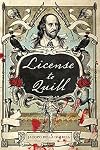
I received this book from my sister and brother-in-law as a gift. Otherwise I don’t know if I would have ever run across it. And yet it is an historical mystery which is a favourite genre for me. The fact it involves William Shakespeare, Francis Bacon, Guy Fawkes and Christopher Marlowe just adds to the enjoyment.
William Shakespeare is at the height of his writing career when he is approached by Guy Fawkes to write a play set in Scotland that involves witches. Fawkes and his conspirators show more want to use the play to incite the people of London to rebel against the King. Shakespeare goes to see the spymaster Thomas Walsingham who advises him to play along with the conspiracy so they will know what is being planned. He sends WS to Francis Bacon, head of the Ordnance Office (also known as Double O), to be equipped with new technology like a rapier with a pistol in the handle and a deck of playing cards containing various substances that can explode or poison or stun the senses. Meanwhile in Italy, Christopher Marlowe, who was a spy for Walsingham before WS, is living a dissolute life until his services are required. WS has lots of adventures following the conspirators who have aligned themselves with some witches in the Forest of Arden. He also writes Macbeth which is scheduled to be performed on November 5, 1605 at the Globe Theatre. If that date sounds familiar it is because it was also the date that the Gunpowder Plot was foiled thanks to Shakespeare’s spying. This is not quite the end of problems for London though. The witches bring their own rebellion to the capital and it takes the combined efforts of Walsingham, Bacon, Shakespeare, Marlowe and others to quell it.
I really enjoyed the portrayal of WS as a reluctant spy but I thought some of the attempts to make the story more like a James Bond thriller were overdone. Nevertheless, it was a fun read and I would recommend it to fans of light-hearted spoofs. show less
William Shakespeare is at the height of his writing career when he is approached by Guy Fawkes to write a play set in Scotland that involves witches. Fawkes and his conspirators show more want to use the play to incite the people of London to rebel against the King. Shakespeare goes to see the spymaster Thomas Walsingham who advises him to play along with the conspiracy so they will know what is being planned. He sends WS to Francis Bacon, head of the Ordnance Office (also known as Double O), to be equipped with new technology like a rapier with a pistol in the handle and a deck of playing cards containing various substances that can explode or poison or stun the senses. Meanwhile in Italy, Christopher Marlowe, who was a spy for Walsingham before WS, is living a dissolute life until his services are required. WS has lots of adventures following the conspirators who have aligned themselves with some witches in the Forest of Arden. He also writes Macbeth which is scheduled to be performed on November 5, 1605 at the Globe Theatre. If that date sounds familiar it is because it was also the date that the Gunpowder Plot was foiled thanks to Shakespeare’s spying. This is not quite the end of problems for London though. The witches bring their own rebellion to the capital and it takes the combined efforts of Walsingham, Bacon, Shakespeare, Marlowe and others to quell it.
I really enjoyed the portrayal of WS as a reluctant spy but I thought some of the attempts to make the story more like a James Bond thriller were overdone. Nevertheless, it was a fun read and I would recommend it to fans of light-hearted spoofs. show less
Lists
Witchy Fiction (1)
Awards

You May Also Like
Associated Authors
Statistics
- Works
- 3
- Also by
- 2
- Members
- 135
- Popularity
- #150,830
- Rating
- 3.3
- Reviews
- 7
- ISBNs
- 4