
Diana C. Mutz
Author of Hearing the Other Side: Deliberative versus Participatory Democracy
About the Author
Diana C. Mutz is the Samuel A. Stouffer Professor of Political Science and Communication at the University of Pennsylvania, where she is director of the Institute for the Study of Citizens and Politics. Her books include In-Your-Face Politics (Princeton) and Hearing the Other Side.
Works by Diana C. Mutz
Tagged
Common Knowledge
- Canonical name
- Mutz, Diana C.
- Legal name
- Mutz, Diana Carole
- Birthdate
- 1962
- Gender
- female
- Education
- Northwestern University (BS)
Stanford University (MA, PhD) - Occupations
- professor (Political Science and Communication)
- Organizations
- University of Pennsylvania (Director, Institute for the Study of Citizens and Politics)
University of Wisconsin-Madison - Nationality
- USA
- Places of residence
- Philidelphia, Pennsylvania, USA
- Associated Place (for map)
- Pennsylvania, USA
Members
Reviews
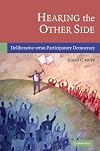
Hearing the Other Side is a technical academic book that hits at a paradox at the heart of democratic theory. Namely, exposure to alternative political views is strongly associated with lower levels of political participation. An educated citizen who understands the issues and alternative rationales for positions is less likely to actually vote. Discourse generates conflict; conflict generates ambiguity; ambiguity generates disengagement. Mutz uses a variety of surveys and experiments to show more probe the extent that Americans actually experience cross-cutting political dialog, and the impact of that dialog on attitudes, and finds that Americans are generally embedded in more homogeneous networks than we might expect, and that contrary naive models of political engagement, more heterogeneous networks lead to less engagement. She postulates a simple, and therefore likely true psychological mechanism, that the social costs of taking extreme and consistent political positions is not worth the resulting arguments.
In 2017, this book is approaching the status of a classic. It was published in 2006, and most of the research was done in the late 90s and early 2000s, which feels like some kind of vanished Paleozoic era, politically speaking. As such, the results are untainted one way or another by Facebook flamewars, twitter botnets, dank memes of the Communist or Fascist variety, and everything else that makes up politics in the present. I don't think any of these developments invalidate Mutz's point. The internet makes all of these discussions about deliberation vs Totally Destroying the Other Side much the same, but moreso.
Sadly, there are several interesting corollaries which are raised and not explored. More educated people live in the least diverse settings. Republicans are more extreme in their views than Democrats, even pre-Tea Party and Trump. The conclusion, that norms for hearing the other side should be more broadly distributed through society and not just confined to legislative elites who actually make policy, is a floppy statement out of line with the clarity and logic of the rest of the book. Still, this is a powerful and potent evidence-based look at why theories of liberal democracy are just that: theories. show less
In 2017, this book is approaching the status of a classic. It was published in 2006, and most of the research was done in the late 90s and early 2000s, which feels like some kind of vanished Paleozoic era, politically speaking. As such, the results are untainted one way or another by Facebook flamewars, twitter botnets, dank memes of the Communist or Fascist variety, and everything else that makes up politics in the present. I don't think any of these developments invalidate Mutz's point. The internet makes all of these discussions about deliberation vs Totally Destroying the Other Side much the same, but moreso.
Sadly, there are several interesting corollaries which are raised and not explored. More educated people live in the least diverse settings. Republicans are more extreme in their views than Democrats, even pre-Tea Party and Trump. The conclusion, that norms for hearing the other side should be more broadly distributed through society and not just confined to legislative elites who actually make policy, is a floppy statement out of line with the clarity and logic of the rest of the book. Still, this is a powerful and potent evidence-based look at why theories of liberal democracy are just that: theories. show less
Awards


Statistics
- Works
- 7
- Members
- 125
- Popularity
- #160,150
- Rating
- 3.8
- Reviews
- 2
- ISBNs
- 19