
Richard McElreath
Author of Statistical Rethinking: A Bayesian Course with Examples in R and Stan
Works by Richard McElreath
Tagged
Common Knowledge
There is no Common Knowledge data for this author yet. You can help.
Members
Reviews
Statistical Rethinking: A Bayesian Course with Examples in R and Stan (Chapman & Hall/CRC Texts in Statistical Science) by Richard McElreath
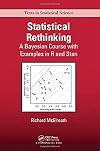
This book is a one-stop shop for learning statistical modeling.
The first six chapters demonstrate many of the concepts in Bayesian statistics and linear models, using fully-worked examples in R. Note that the R code leans heavily on STAN (through the rstan package) and the author's own rethinking package. This makes the examples small enough to be workable, and the mechanisms employed in the rethinking package are fully explained.
Chapters 7 through 12 gradually introduce new and more show more powerful modeling concepts, and things start to get complicated somewhere around chapter ten.
The last two chapters, 13 and 14, put the rest of the book into practice. This is where the models being developed finally start to feel useful, instead of somewhat contrived. I'd fallen out of the habit of doing the examples around chapter 8, but came back to it for these two. Well worth it.
McElreath is one of the new breed of statisticians calling for sanity and reproducibility (ala [b:Statistics Done Wrong: The Woefully Complete Guide|23241062|Statistics Done Wrong The Woefully Complete Guide|Alex Reinhart|https://images.gr-assets.com/books/1422216326s/23241062.jpg|26525687], [b:How Not to Be Wrong: The Power of Mathematical Thinking|18693884|How Not to Be Wrong The Power of Mathematical Thinking|Jordan Ellenberg|https://images.gr-assets.com/books/1387726285s/18693884.jpg|26542434]), and his coverage of statistical modeling is not be missed for the practitioner. He also happens to have written the only statistics textbook that I've read cover-to-cover (and among this CRC "Texts In Statistical Science" series, the only one I've even gotten halfway through).
In short: if you're doing stats, or learning to, read it. show less
The first six chapters demonstrate many of the concepts in Bayesian statistics and linear models, using fully-worked examples in R. Note that the R code leans heavily on STAN (through the rstan package) and the author's own rethinking package. This makes the examples small enough to be workable, and the mechanisms employed in the rethinking package are fully explained.
Chapters 7 through 12 gradually introduce new and more show more powerful modeling concepts, and things start to get complicated somewhere around chapter ten.
The last two chapters, 13 and 14, put the rest of the book into practice. This is where the models being developed finally start to feel useful, instead of somewhat contrived. I'd fallen out of the habit of doing the examples around chapter 8, but came back to it for these two. Well worth it.
McElreath is one of the new breed of statisticians calling for sanity and reproducibility (ala [b:Statistics Done Wrong: The Woefully Complete Guide|23241062|Statistics Done Wrong The Woefully Complete Guide|Alex Reinhart|https://images.gr-assets.com/books/1422216326s/23241062.jpg|26525687], [b:How Not to Be Wrong: The Power of Mathematical Thinking|18693884|How Not to Be Wrong The Power of Mathematical Thinking|Jordan Ellenberg|https://images.gr-assets.com/books/1387726285s/18693884.jpg|26542434]), and his coverage of statistical modeling is not be missed for the practitioner. He also happens to have written the only statistics textbook that I've read cover-to-cover (and among this CRC "Texts In Statistical Science" series, the only one I've even gotten halfway through).
In short: if you're doing stats, or learning to, read it. show less
Statistical Rethinking: A Bayesian Course with Examples in R and Stan (Chapman & Hall/CRC Texts in Statistical Science) by Richard McElreath
If you read through this text you will get a great course in Bayesian statistics with lots of R code, many interesting asides, comparisons to frequentist methods and philosophical comments. I think I understand the Bayesian approach much better than I had before. In my limited experience, using this approach is still a lot of work, gives a near identical answer (since I've avoided p values for years anyway), and the principle advantage is that when the researcher/client tells you what they show more think your confidence intervals mean, they are right. show less
Lists
Statistics
- Works
- 2
- Members
- 166
- Popularity
- #127,844
- Rating
- 4.2
- Reviews
- 2
- ISBNs
- 14