
Dietrich von Hildebrand (1889–1977)
Author of Transformation in Christ
About the Author
Image credit: Image © ÖNB/Wien
Works by Dietrich von Hildebrand
My Battle Against Hitler: Faith, Truth, and Defiance in the Shadow of the Third Reich (2014) 118 copies, 2 reviews
The Encyclical Humanae Vitae: A Sign of Contradiction: An Essay on Birth Control and Catholic Conscience (1969) — Author — 52 copies
Love, Marriage, and the Catholic Conscience: Understanding the Church's Teachings on Birth Control (1998) 47 copies
Santidad y virtud en el mundo 4 copies
A ARTE DE VIVER 2 copies
Moralidad y conocimiento ético de los valores : una investigación sobre problemas éticos estructurales (2006) 2 copies
NUESTRA TRANSFORMACION EN CRISTO 2 copies
Teilhard de Chardin a False Prophet 2 copies
LA AFECTIVIDAD CRISTIANA 1 copy
Why The Tridentine Mass? 1 copy
Filosofi tedeschi d'oggi — Author — 1 copy
Sobre la muerte 1 copy
EL CORAZÓN 1 copy
Przemienienie w Chrystusie 1 copy
Sztuka życia 1 copy
Moralia 1 copy
Sittliche Grundhaltungen 1 copy
Moralia: Nachgelassenes Werk (Gesammelte Werke / Dietrich von Hildebrand) (German Edition) (1980) 1 copy
Die Menschheit am Scheideweg 1 copy
Wobec wartości 1 copy
Heiligkeit und Tüchtigkeit 1 copy
Tagged
Common Knowledge
- Canonical name
- Hildebrand, Dietrich von
- Legal name
- Hildebrand, Dietrich Richard Alfred von
- Birthdate
- 1889-10-12
- Date of death
- 1977-01-26
- Gender
- male
- Education
- University of Munich
University of Göttingen (Ph.D) - Occupations
- philosopher
religious writer
professor - Organizations
- University of Munich
University of Vienna
Catholic University of Toulouse
Fordham University - Relationships
- Hildebrand, Alice von (wife)
Hildebrand, Adolf von (father) - Nationality
- Germany
- Birthplace
- Florence, Kingdom of Italy
- Places of residence
- New Rochelle, New York, USA
- Place of death
- New Rochelle, New York, USA
Members
Reviews
My Battle Against Hitler: Faith, Truth, and Defiance in the Shadow of the Third Reich by Dietrich von Hildebrand
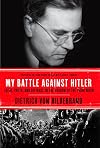
Dietrich von Hildebrand, a German professor of philosophy in Munich, watched with dismay as Germany fell under the spell of Hitler and the Third Reich. In 1933, at age 43, he and his wife Gretchen left Germany to live in Vienna.
In exile he founded a weekly magazine (Der Christliche Standestaat—The Christian Corporative State) that, for five years (until the spring of 1938 when Hitler took over Austria and the von Hildebrands had to flee), was dedicated to unmasking the nationalism, show more militarism, collectivism, and anti-Semitism that combined to make up Nazism.
My Battle Against Hitler is made up of two sections. The first part—von Hildebrand’s memoirs—contains selections from the 5000-page memoir he wrote in 1958 for the benefit of his second wife to help this much younger woman understand his life. This section is organized by year.
The second part is fragments of the essays he published in the Vienna magazine from 1933 to 1938.
The whole thing is stitched together by pieces written by John Henry Crosby and John F. Crosby, translators of the memoirs and essays. The book begins with John Henry Crosby’s chapter “The Life of Dietrich von Hildebrand.” Throughout the book pieces written by the Crosby’s connect the dots between journal entries and put the essay fragments into context.
Von Hildebrand’s journals are interesting and colorful. They depict him as an inveterate people-watcher who tended to categorize those he met as black or white depending on how they viewed Bolshevism and National Socialism. Any whiff of sympathy to those movements colored his entire opinion of a person.
He was someone who also seemed readily star-struck with those in power that he admired. His account of meeting the Empress and Emperor Otto of Belgium in 1933 is typical of his reaction:
As a whole, his memoirs introduce us to the philosophers, thinkers, and politicians of the day with whom he rubbed shoulders in Vienna and other parts of Europe. They are infused with his philosophical idealism which is rooted in his Catholic / Christian worldview. And so he saw Bolshevism and National Socialism as players in the age-old drama that was far bigger than what was being played out on the stage of Europe at that time:
Though I found many of his essays hard to follow (he was a deep, philosophical thinker, quoting names of contemporaries as handles of philosophical movements with which I’m unfamiliar), his strong convictions and clear thinking is, as a whole, hard to resist. I couldn’t help but contrast his well-thought-out opposition to Nazism to our popular movements which, herd-like, rise and fall fueled by little more than trending tweets and social medial ‘LIKE's. Von Hildebrand would have been aghast.
In our time when dueling worldviews continue, von Hildbrand stands as a shining example of someone who knew his convictions, was a master at communicating them, and stuck by them no matter how popular opinion shifted.
For our time, this book is a worthwhile read for his defense of the Jews alone. The journal entries and essays where he decries anti-Semitism could help bolster our own resistance to this movement that is again finding a voice on the streets and university campuses around us.
This book is a treasure for those interested in a close view of pre-World War II Vienna, the political atmosphere and movements of the time, and how one Christian thinker analyzed and evaluated the philosophies that underpinned those movements.
I received My Battle Against Hitler as an e-book download from the publisher for the purpose of writing a review. show less
In exile he founded a weekly magazine (Der Christliche Standestaat—The Christian Corporative State) that, for five years (until the spring of 1938 when Hitler took over Austria and the von Hildebrands had to flee), was dedicated to unmasking the nationalism, show more militarism, collectivism, and anti-Semitism that combined to make up Nazism.
My Battle Against Hitler is made up of two sections. The first part—von Hildebrand’s memoirs—contains selections from the 5000-page memoir he wrote in 1958 for the benefit of his second wife to help this much younger woman understand his life. This section is organized by year.
The second part is fragments of the essays he published in the Vienna magazine from 1933 to 1938.
The whole thing is stitched together by pieces written by John Henry Crosby and John F. Crosby, translators of the memoirs and essays. The book begins with John Henry Crosby’s chapter “The Life of Dietrich von Hildebrand.” Throughout the book pieces written by the Crosby’s connect the dots between journal entries and put the essay fragments into context.
Von Hildebrand’s journals are interesting and colorful. They depict him as an inveterate people-watcher who tended to categorize those he met as black or white depending on how they viewed Bolshevism and National Socialism. Any whiff of sympathy to those movements colored his entire opinion of a person.
He was someone who also seemed readily star-struck with those in power that he admired. His account of meeting the Empress and Emperor Otto of Belgium in 1933 is typical of his reaction:
“The Empress made a very strong impression on me. There was something unbelievably elegant and aristocratic about her face, while her presence as a whole seemed to combine both strength and tenderness. She was immensely attractive. ... Afterward I was able to meet Emperor Otto, who also made a very great impression on me. He was then still very young, about nineteen or twenty. ...I was amazed how well informed he was about all the problems in Austria and how intelligently he spoke about them” – Kindle Location 1927 & 1934.
As a whole, his memoirs introduce us to the philosophers, thinkers, and politicians of the day with whom he rubbed shoulders in Vienna and other parts of Europe. They are infused with his philosophical idealism which is rooted in his Catholic / Christian worldview. And so he saw Bolshevism and National Socialism as players in the age-old drama that was far bigger than what was being played out on the stage of Europe at that time:
“In reality, there have been only two fronts in the world for the past two thousand years; the front for Christ and the front against Christ. He is the cornerstone which separates all spirits” – Kindle Location 5012.
Though I found many of his essays hard to follow (he was a deep, philosophical thinker, quoting names of contemporaries as handles of philosophical movements with which I’m unfamiliar), his strong convictions and clear thinking is, as a whole, hard to resist. I couldn’t help but contrast his well-thought-out opposition to Nazism to our popular movements which, herd-like, rise and fall fueled by little more than trending tweets and social medial ‘LIKE's. Von Hildebrand would have been aghast.
In our time when dueling worldviews continue, von Hildbrand stands as a shining example of someone who knew his convictions, was a master at communicating them, and stuck by them no matter how popular opinion shifted.
For our time, this book is a worthwhile read for his defense of the Jews alone. The journal entries and essays where he decries anti-Semitism could help bolster our own resistance to this movement that is again finding a voice on the streets and university campuses around us.
This book is a treasure for those interested in a close view of pre-World War II Vienna, the political atmosphere and movements of the time, and how one Christian thinker analyzed and evaluated the philosophies that underpinned those movements.
I received My Battle Against Hitler as an e-book download from the publisher for the purpose of writing a review. show less
My Battle Against Hitler: Faith, Truth, and Defiance in the Shadow of the Third Reich by Dietrich von Hildebrand
I chanced upon this book while browsing an on line sale. My familiarity with Dietrich von Hildebrand was slight to non-existent. I would like to congratulate John Henry Crosby and John F. Crosby for this important work and give it the highest recommendation.
The book is divided into two parts: the first being von Hildebrand''s memoirs covering the period from 1921-1938 and the second part consists of the translation of essays published by von Hildebrand in a journal he edited from show more self-imposed exile in Vienna until the completion of the Anschluss which saw the absorption of Austria into Germany.
Von Hildebrand's early life was divided between Florence, his birthplace, and Munich. His father was a successful sculptor and architect. They were secularized Protestants and although von Hildebrand was baptized the family was irreligious in outlook. In 1906 von Hildebrand entered the University of Munich and was a student of Edmund Husserl who eventually directed his doctoral dissertation. He remained a phenomenologist from the standpoint of philosophy for the rest of his life. While studying in Munich he became a friend of Max Scheler to whom the editor gives some credit for inspiring von Hildebrand's eventual conversion to Catholicism. Scheler is said to have observed that "The Catholic Church is the true Church because she produces saints". In any event von Hildebrand and his wife Gretchen converted to Catholicism in 1914. Von Hildebrand spent the war serving as a surgeon's assistant in a hospital in Munich.
Following the war von Hildebrand was appointed to the philosophy faculty at the University of Munich. He became active in intellectual circles focused on themes of anti-nationalism and Catholicism. While attending a conference in Paris in 1921 he was challenged by his largely French audience on the question of Germany's invasion of Belgium in 1914. He responded by characterizing it an "an atrocious crime". This comment generated a serious backlash at home both from religious and non-religious critics. His place on the Nazi Party's hit list dates from this conference.
The bulk of the memoirs are focused on von Hildebrand's efforts to resist the totalitarian temptation in German intellectual and political circles and to fight against the inclination to find compromises and a modus vivendi between the German Church and National Socialism. His politics and his philosophy were aligned around three core principles: complete rejection of or compromise with National Socialism, devout Catholicism, and total rejection of anti-Semitism. His rejection of National Socialism was from the beginning and it was public enough that he felt compelled to flee Munich as early as 1923 during the "Beer Hall Putsch".
He fled to Vienna ten years later after Hitler's accession to power and with the support of Austrian chancellor, Engelbert Dollfuss, founded "Der Christliche Standestaat", translated as "The Christian Corporative State" which espoused a middle way between the spirit of secular, capitalist liberalism and the extremes of National Socialism and Bolshevisim. Eventually he was forced to flee to Czechoslovakia, then France and eventually making his way to the United States and a position at Fordham where he taught form 1940-1960.
The memoirs make for fascinating reading with a cast of characters from all walks of political, religious and intellectual life adding color and texture to the story. The book would have been helped by the inclusion of an index to allow the reader to go back and check on characters whose appearances reoccur over the course of many years. But that is my only quibble. It amused me to note that in a display of perhaps an "all too human" trait, von Hildebrand repeatedly rates the intellects, personalities and worth of his acquaintances based on the firmness of their opposition to National Socialism, their rejection of anti-Semitism and their Catholicism. (He does harbor small reservations, though, about "strict Thomists.")
The essays still speak to us as men and women of good will eight decades after they were written with a goal of inspiring Austria to maintain its independence from and resistance to National Socialism. For readers in need of moral and intellectual sustenance to resist the totalitarian temptations of our times this book will reward your time and effort. show less
The book is divided into two parts: the first being von Hildebrand''s memoirs covering the period from 1921-1938 and the second part consists of the translation of essays published by von Hildebrand in a journal he edited from show more self-imposed exile in Vienna until the completion of the Anschluss which saw the absorption of Austria into Germany.
Von Hildebrand's early life was divided between Florence, his birthplace, and Munich. His father was a successful sculptor and architect. They were secularized Protestants and although von Hildebrand was baptized the family was irreligious in outlook. In 1906 von Hildebrand entered the University of Munich and was a student of Edmund Husserl who eventually directed his doctoral dissertation. He remained a phenomenologist from the standpoint of philosophy for the rest of his life. While studying in Munich he became a friend of Max Scheler to whom the editor gives some credit for inspiring von Hildebrand's eventual conversion to Catholicism. Scheler is said to have observed that "The Catholic Church is the true Church because she produces saints". In any event von Hildebrand and his wife Gretchen converted to Catholicism in 1914. Von Hildebrand spent the war serving as a surgeon's assistant in a hospital in Munich.
Following the war von Hildebrand was appointed to the philosophy faculty at the University of Munich. He became active in intellectual circles focused on themes of anti-nationalism and Catholicism. While attending a conference in Paris in 1921 he was challenged by his largely French audience on the question of Germany's invasion of Belgium in 1914. He responded by characterizing it an "an atrocious crime". This comment generated a serious backlash at home both from religious and non-religious critics. His place on the Nazi Party's hit list dates from this conference.
The bulk of the memoirs are focused on von Hildebrand's efforts to resist the totalitarian temptation in German intellectual and political circles and to fight against the inclination to find compromises and a modus vivendi between the German Church and National Socialism. His politics and his philosophy were aligned around three core principles: complete rejection of or compromise with National Socialism, devout Catholicism, and total rejection of anti-Semitism. His rejection of National Socialism was from the beginning and it was public enough that he felt compelled to flee Munich as early as 1923 during the "Beer Hall Putsch".
He fled to Vienna ten years later after Hitler's accession to power and with the support of Austrian chancellor, Engelbert Dollfuss, founded "Der Christliche Standestaat", translated as "The Christian Corporative State" which espoused a middle way between the spirit of secular, capitalist liberalism and the extremes of National Socialism and Bolshevisim. Eventually he was forced to flee to Czechoslovakia, then France and eventually making his way to the United States and a position at Fordham where he taught form 1940-1960.
The memoirs make for fascinating reading with a cast of characters from all walks of political, religious and intellectual life adding color and texture to the story. The book would have been helped by the inclusion of an index to allow the reader to go back and check on characters whose appearances reoccur over the course of many years. But that is my only quibble. It amused me to note that in a display of perhaps an "all too human" trait, von Hildebrand repeatedly rates the intellects, personalities and worth of his acquaintances based on the firmness of their opposition to National Socialism, their rejection of anti-Semitism and their Catholicism. (He does harbor small reservations, though, about "strict Thomists.")
The essays still speak to us as men and women of good will eight decades after they were written with a goal of inspiring Austria to maintain its independence from and resistance to National Socialism. For readers in need of moral and intellectual sustenance to resist the totalitarian temptations of our times this book will reward your time and effort. show less

Overall helpful. Alice von Hildebrand's two essays were phenomenal and worth the price of the book. I will be seeking out her work elsewhere. Dietrich was much more analytical, dry, and in my view arbitrary, descending almost to the level of a Sunday School scolding. But there were moments where he shined as well, correcting abuses and tempering with love which is normally found in Catholic ethics.
This book was such a toil, and I mean that in the best way possible. It kept me really tied to and involved with my faith, because it's such a long and dense work that you've got to focus and contemplate. Hildebrand's point throughout the book is our necessary surrender, becoming "fools for Christ," to fully recognize the strength and gravity of Christianity. Of all of the chapters - more or less, each focuses on a different virtue - my favorites were finding freedom in Christ, holy mercy, show more and holy sorrow. Hildebrand is a fantastic philosopher and theologian, and this is a very worthwhile read show less
Lists
Awards

You May Also Like


Associated Authors
Statistics
- Works
- 89
- Members
- 3,095
- Popularity
- #8,250
- Rating
- 4.2
- Reviews
- 25
- ISBNs
- 122
- Languages
- 8
- Favorited
- 3