
Colette Audry (1906–1990)
Author of The Battle of the Rails [1945 film]
About the Author
Image credit: babelio.com
Works by Colette Audry
Associated Works
Into That Darkness: From Mercy Killing to Mass Murder (1974) — Traduction, some editions — 774 copies, 14 reviews
Tagged
Common Knowledge
- Birthdate
- 1906-07-06
- Date of death
- 1990-10-20
- Gender
- female
- Education
- École Normale Supérieure de Sèvres
- Occupations
- novelist
screenwriter
literary critic
politician
playwright
teacher (show all 9)
French Resistance
memoirist
short story writer - Organizations
- Lycée Molière, Paris
Les Temps Modernes - Relationships
- Beauvoir, Simone de (friend)
Sartre, Jean-Paul (co-editor)
Audry, Jacqueline (sister) - Short biography
- Colette Audry was born in Orange, in the Provence region of France. Her family moved around during her childhood for her father's assignments in the French préfecture administration, and settled in Paris in 1920. She was the elder sister of Jacqueline Audry, who became a film director, and for whom Colette would write several acclaimed screenplays. After completing secondary studies, she attended the École normale supérieure de Sèvres and passed the agrégation de lettres (teaching certificate) in 1928. She began her career as a teacher in Caen, then moved to Rouen, where she met Simone de Beauvoir, beginning a lifelong friendship. During this period, she also began a lifelong involvement in left-wing politics. In 1936, she was appointed to the Lycée Molière in Paris and also traveled to Spain at the start of the Civil War; afterwards, she helped found the socialist newspaper L'Espagne to promote the Loyalist cause. During World War II, especially after her transfer to Grenoble, she took took part in the French Resistance.
After the war, back in Paris, she served as a project manager at the Ministry of Information. She then returned to teaching, but also pursued a literary career.
She published a memoir, Aux yeux du souvenir (In the Eyes of Memory), in 1947. In addition to writing novels, such as the autobiographical Derrière la baignoire (Behind the Bathtub, 1962), for which she received the Prix Médicis, she was a well-known essayist, short story writer, and playwright. She was a noted literary critic, especially on the works of Jean-Paul Sartre. She collaborated with Sartre on the literary magazine Les Temps Modernes, and directed the publication of works by French and foreign women writers at the Editions Denoël publishing house. She was a member of the Parti socialiste unifié (PSU, Unified Socialist Party), and ran for election to the National Assembly several times without success. In 2013, the main courtyard of the headquarters of the Socialist Party in the rue de Solférino in Paris was named in her honor. - Nationality
- France
- Birthplace
- Orange, Vaucluse, France
- Places of residence
- Paris, France
- Place of death
- Issy-les-Moulineaux, Hauts-de-Seine, Île-de-France, France
- Map Location
- France
- Associated Place (for map)
- France
Members
Reviews

Film insolito per il cinema francese, molto più assimilabile al neorealismo italiano e in particolare a Roberto Rossellini e al suo Paisà. Girato sui luoghi dell'azione reale con ferrovieri autentici, il film ricostruisce l'attentato a un convoglio tedesco durante la seconda guerra mondiale alla vigilia dello sbarco in Normandia. Lo stile è di una spoglia epicità, di un'asciutta tensione, di un'essenzialità quasi documentaristica, di una genuina coralità priva di ogni retorica e show more psicologismo. Si tratta di uno dei pochi film sulla Resistenza francese. Importante l'apporto della fotografia di Henri Alekan e della sceneggiatura essenzialissima di Colette Aud. (fonte: Mymovies) show less
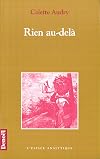
> RIEN AU-DELÀ, par Colette Audry - Éd. Denoël. — Rien au-delà n'est pas un roman mais un recueil de lettres qui nous fait vivre un roman, l'extraordinaire relation qui s'établit entre une femme de 82 ans et un jeune religieux, François. Tout le monde connaît l'histoire d'Eloïse et d'Abelard comme celle vécue par May Ziadeh pour Khalil Gibran, aimantation passionnelle purement subjective puisque ni l'un ni l'autre ne se verront au cours de leur vie. Ici l'auteur aima un moine show more bénédictin. Amour distancié de la plus petite attraction charnelle. Quelques rencontres au hasard des opportunités, mais un échange épistolier, dense, riche, profond en spiritualité et en culture de deux êtres séparés par des disciplines de vie différentes. « Nous avons repoussé les limites des relations humaines » et plus loin : « Certes nous nous sommes manqués dans le temps et je ne peux pas me cacher que c'est une chose déchirante. Mais vous êtes là et nous sommes ensemble. L'état de confiance et d'abandon dans lequel j'entre parfois quand je pense à vous, voilà bien la merveille. » Ce moine va illuminer les deux dernières années de la vie de C. Audry. Elle mourra le 20 octobre 90. Sa dernière lettre à François date du 14 juin. C'est l'hymne ultime à l'amour : « Il faut que je vous dise ce que vous aurez été pour moi : pendant deux ans au moins, davantage, j'espère, vous m'aurez fait connaître ce qu'il peut y avoir de douceur dans la vie… et ce n'est pas une petite chose. Et vous n'étiez pas plus que moi dressé à cela. Il y a beaucoup d'autres choses, mais il n'y a rien au-delà. » La connaissance de soi et de l'autre menait à une aventure spirituelle. (Albert SARALLIER)
—Nouvelles Clés, (30), Eté 1993, (p. 82) show less
—Nouvelles Clés, (30), Eté 1993, (p. 82) show less
Jan 28, 2023 (Edited)French
Film insolito per il cinema francese, molto più assimilabile al neorealismo italiano e in particolare a Roberto Rossellini e al suo Paisà. Girato sui luoghi dell'azione reale con ferrovieri autentici, il film ricostruisce l'attentato a un convoglio tedesco durante la seconda guerra mondiale alla vigilia dello sbarco in Normandia. Lo stile è di una spoglia epicità, di un'asciutta tensione, di un'essenzialità quasi documentaristica, di una genuina coralità priva di ogni retorica e show more psicologismo. Si tratta di uno dei pochi film sulla Resistenza francese. Importante l'apporto della fotografia di Henri Alekan e della sceneggiatura essenzialissima di Colette Aud. (fonte: Mymovies) show less

Questo film a episodi racconta le imprese dei lavoratori delle ferrovie francesi che sostengono le attività della Resistenza francese durante la seconda guerra mondiale. Dall'inizio dell'occupazione nazista alla liberazione, il film mostra l'inestimabile ruolo svolto dai normali lavoratori delle ferrovie nella sconfitta dei tedeschi. La seconda parte del film si occupa principalmente di un audace tentativo di sabotare un trasporto tedesco diretto in Normandia.
Awards


Statistics
- Works
- 12
- Also by
- 2
- Members
- 55
- Popularity
- #295,339
- Rating
- 4.0
- Reviews
- 7
- ISBNs
- 6
- Languages
- 1