
Shmuel Yosef Agnon (1888–1970)
Author of Days of Awe: A Treasury of Jewish Wisdom for Reflection, Repentance, and Renewal on the High Holy Days
About the Author
Shmuel Yosef Agnon was born Shmuel Yosef Halevi Czaczkes in 1888 in Galicia, Austria-Hungary (now Poland). He received training in Yiddish, Hebrew and the Talmud from his father, and was introduced to German literature by his mother. When he was fifteen, his first poems, written in Yiddish and show more Hebrew, were published in the newspaper. He took his pen name, later his legal name, S.Y. Agnon, from the title of his first story Agunot, published in 1909. He lived and worked in Palestine from 1907 until his death in 1970, except for an eleven year stay in Germany. He was buried on the Mount of Olives. Agnon was a prolific novelist and short-story writer. After his move to Jerusalem from Germany, Agnon began writing about the decline of Jewry in Galicia. His first major publication was a two-volume novel, Hakhnasat Kalah (The Bridal Canopy), 1932, which recreates the golden age of Hassidism. Ore'ah Nata' Lalun (A Guest for the Night), 1939, is an apocalyptic novel depicting the ruin of Galicia after World War I. 'Tmol Shilshom (Only Yesterday), published in 1946, is considered his greatest novel, portraying the early pioneer immigrants to Palestine. A great many of his later books are set in his adopted Palestine and deal with the replacement of early Jewish settlements after World War II. Agnon received the Nobel Prize for Literature in 1966, boosting interest in his work outside of Israel. About 85 of Agnon's works have been translated into at least 18 languages. Agnon was made an honorary citizen of Jerusalem in 1962. His portrait appears on the Israeli Fifty New Sheqalim banknote. Other works include Sefer Hamaasim (The Book of Deeds ), published in 1932, Pat Shlema (A Whole Loaf ), from 1933, Shevuat Emunim (Two Tales), 1943, and Kol Sipurav Shel Sh. Y. Agnon ( The Collected Works in 11 volumes), 1931-62. (Bowker Author Biography) Agnon was born in Galicia, the former Austrian crown land in east central Europe. In his home he was influenced by rabbinical and Hasidic traditions and the reviving spirit of European culture, Agnon began writing Hebrew and Yiddish at the age of eight. He contributed poetry and prose to periodicals, such as Ha-Mizpeh and Der Juedische Wecker. After he immigrated to Palestine in 1907, he no longer wrote in Yiddish. He chose the pen name "Agnon" from the title of his first novel, Agunot (Forsaken Wives); its meaning is "cut off" in Hebrew. From 1912 to 1914 Agnon lived in Germany, where he met Salman Schocken and convinced him that someone should undertake the publishing of Hebrew books. In 1931 Berlin Schocken Verlag published four volumes of Agnon's collected works in Hebrew. Agnon was awarded the Bialik Prize for literature in 1934, and in 1936 the Jewish Theological Seminary of America made him an honorary Doctor of Hebrew Letters. Other honors followed, including the Israel Prize in 1954 and 1958. In 1966 he became the first Israeli to receive the Nobel Prize for literature, which was awarded jointly to the Swedish writer Nelly Sachs. Agnon often deals with philosophical and psychological problems in a miraculous or supernatural manner. Reality is colored in a dreamlike atmosphere. Agnon is concerned with contemporary problems of a spiritual nature-the disintegration of traditional life, loss of faith and identity, and loneliness. At the center of his work is the Jew in various manifestations: a person of faith, a nihilist, a victim of pogroms and the Holocaust, a pioneer, and a saint. Creating a unique Hebrew prose style, his works link historic Jewish piety and martyrdom with longing for Israel. Yet they have universal appeal to the modern reader. Agnon himself has said: "I am not a modern writer. I am astounded that I even have one reader. I don't see the reader before me... No, I see before me only the Hebrew letter saying 'write me thus and not thus.' I, to my regret, am like the wicked Balaam. It is written of him that "the word that God putteth in my mouth, that shall I speak"' (The New York Times). (Bowker Author Biography) show less
Disambiguation Notice:
aka S.Y. Agnon
Works by Shmuel Yosef Agnon
Days of Awe: A Treasury of Jewish Wisdom for Reflection, Repentance, and Renewal on the High Holy Days (1965) 338 copies, 2 reviews
Present at Sinai: The Giving of the Law : Commentaries Selected by S.Y. Agnon (1959) 54 copies, 1 review
האש והעצים 7 copies
תהלה ; השנים הטובות 7 copies
Kun väärä oikaistaan : kertomuksia 5 copies
מעצמי אל עצמי 5 copies
פתחי דברים 4 copies
Mi-sod hakhamim : mikhtavim 1909-1970 : Agnon, Brenner, Bialik, Lachower, Katzenelson, Sadan מסוד חכמים (2002) 4 copies
In der Gemeinschaft der Frommen 3 copies
Yidishe òveròk 3 copies
La signora e il venditore ambulante 3 copies
Me-ḥamat ha-metsik מחמת המציק 2 copies
שבועת-אמונים : סיפור 2 copies
TILSIM 2 copies
ספר סופר וסיפור 2 copies
Le opere: Racconti di Gerusalemme 2 copies
ימים נוראים : ספר מנהגות ומדרשות ואגדות לימי הרחמים והסליחות, לראש השנה וליום הכיפורים ולימים… 1 copy
מאז ומעתה 1 copy
בשובה ונחת 1 copy
AYER Y ANTEAYER 1 copy
HUESPED POR UNA NOCHE 1 copy
"Ido i Ėĭnam" 1 copy
Opere 1 copy
על ברל כצנלסון 1 copy
Valaha régen 1 copy
La légende de Yosef della Reina, activiste messianique : Trois versions traduites de l'hébreu et du yiddish (2018) 1 copy
Een simpel verhaal 1 copy
Trohetseden 1 copy
Ainda Ontem 1 copy
Bidmei yameha, Panim acherot 1 copy
Der Treuschwur 1 copy
Modern Herbrew Stories 1 copy
Amistad 1 copy
Sipur pashuṭ 1 copy
Kovets sipurim 1 copy
Me- atsmi el atsmi 1 copy
שבועת אמונים 1 copy
מבחר ספורים 1 copy
סיפורי יום הכפורים 1 copy
Associated Works
The Jewish caravan : great stories of twenty-five centuries (1965) — Contributor, some editions — 141 copies
Israeli Stories: A Selection of the Best Contemporary Hebrew Writing (1965) — Contributor — 123 copies, 1 review
Meesters der Hebreeuwse vertelkunst — Author — 17 copies
Ghetto, Shtetl, or Polis?: The Jewish Community in the Writings of Karl Emil Franzos, Sholom Aleichem, and Shemuel Yosef Agnon (1997) — Associated Name — 2 copies
In Davids Laube : Erzählungen aus Israel — Contributor — 1 copy
Tagged
Common Knowledge
- Canonical name
- Agnon, Shmuel Yosef
- Legal name
- שמואל יוסף עגנון
- Other names
- Agnon, Shmuel Yosef
Agnon, S.Y. - Birthdate
- 1888-07-17
- Date of death
- 1970-02-17
- Gender
- male
- Education
- schooled by his parents
- Occupations
- writer
novelist
short story writer
essayist - Awards and honors
- Bialik Prize (1934 ∙ 1950)
Israel Prize (1954 ∙ 1958)
Nobel Prize (Literature ∙ 1966) - Short biography
- Shmuel Yosef Agnon, known in English as S.Y. Agnon, was born in Galicia (now part of Ukraine) and emigrated to Palestine in 1908. He spent the years 1913 through 1924 in Germany, where he met and married Esther Marx, with whom he had two children. In 1924, he brought his family to Jerusalem, where he lived for the rest of his life. A prolific novelist and short-story writer from an early age, Agnon received numerous awards for his work, including the Nobel Prize for Literature (shared with Nelly Sachs) in 1966 and the Israel Prize on two occasions. He is often cited as one of the great storytellers of our time and for his wit and comic mastery. Agnon is among the most widely-written about and widely-translated of all Hebrew authors. His style and language influenced today's generation of writers. In much of his work, Agnon tried to recapture the lives and traditions of Jews of a former time, and often dealt with important psychological and philosophical questions. After his death in 1970, his daughter Emuna Yaron continued to publish his work posthumously.
- Nationality
- Israel
- Birthplace
- Buchach, Galicia
Buczacz, Poland - Places of residence
- Buchach, Galicia (birthplace)
Ottoman Palestine
Jaffa, Israel
Germany
Talpiot, Jerusalem, Israel - Place of death
- Jerusalem, Israel
- Burial location
- Mount of Olives, Jerusalem, Israel
- Disambiguation notice
- aka S.Y. Agnon
- Associated Place (for map)
- Israel
Members
Reviews
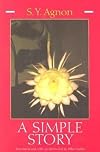
Enjoyable story set in the Jewish community of a small Ukrainian town at the turn of the century. It opens with a poor young Jewish girl being sent to live with her better-off shopkeeper relatives, after being left an orphan. However she is not the central character of the book - that is her relatives' teenage son, Hirschl. Will he and the good (but penniless) Blume be able to make a match? Or will he succumb to parental pressure for someone better for their son?...
The tale is narrated in a show more way that makes you feel, at times, that you are listening to a village story-teller entertaining an audience. From the opening sentence ('The widow Mirl lay ill for many years') it's as if he is talking to people who are familiar with the characters. Rhetorical questions and little homilies punctuate the writing.
I love the comic asides -one character, feeling 'out of it' at a party 'was perfectly presentable, yet unaccustomed to society as he was he kept touching himself to make sure that his tie was still in place and that his socks had not fallen down. He stood there uncertainly, running a hand over his clothes as though he had lice.'
Yet life is far from easy: as one character observes 'What a pitiful thing human life was. A man slept all night in order to rise in the morning, and looked forward all day to sleeping again at night. And between sleeping and waking, what a lot of guff he had to take.' When you finish reading this 'simple story', it makes you think about the way we are required to knuckle down to what society demands of us, and assume the mantle of adulthood. show less
The tale is narrated in a show more way that makes you feel, at times, that you are listening to a village story-teller entertaining an audience. From the opening sentence ('The widow Mirl lay ill for many years') it's as if he is talking to people who are familiar with the characters. Rhetorical questions and little homilies punctuate the writing.
I love the comic asides -one character, feeling 'out of it' at a party 'was perfectly presentable, yet unaccustomed to society as he was he kept touching himself to make sure that his tie was still in place and that his socks had not fallen down. He stood there uncertainly, running a hand over his clothes as though he had lice.'
Yet life is far from easy: as one character observes 'What a pitiful thing human life was. A man slept all night in order to rise in the morning, and looked forward all day to sleeping again at night. And between sleeping and waking, what a lot of guff he had to take.' When you finish reading this 'simple story', it makes you think about the way we are required to knuckle down to what society demands of us, and assume the mantle of adulthood. show less
Days of Awe: A Treasury of Jewish Wisdom for Reflection, Repentance, and Renewal on the High Holy Days by Shmuel Yosef Agnon
Days of Awe is one of those books you recognize from the shelves of synagogue and day school libraries. Until this High Holiday season, I never pulled it down. Now I know why it’s ubiquitous. Agnon, Israel’s greatest writer, fuses together passages from 300 books to form a meditation on Rosh Hashanah, Yom Kippur, and the Ten Days of Repentance between them, exploring their grand meaning and loveliest intricacies. It is a poem in prose, a polyphonic sonata. Days of Awe gathers the wisdom show more of the tradition concerning these most holy days and makes it instantly, majestically accessible. show less
I read a few Agnon stories when I took a Modern Hebrew Literature class in college and was interested in reading more of his work (I loved and still love reading the literature of nobel prize for literature winners though this hasn't always panned out positively for me). And though i was interested i had a lingering doubt in my mind wondering whether or not agnon actually deserved the award, not that he would have been the first writer undeserving of the nobel -cough- t.s. eliot -cough- to show more receive it, nor are the nobels a hard and fast barometer of what is worthwhile reading and what isn't, still the doubt was planted due to my somewhat less than fantastically overwhelmed response to the few stories of his i had read.
Having finally completed this compilation I can say that he did deserve the nobel but maybe not for the reasons that have been stated. i'm not saying this to simply be contrary. when i read some of the praise of agnon and he's described as what is essentially the scribe/sage of the modern jewish experience, i roll my eyes because such a title is hyperbole to the point of being satirical, he might as well have been called the philosopher king of jews if we're following this line of praise to its not too illogical evolution. agnon, to my reading of his work and life, wasn't writing so much about the general jewish experience but rather was attempting to do so through depictions of the specific tinged with the ancient and traditional. the results of this approach vary decidedly almost with each individual story.
That is one of the two main problems i have with agnon: inconsistency. The other is his ego combined with his pretension to the role he set out to create and live for himself as 'the writer'. Agnon, maybe even more so than james joyce (which up until now i really didn't think was possible) was all too entangled in the mystique and grandeur of the writer as both lone wolf and erudite judge of his people and their history as well as their future. this is not to say that neither joyce nor agnon weren't these things, but maybe not to the extent that either one of them imagined. And, again like joyce, this wouldn't matter so much if this role playing and sometimes even holier than thou attitude didn't bleed into the work, but it does, with mixed to mostly good results.
Now, for brass tacks. Despite everything I just typed, i do firmly believe that agnon was, is, and forever shall be a great writer. The best of his stories presented in this collection such as agunot, the sign, on the road, the doctor's divorce, and others, are masterful works. Agnon weaves and interweaves the religious and the secular, the ancient and the modern, as well as the past, the present and the future, into fabulous tales depicting a single people sometimes chained to and sometimes joyful because of, a separateness from the rest of the world and a servitude to a god and a way of life that is at times wonderful and glorious but just as often degrading, antiquated, and simply kindling for the fires of the blast furnaces of not only persecution from the gentile/non-jewish world but as foreboding harbingers for division, judgment, isolation, and spiritual and even at times literal, death from within the jewish community as well.
Agnon never goes for the easy answers in what can only be described as a 'difficult' and 'complicated' history. The holocaust was and is a horrific event and agnon judges the viciousness of the nazis and their compatriots as they deserve to be judged, as inhuman monsters and the absolute most disgusting detritus that this world has produced. But, and this is a huge but, agnon doesn't spare the victims either. He realizes that while the fires were being lit and the jackboots were being fitted, many, too many jews and other future victims sat idly by in ignorance, or worse, denial, relying either on their god or their rituals or really on nothing much at all excepting possibly their own ignorance to save them.
Neither is the state of israel given a clean slate. Agnon gives tacit agreement to the sins of the state, namely that whilst many jews were being marched to their hells on earth constructed by cultured hands and condoning nods, the state was lost in many of the same asinine ritual and cultural wastes of time and energy as their apparent brothers and sisters had before the 'troubles' began. Agnon does of course view israel as a modern miracle but not without more than its fair share of human, and dare i say, divine error. Israel is not the period to the jewish story, the holocaust and jewish conflict with the world and with each other does not and has not gone away since the establishment of the state, it cannot, such a thing is almost beyond impossibility, agnon is aware and doesn't hide this truth.
Overall this is a wonderful but often long winded and exhausting collection of tales. But all hold a magnificent level of depth regarding not only a very specific jewish experience but, when done well, can be easily extrapolated to encompass many factors of the totality of the human experience no matter the culture or the history, but all another set of incidents within the grand and not so grand paradigm of human kind's continuity.
PS 'Pisces' is one of the most boring short stories ever put to the page, this is agnon at his worst and is most of the reason why this collection didn't get five stars from me, read that one with peril and a hell of a lot of patience with very little expectation. show less
Having finally completed this compilation I can say that he did deserve the nobel but maybe not for the reasons that have been stated. i'm not saying this to simply be contrary. when i read some of the praise of agnon and he's described as what is essentially the scribe/sage of the modern jewish experience, i roll my eyes because such a title is hyperbole to the point of being satirical, he might as well have been called the philosopher king of jews if we're following this line of praise to its not too illogical evolution. agnon, to my reading of his work and life, wasn't writing so much about the general jewish experience but rather was attempting to do so through depictions of the specific tinged with the ancient and traditional. the results of this approach vary decidedly almost with each individual story.
That is one of the two main problems i have with agnon: inconsistency. The other is his ego combined with his pretension to the role he set out to create and live for himself as 'the writer'. Agnon, maybe even more so than james joyce (which up until now i really didn't think was possible) was all too entangled in the mystique and grandeur of the writer as both lone wolf and erudite judge of his people and their history as well as their future. this is not to say that neither joyce nor agnon weren't these things, but maybe not to the extent that either one of them imagined. And, again like joyce, this wouldn't matter so much if this role playing and sometimes even holier than thou attitude didn't bleed into the work, but it does, with mixed to mostly good results.
Now, for brass tacks. Despite everything I just typed, i do firmly believe that agnon was, is, and forever shall be a great writer. The best of his stories presented in this collection such as agunot, the sign, on the road, the doctor's divorce, and others, are masterful works. Agnon weaves and interweaves the religious and the secular, the ancient and the modern, as well as the past, the present and the future, into fabulous tales depicting a single people sometimes chained to and sometimes joyful because of, a separateness from the rest of the world and a servitude to a god and a way of life that is at times wonderful and glorious but just as often degrading, antiquated, and simply kindling for the fires of the blast furnaces of not only persecution from the gentile/non-jewish world but as foreboding harbingers for division, judgment, isolation, and spiritual and even at times literal, death from within the jewish community as well.
Agnon never goes for the easy answers in what can only be described as a 'difficult' and 'complicated' history. The holocaust was and is a horrific event and agnon judges the viciousness of the nazis and their compatriots as they deserve to be judged, as inhuman monsters and the absolute most disgusting detritus that this world has produced. But, and this is a huge but, agnon doesn't spare the victims either. He realizes that while the fires were being lit and the jackboots were being fitted, many, too many jews and other future victims sat idly by in ignorance, or worse, denial, relying either on their god or their rituals or really on nothing much at all excepting possibly their own ignorance to save them.
Neither is the state of israel given a clean slate. Agnon gives tacit agreement to the sins of the state, namely that whilst many jews were being marched to their hells on earth constructed by cultured hands and condoning nods, the state was lost in many of the same asinine ritual and cultural wastes of time and energy as their apparent brothers and sisters had before the 'troubles' began. Agnon does of course view israel as a modern miracle but not without more than its fair share of human, and dare i say, divine error. Israel is not the period to the jewish story, the holocaust and jewish conflict with the world and with each other does not and has not gone away since the establishment of the state, it cannot, such a thing is almost beyond impossibility, agnon is aware and doesn't hide this truth.
Overall this is a wonderful but often long winded and exhausting collection of tales. But all hold a magnificent level of depth regarding not only a very specific jewish experience but, when done well, can be easily extrapolated to encompass many factors of the totality of the human experience no matter the culture or the history, but all another set of incidents within the grand and not so grand paradigm of human kind's continuity.
PS 'Pisces' is one of the most boring short stories ever put to the page, this is agnon at his worst and is most of the reason why this collection didn't get five stars from me, read that one with peril and a hell of a lot of patience with very little expectation. show less
I wanted to read a book that many consider to be Agnon’s masterpiece, as well as others who claim it to be one of the finest examples of modern Hebrew literature. I was not disappointed at all. It took me quite a while to finish ‘Only Yesterday’ as apart from being particularly busy in recent weeks, I found that I wanted to read each page quite slowly, savouring the folkloric language and making sure that I had fully absorbed what the author wanted to say.
On the surface this is a tale show more of one man’s passage to the Land of Israel from his home village in Austro-Hungarian Galicia. The pre-WWI Ottoman Palestine he arrives in is a world far removed from his naïve imaginings. Our ‘hero’ – Isaac Kumer – is a young and impoverished Zionist of the Second Aliyah. This was the period of renewed zeal amongst the (mainly Russian) Jews of the pogrom and persecution-beset old country, and although relatively small in number, the wide-ranging influence of its pioneers on subsequent generations in the founding of the State of Israel is beyond compare. Agnon charmingly weaves into his plot many historic (and also the future historic) figures alongside the fictional cast of many. Initially finding his feet in the bustling port town of Jaffa, Isaac eventually makes the trip up to Jerusalem. At either end of this journey Agnon lavishly portrays the fascinating world of these two very different towns – the former being coastal, politicised, and predominantly secular, the latter being of the interior, traditional and overwhelmingly orthodox. If nothing else, this book serves as a wonderfully valuable portrayal of a world now gone. The co-mingling of European Jews and their indigenous brethren, the urban and the rural, the liberal and the conservative, at a time when the very soul of the future Jewish state was in gestation, is fascinating to behold.
After many early setbacks in his attempts to find the work on the land that he had dreamed of [One disappointment of ‘Only Yesterday’ was the nearly complete absence of the Arabs of the country. An exception to this is in reference to those farmers preferring to employ the cheaper Arab labour to that of the Jewish immigrant. They’re referred to in other places, but so scantily that I can only conclude that they did not figure largely in the day to day life at that time of either Agnon himself, or those contemporaries of the period that he is portraying.] – Isaac stumbles on another way to earn a living as a painter.
As his early years in the land are told – sometimes the narrator is from Isaac’s point of view, sometimes detached from Isaac as an omnipotent observer, and sometimes in the lives of others altogether – the novel starts to develop simultaneously on several levels. As well as the tale of Isaac’s days, the reader is aware of the question of being a stranger in a strange land. In Jaffa Isaac is a Galician among the Russians. In the fields he is a Jew among the Arabs. In Jerusalem he is a ‘modern’, or a Zionist, among the Hasidim. And so on. Questions of identity and purpose are constantly in Isaac’s mind as he is also caught between the only two women he has ever known outside of his family – one in Jaffa and the other in Jerusalem.
Agnon has a great sense of humour and mischief as well, as we discover mid-story when he introduces an almost magical or Kafkaesque element in the guise of a stray dog. Balak, the dog, suffers the misfortune to be the butt of Isaac’s tomfoolery in a moment of boredom. The repercussions of the joke are so consequential to the story that I can’t say more. Suffice to say, in every chapter when Balak takes the lead, the reader is treated to an alternate view of the universe from a lonesome dog’s perspective.
Agnon’s writing is soaring and beautiful in as many places depicting the mundane and the ugly of everyday life as it is the wondrous and mystical. The imagery of his tale is powerful and will stay with me for a long time to come. An unforgettable story.
PS:
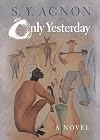
A description of the artwork on the cover: "Pinwheel Vendor" by Reuven Rubin (1923). It is taken from a catalogue for a Rubin exhibition at the Tel Aviv Museum of Art entitled "Dreamland". I include it as it is of some interest considering the publisher's choice and that it seems to express with great subtlety something of the story itself:
An Arab of Sudanese descent sits facing the sea while a Jewish pioneer stands beside him. The Sudanese man’s pose, his elevated chin and the fixed gaze focused on a faraway point on the horizon create the sense of a character operating within the dimensions of “inexhaustible time” – time which is not measured in the units of “here and now” but by means of an hourglass in which the sand grains do not run out. The Sudanese man has so much time that he does not even bother to blow at his pinwheels. Sooner or later, the wind will come. If not sooner, then later. And if not later, then after later. The pioneer at his side stands barefoot like the natives and carries a hoe – a symbol of Zionist activism – on his shoulder, his back turned to the sea. The Sudanese man looks as if he could keep crouching on his heels for a long time. He is in no hurry, and patience is the trait ensuring his survival. He operates in another temporal sphere. By contrast, the “New Jew” – bearded and wearing a European hat – is full of movement and impetuosity. He has no time, and must begin his task. show less
On the surface this is a tale show more of one man’s passage to the Land of Israel from his home village in Austro-Hungarian Galicia. The pre-WWI Ottoman Palestine he arrives in is a world far removed from his naïve imaginings. Our ‘hero’ – Isaac Kumer – is a young and impoverished Zionist of the Second Aliyah. This was the period of renewed zeal amongst the (mainly Russian) Jews of the pogrom and persecution-beset old country, and although relatively small in number, the wide-ranging influence of its pioneers on subsequent generations in the founding of the State of Israel is beyond compare. Agnon charmingly weaves into his plot many historic (and also the future historic) figures alongside the fictional cast of many. Initially finding his feet in the bustling port town of Jaffa, Isaac eventually makes the trip up to Jerusalem. At either end of this journey Agnon lavishly portrays the fascinating world of these two very different towns – the former being coastal, politicised, and predominantly secular, the latter being of the interior, traditional and overwhelmingly orthodox. If nothing else, this book serves as a wonderfully valuable portrayal of a world now gone. The co-mingling of European Jews and their indigenous brethren, the urban and the rural, the liberal and the conservative, at a time when the very soul of the future Jewish state was in gestation, is fascinating to behold.
After many early setbacks in his attempts to find the work on the land that he had dreamed of [One disappointment of ‘Only Yesterday’ was the nearly complete absence of the Arabs of the country. An exception to this is in reference to those farmers preferring to employ the cheaper Arab labour to that of the Jewish immigrant. They’re referred to in other places, but so scantily that I can only conclude that they did not figure largely in the day to day life at that time of either Agnon himself, or those contemporaries of the period that he is portraying.] – Isaac stumbles on another way to earn a living as a painter.
As his early years in the land are told – sometimes the narrator is from Isaac’s point of view, sometimes detached from Isaac as an omnipotent observer, and sometimes in the lives of others altogether – the novel starts to develop simultaneously on several levels. As well as the tale of Isaac’s days, the reader is aware of the question of being a stranger in a strange land. In Jaffa Isaac is a Galician among the Russians. In the fields he is a Jew among the Arabs. In Jerusalem he is a ‘modern’, or a Zionist, among the Hasidim. And so on. Questions of identity and purpose are constantly in Isaac’s mind as he is also caught between the only two women he has ever known outside of his family – one in Jaffa and the other in Jerusalem.
Agnon has a great sense of humour and mischief as well, as we discover mid-story when he introduces an almost magical or Kafkaesque element in the guise of a stray dog. Balak, the dog, suffers the misfortune to be the butt of Isaac’s tomfoolery in a moment of boredom. The repercussions of the joke are so consequential to the story that I can’t say more. Suffice to say, in every chapter when Balak takes the lead, the reader is treated to an alternate view of the universe from a lonesome dog’s perspective.
Agnon’s writing is soaring and beautiful in as many places depicting the mundane and the ugly of everyday life as it is the wondrous and mystical. The imagery of his tale is powerful and will stay with me for a long time to come. An unforgettable story.
PS:
A description of the artwork on the cover: "Pinwheel Vendor" by Reuven Rubin (1923). It is taken from a catalogue for a Rubin exhibition at the Tel Aviv Museum of Art entitled "Dreamland". I include it as it is of some interest considering the publisher's choice and that it seems to express with great subtlety something of the story itself:
An Arab of Sudanese descent sits facing the sea while a Jewish pioneer stands beside him. The Sudanese man’s pose, his elevated chin and the fixed gaze focused on a faraway point on the horizon create the sense of a character operating within the dimensions of “inexhaustible time” – time which is not measured in the units of “here and now” but by means of an hourglass in which the sand grains do not run out. The Sudanese man has so much time that he does not even bother to blow at his pinwheels. Sooner or later, the wind will come. If not sooner, then later. And if not later, then after later. The pioneer at his side stands barefoot like the natives and carries a hoe – a symbol of Zionist activism – on his shoulder, his back turned to the sea. The Sudanese man looks as if he could keep crouching on his heels for a long time. He is in no hurry, and patience is the trait ensuring his survival. He operates in another temporal sphere. By contrast, the “New Jew” – bearded and wearing a European hat – is full of movement and impetuosity. He has no time, and must begin his task. show less
Lists
Awards


You May Also Like


Associated Authors
Statistics
- Works
- 132
- Also by
- 12
- Members
- 2,618
- Popularity
- #9,804
- Rating
- 3.7
- Reviews
- 29
- ISBNs
- 159
- Languages
- 13
- Favorited
- 11
