
Ellen Swift
Author of Roman Dress Accessories
About the Author
Image credit: Dr. Ellen Swift
Works by Ellen Swift
Associated Works
Tagged
Common Knowledge
- Canonical name
- Swift, Ellen
- Other names
- Swift, Ellen Victoria
- Birthdate
- 1972-03-07
- Gender
- female
- Education
- University College London (PhD|Archaeology|1999)
- Occupations
- archaeologist
university lecturer - Organizations
- Roman Finds Group
Instrumentum
University of Kent - Short biography
- Educated in University College London, she has wide interests in artefact studies as well as the late and post-Roman transition in the West; she is also interested in late Roman dress and Roman and late antique art.
Members
Reviews
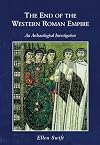
As Dr Swift acknowledges, “the End of the Roman Empire is a misleading term to use for the changes at the end of the fourth century and in the fifth century. The end of official Roman authority would perhaps be more accurate.” The thrust of this book, distilled from her doctoral research, is that the archaeology of personal items may help chart the gradual transition from Western Empire to Medieval Europe, but that it still leaves many questions unanswered.
This book is plentifully show more illustrated with articles such as jewellery – bracelets, necklaces and arm-rings, for example – and status symbols – crossbow brooches and belt buckles and fittings, together with distribution maps. The story they seem to tell is a complex one, as you might expect. Finds from the military frontiers of the Danube, Rhine and, later, the Meuse differ from more civilised areas, but the picture changes over time. Arm rings seem to have evolved from male weapon-arm items of adornment to become generalised female jewellery. Status symbols like the so-called crossbow brooch begin as military badges of office but by later centuries are made in precious metals for non-military or non-Roman individuals (such as the general Stilicho’s young son or the Frankish king Childeric).
The author charts too how designs for bracelets, say, in some cases crossed provincial boundaries and in others had a limited distribution, and how certain barbarian fashions influenced Roman civilian dress so that it becomes difficult to distinguish Germans from Roman citizens. As well as being fascinating in its own right, the presentation of this research has implications for those trying to identify in an insular context a clear division between native Briton and immigrant Saxon.
Revisiting this since it was first published at the turn of the millennium, I’m struck by some general thoughts. The first is that, like any other scientific discipline, archaeological research will inevitably have moved on from the work that Ellen Swift did at the end of the 20th century. Myriad excavations, thousands of finds, improved techniques and new theoretical models may well prove some of her tentative conclusions outdated (though probably not a lot). But it is very much this kind of painstaking work that helps bring aspects of this age of transition into clearer focus, and not the musings of speculative antiquarians using even more outdated sources to push their distorted visions of history on a general public eager for that dangerous mix of novelty and imagined conspiracy.
I should add that, as well as those wonderful illustrations, The End of the Western Roman Empire includes a gazetteer of museums in north-western Europe containing important collections of Roman material, along with recommended general reading and detailed references in the form of monographs and journal articles.
http://wp.me/s2oNj1-end show less
This book is plentifully show more illustrated with articles such as jewellery – bracelets, necklaces and arm-rings, for example – and status symbols – crossbow brooches and belt buckles and fittings, together with distribution maps. The story they seem to tell is a complex one, as you might expect. Finds from the military frontiers of the Danube, Rhine and, later, the Meuse differ from more civilised areas, but the picture changes over time. Arm rings seem to have evolved from male weapon-arm items of adornment to become generalised female jewellery. Status symbols like the so-called crossbow brooch begin as military badges of office but by later centuries are made in precious metals for non-military or non-Roman individuals (such as the general Stilicho’s young son or the Frankish king Childeric).
The author charts too how designs for bracelets, say, in some cases crossed provincial boundaries and in others had a limited distribution, and how certain barbarian fashions influenced Roman civilian dress so that it becomes difficult to distinguish Germans from Roman citizens. As well as being fascinating in its own right, the presentation of this research has implications for those trying to identify in an insular context a clear division between native Briton and immigrant Saxon.
Revisiting this since it was first published at the turn of the millennium, I’m struck by some general thoughts. The first is that, like any other scientific discipline, archaeological research will inevitably have moved on from the work that Ellen Swift did at the end of the 20th century. Myriad excavations, thousands of finds, improved techniques and new theoretical models may well prove some of her tentative conclusions outdated (though probably not a lot). But it is very much this kind of painstaking work that helps bring aspects of this age of transition into clearer focus, and not the musings of speculative antiquarians using even more outdated sources to push their distorted visions of history on a general public eager for that dangerous mix of novelty and imagined conspiracy.
I should add that, as well as those wonderful illustrations, The End of the Western Roman Empire includes a gazetteer of museums in north-western Europe containing important collections of Roman material, along with recommended general reading and detailed references in the form of monographs and journal articles.
http://wp.me/s2oNj1-end show less
You May Also Like
Associated Authors
Statistics
- Works
- 9
- Also by
- 5
- Members
- 69
- Popularity
- #250,751
- Rating
- 4.3
- Reviews
- 1
- ISBNs
- 13