
John Sorenson (2) (1952–)
Author of Ape
For other authors named John Sorenson, see the disambiguation page.
Works by John Sorenson
Tagged
Common Knowledge
Members
Reviews
All forms of oppression legitimize themselves through ideologies that justify systems of power and domination, presenting exploitation as the natural outcome of a hierarchical ranking of beings.
It took me a very long time to finish such a short book. The reason was not that I was busy, or that it was difficult reading. The book was just awful, and I never wanted to pick it up.
Sorenson takes the position of the social ecologist - arguing that domination over animals is a reflection of the show more dominant/submissive dichotomy in our own society, reflecting ills such as the gender disparity and economic divides. Sadly, the book reads like someone offered to publish Sorenson's dissertation - and it wasn't a very good one. At many points, I felt as though I was reading a paper draft on animal rights that a freshman in my applied ethics course had written, and by "draft" I mean the version of the paper that the student had me read before the deadline, which I gave back with notes all over, asking "argument?", "evidence?", "backing for this claim?" The writing is incredibly repetitive - an issue which is exacerbated by a consistent disorganization. Within the first chapter alone, Sorenson basically runs around the same didactic circle three times, ultimately repeating each one of his points in order. The writing style is also poor, peppered with run-on sentences and overly dependent on jargon.
The biggest thing is this: I agree with Sorenson, he is preaching to the choir, and even I found myself unconvinced by his "arguments" - primarily because I couldn't see him making any. He begins the book by presenting some historically important perspectives on animal rights and speciesism - Peter Singer says this, so-and-so says that, but he never tells us why these people have said these things, what their arguments were. And then he makes the important normative claim that we cannot treat animals as mere property or things to be used - but I never saw him argue for this point either. This was the major problem which undermined the entire project. Had this actually been written by a freshman for my ethics course, it would not have received higher than a C - and Sorenson is not a college freshman, he has a Ph.D! I guess the dissertation requirements in sociology just aren't as stringent as they are in philosophy... show less
It took me a very long time to finish such a short book. The reason was not that I was busy, or that it was difficult reading. The book was just awful, and I never wanted to pick it up.
Sorenson takes the position of the social ecologist - arguing that domination over animals is a reflection of the show more dominant/submissive dichotomy in our own society, reflecting ills such as the gender disparity and economic divides. Sadly, the book reads like someone offered to publish Sorenson's dissertation - and it wasn't a very good one. At many points, I felt as though I was reading a paper draft on animal rights that a freshman in my applied ethics course had written, and by "draft" I mean the version of the paper that the student had me read before the deadline, which I gave back with notes all over, asking "argument?", "evidence?", "backing for this claim?" The writing is incredibly repetitive - an issue which is exacerbated by a consistent disorganization. Within the first chapter alone, Sorenson basically runs around the same didactic circle three times, ultimately repeating each one of his points in order. The writing style is also poor, peppered with run-on sentences and overly dependent on jargon.
The biggest thing is this: I agree with Sorenson, he is preaching to the choir, and even I found myself unconvinced by his "arguments" - primarily because I couldn't see him making any. He begins the book by presenting some historically important perspectives on animal rights and speciesism - Peter Singer says this, so-and-so says that, but he never tells us why these people have said these things, what their arguments were. And then he makes the important normative claim that we cannot treat animals as mere property or things to be used - but I never saw him argue for this point either. This was the major problem which undermined the entire project. Had this actually been written by a freshman for my ethics course, it would not have received higher than a C - and Sorenson is not a college freshman, he has a Ph.D! I guess the dissertation requirements in sociology just aren't as stringent as they are in philosophy... show less
 This review was written for LibraryThing Early Reviewers.
Despite the title, this is not really a book about Canada. It is Canada-focused, but it is more of a general introduction to animal rights. That was good for me, because it's the animal rights part that I was interested in, and I think I might have missed the "About Canada" part when requesting the book from LibraryThing's Early Reviewer program.
Anyway it is a well-written book with plenty of research and examples. It doesn't pull any punches in describing the full horror of foie gras, show more factory farming, hunting, seal-clubbing, etc. For example you can read about a video that showed "employees slamming live ducks into the floor, grabbing ducks by their necks and throwing them through the air, and force feeding ducks to the point where they vomited food stained bright red with blood from their damaged throats."
I think it's good to read things like that, as horrible as they are. The only way many of us are able to eat meat is by lying to ourselves about exactly what is involved. Even the language we use shields us from reality - "meat" instead of dead animals, "pork" instead of pig, "rump steak" instead of cow's arse, etc. Reading about the cruelty and suffering involved in the food industry, and in many other industries involving the exploitation of animals for profit, is important I think.
Sorenson argues for a concept of animal rights much broader than mere 'humane' treatment, however. He wants to overturn the whole way of viewing animals as commodities to be profited from, ending what he calls 'speciesism' and replacing it with a view of animals as fellow beings with their own rights. It was a very interesting book, full of compelling arguments, and I'm happy I came across it. show less
Anyway it is a well-written book with plenty of research and examples. It doesn't pull any punches in describing the full horror of foie gras, show more factory farming, hunting, seal-clubbing, etc. For example you can read about a video that showed "employees slamming live ducks into the floor, grabbing ducks by their necks and throwing them through the air, and force feeding ducks to the point where they vomited food stained bright red with blood from their damaged throats."
I think it's good to read things like that, as horrible as they are. The only way many of us are able to eat meat is by lying to ourselves about exactly what is involved. Even the language we use shields us from reality - "meat" instead of dead animals, "pork" instead of pig, "rump steak" instead of cow's arse, etc. Reading about the cruelty and suffering involved in the food industry, and in many other industries involving the exploitation of animals for profit, is important I think.
Sorenson argues for a concept of animal rights much broader than mere 'humane' treatment, however. He wants to overturn the whole way of viewing animals as commodities to be profited from, ending what he calls 'speciesism' and replacing it with a view of animals as fellow beings with their own rights. It was a very interesting book, full of compelling arguments, and I'm happy I came across it. show less
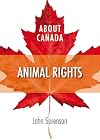
This review was written for LibraryThing Early Reviewers.Adopting Mahatma Gandhi’s idea that “the greatness of a nation and its moral progress can be judged by the way its animals are treated,” this book considers the status of animals in Canada. Casting a critical gaze over how dominant ideologies, such as capitalism and patriarchy, have negatively impacted our relationships with the natural world, Sorenson examines the institutional exploitation of animals in agriculture, fashion and entertainment. Addressing the fur trade, seal hunt, show more Calgary Stampede, puppy mills, horse slaughter and Canada’s virtually unregulated vivisection industry, the book analyzes discourses used by animal-exploitation industries to defend their practices and suggests that a society that claims to protect animals while maintaining antiquated laws is suffering from “moral schizophrenia.” This book advocates an abolitionist agenda, promotes veganism as a personal and political commitment, shows the economic, environmental and health costs of animal exploitation and presents animal rights as a social justice issue. show less

This book is an excellent primer on animal rights in general, and on how animals are treated in Canada specifically. Animal Rights starts off with an introduction to animal rights, and leads right into eating animals, fur, killing seals, vivisection, hunting, zoos and rodeos and keeping exotic pets.
While this book might be hard to stomach for some, it really exposes many cruelties to animals and what could be done better in Canada. It also compares Canada to the US and sometimes UK.
This is show more definitely not the kind of book I would recommend to somebody who doesn't already have some insight into veganism or animal rights and would probably be best for somebody who is already vegan or is interested in learning more about the animal rights movement. It is certainly not a book about vegan nutrition or agriculture, and does not attempt to solve all of the problems inherent in exploiting animals, it just exposes them for readers to (metaphorically) see. show less
While this book might be hard to stomach for some, it really exposes many cruelties to animals and what could be done better in Canada. It also compares Canada to the US and sometimes UK.
This is show more definitely not the kind of book I would recommend to somebody who doesn't already have some insight into veganism or animal rights and would probably be best for somebody who is already vegan or is interested in learning more about the animal rights movement. It is certainly not a book about vegan nutrition or agriculture, and does not attempt to solve all of the problems inherent in exploiting animals, it just exposes them for readers to (metaphorically) see. show less
This review was written for LibraryThing Early Reviewers.You May Also Like
Associated Authors
Statistics
- Works
- 8
- Members
- 78
- Popularity
- #229,021
- Rating
- 3.1
- Reviews
- 7
- ISBNs
- 21
