

Andrew Soltis
Author of Pawn Structure Chess
About the Author
Chess Grandmaster Andy Soltis has been influential in chess circles for more than three decades. His written works include The Inner Game of Chess: How They Calculate and Win and Grandmaster Secret Endings. (Bowker Author Biography)
Series
Works by Andrew Soltis
Bobby Fischer: The Career and Complete Games of the American World Chess Champion (2009) — Contributor — 54 copies, 1 review
Tal, Petrosian, Spassky and Korchnoi: A Chess Multibiography with 207 Games (2019) 31 copies, 1 review
Smyslov, Bronstein, Geller, Taimanov and Averbakh: A Chess Multibiography with 220 Games (2021) 19 copies
Winning with the Ruy Lopez Exchange Variation (Subtitle: Fischer's Weapon) (1992) 19 copies, 1 review
Colle System: Zukertort Variation, 5 b3: A White Opening You Can Use for the Rest of Your Career (1998) 8 copies
Best Chess Games of Boris Spassky 3 copies
Grjótgarðsárásin 1 copy
Sigurleiðir á svart 1 copy
pending 1 copy
Associated Works
The Book of the Nottingham International Chess Tournament, 10th to 28th August, 1936 (1937) — Foreword, some editions — 112 copies, 2 reviews
Tagged
Common Knowledge
- Legal name
- Soltis, Andrew Eden
- Other names
- SOLTIS, Andrew Eden
SOLTIS, Andrew
SOLTIS, Andy - Birthdate
- 1947-05-28
- Gender
- male
- Occupations
- chess writer
newspaper columnist (New York Post)
chess grandmaster (1980) - Organizations
- United States Chess Federation
New York Post (chess columnist) - Nationality
- USA
- Birthplace
- Hazleton, Pennsylvania, USA
- Places of residence
- Hazelton, Pennsylvania, USA
- Map Location
- USA
Members
Reviews
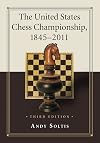
GM Andy Soltis's "The United States Chess Championshio, 1845-2011", published by McFarland, in the third edition, extends the 2nd edition (1845-1996), and the first (1845-1985).( The added chapters are: Chapter Eleven, Champions Galore(1985-1996), Chapter Twelve, Sponsor Shock(1997-2011)). Running to 280 pages (softcover), the book measures 7"x10". The games are in short algebraic notation.
The United States Chess championship, over the years, has undergone various changes in format, time show more controls and the vicissitudes of prize money fund. There is a one-page Introduction that surveys this.
Tournament cross tables, (and in later years, play-off match scores) or from 2002 on, when entrants were too numerous for all-play-all, round by round tables are provided.
The style of writing is uniformly good. This has to be the best, non-dry account of chess, selective and discerning, with sharp analysis and great color. First, the background is set. In some cases, colorful mini-biographies are presented. Key games from each event, sometimes an ending or a key moment, always accompanied by a diagram, are explained. Here are a couple of expressive samples: Chapter eight: The Fischer Era "On December 1, 1957, 14-year old Bobby Fischer had a bad day....He los[t] a long bishops-of-opposite-color ending to another junior star, Charles Kalme who went on to share first prize. Fischer,...,ended up in a huge tie for sixth place...This may be worthy of only a footnote, but it is a footnote worth remembering. For this was the last time Fischer would lose to an American for nearly four years." Of course, Fischer, it is well-known, went from strength to strength. In 1964, at the US Championship, he performed the incredible feat of 11 wins, 0 losses, 0 draws, winning by margin of 3.5.
New analyses have been added to the old edition. On page 112, Soltis finds that Kasparov in "Great Predecessors" has been using a wrong move from the game Saidy-Fischer, 1964. In other new analysis, Soltis credits Karsten Muller with improvements in analysis to Mednis-Fischer. (1959)
I present another example of the charming, sly, un-put-downable nature of the writing, a true rarity in well-researched chess history accounts.
In the subsection "1993:Whodunit?", "The 39th Championship can be seen as a murder mystery: "Who killed Gata Kamsky's chances for his 2nd title?" / Among the suspects: Yermolinsky (Soltis now shows a full game Wolff-Yermolinsky, a French, 'Yermo' winning in 27). But, (Soltis resumes) as a suspect in the elimination of Kamsky, "Yermo" had a good alibi. He lost to Kamsky in Round 6 .../Shabalov, star emigre, flashy tactician in the style of Tal, might have been the culprit who did in GM Gulko, also helped doom Benjamin's bid for the title. But he had good reason to avoid suspicion in the demise of Kamsky. He helped rather than harmed the Tatar emigre's chances by losing to him in the tenth round..../On the eve of the final round the key pairings were Yermo(7) versus D.Gurevich (6),shabalov (7) versus Federowicz(6), Kamsky (6.5) versus Christiansen(4). (Soltis gives us the full game, with the winning stroke)35...Rxb3! The murder weapon!"
Regarding the choice of games to present from the 55+ championships, clever choices have been made, so there are few dull draws. Even pre-arranged draws are sometimes highlighted in a witty manner. For example, in 1988, deFirmian beat Miles in a Pirc defence (a game which is shown and annotated). "After this the other players had some fun with these moves on the days they decided not to play chess. For example:B07 Irregular defence white Benjamin black Federowicz 1.c3 e5 2.d3 d5 3.Qc2 Nc6 4.Nf3 f5 5.Qa4 Bd6 6.e4 Nf6 7.Bg5 fxe4 8.dxe4 dxe4 9.Nfd2 Bf5 10.Bb5 O-O 11.O-O Nd4. If you are bewildered by all this," continues Soltis, "turn the board around. It is the same position as deFirmian-Miles but with colors reversed. The joke ended with: 12.cxd4 exd4 13.Qb3+ drawn"
Lapshun and Sarkar are not household names but they played a game in the 2003 Championships where white obtained two queens but could not win. Black had Q+2N+R+B versus White's 2Q+N+P. Soltis provides the game and notes"now starts a pawn queening race" but "W soon discovers that the board is too small for two queens. as the maxim goes!". A fun game to play over.
There was a hilarious account of a game where the chess knowledge of one of the players consisted in its entirety, according to Soltis, of only the Four Pawns Attack in the KID and rooks' endings and he was able to put both to work to get a win.
The biographies of Tarjan, Browne, and Grefe must be read to be savored. Of Browne he says, "dual citizenship.. left US in 1969 to compete under Aussie flag...had a change of heart three years later..hardest fighting member of the new generation, an intense, nervous player who gave 110 percent of himself in every game, analyzed every conceivable variation, and as a result, was frequently at war with his side of the chess clock. (And sometimes with his tournament director as well.)"
The book is rounded off by the following. ECO codes index, Openings Index, U.S.Chess Championship summary with year, place held and winner. There is an interesting section of individual records. These are small tables. Most tournaments played in, most consecutive tournaments played in, most plus scores, most games played, most games won (Reshevsky 125, Walter Browne 85, Benjamin 84), most tournaments without loss (Fischer 6 ), Biggest Margin of Victory (Fischer 3.5), Most Wins, One Tournament (Not Fischer but Denker 14 wins and Reshevsky 14 wins), Most Draws One Tournament, Most Losses One Tournament (Kamran Shirazi 16(!)), Highest Winning Percentage (three or more tournaments)
There is also a general Index running to six pages, mainly of players' names.
With so much research, good game selection, light but to the point annotation, wonderful writing, are there any negatives or things I wish were handled better? A few. I would have liked to see a Edition-specific introduction highlighting the research and addition and deletion. A Foreword or Preface. With the production costs kept in check with a soft-cover, the book is nevertheless an unwieldy 10 inch X 7 inch. All diagrams are correctly positioned just after the move of the game in the text, a welcome rarity in chess type-setting, nevertheless, the publishers have moved the diagram off to the right of the space, making them a little smaller (a tad over 1.5 inch square) with the left space reserved for e.g. ("After 35.Bf1"). I, for one, would have like to see diagrams that were a little bigger.
I give the book 4.5 stars out of 5, and recommend it heartily, as an addition to any chess library. It finds a niche in United States chess historical research, and into that prestigious institution, the Championship. There is a veritable feast between its pages to which you will return time and again. show less
The United States Chess championship, over the years, has undergone various changes in format, time show more controls and the vicissitudes of prize money fund. There is a one-page Introduction that surveys this.
Tournament cross tables, (and in later years, play-off match scores) or from 2002 on, when entrants were too numerous for all-play-all, round by round tables are provided.
The style of writing is uniformly good. This has to be the best, non-dry account of chess, selective and discerning, with sharp analysis and great color. First, the background is set. In some cases, colorful mini-biographies are presented. Key games from each event, sometimes an ending or a key moment, always accompanied by a diagram, are explained. Here are a couple of expressive samples: Chapter eight: The Fischer Era "On December 1, 1957, 14-year old Bobby Fischer had a bad day....He los[t] a long bishops-of-opposite-color ending to another junior star, Charles Kalme who went on to share first prize. Fischer,...,ended up in a huge tie for sixth place...This may be worthy of only a footnote, but it is a footnote worth remembering. For this was the last time Fischer would lose to an American for nearly four years." Of course, Fischer, it is well-known, went from strength to strength. In 1964, at the US Championship, he performed the incredible feat of 11 wins, 0 losses, 0 draws, winning by margin of 3.5.
New analyses have been added to the old edition. On page 112, Soltis finds that Kasparov in "Great Predecessors" has been using a wrong move from the game Saidy-Fischer, 1964. In other new analysis, Soltis credits Karsten Muller with improvements in analysis to Mednis-Fischer. (1959)
I present another example of the charming, sly, un-put-downable nature of the writing, a true rarity in well-researched chess history accounts.
In the subsection "1993:Whodunit?", "The 39th Championship can be seen as a murder mystery: "Who killed Gata Kamsky's chances for his 2nd title?" / Among the suspects: Yermolinsky (Soltis now shows a full game Wolff-Yermolinsky, a French, 'Yermo' winning in 27). But, (Soltis resumes) as a suspect in the elimination of Kamsky, "Yermo" had a good alibi. He lost to Kamsky in Round 6 .../Shabalov, star emigre, flashy tactician in the style of Tal, might have been the culprit who did in GM Gulko, also helped doom Benjamin's bid for the title. But he had good reason to avoid suspicion in the demise of Kamsky. He helped rather than harmed the Tatar emigre's chances by losing to him in the tenth round..../On the eve of the final round the key pairings were Yermo(7) versus D.Gurevich (6),shabalov (7) versus Federowicz(6), Kamsky (6.5) versus Christiansen(4). (Soltis gives us the full game, with the winning stroke)35...Rxb3! The murder weapon!"
Regarding the choice of games to present from the 55+ championships, clever choices have been made, so there are few dull draws. Even pre-arranged draws are sometimes highlighted in a witty manner. For example, in 1988, deFirmian beat Miles in a Pirc defence (a game which is shown and annotated). "After this the other players had some fun with these moves on the days they decided not to play chess. For example:B07 Irregular defence white Benjamin black Federowicz 1.c3 e5 2.d3 d5 3.Qc2 Nc6 4.Nf3 f5 5.Qa4 Bd6 6.e4 Nf6 7.Bg5 fxe4 8.dxe4 dxe4 9.Nfd2 Bf5 10.Bb5 O-O 11.O-O Nd4. If you are bewildered by all this," continues Soltis, "turn the board around. It is the same position as deFirmian-Miles but with colors reversed. The joke ended with: 12.cxd4 exd4 13.Qb3+ drawn"
Lapshun and Sarkar are not household names but they played a game in the 2003 Championships where white obtained two queens but could not win. Black had Q+2N+R+B versus White's 2Q+N+P. Soltis provides the game and notes"now starts a pawn queening race" but "W soon discovers that the board is too small for two queens. as the maxim goes!". A fun game to play over.
There was a hilarious account of a game where the chess knowledge of one of the players consisted in its entirety, according to Soltis, of only the Four Pawns Attack in the KID and rooks' endings and he was able to put both to work to get a win.
The biographies of Tarjan, Browne, and Grefe must be read to be savored. Of Browne he says, "dual citizenship.. left US in 1969 to compete under Aussie flag...had a change of heart three years later..hardest fighting member of the new generation, an intense, nervous player who gave 110 percent of himself in every game, analyzed every conceivable variation, and as a result, was frequently at war with his side of the chess clock. (And sometimes with his tournament director as well.)"
The book is rounded off by the following. ECO codes index, Openings Index, U.S.Chess Championship summary with year, place held and winner. There is an interesting section of individual records. These are small tables. Most tournaments played in, most consecutive tournaments played in, most plus scores, most games played, most games won (Reshevsky 125, Walter Browne 85, Benjamin 84), most tournaments without loss (Fischer 6 ), Biggest Margin of Victory (Fischer 3.5), Most Wins, One Tournament (Not Fischer but Denker 14 wins and Reshevsky 14 wins), Most Draws One Tournament, Most Losses One Tournament (Kamran Shirazi 16(!)), Highest Winning Percentage (three or more tournaments)
There is also a general Index running to six pages, mainly of players' names.
With so much research, good game selection, light but to the point annotation, wonderful writing, are there any negatives or things I wish were handled better? A few. I would have liked to see a Edition-specific introduction highlighting the research and addition and deletion. A Foreword or Preface. With the production costs kept in check with a soft-cover, the book is nevertheless an unwieldy 10 inch X 7 inch. All diagrams are correctly positioned just after the move of the game in the text, a welcome rarity in chess type-setting, nevertheless, the publishers have moved the diagram off to the right of the space, making them a little smaller (a tad over 1.5 inch square) with the left space reserved for e.g. ("After 35.Bf1"). I, for one, would have like to see diagrams that were a little bigger.
I give the book 4.5 stars out of 5, and recommend it heartily, as an addition to any chess library. It finds a niche in United States chess historical research, and into that prestigious institution, the Championship. There is a veritable feast between its pages to which you will return time and again. show less
 This review was written for LibraryThing Early Reviewers.
It's hard to start a review for a book when the title does a good job of explaining what it's all about. The United States Chess Championship (1845-2011) indeed covers some of the games played during the 150 years of one of the major chess championships in this country.
Chess books are very hit or miss with decent editors: there are quite a few out there that have an unreasonable amount of typographical errors, poor sentence structure, and even wrongly-placed diagrams (many also have flawed show more analysis of the moves, but that assessment could change over time). Andy Soltis usually has good editors for his books, and thankfully, this time is no different, although there are a few questionable spots along the way. For example, GM Tony Miles is introduced to us in the 1989 championship writeup, except one of his games was explicitly analyzed in this book when he first appeared in the 1988 championship. One major chess player -- Sammy Reshevsky, winner of seven US Championships -- drops out of sight and we never hear why he stopped playing, while a modern wunderkind who played in two recent championships (never winning the tournament) gets a full paragraph of his later giving up chess to work for Google.
Of course, the people most likely to read this book are those who already know of Fischer, Browne, Evans, Reshevsky, and Seirawan; the readers are those who want to see the games played. There are usually two complete games analyzed for each championship, one of which is generally played by the eventual winner (for many years, the tournament was a round-robin format, meaning that there wasn't any "championship" game as is the case with other tournaments). One of my favorite parts was when Soltis let contemporary authors analyze some of the earliest games, although he did provide more updated commentary when necessary.
Overall, this is a great book for any chess lover, whether a beginner looking to try out styles of various players, or an expert who wonders how his or her opening might have been defended against by some of the greats. It would have been impressive to have included all the games, but with some of the more recent tournaments having over thirty players, that would make for one incredibly thick book!
[Early Reviewer book]
------------------------------------
Grandmaster draws are
Often skipped for best games to
Get analysis. show less
Chess books are very hit or miss with decent editors: there are quite a few out there that have an unreasonable amount of typographical errors, poor sentence structure, and even wrongly-placed diagrams (many also have flawed show more analysis of the moves, but that assessment could change over time). Andy Soltis usually has good editors for his books, and thankfully, this time is no different, although there are a few questionable spots along the way. For example, GM Tony Miles is introduced to us in the 1989 championship writeup, except one of his games was explicitly analyzed in this book when he first appeared in the 1988 championship. One major chess player -- Sammy Reshevsky, winner of seven US Championships -- drops out of sight and we never hear why he stopped playing, while a modern wunderkind who played in two recent championships (never winning the tournament) gets a full paragraph of his later giving up chess to work for Google.
Of course, the people most likely to read this book are those who already know of Fischer, Browne, Evans, Reshevsky, and Seirawan; the readers are those who want to see the games played. There are usually two complete games analyzed for each championship, one of which is generally played by the eventual winner (for many years, the tournament was a round-robin format, meaning that there wasn't any "championship" game as is the case with other tournaments). One of my favorite parts was when Soltis let contemporary authors analyze some of the earliest games, although he did provide more updated commentary when necessary.
Overall, this is a great book for any chess lover, whether a beginner looking to try out styles of various players, or an expert who wonders how his or her opening might have been defended against by some of the greats. It would have been impressive to have included all the games, but with some of the more recent tournaments having over thirty players, that would make for one incredibly thick book!
[Early Reviewer book]
------------------------------------
Grandmaster draws are
Often skipped for best games to
Get analysis. show less
This review was written for LibraryThing Early Reviewers.The United States Chess Championship, 1845-2011, by Andy Soltis is the third edition. The first was written by Gene McCormick in 1985, and the second by Any Soltis in 2006. The latter only covers the Championship up to 1996. All three were published by Mcfarland Press. I haven't seen the previous editions, so I can't compare them, but I am thoroughly impressed with this one.
Soltis tells the story of US chess through the lens of its premier event, from its uncertain beginning as a leisurely, show more untimed match between gentlemen, to the fast-paced, hi-tech, corporate-sponsored slugfest it has become. The story he tells is both informative and entertaining, for it includes the lives of many great and often eccentric players, as well as the evolving cultural climate within which chess evolved. Only one US champion went on to become world champion, so the names that fill most of these pages are not the most famous in chess history. But they are certainly as colorful as anything the Old Word has produced.
What impresses me the most is that Soltis never sinks into gossip. High-level chess is filled with personality clashes, unsportsmanlike behavior, and outrageous accusations, but Soltis sails above all that in his serious, almost reverential treatment of the game itself. He tells the story of US chess in a clear, evenhanded, and respectful manner, skirting or ignoring the seamier anecdotes or speculations about character that so often fills chess reportage. But, despite not taking any cheap shots, there is still plenty to amaze and entertain.
The book includes an ample assortment of annotated games from all the events, showing the growth of chess theory and style over the last 166 years. For each tournament, we get the tables of results, even during the years when the Championship was run as a Swiss-system tournament. The book also includes some valuable back matter. Along with a general index, there is an index of openings and ECO classified openings, a summary of the entire history, as well as some fascinating personal records set during the fifty-five tournaments (excluding playoffs). All in all, this is an excellent addition to anyone's chess library. show less
Soltis tells the story of US chess through the lens of its premier event, from its uncertain beginning as a leisurely, show more untimed match between gentlemen, to the fast-paced, hi-tech, corporate-sponsored slugfest it has become. The story he tells is both informative and entertaining, for it includes the lives of many great and often eccentric players, as well as the evolving cultural climate within which chess evolved. Only one US champion went on to become world champion, so the names that fill most of these pages are not the most famous in chess history. But they are certainly as colorful as anything the Old Word has produced.
What impresses me the most is that Soltis never sinks into gossip. High-level chess is filled with personality clashes, unsportsmanlike behavior, and outrageous accusations, but Soltis sails above all that in his serious, almost reverential treatment of the game itself. He tells the story of US chess in a clear, evenhanded, and respectful manner, skirting or ignoring the seamier anecdotes or speculations about character that so often fills chess reportage. But, despite not taking any cheap shots, there is still plenty to amaze and entertain.
The book includes an ample assortment of annotated games from all the events, showing the growth of chess theory and style over the last 166 years. For each tournament, we get the tables of results, even during the years when the Championship was run as a Swiss-system tournament. The book also includes some valuable back matter. Along with a general index, there is an index of openings and ECO classified openings, a summary of the entire history, as well as some fascinating personal records set during the fifty-five tournaments (excluding playoffs). All in all, this is an excellent addition to anyone's chess library. show less
This review was written for LibraryThing Early Reviewers.
This was a very good summary of the three-time chess world champion Mikhail Botvinnik. It was a little light on information about his youth -- for two obvious reasons (one is that few people's youthful experiences are remembered in any detail, and the other being that he grew up in the secretive Soviet Union). Otherwise, as is usual with any book written by Andy Soltis, we are generally given complete games with a fair amount of analysis, both "at the time" (usually Botvinnik's own show more annotations) and current thought.
I was most fascinated by two themes in this biography. The first was Botvinnik's ultra-structured personality, which required him to really hate his opponent before he could truly beat him (hence, Botvinnik's three non-consecutive turns as champion). The second was how important chess appeared to be in the Soviet Union during the post-World War II and Cold War periods. Botvinnik was sometimes prone to exaggerate his own importance to the cause of communism, but he seemed to believe that he reported only to the highest command -- perhaps even to Stalin himself. This book doesn't completely answer the question of whether other Soviet grandmasters were forced to lose matches in order to prove how powerful the player-of-the-year was, but there are enough hints to suspect this was the case.
All in all, it's a good mix of biography and chess analysis. (I would have liked to have seen a few more pictures in this nice hardcover book, but it's possible there weren't that many to pick from.) I'll probably never forget the mental image of Botvinnik preparing for one of his more important tournaments by requiring his practice opponent to smoke and blow that smoke in his face, so Botvinnik could learn to ignore the smell during the real match.
[Early Reviewer book]
---------------------------------------
LT Haiku:
Methodical thought
plus overconfidence in
positional play. show less
I was most fascinated by two themes in this biography. The first was Botvinnik's ultra-structured personality, which required him to really hate his opponent before he could truly beat him (hence, Botvinnik's three non-consecutive turns as champion). The second was how important chess appeared to be in the Soviet Union during the post-World War II and Cold War periods. Botvinnik was sometimes prone to exaggerate his own importance to the cause of communism, but he seemed to believe that he reported only to the highest command -- perhaps even to Stalin himself. This book doesn't completely answer the question of whether other Soviet grandmasters were forced to lose matches in order to prove how powerful the player-of-the-year was, but there are enough hints to suspect this was the case.
All in all, it's a good mix of biography and chess analysis. (I would have liked to have seen a few more pictures in this nice hardcover book, but it's possible there weren't that many to pick from.) I'll probably never forget the mental image of Botvinnik preparing for one of his more important tournaments by requiring his practice opponent to smoke and blow that smoke in his face, so Botvinnik could learn to ignore the smell during the real match.
[Early Reviewer book]
---------------------------------------
LT Haiku:
Methodical thought
plus overconfidence in
positional play. show less
This review was written for LibraryThing Early Reviewers.You May Also Like


Associated Authors
Statistics
- Works
- 142
- Also by
- 1
- Members
- 2,302
- Popularity
- #11,157
- Rating
- 3.8
- Reviews
- 27
- ISBNs
- 159
- Languages
- 5
- Favorited
- 1
